



How to Write Scoring Answers for Class 4 Our Sky (NCERT EVS)
Draw (page 152)
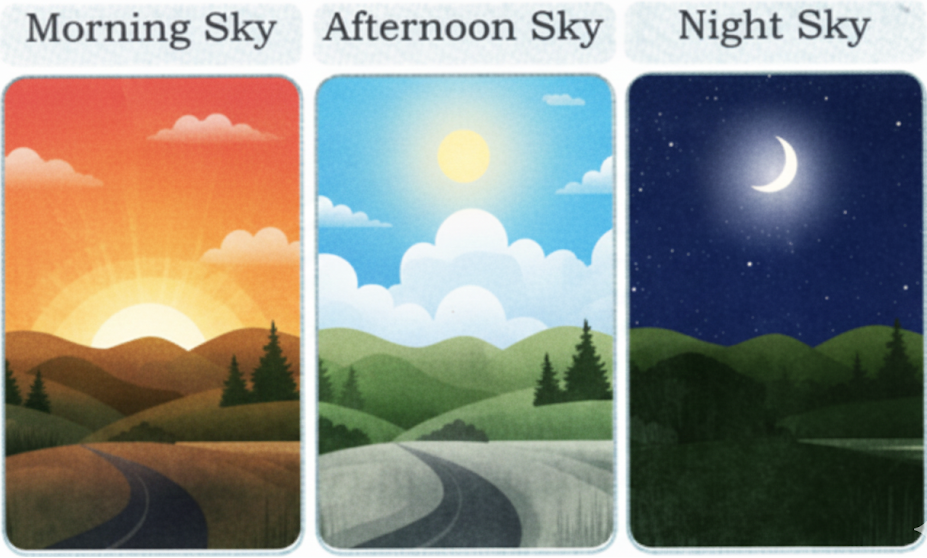
Question. Draw a picture of the sky as it appears in the morning, afternoon and at night, in the spaces given below.
Answer:
Question. Write down what you observe in the sky during the morning, afternoon and at night, in the table given below. A few boxes are filled for you. You may expand your table by adding new points.
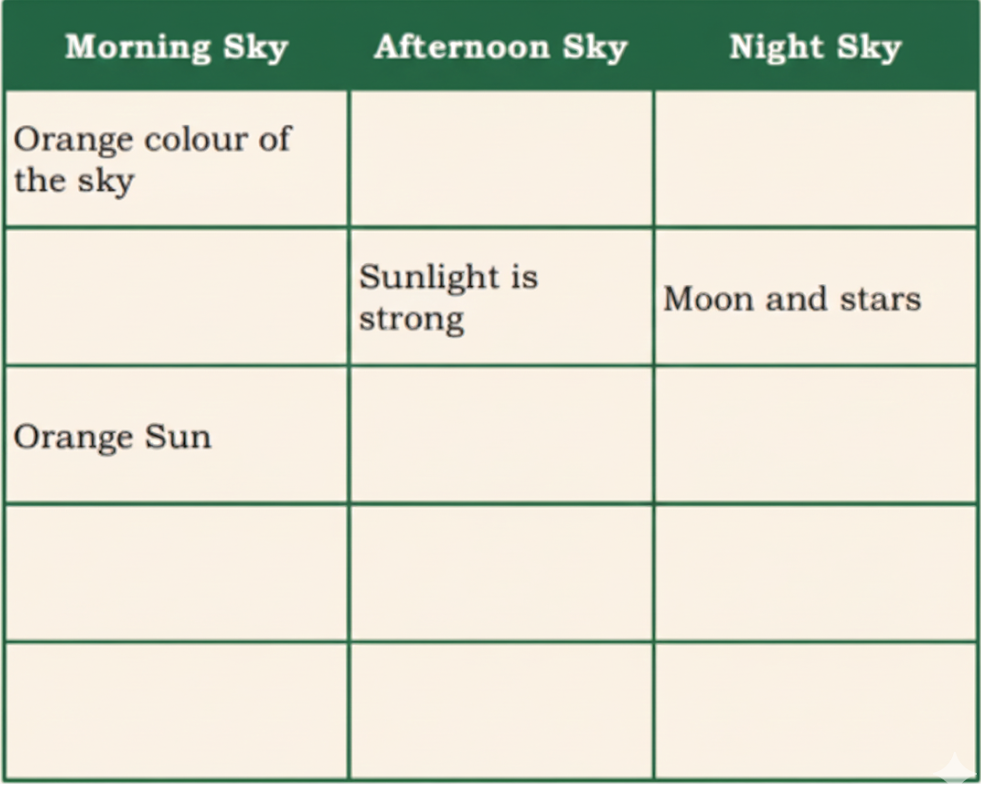
Answer:
Question. Share your observations with your classmates and compare them.
Answer: Students should do it by themselves.
Question. Have you observed any change in the activities, and the behaviour of animals and plants at different times of a day? Discuss these changes with your friends and make a list.
Answer: Students should do it by themselves.
Have you observed the changes during sunrise and sunset?
When the Sun rises:
Question 1. How does the sky look?
Answer: The sky appears orange at first and gradually grows brighter as the Sun comes up in the eastern direction.
Question 2. What do the birds and animals do?
Answer: As morning begins, birds fill the air with their songs and take flight. Animals wake from rest and start moving about in search of food.
Question 3. What changes do we find at home?
Answer: Sunlight fills the house, making it brighter. People wake up, open the windows, and begin their day by cleaning the house and getting ready for school or work.
When the Sun sets:
Question 1. How does the sky look?
Answer: As the Sun goes down in the west, the sky changes to shades of orange and red.
Question 2. What do the birds and animals do?
Answer: Birds fly back to their nests, and many animals return to their shelters to rest.
Question 3. What changes do we find at home?
Answer: Lights are turned on inside homes, and people come back after finishing their work.
NCERT Intext Questions (Page 155)
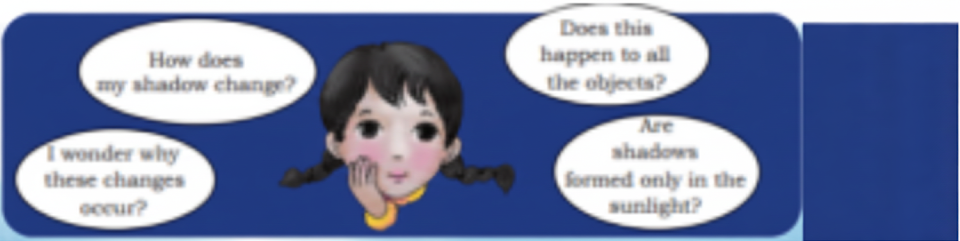
Answer: A shadow changes when the position of the Sun changes during the day, such as in the morning, afternoon, or evening. The shape of the shadow also changes if the shape or position of the body changes.
Only objects that block light completely can form clear shadows, and when the object moves, its shadow moves along with it.
These changes occur because the Sun’s position in the sky keeps shifting, which affects the size and direction of the shadow.
No, shadows are not formed only by the Sun. They can also be created using other light sources like a torch or a lamp, as long as the light is blocked by an object.
Find Out (Page 156)
Let us try something interesting.
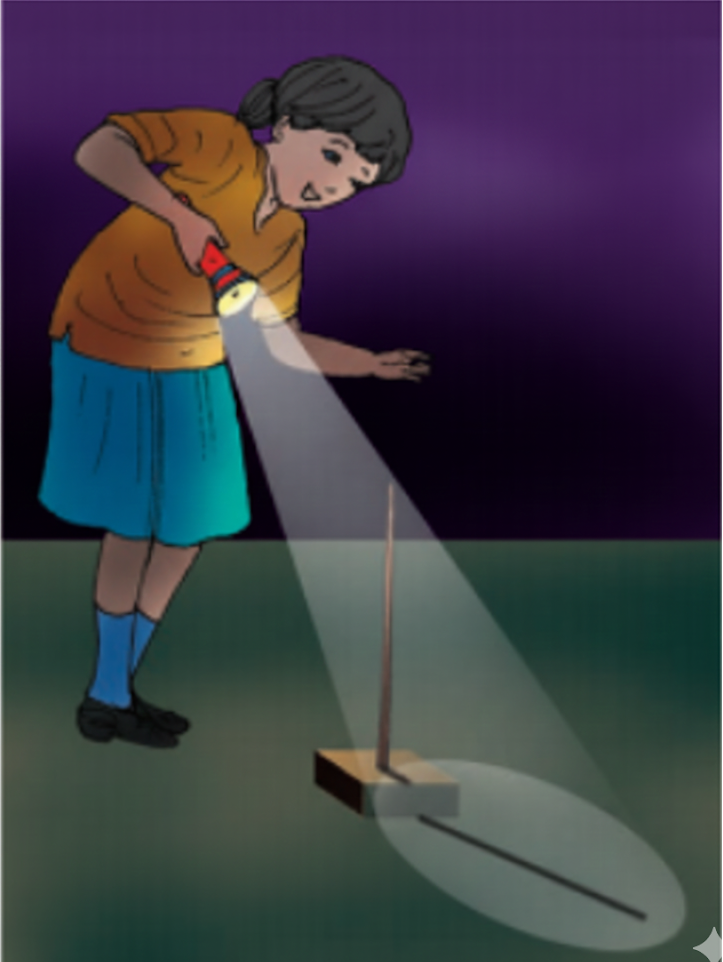
1. Take a torch and a stick. Close the doors and windows to make the room dark.
2. Hold the stick in one place and turn on the torch. Shine the torchlight on the stick.
3. Observe the changes in the shadow of the stick, in the following situations:
Move the stick back and forth.
Change the direction of the torch.
Think and answer the following questions.
Question. If we change the distance of the source of light from the stick (an object), how will the shadow change?
Answer: When a light source is placed near an object, the shadow appears larger. As the light source is moved farther away, the shadow becomes smaller.
Question. If we change the direction of the torch (source of light), how will the shadow change?
Answer: When the torch is turned in a different direction, the shadow shifts as well and appears on the side opposite to the light source.
Draw (Page 157)
Question. Draw the position of the Sun and corresponding shadows in the images given below.
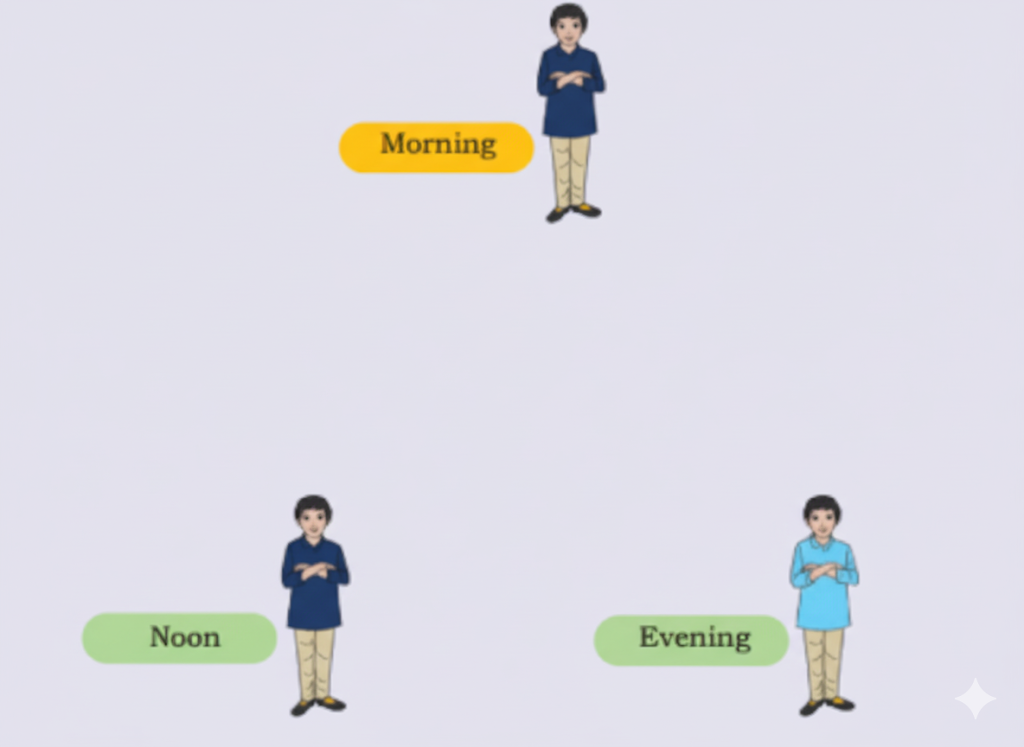
Answer:
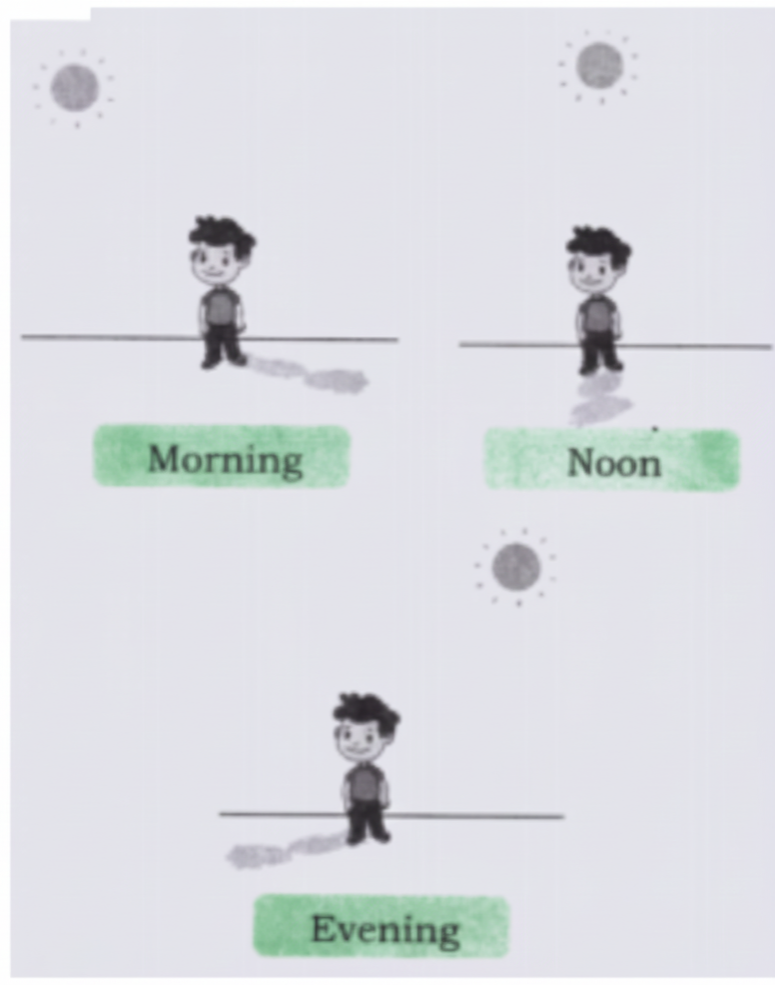
Night Sky (Page 159)
After sunset, the sky dazzles with thousands of twinkling stars. We observe various patterns of stars in the night sky. Draw any pattern you have observed, in the box below:
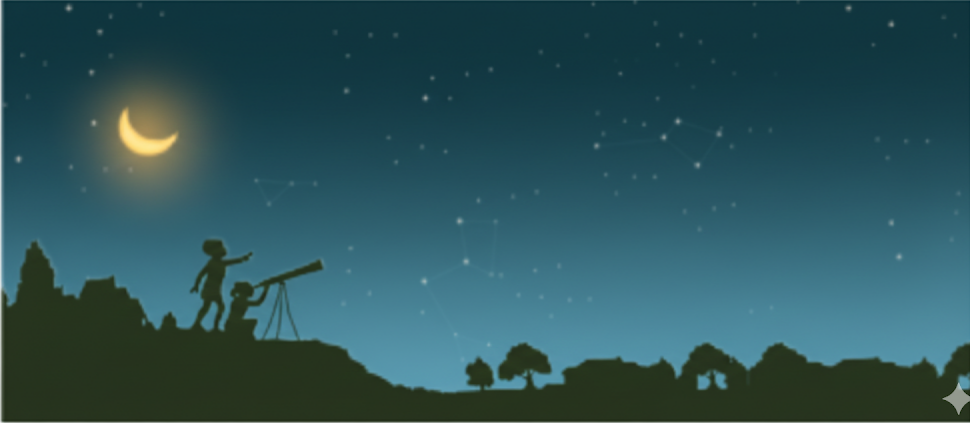
Answer:
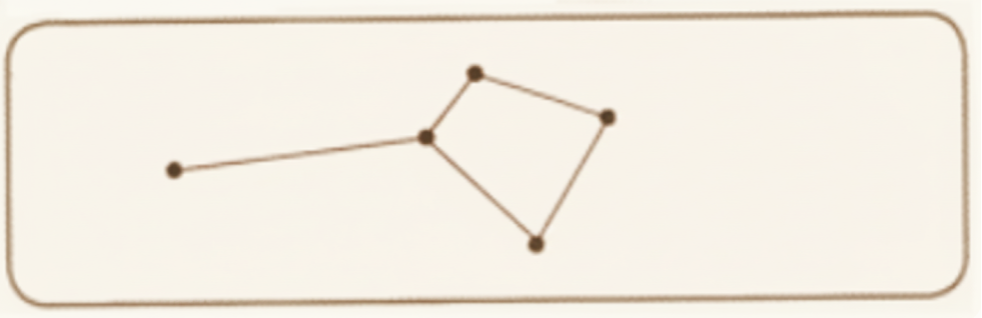
Question. Share the drawing with your friends and discuss the common patterns of stars.
Answer: Students should do it by themselves.
Draw (Page 160)
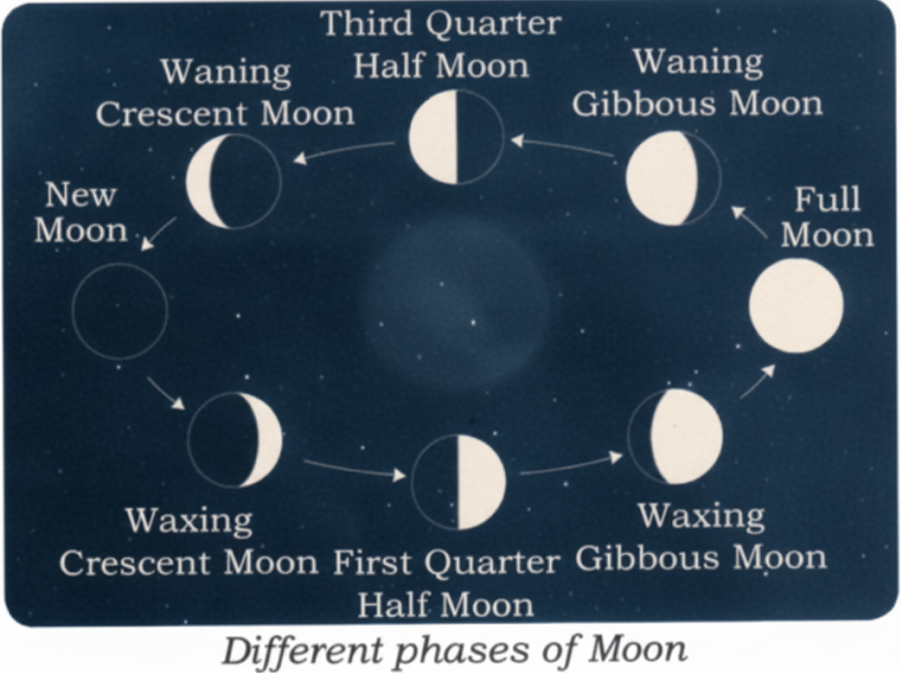
Question. Observe the Moon in the sky and draw the shapes of the Moon you have observed on different nights.
Answer:
Discuss (Page 160)
Discuss with your friends:
Question. Is there a pattern to the way the shape of the Moon changes?
Answer: Yes, the Moon’s shape changes in a regular cycle. It gradually grows from a new Moon to a full Moon and then slowly shrinks until it becomes invisible again, returning to the new Moon. This pattern continues repeatedly.
Question. Are there days when the Moon is not visible in the sky?
Answer: Yes, there are certain nights when the Moon cannot be seen at all. Such a night is known as Amavasya or the New Moon night.
Write (Page 162)
Question. Do you celebrate any festivals in your family or community related to the Sun or the Moon? What do you call them in your language?
Answer: Students should do it by themselves.
Let Us Reflect (Pages 162-163)
Question 1. Give two differences between:
(a) Day and night
(b) Sky in the morning and in the evening
(c) Our activities during the day and at night
(d) Activities of animals during the day and at night.
Answer:
(a)
Day: The Sun can be seen and the sky remains bright.
Night: The sky is dark, and the Moon and stars are visible.
(b)
Morning: The sky turns orange as the Sun rises in the east.
Evening: The sky takes on reddish-orange shades as the Sun sets in the west.
(c)
Day: People usually go to school or work, play, and carry out daily tasks.
Night: People have dinner, complete homework, and rest or sleep.
(d)
Day: Many animals such as cows, dogs, birds, squirrels, and butterflies are active during daylight. They move around and search for food.
Night: Some animals, like owls and bats, are active after dark. They hunt or look for food at night, while most other animals rest or sleep.
Question 2. Enquire about something
A teacher said that the Sun appears to move from East to West during the day. Meera is curious about this statement and has some questions for her teacher. List at least two questions that she can ask.
Answer:
Meera might ask questions such as:
What causes the Sun to seem as if it is moving across the sky?
Does the Sun actually move, or is this movement due to the Earth’s motion?
Question 3. Figure it out
Suppose you stand at the same spot during the morning and the afternoon. In the morning, your shadow points in one direction, while in the afternoon it points in another. Why? Would the length of your shadow be the same at both times?
Answer: No, the shadow does not remain the same in length or direction throughout the day.
In the morning, when the Sun rises in the east, the shadow is long and falls towards the west.
At noon, the Sun is almost overhead, so the shadow becomes very short.
In the afternoon, as the Sun moves towards the west, the shadow grows longer again and appears in the opposite direction, towards the east.
Question 4. Get creative with words
(a) Write your own poem inspired by the beauty of the sky.
(b) Complete the riddle below and answer it –
Only one colour, but not one size Appears with light, looks very nice What is it?
Answer:
(a)
The sky stretches wide, glowing bright,
Blue in the day, dark at night.
Orange at dawn, red at dusk,
With the Moon and stars shining above us.
(b)
It has one colour but keeps changing size,
Forms in the light before your eyes.
It moves along wherever you go,
And fades away when the light is low.
What is it?
Shadow
Explore the Beauty of Our Sky with NCERT Solutions (2026-27)
Learning about the Our Sky Class 4 EVS chapter makes studying fun and meaningful. By practicing these NCERT exercise solutions, you can easily understand topics like the changing sky, Sun, Moon, and stars, and boost your exam confidence.
This chapter explains how shadows form, sky patterns change, and why night and day are different. Regular revision and discussing observations with friends will break down tough concepts for better exam scores.
Make use of Class 4 Our Wondrous World Chapter 10 NCERT solutions (2026-27) to practice each question. Reviewing Shadow and Moon phases will sharpen your skills and help you shine in your EVS tests.
FAQs on NCERT Solutions For Class 4 Our Wonderous World Chapter 10 Our Sky - 2026-27 Free PDF Download (Login Required)
1. What is covered in NCERT Solutions for Class 4 Our Wonderous Wrold Chapter 10: Our Sky?
The NCERT Solutions for Class 4 Our Wonderous Wrold Chapter 10: Our Sky include detailed stepwise answers, key definitions, and diagrams to help CBSE students understand EVS concepts and prepare for exams. Main coverage includes:
- Step-by-step solutions for all textbook and intext questions
- Detailed explanations of key topics like the sky, sun, moon, stars, and their patterns
- Exam-ready definitions, diagrams, and map labelling
- CBSE-aligned tips and marking scheme
- Free downloadable PDF for revision
2. How do I write stepwise NCERT answers to score full marks in Class 4 EVS Chapter 10?
To score full marks in Class 4 EVS Chapter 10, present your answers in logical steps and use keywords from the NCERT Solutions:
- Start each answer by directly addressing the question
- Break explanations into clearly numbered steps
- Include definitions and diagrams where required
- Highlight important terms like sun, moon, stars, constellations
- Keep answers neat and underlined headings when possible
3. Which questions are most likely to come from Our Sky in CBSE Class 4 exams?
CBSE Class 4 EVS exams frequently ask questions on key topics from 'Our Sky':
- Definitions (e.g., What is a constellation?)
- Diagram or map labelling (sun, moon phases, stars)
- Differences between day and night sky
- Long answers on movement of Earth and how we see the sky
- Short answers and one word answers for key concepts
4. Are diagrams or definitions mandatory in answers from Chapter 10: Our Sky?
Yes, including diagrams and clear definitions is important in Class 4 EVS answers for Chapter 10, as per the CBSE marking scheme.
- Draw neat and labelled diagrams when questions ask for pictures (e.g., phases of the moon, stars)
- Provide exam-ready definitions for terms like constellation, satellite, or the sky
- Well-labelled diagrams fetch easy marks
5. How should I structure long answers in Class 4 EVS to match CBSE marking?
For long answers in Class 4 EVS, follow a clear structure to get full CBSE marks:
- Start with a definition or introduction
- Use stepwise or pointwise explanation
- Add examples or diagrams as needed
- End with a summary or conclusion
- Highlight main keywords like sunrise, sunset, moon, stars
6. Where can I download the free PDF of NCERT Solutions for Class 4 Our Wonderous Wrold Chapter 10?
You can download a free PDF of NCERT Solutions for Class 4 EVS Chapter 10 from leading educational websites. The PDF contains:
- Exercise-wise, step-by-step answers
- Handy definitions and key terms
- Clear diagrams and map labelling examples
- Quick revision notes for CBSE 2026–27
7. How can studying NCERT Solutions for Our Sky help me score better in exams?
Reviewing NCERT Solutions for Chapter 10: Our Sky helps you:
- Understand complex EVS concepts clearly
- Practice stepwise answers as required by CBSE marking scheme
- Revise key diagrams and definitions
- Prepare for common exam patterns, including long and short answers
8. What are the most important definitions and diagrams to learn from Our Sky?
The most important points from Chapter 10 include these definitions and diagrams:
- Constellation (group of stars forming a pattern)
- Phases of the moon: New moon, full moon, crescent
- Sun and stars diagram
- Map labelling for the sky and objects seen at night
9. How does practicing with accurate NCERT solutions prepare students for Class 4 EVS exams?
Practicing with accurate NCERT solutions for Class 4 EVS ensures:
- Thorough understanding of question patterns and marking schemes
- Exposure to likely exam questions
- Confidence in writing answers in the correct format
- Helps avoid common mistakes and improves revision
10. How can I quickly revise Class 4 EVS Chapter 10: Our Sky before an exam?
To revise Chapter 10 rapidly, follow these steps:
- Read through quick revision notes and key definitions
- Practice drawing simple, labelled diagrams
- Go over stepwise answers from NCERT Solutions
- Test yourself using important questions and exercises
11. Do examiners award partial marks for correct steps even if the final answer is wrong?
Yes, in CBSE Class 4 EVS exams, partial marks are given for correct steps or partial answers, even if the final answer is incorrect.
- Always show your workings and steps clearly
- Attempt every part of a question for the best chance at scoring
12. How to learn diagrams and map labelling for Class 4 Our Sky chapter exams?
Learning diagrams and labels for Chapter 10: Our Sky is easy if you:
- Practice drawing simple diagrams of the sun, moon, and stars neatly
- Use labels and captions clearly as shown in NCERT Solutions
- Review examples in your textbook and practice regularly
