



How to Write Exam-Ready Answers for Class 4 EVS Chapter 7: How Things Work
Activity 1 (Page 105)
Question 1. Do you think all objects can spin? Make a list of a few objects that can spin.
Answer: No, all objects cannot spin. Some objects can spin easily, while others do not spin at all.
Few objects that can spin:
Coin
Bottle cap
Lattu
Football
Ceiling fan
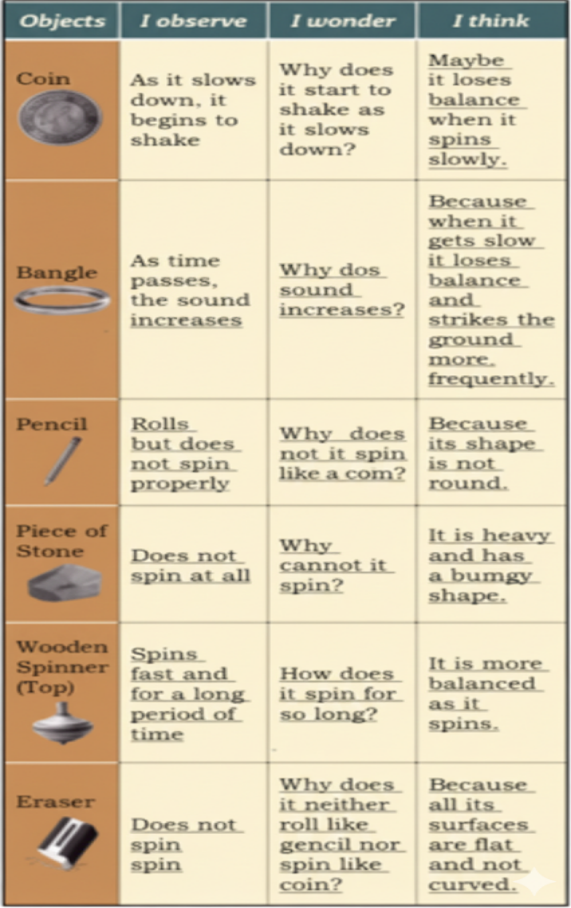
Question 2. Collect the objects mentioned in the table given below. Spin and observe them. Then, complete the table.
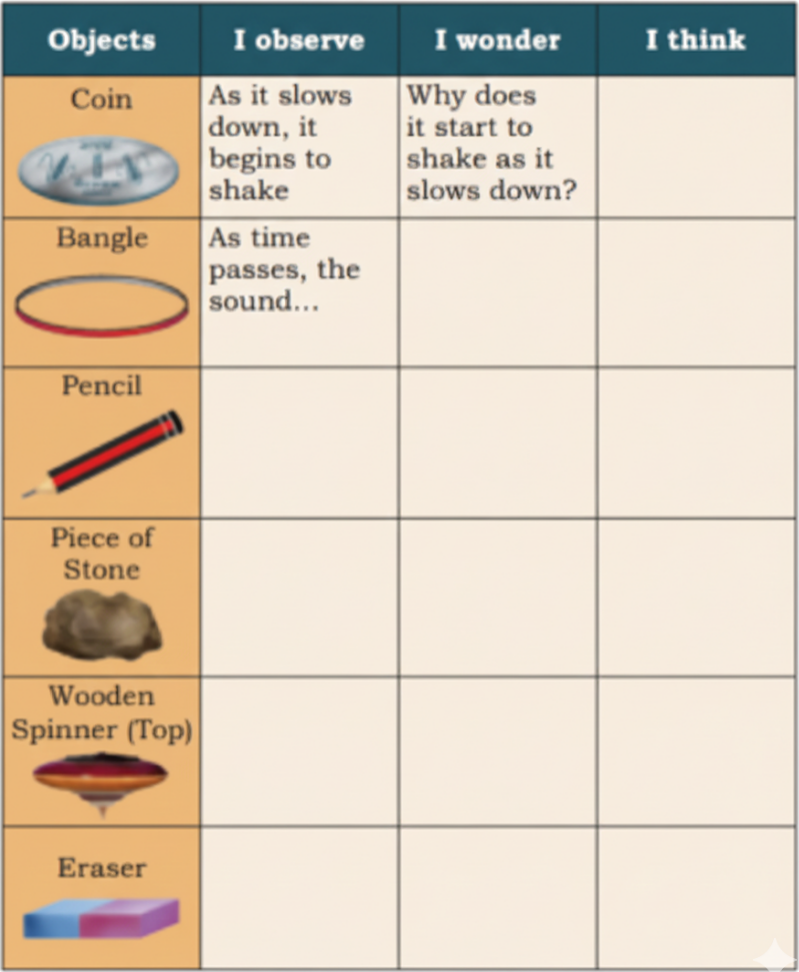
Answer:
Activity 2 (Pages 106 – 107)
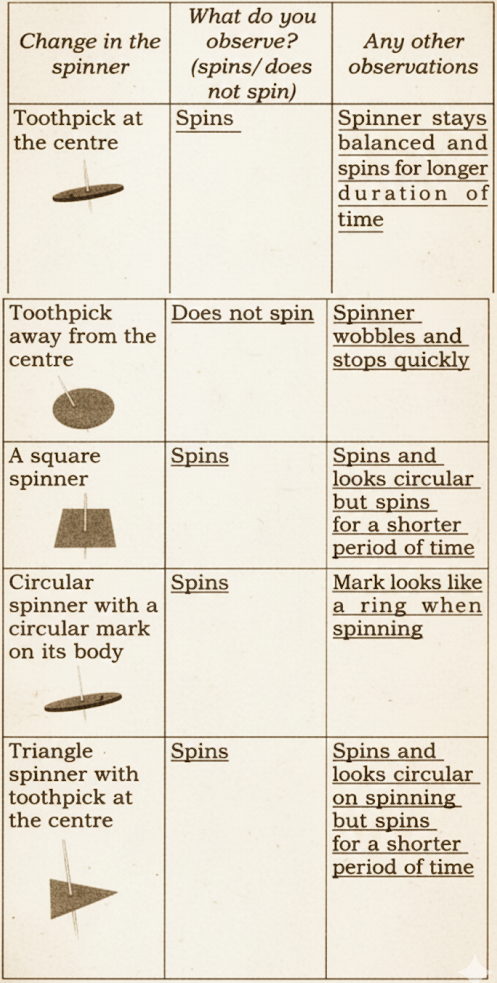
Collect things, such as pieces of cardboard, toothpicks, an empty tube of a ballpoint pen, and other small objects. Make the following spinners. Spin them and record your observations.
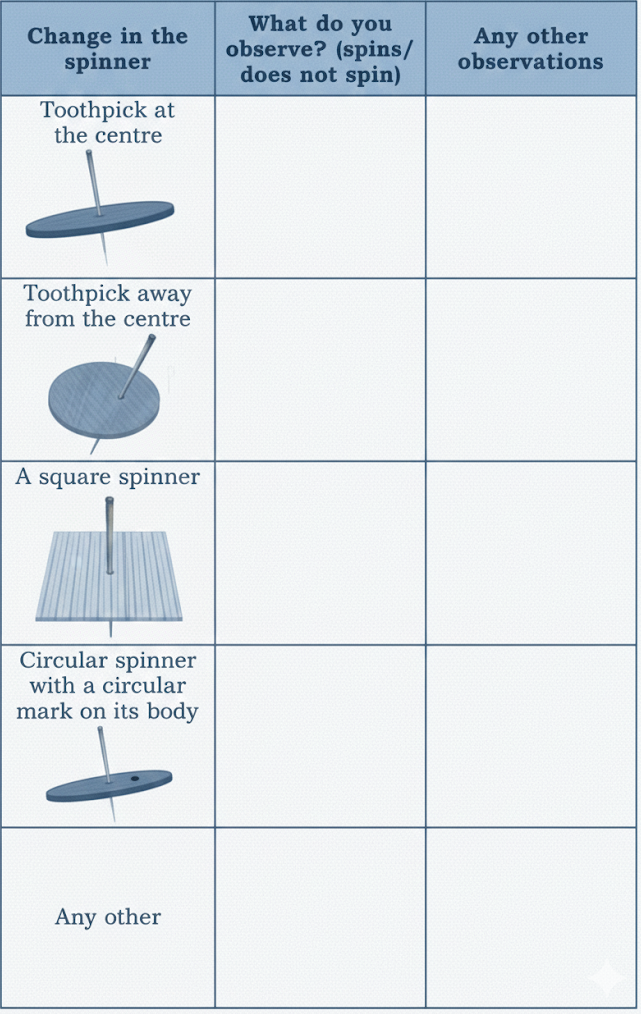
Answer:
Discuss (Page 10.8)
Question 1. Which of the spinners did not spin properly? Discuss the possible reasons.
Answer: The spinner did not spin well when the toothpick was placed away from the centre because it was unbalanced. When the hole is not in the middle, the spinner wobbles and falls over quickly.
Question 2. Have you noticed the position of the hole in the first two spinners? Did this difference in the position of the hole make a difference in the spinning of these spinners?
Answer: Yes, I observed the difference in the position of the hole in the first two spinners. The first spinner had the hole at the centre, which kept it balanced and allowed it to spin for a longer time. However, the second spinner had the hole away from the centre, so it was unbalanced and did not spin properly. This shows that the position of the hole makes a big difference.
Activity 3 (Pages 110-111)
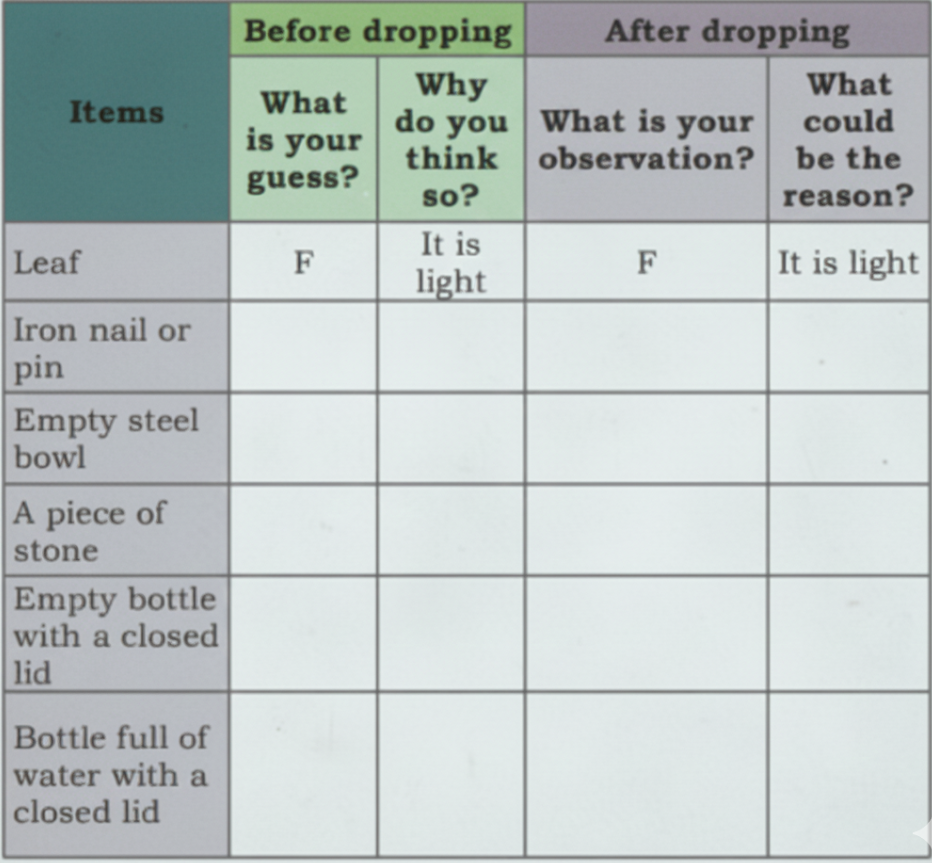
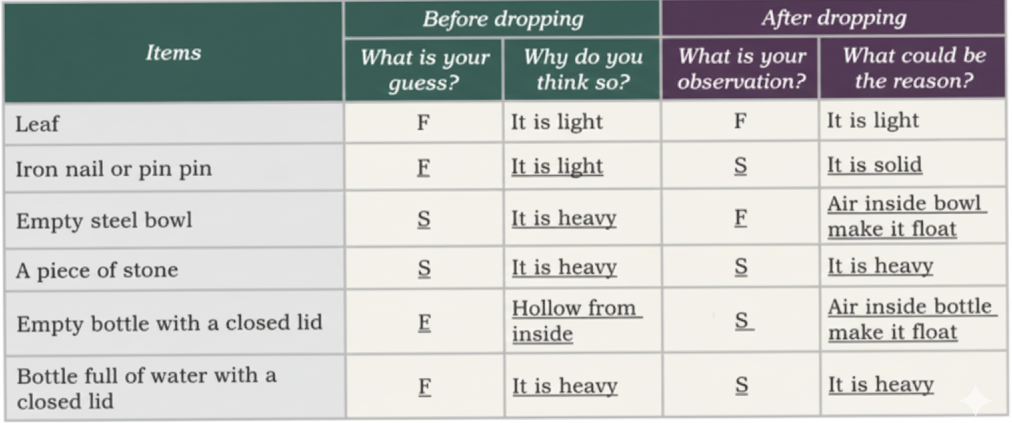
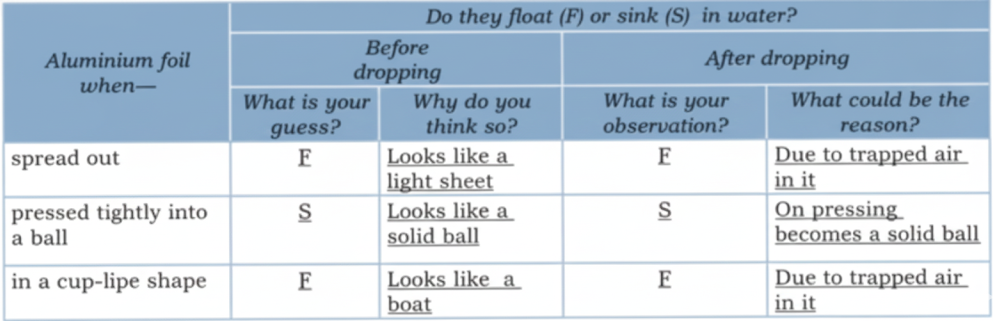
Collect objects, such as a leaf, an iron nail, an empty bowl (katori), a plastic bottle with a lid, pieces of stone, aluminium foil and other things of your choice. Fill a bucket with water. Before dropping the things listed in the table, guess whether things will float or sink. You may try other things too. Then, observe what happens when it is actually dropped in water. You can write ‘F’ for objects that float and ‘S’ for objects that sink.
Answer:
Discuss (page III)
Did all the light objects float and all the heavy objects sink? Name the heavy objects that floated and lighter objects that sank.
Answer: No, all the light objects did not float and all the heavy objects did not sank.
An empty steel bowl was heavy but it floated.
An iron nail or pin was light but it sank.
Activity 5 (Pages 113 -114)
Question 1. Let us create some boats:
Collect some paper, cardboard boxes, ice-cream sticks, clay, adhesive tape, etc.
Create groups of three to four students.
Think of how you can make a boat using some of the materials that you have.
Draw a picture.
Prepare a boat. Try to ensure that your boat is different from boats made by other groups.
Organise an exhibition of boats in the class.
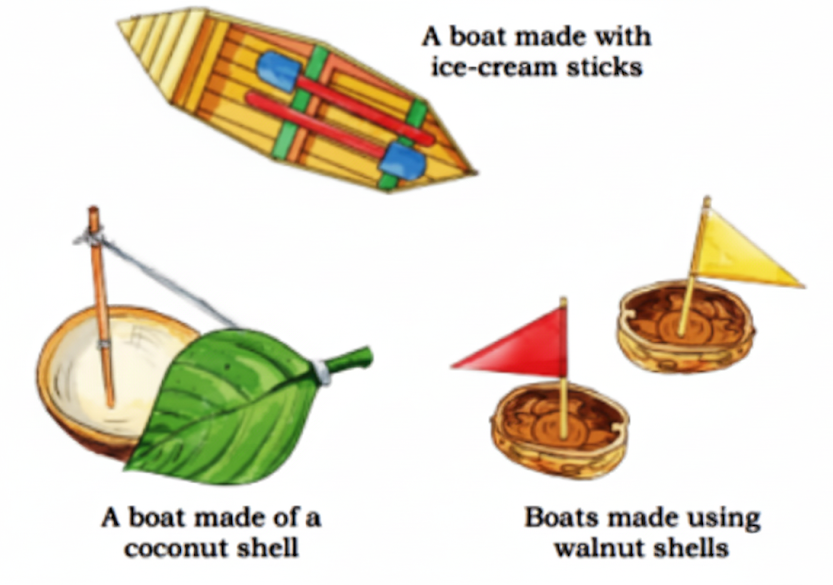
Following are some different types of boats which can be made.
Answer: Students should do it by themselves.
Question 2. Compare your boat with others boats.
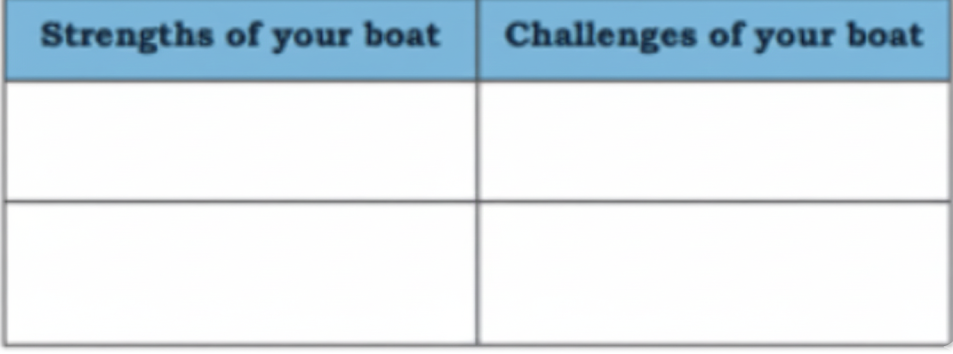
Answer: Students should do it by themselves.
Let Us Reflect (Pages 115-116)
1. Enquire about something
When Ravi spins a spinner, he notices that it slows down and eventually stops. He is curious about this and asks his teacher some questions. List at least two questions that he could ask.
Question 1. Why does the spinner slows down after sometime?
Question 2. What makes the spinner stop spinning?
2. Figure It out
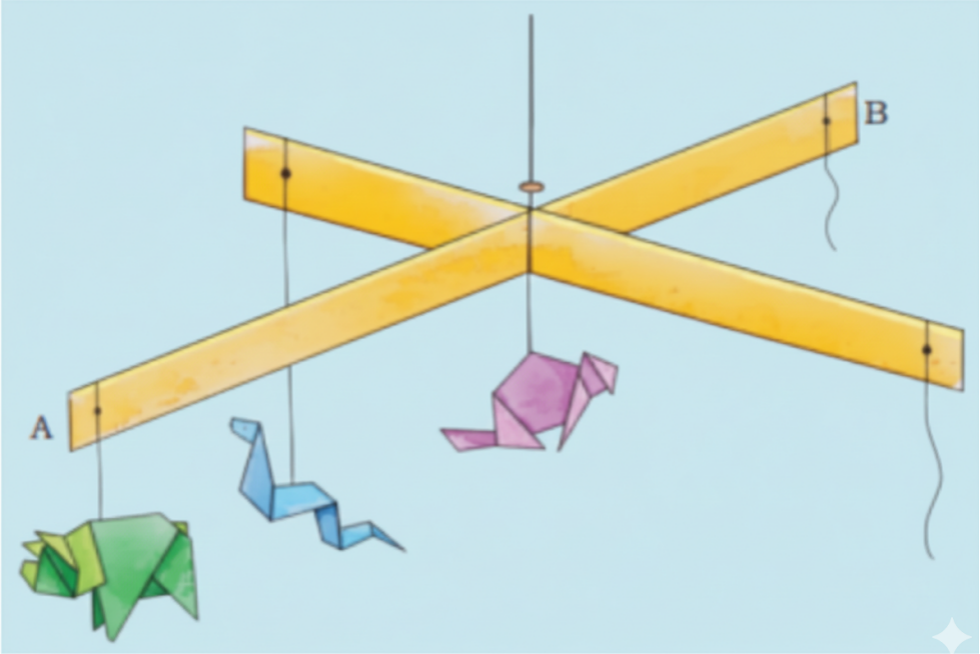
(a) The following figure is bending towards the side ‘A’. What should be done to balance it?
(b) How would you make a floating object sink and a sinking object float?
Answer:
(a) To bring the balance into equilibrium, we can place an extra load on side B, take away the object from side A, or shift the weight closer to the centre point of the balance.
(b) If we want an object that floats to sink, we can increase its mass by adding weight or alter its shape so it displaces less water.
To help a sinking object float, we can attach a lightweight material such as a sponge or modify its shape so it can stay on the surface.
Do an activity
Classify the objects below based on whether they float or sink in water.
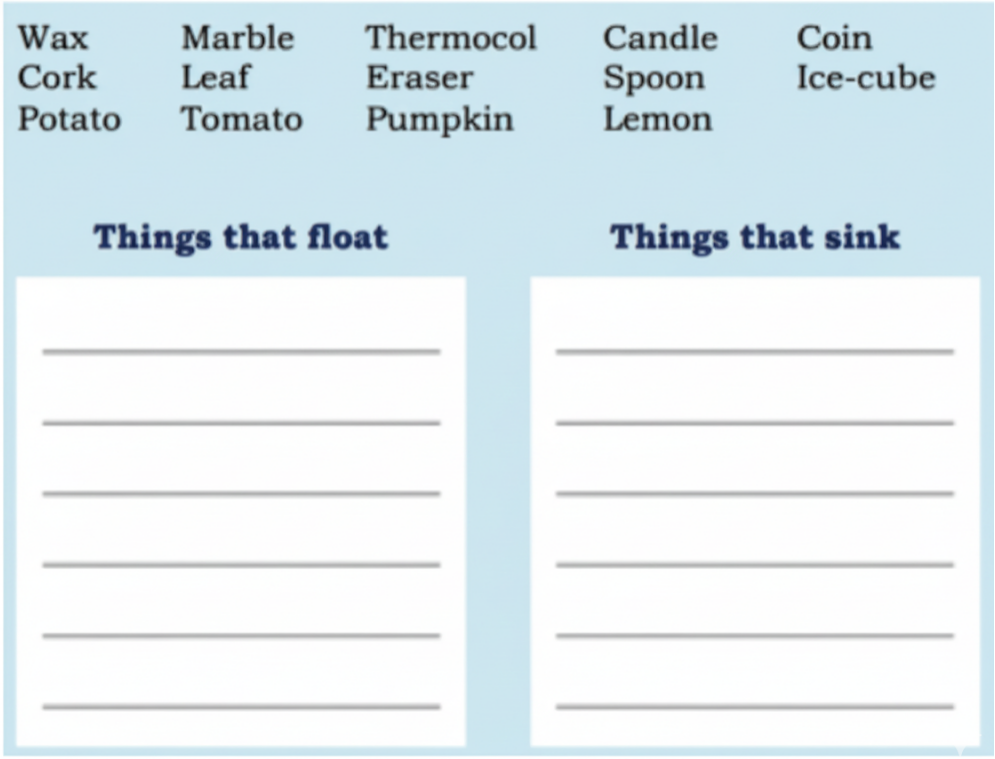
Answer:
Understanding How Things Work: A Student-Friendly Guide
Chapter 7 of Class 4 EVS explores how different things work in our daily lives. With fun experiments on spinning, floating, and sinking, students develop a curiosity for science while easily understanding real-world concepts.
Practicing these activities makes learning about spinners, boats, and floating objects both engaging and valuable. By doing hands-on tasks, children grasp the reasons behind everyday phenomena—making their NCERT EVS preparation even stronger.
Revise all key questions and try the suggested activities for the best exam results. Understanding how things work not only boosts your exam confidence but also helps you observe and question the world around you.
FAQs on NCERT Solutions For Class 4 Our Wonderous World Chapter 7 How Things Work - 2026-27 Free PDF Download (Sign-in Required)
1. What are NCERT Solutions for Class 4 Our Wonderous Wrold Chapter 7: How Things Work?
NCERT Solutions for Class 4 Our Wonderous Wrold Chapter 7: How Things Work give stepwise, CBSE-aligned answers for all textbook exercises.
- Detailed and accurate solutions for each question in Chapter 7
- Follow the CBSE 2026–27 marking scheme
- Help students understand concepts and score full marks
- Available free to download as PDF for easy revision
2. How should I write stepwise NCERT answers to get full marks in Class 4 EVS Chapter 7?
To score full marks, answers should be stepwise, clear, and match the CBSE marking scheme:
- Begin with a definition or direct answer
- Add supporting facts, examples, or steps
- Include diagrams if asked (well-labeled and neat)
- Use key terms from the chapter like machine, function, diagram
- Keep answers concise and relevant
3. Which questions from Class 4 Our Wonderous Wrold Chapter 7 are often asked in exams?
Frequently asked questions in exams from Chapter 7 include:
- Definitions of machines and tools
- Short notes on types of machines and how they work
- Drawing and labeling diagrams of simple devices
- Differences between manual and electrical tools
- Listing examples of machines used at home or school
4. Are diagrams or definitions necessary for Class 4 EVS Chapter 7 answers?
Yes, diagrams and definitions are essential for scoring full marks:
- Definitions: Clearly define key terms when asked (like lever, pulley, screw)
- Diagrams: Draw neat, labeled illustrations for devices or machines (if specified)
- Using both improves answer quality and marks
5. What is the best way to structure long answers in Class 4 EVS Chapter 7 for exams?
Structure long answers to Class 4 EVS Chapter 7 with:
- Introduction: Start with the main definition or idea
- Explanation: Give details in bullet points or short paragraphs
- Examples: List relevant examples or applications
- Diagram (if needed): Include a labeled figure
- Finish with a conclusion or summary sentence
6. Where can I download the Class 4 Our Wonderous Wrold Chapter 7 solutions PDF for free?
You can download the free PDF of Class 4 Our Wonderous Wrold Chapter 7 NCERT Solutions from trusted educational websites:
- Solutions are formatted for offline study and last-minute revision
- PDFs include stepwise answers, diagrams, and definitions
- Always use the version for the current academic year (2026–27)
7. What are key definitions needed for Class 4 EVS How Things Work?
Key definitions for exam success in Class 4 EVS Chapter 7:
- Machine: A tool or device that helps us do work easily
- Lever: A rigid bar used to lift or move loads
- Pulley: A wheel with a rope, used to lift heavy things
- Simple Machine: Devices with few or no moving parts that help us work
8. How can I revise Class 4 EVS Chapter 7 quickly before exams?
For fast revision of Class 4 EVS Chapter 7:
- Make a revision planner (1-day, 3-day, 7-day)
- Use flash notes and diagrams for quick recall
- Practice writing stepwise answers to important questions
- Solve previous year and sample questions
- Review key definitions and diagrams just before the test
9. Are NCERT Solutions enough for Class 4 EVS exams?
NCERT Solutions are usually sufficient for Class 4 EVS exams if studied thoroughly:
- Cover all back exercise, intext, and exemplar questions
- Include step-by-step answers and diagrams as per CBSE format
- For higher scores, practice sample and previous year questions too
10. How do I learn diagrams for Class 4 Our Wonderous Wrold Chapter 7 effectively?
To master diagrams for Chapter 7:
- Practice drawing each diagram multiple times
- Label every part neatly
- Follow NCERT conventions for diagrams (use ruler, simple lines)
- Check solved examples in your solutions PDF
- Revise common diagrams like lever, pulley, wheel
11. What are the most important topics from Class 4 EVS Chapter 7: How Things Work?
The most important topics in Chapter 7 are:
- Types of simple machines (lever, pulley, inclined plane, wheel and axle, screw)
- How simple machines work in daily life
- Examples and uses of machines
- Drawing and labelling diagrams of simple tools
- Difference between manual and electrical devices
12. Do examiners award partial marks for correct steps even if the final answer is wrong in Class 4 EVS?
Yes, CBSE examiners often give partial marks for showing correct steps or explanations, even if the final answer has a mistake. To maximize marks:
- Write detailed, stepwise answers showing all your work
- Include diagrams and keywords as per marking scheme
13. How do CBSE marking schemes affect answers in Class 4 EVS How Things Work?
The CBSE marking scheme rewards:
- Relevant use of definitions, steps, and diagrams
- Highlighting keywords from the chapter
- Neat and structured presentation
- Stepwise breakdown of processes or explanations
