



Stepwise Answers & Important Questions for Class 4 EVS Chapter 9
Activity 1 (Page 131)
You might have visited some places during your vacation. Write the name of the places and something special about them. Ask two or three of your friends about the places they had visited, and fill the table given below.
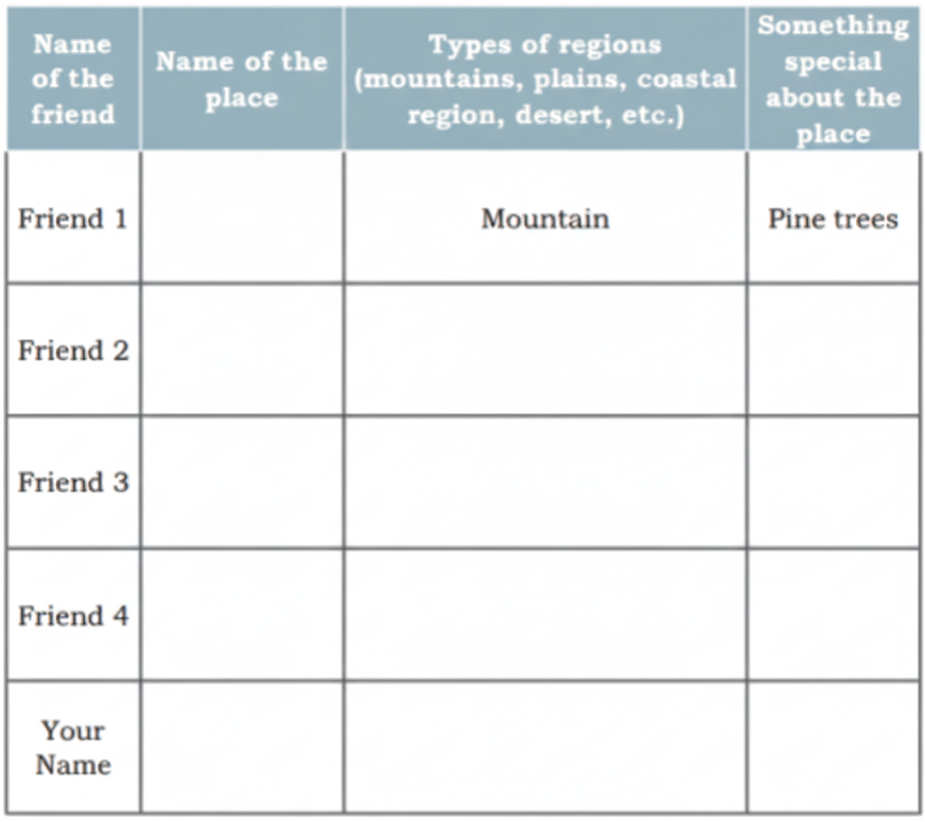
Which type of place do you find interesting?
What similarities and differences do you find in the place you visited, and those visited by your friends?
Answer:
My Favourite Region
I enjoy visiting mountainous areas the most. These regions have cool weather, are rich in greenery, and offer stunning natural scenery. I also love seeing snow and animals such as yaks and mountain goats found in these areas.
Similarities:
Both Sikkim and Shimla are hilly regions and are rich in natural greenery.
Jaipur and Puri are known for their traditional clothing and cultural dance forms.
Differences:
Jaipur has a hot and dry climate, whereas hill regions like Shimla and Sikkim have a cool climate with lush greenery.
Puri is a coastal town located near the sea, while Sikkim is situated in the mountainous region.
(Note: Students’ answers may differ based on their interests and understanding.)
Write (Pages 132-133)
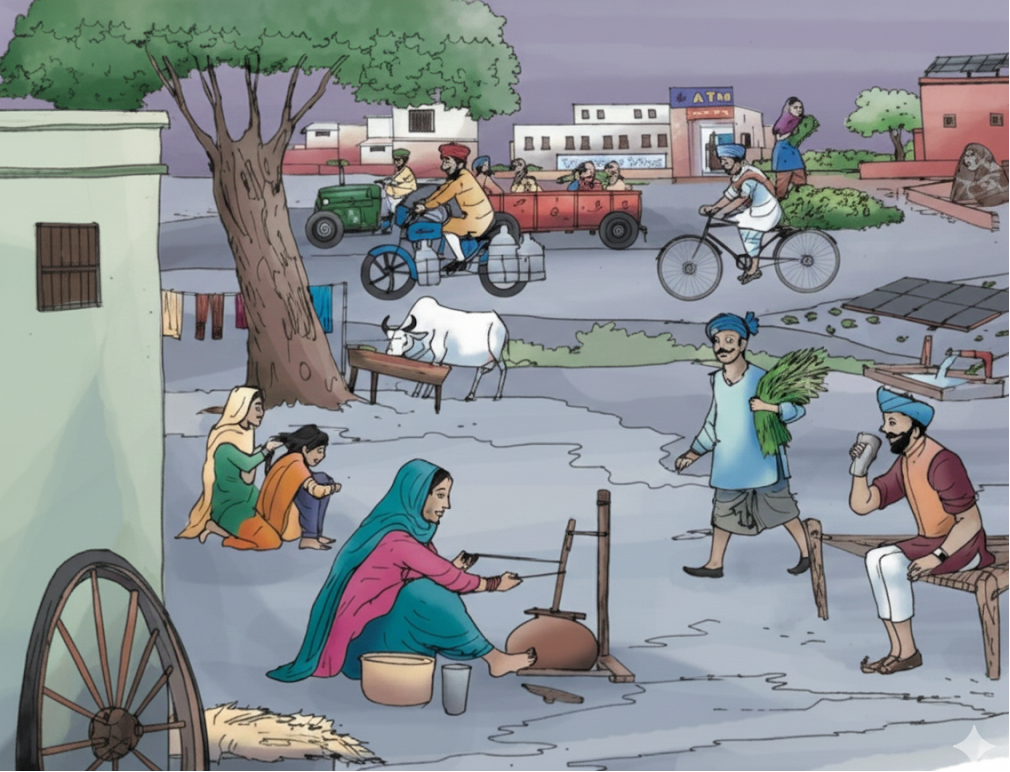
Look at the picture above and write your observations:
Question 1. What kind of land do you see in the picture?
Answer: The scene looks like a countryside village, featuring unpaved roads, patches of greenery, and a combination of traditional and contemporary buildings.
Question 2. List the activities that people are engaged in.
Answer: The picture shows many everyday activities, such as preparing buttermilk, a man sitting and drinking it, people travelling by bicycle, a milk vendor transporting milk on a motorcycle, and a tractor being used for farm work. Some villagers are carrying vegetables, while others are sitting, walking, and talking with one another. Modern methods can also be seen, like seeds being planted using a drone and a person withdrawing cash from an ATM. In addition, people are engaged in different agricultural tasks, and buffaloes can be seen grazing on grass.
Question 3. Which animals do you see in the picture?
Answer: The picture shows a cow and several buffaloes that are kept for agricultural work and for producing milk.
Question 4. Do you notice anything unique about the clothing of the people?
Answer: Yes, the people are dressed in traditional Punjabi village attire. The men are wearing turbans along with kurta-pyjamas or dhoti-kurta, while the women are dressed in bright salwar kameez and have dupattas draped over their heads.
Write (Page 133)
What is the most popular food in your region? Can you list the main ingredients used in its preparation?

Name of the food item: …………….
…………………………………………………
…………………………………………………
Ingredients: …………….
………………………………….
………………………………….
Answer:
I am from Kerala.
Name of the food item: Dosa and idli.
Ingredients: Both are made from fermented batter of rice and lentils (urad).
(Note: Answer of this question may vary according to the students’ region.)
Question 1. What kind of land do you see?
Answer: The land shown in the picture appears to be a desert, as it has sand dunes, sparse plant life, and dry environmental conditions.
Question 2. What types of plants do you see in the picture? How are they different from the plants you see in your locality?
Answer: The picture shows plants such as cactus, khejri, and palm trees. These desert plants are adapted to survive with very little water. In contrast, the plants found in my locality, which is a plain region, are generally green and leafy because they receive sufficient water.
Question 3. Is there something unique about the way people in this village are dressed?
Answer: Yes, the people are dressed in bright traditional attire, which is different from the clothing worn in my region. The women are wearing ghaghras, bandhani dupattas, and colourful bangles, while the men are dressed in turbans along with kurta-pyjamas or dhotis.
Question 4. How do you think people travel in deserts?
Answer: People living in desert regions often use camels for travel, which is why camels are known as the “ship of the desert.” They are well suited for carrying goods and can travel long distances because they can store water in their bodies. In some areas, camel-drawn carts are also commonly used.
Question 5. What do you like the most in the picture?
Answer: I enjoy the vibrant cultural celebration shown in the picture, especially the music and dancing. The atmosphere appears cheerful and reflects how people celebrate and take pride in their culture even in a dry desert region.
Find Out (Page 137)
Ask your family members about the folk songs and dances from your region, and note them down in the table below.
(Note: Answer of this question may vary according to the students’ region.)

Answer:
Note: Students’ answers may differ depending on their region and cultural background.
Discuss (Page 138)
Why do you think water is scarce in the desert?
Answer: Water is limited in desert regions because they get very little rainfall. The climate is extremely hot and dry, causing any available water to evaporate quickly. Deserts also lack large rivers and lakes. In addition, the sandy soil does not hold moisture well, so water either seeps away or evaporates before it can be used by plants, animals, or people.
On The Seashore, With Chandni (Page 139)
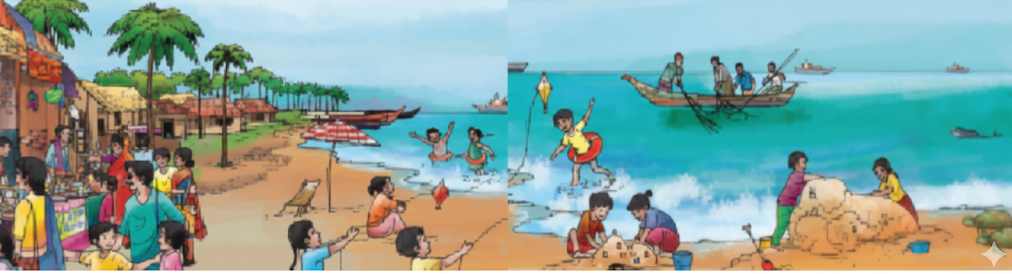
Look at the picture given below and write your observations.
Question 1. List the different kinds of activities that the people are doing.
Answer: The picture shows a variety of activities taking place. Some people are fishing in the sea from a boat using nets. Children can be seen flying kites and building sandcastles on the beach with buckets and spades. A few kids are shaping a large sand sculpture that looks like an elephant, while others are swimming in the shallow water with the help of a float ring. In addition, some people are busy shopping nearby.
Question 2. What kinds of trees are found near the sea, and how are they different from those in the deserts and plains?
Answer: Trees found near the sea include coconut and palm trees. These tall trees are well suited to grow in sandy soil and salty coastal conditions.
In desert areas, small plants such as cactus, khejri, and babool are commonly seen. They grow in dry, sandy soil and can survive with very little water. Some plants, like the cactus, store water in their stems.
In the plains, many green trees such as mango and neem grow abundantly. They have broad leaves that help in photosynthesis and thrive because the soil in these regions provides plenty of water.
Question 3. List the find activities you would like to do on a beach.
Answer: I would enjoy doing activities such as swimming and playing in the sea waves, making sandcastles and sand sculptures, flying a kite, collecting seashells along the beach, and watching marine life like dolphins or turtles from the shore.
Question 4. What is special about the dresses people wear in the coastal regions?
Answer: People living in coastal regions usually wear light and comfortable clothing such as shorts, T-shirts, and swimwear because the climate is hot and humid. Cotton clothes are commonly preferred as they keep the body cool and dry quickly. Fishermen generally wear simple outfits like shirts and lungis that are suitable for their work.
Activity 2 (Page 141)
Let us Create
Use one coastal item to create a fun decor object like a photo frame, a necklace, a painted pebble, a mini basket or a sand art jar. Add your own creative twist and display your work in the class! You can use any other locally available materials to create the decor items.
Answer:
Discuss
Question 1. Write your observations on how life around a coastal region differs from the life in a desert.
Answer:
Life in a Coastal Region
People living in coastal areas mainly earn their living through fishing. Seafood such as fish and prawns is a regular part of their diet. These regions experience a humid climate with frequent rainfall. Coconut and palm trees are commonly seen, and daily life often includes activities like boating, fishing, and tourism related to beaches.
Life in a Desert Region
Life in desert areas is shaped by dry, sandy land and limited water availability. Animals and birds such as camels (known as the “ship of the desert”), lizards, wild cats, pythons, and eagles are commonly found here. Days are extremely hot, while nights can be quite cold. Vegetation includes cactus, khejri, babool, and other thorny plants. Traditional homes are usually built with mud and thatched roofs to suit the climate. Popular local dishes include dal-bati-churma and ker sangri.
Question 2. Why is it important to keep our beaches clean?
Answer: Keeping beaches clean is very important. Polluted beaches can harm marine animals and birds. Clean beaches help keep the water safe and make the area pleasant for visitors. When beaches are well maintained, they attract more tourists, which supports the livelihood of local people. Clean beaches also protect nature and keep the environment healthy and beautiful for everyone.
Activity 3 (Page 142)
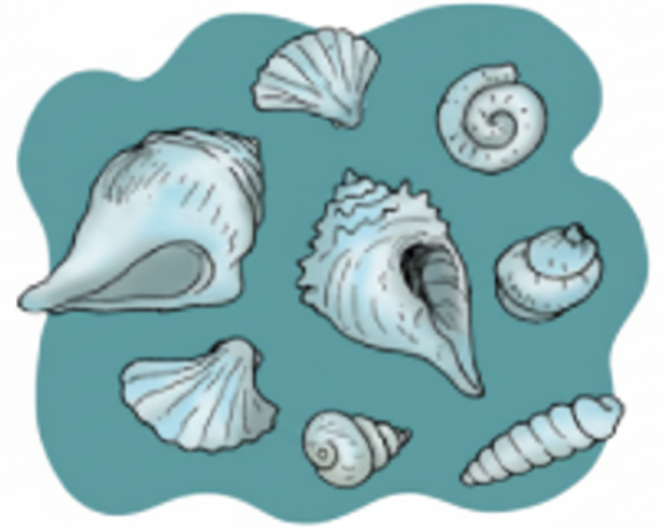
Can you identify these creatures?
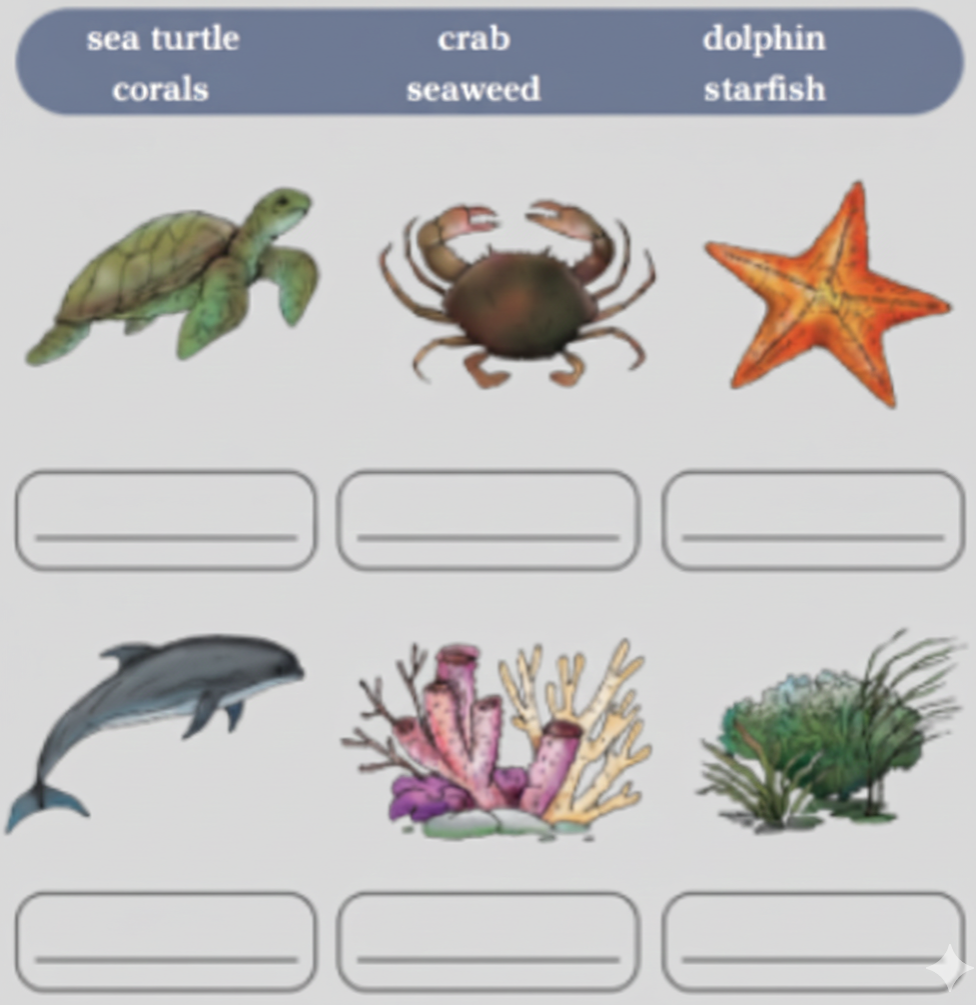
Answer:
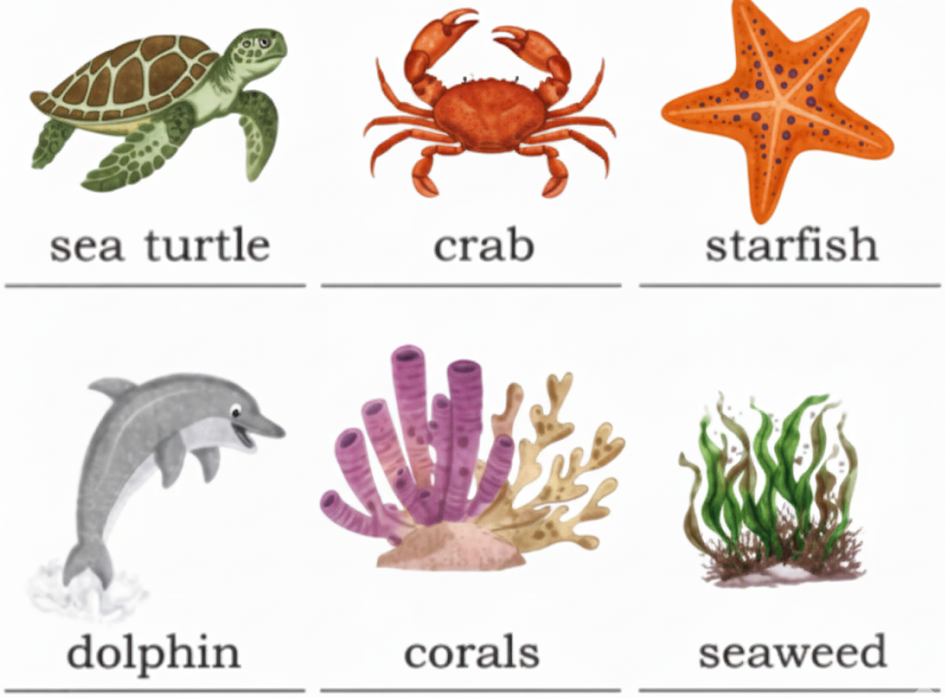
Discuss (Page 143)
Question 1. What are the adverse effects of a cyclone?
Answer: A cyclone brings powerful winds and heavy rainfall that can destroy houses, trees, and crops. It may cause severe flooding, washing away roads and buildings. Cyclones also pose a danger to people and animals and disrupt normal life in coastal regions.
Question 2. How can communities be better prepared for such situations?
Answer: Communities can prepare better for cyclones through a combination of effective early warning systems, strong infrastructure, and public awareness. People can stay safe by paying attention to weather alerts on the radio, television, mobile apps such as Sachet, or warning sirens, and by moving to safer locations in advance.
It is important to build sturdy houses, keep emergency supplies ready—including food, drinking water, a first-aid kit, torches, batteries, and important documents—and support one another during emergencies. Constructing cyclone-resistant homes and strengthening public buildings like schools and hospitals also helps reduce damage. In addition, educating people about environmental challenges and safety measures plays a key role in preparedness.
In The Mountains, With Nayan (Pages 144-145)
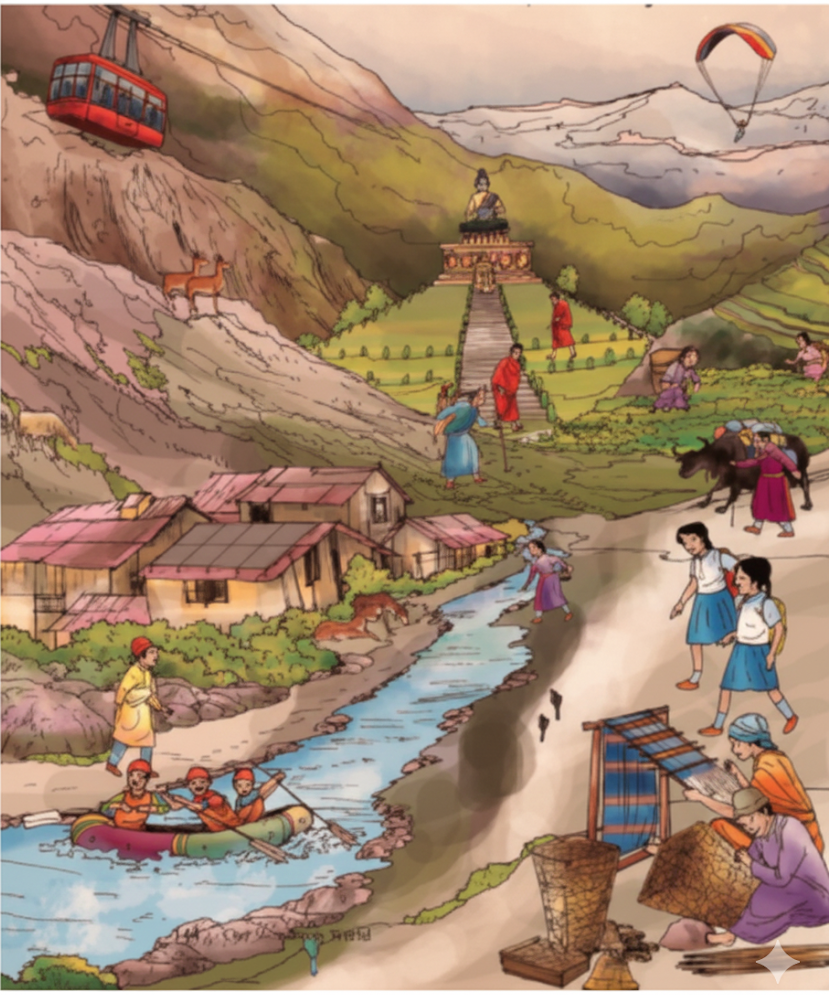
Question 1. What type of animals do you see in the picture?
Answer: In the picture, animals such as yaks, goats, mountain goats, deer, and some types of birds can be seen. These animals are well adapted to live in cold, mountainous regions.
Question 2. How are the dresses worn by people living in the mountains different from those worn in your region?
Answer: People living in mountainous regions wear attractive traditional outfits such as the bakhu, dumdyam, and guayo cholo. Their clothing is usually thick and made of wool to keep them warm and protect them from the cold climate. In comparison, people in my region mostly wear light cotton clothes like T-shirts, jeans, or dresses, which are more suitable for the warm and moderate weather.
Question 3. Describe the trees found in the mountains.
Answer: Trees found in mountainous regions are generally tall and slender, such as oak, pine, walnut, and chestnut. These trees are specially adapted to cold, hilly conditions, with cone-shaped forms that help snow slide off easily and reduce heat loss.
Discuss (Page 147)
Question 1. How does the cold climate in mountain regions affect the way people live and dress?
Answer: The cold weather in mountain regions makes it necessary for people to wear warm woollen clothing. They also build well-insulated houses using wood or stone to protect themselves from the cold. Fireplaces or stoves are commonly used for heating, and people prefer hot drinks and warm meals to stay comfortable and healthy.
Question 2. What traditional clothes are worn in your region? How do they match with the local climate?
Answer: If I lived in a hot and dry desert region, people there would usually wear loose, cotton clothing. For example, in Rajasthan, India, men commonly wear turbans, loose shirts, and dhotis, while women wear ghaghras and odhnis. These clothes cover most of the body to protect it from the strong sun, while still allowing air to pass through and keep the body cool.
(Note: Answers may vary depending on the student’s region.)
Question 3. Why do you think certain trees, like pine and oak, grow better in the mountains?
Answer: Pine and oak trees grow well in mountainous areas because they are specially adapted to cold conditions. They have strong roots that grip the rocky soil firmly and narrow, needle-like leaves that reduce water loss. Their cone-shaped structure helps snow slide off easily, preventing the branches from breaking under heavy snowfall.
Question 4. How do animals like yak survive in the cold climate of Sikkim?
Answer: Yaks are able to survive the cold climate of Sikkim due to their special physical adaptations. They have thick fur and a layer of fat that helps keep their bodies warm. Yaks also store fat to provide energy during winters when food is limited. Their broad hooves give them a firm grip on snowy and rocky ground, allowing them to move easily and graze on grasses and other sparse vegetation found in the mountainous regions of Sikkim.
Discuss (Page 148)
Question 1. Why do you think traditional houses in Sikkim are built with wood and have slanting roofs?
Answer: Traditional houses in Sikkim are mainly constructed using wood, which helps keep the interiors warm during cold weather. They usually have sloping roofs that allow rain and snow to flow off easily, preventing water or snow from collecting and causing leaks or damage to the structure.
Question 2. Does your house have any feature that is similar to the houses in the mountains?
Answer: Yes, my house also has a sloping roof that allows rainwater to drain off easily. It has windows that let in fresh air and natural sunlight.
(Note: Answers may vary depending on the student’s region.)
Question 3. Why are landslides common in mountains during the rainy season?
Answer: Landslides often occur in mountainous areas during the rainy season because heavy rainfall loosens the soil, causing rocks and earth to slide down the slopes.
Question 4. What do you think can be done to keep people safe during the landslides?
Answer: People can be protected from landslides by providing early warning alerts, constructing strong retaining walls, and planting more trees to help hold the soil in place. Shifting people to safer areas and avoiding construction on unstable slopes can also reduce the risk during landslides.
Question 5. What can communities do to help people who lose their homes or get affected by natural disasters?
Answer: Communities can support those affected by providing food, clothing, and shelter through relief camps. They can also contribute by donating money, sharing essential supplies, and helping rebuild homes and schools. In addition, volunteers can offer emotional support and take part in rescue and clean-up activities.
Life In My Land form (Page 149)
Draw the landform around you in the space given below. Name the area, the type of landform, some interesting features of the people, their professions, food, houses, plants and animals.

Answer:
Name of the Area: Green Plains
Type of Landform: Plains
Interesting Features:
People: The residents of Green Plains are mostly dedicated farmers who cultivate crops and take care of livestock.
Professions: Farming is the main occupation, along with activities such as trading and pottery.
Food: People commonly eat rice, chapatis, and vegetables. Dairy products like milk and fresh butter are widely used in their meals.
Houses: Homes are usually built using bricks, mud, and wood and have simple, practical designs.
Plants: The plains are rich in agricultural crops such as wheat, rice, and maize. Trees like mango, neem, and peepal are often seen along the roads.
Animals: Animals such as cows, goats, and chickens are commonly reared for milk, meat, and eggs. Small birds like sparrows and pigeons are also frequently found in this region.
Let Us Reflect (Pages 150-151)
Question 1. Compare life in the mountains and plains by capturing the differences in trees, animals, houses, clothes, food, festivals and art forms.
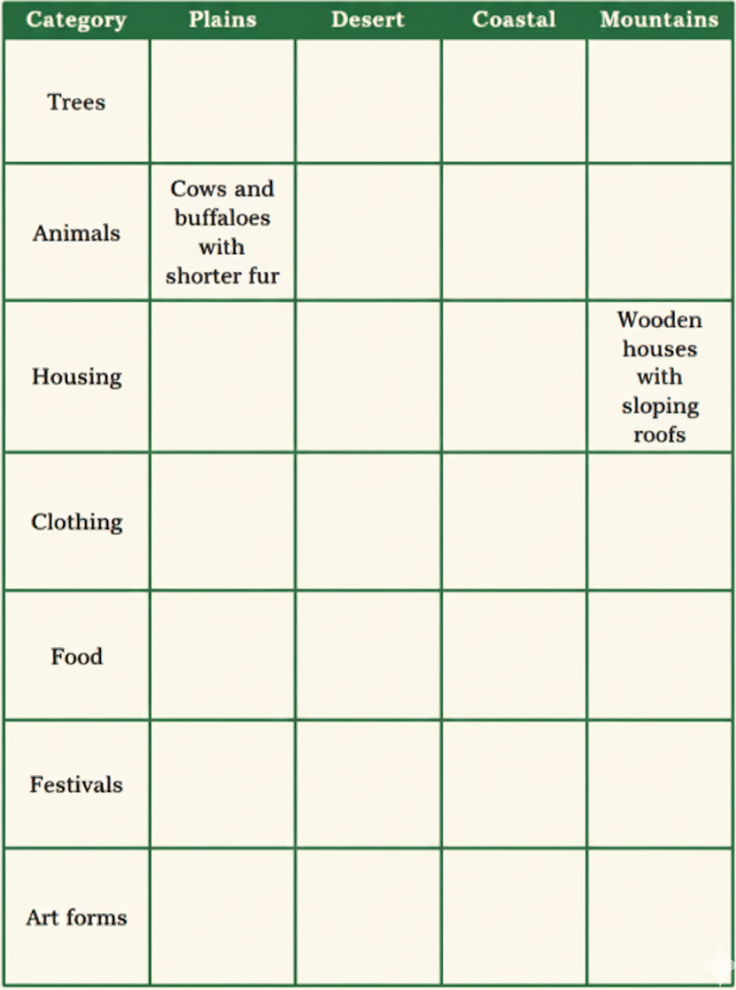
Answer:
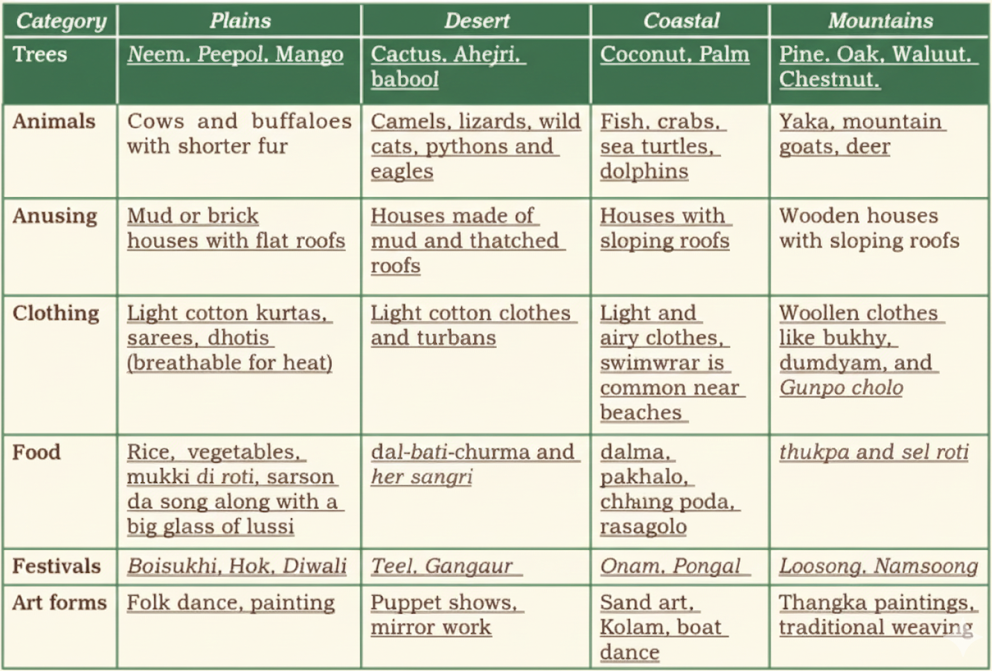
Question 2. Design and draw a landform by combining your favourite features from mountains, plains, coasts, and deserts.

(a) What made you choose different features for your landform?
(b) How does each feature benefit people, animals or plants?
(c) What difficulties might people face living in your Jandlorm?
Answer:
(a) I selected mountains for their cool climate and scenic beauty, plains for easy farming and smooth transportation, coastal areas for enjoyable beaches and fishing activities, and deserts for their unique sand dunes and camels. I designed my land by combining the best features of mountains, plains, coasts, and deserts to create a rich and lively region.
(b) Mountains provide fresh air, clean water from rivers, and shelter for animals such as yaks. Plains are ideal for agriculture, as many crops grow well there. Coastal areas supply fish and other seafood and allow travel by boats. Deserts support special plants like cactus that require very little water, and animals like camels are helpful to people because they can survive hot and dry conditions by storing water in their humps.
(c) People living in such a mixed region may face several challenges. They might experience extreme changes in weather, such as heat in desert areas, cold in mountainous regions, and storms near the coast. They would also need to cope with natural problems like landslides, floods, and droughts.
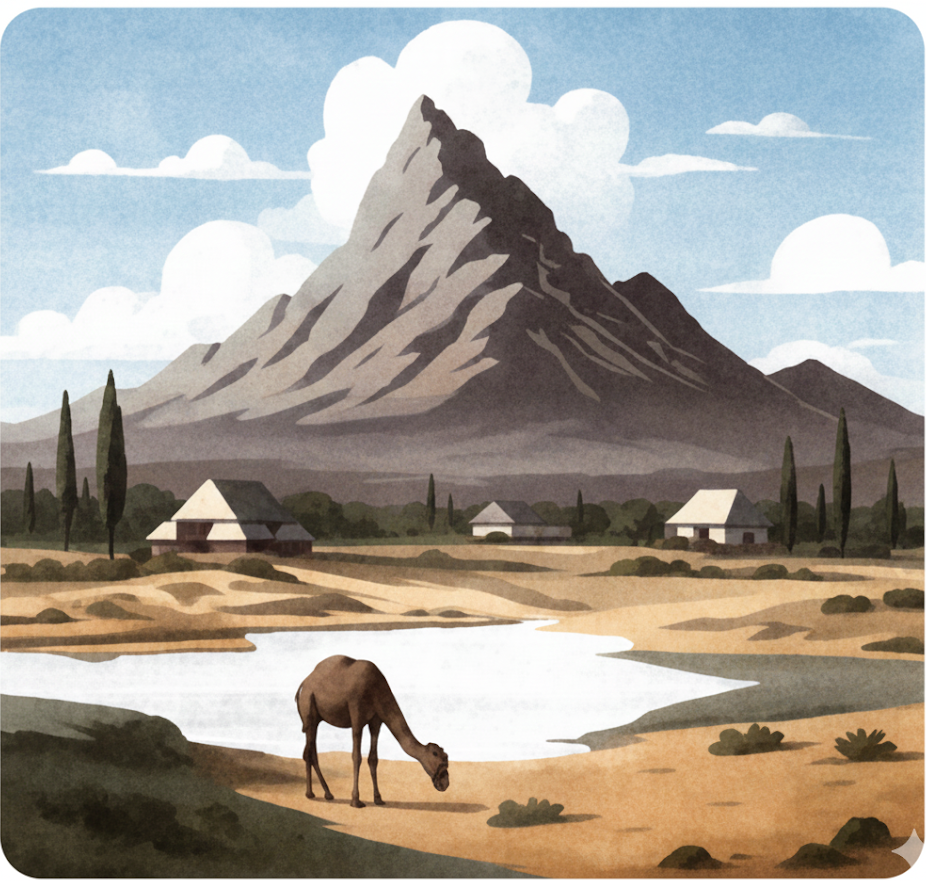
Explore India's Diverse Landforms – NCERT EVS Class 4 Chapter 9
Understanding the unique features of different lands and lives in India helps you learn about our country’s rich diversity. Mastering this chapter prepares you for questions related to deserts, coasts, plains, and mountains in your EVS exams.
This lesson covers how people, animals, and plants adapt to various landforms in India. Focus on the key differences between each region, such as their homes, foods, and festivals, for easy and effective revision.
Revise regularly and create comparison tables for better exam performance. Use colourful drawings and mind maps to remember important points—helping you score higher in your Class 4 EVS exams and enjoy learning about our wonderful world!
FAQs on NCERT Solutions For Class 4 Our Wonderous World Chapter 9 Different Lands, Different Lives - 2026-27 Free PDF Download (Sign-in Required)
1. What are the important questions in Class 4 EVS Chapter 9?
The most important questions in Class 4 EVS Chapter 9: Different Lands, Different Lives include concepts about different types of lands, ways of living in various regions, and how the environment affects people's lives. Key areas to focus on are:
- Differences between life in mountains, plains, and deserts.
- How food, clothes, and houses change according to the region.
- Map or diagram labelling (if given in the textbook).
- Short and long answer questions from NCERT back exercises.
- Definition-based questions (e.g., desert, oasis, etc.).
2. How to answer long questions in Different Lands Different Lives?
To score full marks in long answers for Class 4 EVS Chapter 9, follow a stepwise and structured format:
- Start with an introduction that explains the main topic.
- Use clear headings or paragraphs for each point (e.g., food, shelter, clothing).
- Add examples from the chapter wherever possible.
- Include key terms and highlight important differences.
- Conclude with a summary sentence if possible.
Use bullet points for clarity and include relevant NCERT/CBSE keywords for better marks.
3. Are diagrams needed in Chapter 9 EVS?
Diagrams and map labelling are helpful and sometimes required in Class 4 EVS Chapter 9 answers. Including neat diagrams can make your answers more attractive and help you score easy marks, especially when describing different types of land, houses, or clothing. Check your NCERT textbook exercises for any diagram-based questions and practice labelling them accurately.
4. Where can I download Class 4 EVS Chapter 9 solutions PDF?
You can easily download the NCERT Solutions for Class 4 EVS Chapter 9: Different Lands, Different Lives PDF from trusted educational websites providing CBSE-aligned materials. Look for a single-click free PDF download option for offline study and revision.
5. How do I write stepwise NCERT answers to score full marks?
Writing stepwise NCERT answers helps match the CBSE marking scheme and score full marks:
- Read the question carefully and underline keywords.
- Begin each answer with a brief introduction (one or two lines).
- Use bullet points or separate steps for each point asked.
- Include diagrams if the question demands it.
- Conclude with a summary (for long answers).
6. What are the most important topics from this chapter?
The most important topics for Class 4 EVS Chapter 9: Different Lands, Different Lives include:
- Different types of regions (mountains, plains, deserts, coastal areas).
- How climate affects food, shelter, and occupations.
- Adaptations of people to their environment.
- Locating places on a map or identifying features from pictures.
7. How to present long answers to match CBSE marking?
To align your long answers with the CBSE marking scheme, follow these tips:
- Structure your response in clear paragraphs or bullet points.
- Use keywords from the NCERT book.
- Cover all parts of the question with examples.
- Add relevant diagrams if the topic involves physical regions, houses, or clothes.
- Keep your handwriting neat and avoid spelling mistakes.
8. How can I revise Class 4 EVS Chapter 9 quickly before exams?
To revise Chapter 9: Different Lands, Different Lives quickly, use these steps:
- Read summary and key points from your NCERT book.
- Practice all back exercise and intext questions from stepwise solutions.
- Go through important definitions and diagrams.
- Take mock tests or solve worksheets if available.
- Revise flash notes or quick revision cards for last-minute preparation.
9. What are examiners looking for in Class 4 EVS Chapter 9 answers?
CBSE examiners look for answers that are:
- Direct and to the point
- Include essential keywords from the chapter
- Show clear understanding of differences between regions
- Include diagrams/maps where asked
- Demonstrate neatness and proper sequence in stepwise answers
10. Are NCERT Solutions enough for Class 4 EVS exams?
NCERT Solutions for Class 4 EVS are usually sufficient to prepare for your CBSE exams, as they cover all textbook questions and key topics. For best results, revise regularly, practice writing answers, and attempt a few sample or previous year papers for thorough exam readiness.
