






NCERT Solutions For Class 11 Biology Chapter 19 Excretory Products And Their Elimination in Hindi - 2026-27
In NCERT Solutions Class 11 Biology Chapter 19 In Hindi, you’ll learn all about excretory products and how our body gets rid of waste. This chapter explains how organs like the kidneys, skin, and lungs help in removing harmful substances and maintaining balance inside our bodies. Concepts like osmoregulation, urine formation, and excretory system parts are explained in a way that's easy to follow, especially if Hindi is your medium.
 Table of Content
If you get stuck on topics like GFR, ADH, or the functions of the nephron, you are not alone! Vedantu’s free NCERT Solutions break down each question with clear answers and stepwise explanations. For a quick reference, you can also download chapter-wise PDFs, making revision and exam prep much simpler. You may also want to see the latest Class 11 Biology syllabus to check how this chapter fits in your exam plan.
Using these NCERT Solutions, you’ll understand all the key processes and clear up common confusions, giving you more confidence to answer different types of questions in your exams. This chapter is an essential part of human physiology you’ll need to score well in your Biology paper. For more chapters or all solutions, check the full NCERT Solutions for Class 11 Biology.


1. गुच्छीय निस्यंद दर (GFR) को परिभाषित कीजिए।
उत्तर: वृक्कों द्वारा प्रति मिनट निस्यंदित की गई मूत्र की मात्रा गुच्छीय नियंद दर (GFR) कहलाती है। एक स्वस्थ व्यक्ति में यह 125ml/मिनट अथवा 180 ली प्रतिदिन होती है।
2. गुच्छीय निस्पंदन दर (GFR) की स्व नियमन क्रियाविधि को समझाइए।
उत्तर: गुच्छीय निस्पंदन की दर के नियमन के लिए गुच्छीय आसन्न उपकरण द्वारा एक अति सूक्ष्म क्रियाविधि सम्पन्न की जाती है। यह विशेष संवेदी उपकरण अभिवाही तथा अपवाही धमनिकाओं के सम्पर्क स्थल पर दूरस्थ संकलित नलिका की कोशिकाओं में रूपान्तरण से बनता है। गुच्छ निस्पंदन दर में गिरावट इन आसन्न गुच्छ कोशिकाओं को रेनिन के स्रावण के लिए सक्रिय करती है जो वृक्कीय रक्त का प्रवाह बढ़ाकर गुच्छन कंद दर को पुनः सामान्य कर देती है।
3. निम्नलिखित कथनों को सही अथवा गलत में इंगित कीजिए :-
(अ) मूत्रण प्रतिवर्ती क्रिया द्वारा होता है।
उत्तर: सही।
(ब) ए०डी०एच० मूत्र को अल्पपरासरणी बनाते हुए जल के निष्कासन में सहायक होता है।
उत्तर: गलत।
(स) बोमेन संपुट में रक्त प्लाज्मा से प्रोटीन रहित तरल निस्पंदित होता है।
उत्तर: सही।
(द) हेनले लूप मूत्र के सांद्रण में महत्वपूर्ण भूमिका निभाता है।
उत्तर: सही।
(य) समीपस्थ संवलित नलिका (PCT) में ग्लूकोज सक्रिय रूप से पुनः अवशोषित होता है।
उत्तर: सही।
4. प्रतिधारा क्रियाविधि का संक्षेप में वर्णन कीजिए।
उत्तर: प्रतिधारा क्रियाविधि :-
शरीर में जैल की कमी हो जाने पर वृक्क सान्द्र मूत्र उत्सर्जित करने लगते हैं। इसमें जल की मात्रा बहुत कम और उत्सर्जी पदार्थों की मात्रा बहुत अधिक हो जाती है। ऐसा मूत्र रक्त की तुलना में 4-5 गुना अधिक गाढ़ा हो सकता है। इसकी परासरणीयता 1200 से 1400 मिली ऑस्मोल्स/लीटर हो सकती है। मूत्र के सांद्रण की प्रक्रिया में जक्स्टा मेडुलरी (juxta medullary) वृक्क नलिकाओं की विशेष भूमिका हो जाती है; क्योंकि हेनले के लूप तथा परिजालिका केशिकाओं (वासा रेक्टा-vasa recta) के लूप पेल्विस तक फैले होते हैं। यह प्रक्रिया ADH के नियंत्रण में तथा पिरामिड के ऊतक द्रव्य में वल्कुट भाग से पेल्विस तक क्रमिक उच्च परासरणीयता बनाए रखने पर निर्भर करती है। वृक्कों के वल्कुट भाग में ऊतक तरल की परासरणीयता 300 मिली ऑस्मोल/लीटर जल होती है। मध्यांश (medulla) भाग के पिरामिड में यह परासरणीयता क्रमशः बढ़कर पेल्विस तक 1200 से 1400 मिली ऑस्मोल्स/लीटर जल हो जाती है। ऊतक तरल की परासरणीयता मुख्यतः Na+ व Cl– आयन तथा यूरिया पर निर्भर करती है।
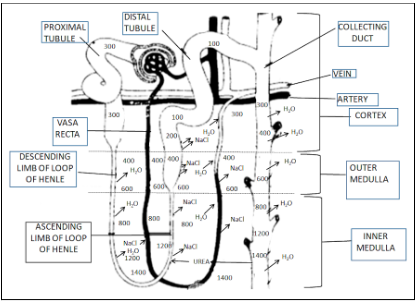
Na+ , Cl– आयन्स का परिवहन हेनले लूप की आरोही भुजा द्वारा होता है जिसका हेनले लुप की अवरोही भुजा के साथ विनिमय किया जाता है। सोडियम क्लोराइड ऊतक द्रव्य को वासा रेक्टा की आरोही भुजा द्वारा लौटा दिया जाता है। इसी प्रकार यूरिया की कुछ मात्रा हेनले लूप के सँकरे आरोही भाग में विसरण द्वारा पहुंचती है जो संग्रह नलिका द्वारा ऊतक द्रव्य को पुनः लौटा दी जाती है। हेनले लूप तथा वसा रेक्टा द्वारा इन पदार्थों के परिवहन को प्रतिधारा क्रियाविधि द्वारा सुगम बनाया जाता है। इसके फलस्वरूप मध्यांश के ऊतक द्रव्य की प्रवणता बनी रहती है। यह प्रवणता संग्रह नलिका द्वारा जल के अवशोषण में सहायता करती है और नियंद का सान्द्रण करती है। प्रतिधारा क्रियाविधि जल के ह्रास को रोकने की प्रमुख विधि है।
5. उत्सर्जन में यकृत, फुफ्फुस तथा त्वचा का महत्व बताइए।
उत्तर: मनुष्य तथा अन्य कशेरुकियों में वृक्क के अतिरिक्त यकृत, फुफ्फुस तथा त्वचा का उत्सर्जन में महत्त्व है। ये सहायक उत्सर्जी अंगों की तरह कार्य करते हैं।
(i) यकृत (Liver) : यकृत अमोनिया को यूरिया में बदलता है। यूरिया अमोनिया की तुलना में कम हानिकारक होता है। यकृत कोशिकाएँ हीमोग्लोबिन के विखंडन से पित्त वर्णक बिलीरुबिन (bilirubin), बिलिवर्डिन (biliverdin) बनाती हैं। इसके अतिरिक्त पित्त में उत्सर्जी पदार्थ कोलेस्टेरॉल (cholesterol), कुछ निम्नीकृत स्टेरॉयड हॉर्मोन्स, औषधियाँ आदि होती हैं। ये उत्सर्जी पदार्थ यकृत के पित्त द्वारा ग्रहणी में पहुँच जाते हैं और मल के साथ शरीर से त्याग दिए जाते हैं।
(ii) फुफ्फुस (Lungs) :
श्वसन क्रिया के फलस्वरूप मुक्त CO2 (18 L/day) एवं जलवाष्प फेफड़ों (फुफ्फुस) द्वारा शरीर से निष्कासित होती है।
(iii) त्वचा (Skin) :
जलीय प्राणियों में अमोनिया का उत्सर्जन त्वचा द्वारा होता है। स्थलीय जंतुओं, में त्वचा की स्वेद ग्रंथियों (sweat glands) द्वारा जल, खनिज तथा सूक्ष्म मात्रा में यूरिया, लैक्टिक अम्ल आदि पसीने के रूप में उत्सर्जित होता है। त्वचा की तेल ग्रंथियां (oil glands), सीबम (sebum) के साथ कुछ हाइड्रोकार्बन, मोम (wax), स्टेरॉल (sterol), वसीय अम्ल (fatty acids) आदि उत्सर्जित होते हैं।
6. मूत्रण की व्याख्या कीजिए।
उत्तर: मृत्रण मूत्र वृक्क में बनकर मूत्राशय में एकत्र होता रहता है। सामान्यतः अन्त:मूत्रीय तथा बाह्य मूत्रीय संकोचक पेशियों के संकुचन के कारण मूत्र मार्ग बंद रहता है। मूत्राशय से मूत्र त्याग तभी होता है जब मूत्रमार्ग की दोनों प्रकार की संकोचक पेशियाँ शिथिल हो जाएँ। अन्त:मूत्रीय संकोचक में अरेखित पेशी तथा बाह्य मूत्रीय संकोचक में रेखित पेशी तन्तु होते हैं, इसलिए अंत:मूत्रीय संकोचक का शिथिलन स्वायत्त तंत्रिका तंत्र के नियंत्रण में होने वाली अनैच्छिक और बाह्य मूत्रीय पेशियों का शिथिलन एक ऐच्छिक प्रतिक्रिया होती है। मूत्रण वास्तव में अनैच्छिक तथा ऐच्छिक प्रतिक्रियाओं के सही प्रभाव से होता है। ऐच्छिक नियंत्रण के कारण हम इच्छानुसार मूत्र त्याग करते हैं।
7. स्तम्भ I के बिंदुओं का खण्ड स्तम्भ II से मिलान कीजिए :-
स्तम्भ I स्तम्भ II
(i) अमोनिया उत्सर्जन (अ) पक्षी
(ii) बोमेन सम्पुट (ब) जल का पुनः अवशोषण
(iii) मूत्र (स) अस्थिल मछलियां
(iv) यूरिक अम्ल उत्सर्जन (द) मूत्राशय
(v) ए०डी०एच० (य) वृक्क नलिका
उत्तर: स्तम्भ I स्तम्भ II
(i) अमोनिया उत्सर्जन (स) अस्थिल मछलियां
(ii) बोमेन सम्पुट (य) वृक्क नलिका
(iii) मूत्र (द) मूत्राशय
(iv) यूरिक अम्ल उत्सर्जन (अ) पक्षी
(v) ए०डी०एच० (ब) जल का पुनः अवशोषण
8. परासरण नियमन का अर्थ बताइए।
उत्तर: परासरण नियमन वृक्क शरीर से हानिकारक पदार्थों को मूत्र के रूप में शरीर से निरन्तर बाहर निकालते रहते हैं। इसके अतिरिक्त ऊतक तरल में लवणों और जल की मात्रा का नियंत्रण भी करते हैं। शरीर में जल की मात्रा के बढ़ जाने अर्थात शरीर के तरल की परासरणीयता (osmolality) के कम हो जाने पर मूत्र पतला (तनु) हो जाता है और उसकी मात्रा बढ़ जाती है। शरीर में जल की कमी होने पर अर्थात शरीर के ऊतक तरल की परासरणीयता के बढ़ जाने पर मूत्र गाढ़ा हो जाता है और इसकी मात्रा कम हो जाती है। मूत्र की मात्रा का नियंत्रण मुख्यतः एल्डोस्टेरोन (aldosterone) तथा एंटी डाइयूरेटिक (antidiuretic hormone, ADH) द्वारा होता है। एल्डोस्टेरोन Na+ के पुनरावशोषण को बढ़ाता है, जिससे अंत:वातावरण में Na+ की उपयुक्त मात्रा बनी रहे। एण्टी डाइयूरेटिक (ADH) या वैसोप्रेसिन (vasopressin) मूत्र के तनुकरण या सांद्रण का प्रमुख नियंत्रक होता है। परासरण नियमन प्रक्रिया द्वारा जीवधारी के शरीर में परासरणीयता (osmotality) को नियन्त्रित रखा जाता है।
9. स्थलीय प्राणी सामान्यतः यूरिया उत्सर्जी या यूरिक अम्ल उत्सर्जी होते हैं तथा अमोनिया उत्सर्जी नहीं होते हैं, क्यों?
उत्तर: प्रोटीन्स के पाचन के फलस्वरूप अमीनो अम्ल प्राप्त होते हैं। जीवधारी आवश्यकता से अधिक अमीनो अम्लों का अमोनीकरण या अमीनो हरण (deamination) करते हैं। इससे कीटो समूह (Keto group) एवं अमीनो समूह से अमोनिया (ammonia) प्राप्त होती है। कीटो समूह का उपयोग उपचय (catabolism) के अन्तर्गत ऊर्जा उत्पादन में हो जाता है।अमोनिया को जलीय जंतुओं में उत्सर्जी कर दिया जाता है। यह जल में घुलनशील और विषैली होती है। उसकी उत्सर्जित करने के लिए अधिक जल की आवश्यकता होती है। इसी कारण अमोनिया जलीय प्राणियों का मुख्य उत्सर्जी पदार्थ है। अमोनिया उत्सर्जी स्थलीय जंतुओं में अमोनिया को यकृत द्वारा यूरिया में बदल दिया जाता है। यूरिया जल में घुलनशील और अमोनिया की तुलना में बहुत कम विषैला या हानिकारक होता है। अतः अधिकांश स्थलीय जन्तु यूरिया उत्सर्जी (ureotelic) होते हैं। जैसे - अनेक उभयचर तथा स्तनी प्राणी।। शुष्क परिस्थितियों में रहने वाले जन्तु; जैसे - सरीसृप एवं पक्षी वर्ग के सदस्यों में जल की कमी बनी रहती है। जल संचय के लिए ये प्राणी यूरिया को यूरिक अम्ल (uric acid) के रूप में उत्सर्जित करते हैं। यूरिक अम्ल जल में अघुलनशील होता है। यह विषैला नहीं होता, इसे मल के साथ त्याग दिया जाता है। सरीसृप, पक्षी, कीट आदि यूरिक अम्ल उत्सर्जी (uricotelic) होते हैं।
10. वृक्क के कार्य में जक्सटा गुच्छ उपकरण (JGA) का क्या महत्व है?
उत्तर: जक्सटा गुच्छ उपकरण (Juxta glomerular apparatus, JGA) की उत्सर्जन में जटिल नियमनकारी भूमिका है।JGA की विशिष्ट कोशिकाएँ कोशिका गुच्छ नियंदन का स्व नियमन स्वयं वृक्क द्वारा उत्पन्न दाब क्रियाविधि(renal pressure mechanism) की उपस्थिति के कारण होता है। इसकी खोज टाइगर स्टेट और बर्गमन (Tiger State and Bergman, 1898) ने की, JGA की विशिष्ट कोशिकाओं से रेनिन हार्मोन स्रावित होता है। Na+ की कम सान्द्रता या निम्न कोशिका गुच्छ निस्पंदन दर या निम्न कोशिका गुच्छ दाब (glomerular pressure) के कारण रेनिन रक्त में उपस्थित एन्जियोटेंसिनोजन (angiotensinogen) को एंजियोटेंसिन-I (angiotensin-I) और बाद में एंजियोटेंसिन-II (angiotensin-II) में बदलता है। एंजियोटेंसिन-II एक प्रभावकारी वाहिका संकीर्ण (vasoconstrictor) का कार्य करता है, जो गुच्छीय रुधिर दाब तथा जी०एफ०आर० (glomerular filtration rate, GFR) को बढ़ा देता है। एंजियोटेंसिन-II अधिवृक्क वल्कुट को एल्डोस्टेरोन (aldosterone) हार्मोन के स्राव को प्रेरित करता है। एल्डोस्टेरोन स्रावी नलिका के दूरस्थ भाग में Na’ तथा जल के पुनरावशोषण को बढ़ाता है। इससे रक्त दाब तथा जी०एफ०आर० में वृद्धि होती है। यह जटिल क्रियाविधि रेनिन एन्जियोटेन्सिन (renin angiotensin mechanism) कहलाती है।
11. नाम का उल्लेख कीजिए :-
(अ) एक कशेरुकी जिसमें ज्वाला कोशिकाओं द्वारा उत्सर्जित होता है।
उत्तर: सेफेलोकॉडेंट (एम्फीऑक्सस)।
(ब) मनुष्य के वृक्क के वल्कुट के भाग जो मध्यांश के पिरामिड के बीच धंसे रहते हैं।
उत्तर: बर्टिनी के स्तम्भ।
(स) हेनले लूप के समानांतर उपस्थित कोशिका का लूप।
उत्तर: वासा रेक्टा।
12. रिक्त स्थान भरिए :-
(अ) हेनले लूप की आरोही भुजा जल के लिए………….जबकि अवरोही भुजा इसके लिए है।
उत्तर: अपारगम्य, पारगम्य।
(ब) वृक्क नलिका के दूरस्थ भाग द्वारा जल का पुनरावशोषण…………हार्मोन द्वारा होता है।
उत्तर: ADH
(स) अपोहन द्रव में………..पदार्थ के अलावा रक्त प्लाज्मा के अन्य सभी पदार्थ उपस्थित होते हैं।
उत्तर: नाइट्रोजनी व्यर्थ।
(द) एक स्वस्थ वयस्क मनुष्य द्वारा औसतन ग्राम यूरिया का प्रतिदिन उत्सर्जन होता |
उत्तर: 25-30
NCERT Solutions for Class 11 Biology Chapter 19 Excretory Products and their Elimination in Hindi
Chapter-wise NCERT Solutions are provided everywhere on the internet with an aim to help the students to gain a comprehensive understanding. Class 11 Biology Chapter 19 solution Hindi mediums are created by our in-house experts keeping the understanding ability of all types of candidates in mind. NCERT textbooks and solutions are built to give a strong foundation to every concept. These NCERT Solutions for Class 11 Biology Chapter 19 in Hindi ensure a smooth understanding of all the concepts including the advanced concepts covered in the textbook.
NCERT Solutions for Class 11 Biology Chapter 19 in Hindi medium PDF download are easily available on our official website (vedantu.com). Upon visiting the website, you have to register on the website with your phone number and email address. Then you will be able to download all the study materials of your preference in a click. You can also download the Class 11 Biology Excretory Products and their Elimination solution Hindi medium from Vedantu app as well by following the similar procedures, but you have to download the app from Google play store before doing that.
NCERT Solutions in Hindi medium have been created keeping those students in mind who are studying in a Hindi medium school. These NCERT Solutions for Class 11 Biology Excretory Products and their Elimination in Hindi medium pdf download have innumerable benefits as these are created in simple and easy-to-understand language. The best feature of these solutions is a free download option. Students of Class 11 can download these solutions at any time as per their convenience for self-study purpose.
These solutions are nothing but a compilation of all the answers to the questions of the textbook exercises. The answers/ solutions are given in a stepwise format and very well researched by the subject matter experts who have relevant experience in this field. Relevant diagrams, graphs, illustrations are provided along with the answers wherever required. In nutshell, NCERT Solutions for Class 11 Biology in Hindi come really handy in exam preparation and quick revision as well prior to the final examinations.

FAQs on NCERT Solutions For Class 11 Biology In Hindi Chapter 19 Excretory Products And Their Elimination - 2026-27 Free PDF Download (Sign-in Required)
1. Where can I find accurate, step-by-step NCERT Solutions for Class 11 Biology Chapter 19, Excretory Products and their Elimination?
Vedantu provides comprehensive and meticulously crafted NCERT Solutions for Class 11 Biology Chapter 19. Each solution is prepared by subject matter experts and follows a step-by-step format to help students understand the correct methodology for answering questions as per the CBSE guidelines.
2. Are the NCERT Solutions for Chapter 19 on Vedantu fully aligned with the latest CBSE 2026-27 syllabus?
Yes, all NCERT Solutions on Vedantu, including those for Chapter 19, Excretory Products and their Elimination, are updated and fully aligned with the latest CBSE 2026-27 syllabus. Our experts ensure that the solutions cover all the topics and question patterns prescribed in the current curriculum.
3. How do the NCERT Solutions for this chapter explain the correct method for drawing and labelling the structure of a nephron for exams?
The NCERT solutions provide clear, well-labelled diagrams of the nephron as per textbook standards. The solutions emphasise the correct terminology and positioning for all parts, including the Malpighian body (glomerulus and Bowman's capsule), Proximal Convoluted Tubule (PCT), Henle's Loop, and Distal Convoluted Tubule (DCT), ensuring you can replicate them accurately for high scores.
4. How do the provided NCERT solutions break down the complex process of urine formation into simple, understandable steps?
The solutions simplify the process by explaining it in three distinct, sequential stages:
- Glomerular Filtration: Explaining how blood is filtered in the glomerulus.
- Selective Reabsorption: Describing how essential substances are reabsorbed back into the blood from the filtrate in the renal tubules.
- Tubular Secretion: Detailing how waste ions and products are actively secreted from the blood into the filtrate.
5. Why is understanding the counter-current mechanism important for exams? How do the NCERT solutions for Chapter 19 clarify this concept?
The counter-current mechanism is a crucial topic as it explains how humans produce concentrated urine, which is a key adaptation for water conservation. The NCERT solutions clarify this concept by using simplified explanations and flow diagrams to illustrate the exchange of solutes between the two limbs of Henle's Loop and the vasa recta. This helps students grasp the core principle and answer related higher-order questions effectively.
6. How do Vedantu's solutions help in understanding the hormonal regulation of kidney function, such as the roles of ADH and the Renin-Angiotensin system?
Vedantu's solutions explain the hormonal feedback loops with clarity. They detail how hormones regulate kidney function step-by-step. For instance, they explain how Antidiuretic Hormone (ADH) controls water reabsorption in the DCT and collecting ducts, and how the Renin-Angiotensin-Aldosterone System (RAAS) is activated to regulate the Glomerular Filtration Rate (GFR). This focus on mechanism helps in answering analytical questions.
7. Beyond just answers, how do the NCERT Solutions for Excretory Products and their Elimination help in applying concepts to solve questions about disorders?
The solutions go beyond simple definitions of disorders like Uremia, Renal Calculi, or Glomerulonephritis. They link each disorder to the malfunction of a specific part of the excretory system. For example, they explain how renal failure necessitates procedures like hemodialysis. This approach helps you tackle 'Higher Order Thinking Skills' (HOTS) and application-based questions, which are common in CBSE exams.
