









AM and PM Meaning in Time with Examples and 12 Hour Clock Explanation
Observe the following image of a clock:
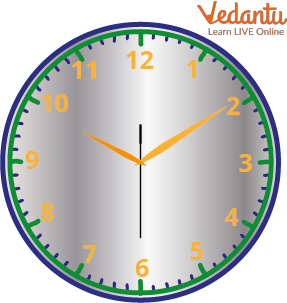
An Analog Clock
As you can see in the image, it is an analog clock. It shows, along with the hands, the numbers ordered from right to left and from 1 to 12. Each number indicates an hour of the day.
The 12-hour clock system uses the digits 1 through 12 followed by am or pm to denote each of the 24 hours of the day. While 2 AM is two hours after midnight and 10 PM is two hours before midnight, 6 AM and 6 PM are respectively early in the morning and late in the evening. Post meridiem is frequently abbreviated as PM, pm, p.m., or P.M., whereas ante meridiem is commonly referred to as AM, am, a.m., or A.M.
How to remember AM and PM full forms?
It could be challenging for people unfamiliar with the 12-hour convention to remember what is pm and am in time. There is a straightforward fix, though, and it doesn't need to understand the exact translation of the abbreviations (ante/post meridiem).
AM begins with the letter A in the alphabet.
Knowing that A denotes the beginning of the alphabet might be a wonderful point of reference for memorization given that AM corresponds to the start of the day.
Meanwhile, AM should be given the classification before noon because it is closer to PM in the alphabet.
Look at the following equivalence table.
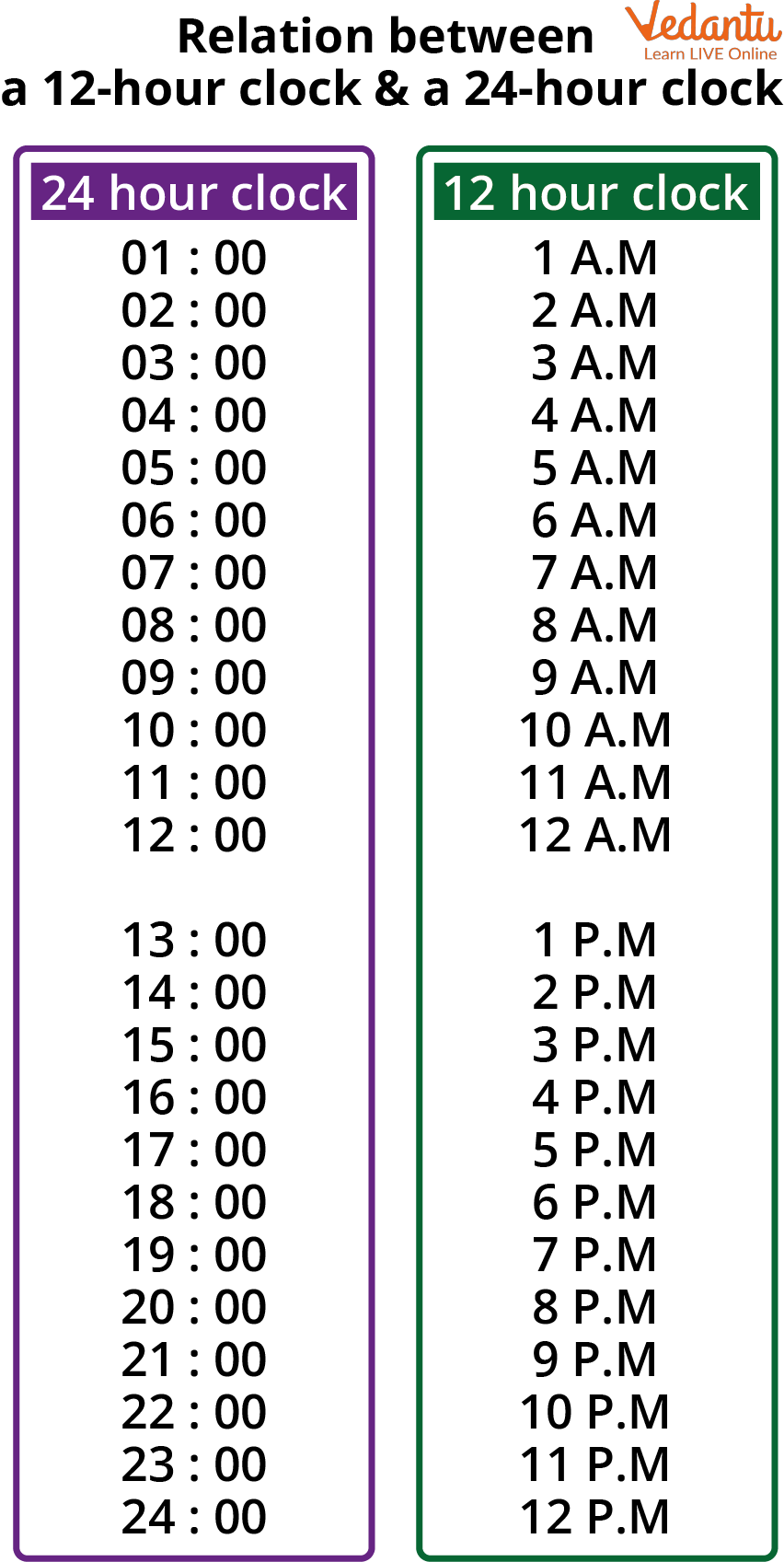
Table of Time
Now, look at the “12 hour” format. Have you noticed that when indicating a time, it appears written in one of the following ways?

Two Analog Clocks with Time 8 am and 8 pm
The difference between the two scripts is the letters am and pm time. But what do they mean?
The am, means "before noon" and pm means "after noon”.
This time format shows 12:00 hours of the day. The midpoint is also called "noon."
From midnight to noon, the abbreviation am is used, and from noon to midnight, the abbreviation pm is used.
Solved Examples
Q1: Solve the following problem.
Sofia started cooking at 4:25 pm It took her an hour and fifteen minutes to finish the dessert she made. At what time did Sofia finish dessert?
Look at a clock at your home to solve this sum.
Ans: You will calculate at what time Sofia finished the dessert. To do this, at the start time, you are going to add the time elapsed in preparing the dessert, that is, 1 hour and 15 minutes, which leads to the following operation:
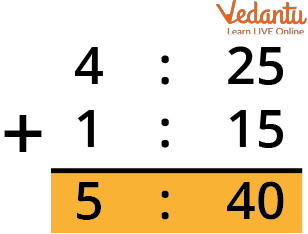
Addition of Time
This is how you have to add measures of time:
The addends are placed so that the hours are in the same column, the minutes are in another, and the seconds, if any, are in another.
Add seconds to seconds, minutes to minutes, and hours to hours.
If, once the seconds are added, they are more than 60, they are changed to minutes.
If, once the minutes are added, they are more than 60, they are converted to hours.
In general, if the sum that is made per unit of time allows forming a new immediately larger unit, then the necessary measurement is transferred to the next column, and the remaining units are left in the current column.
According to the above information, the result is 5:40 pm, when Sofia finished cooking the dessert.
Activity 1: Order the following images according to the time in which the activities shown could be carried out.

Images at Different Hours of Time
As you can see, they have the same time, but at different parts of the day. Some occur "before noon" or am, and others "after noon" or pm.
On the left side, we should accommodate the activities that can be done at nine in the morning, and on the right, those that can be done at nine at night.
On the left side would be the image where the girl is having breakfast, the boy who is in class, and finally, where the boy plays with his pet.
On the right side, all the images show nocturnal activities such as stargazing, sleeping, and organizing school supplies for the next morning are to be placed.
The correct classification would be the following:

Different Images at Two Times of Day
Practice Questions
Q1: The time is 18:35 on the 24-hour clock. What is 18:35 on the am and pm time clock?
Ans: 6:35 PM.
Q2: What is 1:38 PM on the 24-hour clock?
Ans: 13:38 PM.
Summary
As we have said above, the acronym AM refers to the first twelve hours of the day, starting at midnight:
Twelve o'clock at night would be 12 am. Am and Pm in English are incorporated into commonly used digital clocks. In writing, and when we do not want to misrepresent or confuse the times at which an event occurred, such as in a newspaper report, we may prefer to avoid am and pm and rely on the 24-hour system.
FAQs on What Is PM and AM in Time in the 12 Hour Clock System
1. What is PM and AM in time?
The terms AM and PM are used in the 12-hour clock system to divide the day into two 12-hour periods. AM (Ante Meridiem) means "before midday" and covers time from 12:00 midnight to 11:59 before noon. PM (Post Meridiem) means "after midday" and covers time from 12:00 noon to 11:59 at night. This system helps distinguish between morning and evening times in daily life.
2. What does AM mean in time?
AM means Ante Meridiem, which is a Latin term meaning "before midday." It refers to the time period from 12:00 AM (midnight) to 11:59 AM (just before noon). All morning times, such as 6:30 AM or 9:00 AM, fall within this period in the 12-hour clock format.
3. What does PM mean in time?
PM stands for Post Meridiem, a Latin phrase meaning "after midday." It includes the time period from 12:00 PM (noon) to 11:59 PM (just before midnight). All afternoon and evening times, such as 3:00 PM or 8:45 PM, belong to this part of the 12-hour clock system.
4. Is 12 AM midnight or noon?
12 AM is midnight, which marks the beginning of a new day. In the 12-hour clock system, midnight is written as 12:00 AM, while 12 PM represents noon. A helpful rule is that AM covers times after midnight and before noon.
5. Is 12 PM noon or midnight?
12 PM is noon, the middle of the day. Noon occurs exactly between the morning (AM) and afternoon (PM). After 12:00 PM, the time continues as 1:00 PM, 2:00 PM, and so on until 11:59 PM before midnight.
6. How do you convert AM and PM to 24-hour time?
To convert AM and PM time to 24-hour format, adjust the hour based on whether it is AM or PM. Follow these rules:
- AM times: Keep the hour the same, except 12 AM becomes 00:00.
- PM times: Add 12 to the hour (except 12 PM stays 12).
Example: 3:00 PM → 3 + 12 = 15:00; 7:00 AM → 07:00.
7. How do you convert 24-hour time to AM and PM?
To convert 24-hour time to AM/PM format, subtract 12 from hours greater than 12 and label them PM. Use these steps:
- If the hour is 00, write 12 AM.
- If the hour is from 01 to 11, it is AM.
- If the hour is 12, it is 12 PM.
- If the hour is 13 to 23, subtract 12 and label PM.
Example: 18:00 → 18 − 12 = 6:00 PM.
8. What is the difference between AM and PM?
The difference between AM and PM is that AM represents time before noon, while PM represents time after noon. In the 12-hour clock system:
- AM: 12:00 midnight to 11:59 before noon (morning hours)
- PM: 12:00 noon to 11:59 at night (afternoon and evening hours)
This distinction prevents confusion between morning and evening times.
9. Why do we use AM and PM instead of 24-hour time?
We use AM and PM because the 12-hour clock system is simpler and commonly used in everyday life. It divides the 24-hour day into two equal parts:
- Morning period (AM)
- Afternoon and evening period (PM)
However, the 24-hour clock is often used in military, aviation, and scientific contexts to avoid confusion between similar times like 6:00 AM and 6:00 PM.
10. Can you give an example of AM and PM time?
An example of AM and PM time shows how the same hour can represent two different parts of the day. For example:
- 8:00 AM means 8 o'clock in the morning.
- 8:00 PM means 8 o'clock in the evening.
This is why the AM/PM notation is important in the 12-hour clock format to clearly indicate morning or evening time.
