




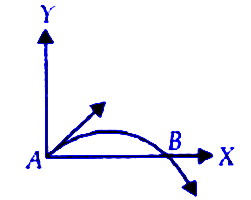
The velocity of a projectile at the initial point A is (2i + 3j) m/s. It's velocity (in m/s) at point B is
(A) -2i - 3j
(B) -2i + 3j
(C) 2i -3j
(D) 2i+3j
Answer
 Verified
244.2k+ views
Hint: This is the case of projectile motion. The velocity has 2 components, one along the x axis and the other along the y-axis. The body does not undergo any resistance in the x-direction. In the y direction, it moves against gravity. As gravity is a conservative force, the magnitude of the y component of velocity will stay the same.
Complete- step-by-step solution
Let’s split the motion into both the x and y components.
Y-component: When the body is going up, it moves opposite to the direction of gravity and experiences acceleration of ‘–g’ and is the vertical component of the velocity reduced to zero, this position is known as max height. When returning or losing altitude, it gains velocity (with acceleration ‘+g’) as it is moving in the direction of gravity. As gravity is a conservative force, hence after traveling equal distance up and falling down the same distance the y-component of the velocity will remain the same in magnitude but will reverse the sign (or reverse the direction). So the component will be -3 m/s
X-component: There is no force/acceleration experienced in this direction, hence the component is unchanged. Hence the component will be 2 m/s
Therefore the correct answer is option C
Note: If the velocity is given in terms of variables and we need to find the length of the path, then we will have to differentiate the velocity. Also, point B in this question is called the range of the projectile motion. It is the farthest distance that the body travels.
Complete- step-by-step solution
Let’s split the motion into both the x and y components.
Y-component: When the body is going up, it moves opposite to the direction of gravity and experiences acceleration of ‘–g’ and is the vertical component of the velocity reduced to zero, this position is known as max height. When returning or losing altitude, it gains velocity (with acceleration ‘+g’) as it is moving in the direction of gravity. As gravity is a conservative force, hence after traveling equal distance up and falling down the same distance the y-component of the velocity will remain the same in magnitude but will reverse the sign (or reverse the direction). So the component will be -3 m/s
X-component: There is no force/acceleration experienced in this direction, hence the component is unchanged. Hence the component will be 2 m/s
Therefore the correct answer is option C
Note: If the velocity is given in terms of variables and we need to find the length of the path, then we will have to differentiate the velocity. Also, point B in this question is called the range of the projectile motion. It is the farthest distance that the body travels.
Recently Updated Pages
JEE Main 2026 Admit Card OUT LIVE Soon| Session 2 Direct Download Link

JEE Main 2026 Session 2 City Intimation Slip Expected Soon: Check How to Download
JEE Main 2026 Session 2 Application Form: Reopened Registration, Dates & Fees
JEE Main 2026 Session 2 Registration (Reopened): Last Date, Fees, Link & Process
WBJEE 2026 Registration Started: Important Dates Eligibility Syllabus Exam Pattern
Dimensions of Charge: Dimensional Formula, Derivation, SI Units & Examples
Trending doubts
JEE Main 2026: Exam Dates, Session 2 Updates, City Slip, Admit Card & Latest News
Ideal and Non-Ideal Solutions Explained for Class 12 Chemistry
Understanding the Angle of Deviation in a Prism
Understanding Differential Equations: A Complete Guide
Hybridisation in Chemistry – Concept, Types & Applications
Understanding the Electric Field of a Uniformly Charged Ring
Other Pages
JEE Advanced Marks vs Ranks 2025: Understanding Category-wise Qualifying Marks and Previous Year Cut-offs
JEE Advanced 2026 - Exam Date (Released), Syllabus, Registration, Eligibility, Preparation, and More
CBSE Notes Class 11 Physics Chapter 1 - Units And Measurements - 2025-26
Important Questions For Class 11 Physics Chapter 1 Units and Measurement - 2025-26
CBSE Notes Class 11 Physics Chapter 4 - Laws of Motion - 2025-26
CBSE Notes Class 11 Physics Chapter 14 - Waves - 2025-26