




The force exerted on 10 kg block by floor of lift as shown in the figure is (take g = 10 m/$s^2$)
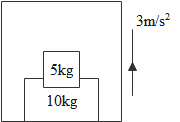
A) 180 N
B) 150 N
C) 195 N
D) 135 N
Answer
 Verified
244.5k+ views
Hint We should know that a block diagram is defined as the diagram of a system where the principal parts or we can say that the functions are represented by the blocks connected by the lines that will give us an idea about the relationships of the blocks. Using this principal, we can solve the question.
Complete step by step answer
We know that it is given that g = 10 $m/{s^2}$.
The block diagram of 5 kg block is given as:
a = 3m/$s^2$
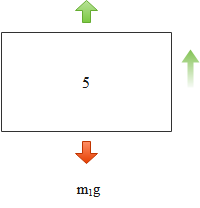
Let us consider that ${m_1}$ is the mass and the a be acceleration.
${N_1}$ is the normal reaction on ${m_1}$by the mass ${m_2}$
The equations are given as:
${{N}_{1}}-{{m}_{1}}g={{m}_{1}}a........(i)$
${\Rightarrow {N_1} = {m_1}g + {m_1}a}$
${N_1}$ denotes the normal reaction on the ${m_2}$by ${m_1}$.
${N_2}$ denotes the normal reaction on the ${m_2}$by floor.
The equations are given as:
${{N_2} - {N_1} - {m_2}g = {m_2}a.......(ii)}$
$\Rightarrow {N_2} = {N_1} + {m_2}g + {m_2}a$
From equation (ii) and equation (i):
${N_2} = {m_1}g + {m_1}a + {m_2}g + {m_2}a$
$\Rightarrow {N_2} = 5 \times 10 + 5 \times 3 + 10 \times 10 + 10 \times 3$
$\Rightarrow {N_2} = 50 + 15 + 100 + 30$
$\Rightarrow {N_2} = 195N$
Therefore, the force exerted on 10 kg by floor is 195 N.
The correct answer is option C.
Note We should know that a force which is acting perpendicular to the two surfaces which are in contact with each other. If the weight is the only vertical force that is acting on an object lying or that is moving on a horizontal surface, the normal reaction force is equal in magnitude, but is in the opposite direction to the weight.
Complete step by step answer
We know that it is given that g = 10 $m/{s^2}$.
The block diagram of 5 kg block is given as:
a = 3m/$s^2$
Let us consider that ${m_1}$ is the mass and the a be acceleration.
${N_1}$ is the normal reaction on ${m_1}$by the mass ${m_2}$
The equations are given as:
${{N}_{1}}-{{m}_{1}}g={{m}_{1}}a........(i)$
${\Rightarrow {N_1} = {m_1}g + {m_1}a}$
${N_1}$ denotes the normal reaction on the ${m_2}$by ${m_1}$.
${N_2}$ denotes the normal reaction on the ${m_2}$by floor.
The equations are given as:
${{N_2} - {N_1} - {m_2}g = {m_2}a.......(ii)}$
$\Rightarrow {N_2} = {N_1} + {m_2}g + {m_2}a$
From equation (ii) and equation (i):
${N_2} = {m_1}g + {m_1}a + {m_2}g + {m_2}a$
$\Rightarrow {N_2} = 5 \times 10 + 5 \times 3 + 10 \times 10 + 10 \times 3$
$\Rightarrow {N_2} = 50 + 15 + 100 + 30$
$\Rightarrow {N_2} = 195N$
Therefore, the force exerted on 10 kg by floor is 195 N.
The correct answer is option C.
Note We should know that a force which is acting perpendicular to the two surfaces which are in contact with each other. If the weight is the only vertical force that is acting on an object lying or that is moving on a horizontal surface, the normal reaction force is equal in magnitude, but is in the opposite direction to the weight.
Recently Updated Pages
JEE Main 2026 Admit Card OUT LIVE Soon| Session 2 Direct Download Link

JEE Main 2026 Session 2 City Intimation Slip Expected Soon: Check How to Download
JEE Main 2026 Session 2 Application Form: Reopened Registration, Dates & Fees
JEE Main 2026 Session 2 Registration (Reopened): Last Date, Fees, Link & Process
WBJEE 2026 Registration Started: Important Dates Eligibility Syllabus Exam Pattern
Dimensions of Charge: Dimensional Formula, Derivation, SI Units & Examples
Trending doubts
JEE Main 2026: Exam Dates, Session 2 Updates, City Slip, Admit Card & Latest News
Ideal and Non-Ideal Solutions Explained for Class 12 Chemistry
Understanding the Angle of Deviation in a Prism
Understanding Differential Equations: A Complete Guide
Hybridisation in Chemistry – Concept, Types & Applications
Understanding the Electric Field of a Uniformly Charged Ring
Other Pages
JEE Advanced Marks vs Ranks 2025: Understanding Category-wise Qualifying Marks and Previous Year Cut-offs
JEE Advanced 2026 - Exam Date (Released), Syllabus, Registration, Eligibility, Preparation, and More
CBSE Notes Class 11 Physics Chapter 1 - Units And Measurements - 2025-26
Important Questions For Class 11 Physics Chapter 1 Units and Measurement - 2025-26
CBSE Notes Class 11 Physics Chapter 4 - Laws of Motion - 2025-26
CBSE Notes Class 11 Physics Chapter 14 - Waves - 2025-26