




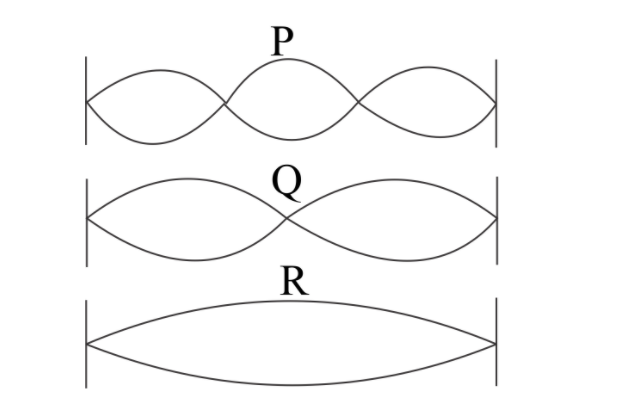
The diagram below Shows three different modes of vibrations $P$, $Q$ and $R$ of the same string. The sound of which string will have maximum shrillness.
Answer
 Verified
257.7k+ views
Hint We know that the shrillness of a wave or vibration is directly proportional to frequency of wave. Loudness of vibration depends on its amplitude. Then the vibration with maximum frequency has maximum shrillness.
Complete step by step solution
We know that the shrillness of a wave or vibration is directly proportional to frequency of wave. Then the vibration with maximum frequency has maximum shrillness.
In the above diagram, vibration $P$ covers three loops, vibration $Q$ covers two loops when vibration $R$ covers only one loop.
Means vibration in string $P$ has more frequency than other two string $Q$ and $R$. Then frequency of vibration $P$ is maximum among all three vibrations.
We know maximum frequency means maximum shrillness. Then vibration $P$ has maximum shrillness.
Hence the answer is $P$.
Note: We know that sound is also the vibration of a particle. And loudness of sound depends on amplitude of sound wave and shrillness of sound depends on frequency of sound. To increase loudness of sound we just need to increase the amplitude of sound. And we never change the frequency of sound because all information is just a varying frequency of sound wave. If we do so the message in sound changes.
Complete step by step solution
We know that the shrillness of a wave or vibration is directly proportional to frequency of wave. Then the vibration with maximum frequency has maximum shrillness.
In the above diagram, vibration $P$ covers three loops, vibration $Q$ covers two loops when vibration $R$ covers only one loop.
Means vibration in string $P$ has more frequency than other two string $Q$ and $R$. Then frequency of vibration $P$ is maximum among all three vibrations.
We know maximum frequency means maximum shrillness. Then vibration $P$ has maximum shrillness.
Hence the answer is $P$.
Note: We know that sound is also the vibration of a particle. And loudness of sound depends on amplitude of sound wave and shrillness of sound depends on frequency of sound. To increase loudness of sound we just need to increase the amplitude of sound. And we never change the frequency of sound because all information is just a varying frequency of sound wave. If we do so the message in sound changes.
Recently Updated Pages
Circuit Switching vs Packet Switching: Key Differences Explained

Dimensions of Pressure in Physics: Formula, Derivation & SI Unit
JEE General Topics in Chemistry Important Concepts and Tips
JEE Extractive Metallurgy Important Concepts and Tips for Exam Preparation
JEE Atomic Structure and Chemical Bonding important Concepts and Tips
JEE Amino Acids and Peptides Important Concepts and Tips for Exam Preparation
Trending doubts
JEE Main 2026: Exam Dates, Session 2 Updates, City Slip, Admit Card & Latest News
JEE Main Participating Colleges 2026 - A Complete List of Top Colleges
JEE Main 2026 Application Login: Direct Link, Registration, Form Fill, and Steps
JEE Main Colleges 2026: Complete List of Participating Institutes
JEE Main Marking Scheme 2026- Paper-Wise Marks Distribution and Negative Marking Details
Hybridisation in Chemistry – Concept, Types & Applications
Other Pages
JEE Advanced 2026 - Exam Date (Released), Syllabus, Registration, Eligibility, Preparation, and More
JEE Advanced Marks vs Ranks 2025: Understanding Category-wise Qualifying Marks and Previous Year Cut-offs
CBSE Notes Class 11 Physics Chapter 1 - Units And Measurements - 2025-26
NCERT Solutions For Class 11 Physics Chapter 1 Units And Measurements - 2025-26
Important Questions For Class 11 Physics Chapter 1 Units and Measurement - 2025-26
JEE Advanced Weightage 2025 Chapter-Wise for Physics, Maths and Chemistry