




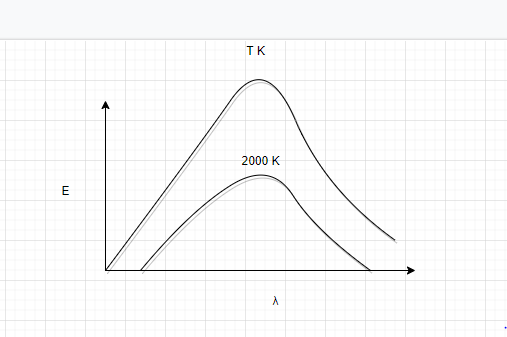
The adjoining diagram shows the spectral energy density distribution ${E_\lambda }$ of black body at two different temperatures. If the area under the curves are in the ratio $16:1$, the value of temperature $T$ is
A. $32000\,K$
B. $16000\,K$
C. $8000\,K$
D. $4000\,K$
Answer
 Verified
258k+ views
Hint: For a blackbody the relation between emissive power and temperature is given by Stefan’s law which states that emissive power is directly proportional to the fourth power of temperature.
$E \propto {T^4}$
Where, $E$ is the emissive power and $T$ is the temperature.
The area under the graph between energy density ${E_\lambda }$ and wavelength $\lambda $ gives the emissive power.
Complete step by step answer:
For a blackbody the relation between emissive power and temperature is given by Stefan’s law which states that emissive power is directly proportional to the fourth power of temperature.
$E \propto {T^4}$
Where, $E$ is the emissive power and $T$ is the temperature
The area under the graph between energy density ${E_\lambda }$ and wavelength $\lambda $ gives the emissive power.
Let the area under the curve at $T\,K$ be ${A_1}$.Then
${A_1} \propto {T^4}$ …… (1)
That is,${A_1} = \sigma {T^4}$
Let area under the curve at $2000\,K$ be ${A_2}$ ;then,
${A_2} \propto {\left( {2000} \right)^4}$ …….. (2)
That is,
${A_2} = \sigma {\left( {2000} \right)^4}$
Divide equation (1) by (2)
$\dfrac{{{A_1}}}{{{A_2}}} = \dfrac{{{T^4}}}{{{{\left( {2000} \right)}^4}}}$ ……. (3)
Ratio of area is given as $16:1$
Substituting this in equation (3), we get
$
\dfrac{{16}}{1} = \dfrac{{{T^4}}}{{{{2000}^4}}} \\
\left( {\dfrac{T}{{2000}}} \right) = {\left( {16} \right)^{\dfrac{1}{4}}} \\
T = 2000 \times 2 \\
= 4000K \\
$
So, the correct answer is option D.
Note: A black body is a body that absorbs all the radiation falling on it and it has emissivity equal to 1. It is important in this problem that we consider the power of the temperature and just don’t solve it assuming a linear relationship.
$E \propto {T^4}$
Where, $E$ is the emissive power and $T$ is the temperature.
The area under the graph between energy density ${E_\lambda }$ and wavelength $\lambda $ gives the emissive power.
Complete step by step answer:
For a blackbody the relation between emissive power and temperature is given by Stefan’s law which states that emissive power is directly proportional to the fourth power of temperature.
$E \propto {T^4}$
Where, $E$ is the emissive power and $T$ is the temperature
The area under the graph between energy density ${E_\lambda }$ and wavelength $\lambda $ gives the emissive power.
Let the area under the curve at $T\,K$ be ${A_1}$.Then
${A_1} \propto {T^4}$ …… (1)
That is,${A_1} = \sigma {T^4}$
Let area under the curve at $2000\,K$ be ${A_2}$ ;then,
${A_2} \propto {\left( {2000} \right)^4}$ …….. (2)
That is,
${A_2} = \sigma {\left( {2000} \right)^4}$
Divide equation (1) by (2)
$\dfrac{{{A_1}}}{{{A_2}}} = \dfrac{{{T^4}}}{{{{\left( {2000} \right)}^4}}}$ ……. (3)
Ratio of area is given as $16:1$
Substituting this in equation (3), we get
$
\dfrac{{16}}{1} = \dfrac{{{T^4}}}{{{{2000}^4}}} \\
\left( {\dfrac{T}{{2000}}} \right) = {\left( {16} \right)^{\dfrac{1}{4}}} \\
T = 2000 \times 2 \\
= 4000K \\
$
So, the correct answer is option D.
Note: A black body is a body that absorbs all the radiation falling on it and it has emissivity equal to 1. It is important in this problem that we consider the power of the temperature and just don’t solve it assuming a linear relationship.
Recently Updated Pages
Circuit Switching vs Packet Switching: Key Differences Explained

Dimensions of Pressure in Physics: Formula, Derivation & SI Unit
JEE General Topics in Chemistry Important Concepts and Tips
JEE Extractive Metallurgy Important Concepts and Tips for Exam Preparation
JEE Atomic Structure and Chemical Bonding important Concepts and Tips
JEE Amino Acids and Peptides Important Concepts and Tips for Exam Preparation
Trending doubts
JEE Main 2026: Exam Dates, Session 2 Updates, City Slip, Admit Card & Latest News
JEE Main Participating Colleges 2026 - A Complete List of Top Colleges
JEE Main Colleges 2026: Complete List of Participating Institutes
JEE Main Marking Scheme 2026- Paper-Wise Marks Distribution and Negative Marking Details
Hybridisation in Chemistry – Concept, Types & Applications
Understanding the Electric Field of a Uniformly Charged Ring
Other Pages
JEE Advanced 2026 - Exam Date (Released), Syllabus, Registration, Eligibility, Preparation, and More
JEE Advanced Marks vs Ranks 2025: Understanding Category-wise Qualifying Marks and Previous Year Cut-offs
CBSE Notes Class 11 Physics Chapter 1 - Units And Measurements - 2025-26
NCERT Solutions For Class 11 Physics Chapter 1 Units And Measurements - 2025-26
Important Questions For Class 11 Physics Chapter 1 Units and Measurement - 2025-26
JEE Advanced Weightage 2025 Chapter-Wise for Physics, Maths and Chemistry