




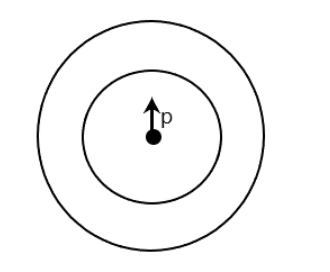
Shown in the figure is a shell made of a conductor. It has inner radius \[a\] and outer radius \[b\], and carries charge \[Q\]. At its centre is a dipole \[\vec P\] as shown, in this case:
(A) Electric field outside the shell is the same as that of a point charge at the centre of the shell
(B) Surface charge density on the inner surface of shell is zero everywhere
(C) Surface charge density on the inner surface \[Q/2\] is uniform and equal to \[E = \dfrac{{Q/2}}{{4\pi {a^2}}}\]
(D) Surface charge density on the outer surface depends on \[\left| {\vec P} \right|\]
Answer
 Verified
274.8k+ views
Hint: Due to the presence of the dipole, charge density inside the shell will at some point exist. Since it is a dipole, the charge induced on the outer shell will be equal to zero.
Formula used: In this solution we will be using the following formulae;
\[E = K\dfrac{Q}{{{r^2}}}\] where \[E\] is the electric field of a charge distribution of total charge \[Q\] with distance greater than radius, and \[r\] is the distance of interest from the centre. \[K\] is a constant.
Complete Step-by-Step Solution:
We have a shell made of a conductor. It has an inner radius of a particular length, and an outer radius of a particular length. There’s a dipole \[\vec P\] at the centre but the shell in general has a charge Q. We are to identify which of the statements will hold true.
Let’s investigate what happens to the shell due to the presence of the dipole, basically the electrostatic state of the shell.
Now, as it is known, a dipole is an equal and negative charge separated by a distance. Let’s assume first that the shell is uncharged. The positive side of the dipole will induce a negative charge on the inner shell closest to it, and the negative side of the dipole will induce a positive charge on the other side.
However, because the dipole has a total charge of zero, the charge induced on the outer surface is hence zero. Observe that for the uncharged sphere the total charge is hence zero so the electric field outside is zero. However the shell is actually charged with a charge \[Q\]. The electric field due to a charge distribution of a charge at the surface is given as
\[E = K\dfrac{Q}{{{r^2}}}\], hence this is like a charge at the centre of the shell.
Thus, the correct option is A.
Note: For clarity, the charge induced on the outside is zero because, while the charge induced on the inner is held by the dipole tending to leave its opposite charge behind. However, the shell is conducting, hence the positive negative will recombine allowing the induction to cancel.
Formula used: In this solution we will be using the following formulae;
\[E = K\dfrac{Q}{{{r^2}}}\] where \[E\] is the electric field of a charge distribution of total charge \[Q\] with distance greater than radius, and \[r\] is the distance of interest from the centre. \[K\] is a constant.
Complete Step-by-Step Solution:
We have a shell made of a conductor. It has an inner radius of a particular length, and an outer radius of a particular length. There’s a dipole \[\vec P\] at the centre but the shell in general has a charge Q. We are to identify which of the statements will hold true.
Let’s investigate what happens to the shell due to the presence of the dipole, basically the electrostatic state of the shell.
Now, as it is known, a dipole is an equal and negative charge separated by a distance. Let’s assume first that the shell is uncharged. The positive side of the dipole will induce a negative charge on the inner shell closest to it, and the negative side of the dipole will induce a positive charge on the other side.
However, because the dipole has a total charge of zero, the charge induced on the outer surface is hence zero. Observe that for the uncharged sphere the total charge is hence zero so the electric field outside is zero. However the shell is actually charged with a charge \[Q\]. The electric field due to a charge distribution of a charge at the surface is given as
\[E = K\dfrac{Q}{{{r^2}}}\], hence this is like a charge at the centre of the shell.
Thus, the correct option is A.
Note: For clarity, the charge induced on the outside is zero because, while the charge induced on the inner is held by the dipole tending to leave its opposite charge behind. However, the shell is conducting, hence the positive negative will recombine allowing the induction to cancel.
Recently Updated Pages
Wheatstone Bridge – Principle, Formula, Diagram & Applications

Mass vs Weight: Key Differences Explained for Students
Circuit Switching vs Packet Switching: Key Differences Explained
Uniform Acceleration Explained: Formula, Examples & Graphs
Young’s Double Slit Experiment Derivation Explained
Classification of Drugs in Chemistry: Types, Examples & Exam Guide
Trending doubts
JEE Main 2026: Exam Dates, Session 2 Updates, City Slip, Admit Card & Latest News
Understanding the Electric Field of a Uniformly Charged Ring
Understanding Atomic Structure for Beginners
Derivation of Equation of Trajectory Explained for Students
Electron Gain Enthalpy and Electron Affinity Explained
How to Convert a Galvanometer into an Ammeter or Voltmeter
Other Pages
CBSE Class 12 Physics Question Paper 2026: Download SET-wise PDF with Answer Key & Analysis
JEE Advanced 2026 Notification Out with Exam Date, Registration (Extended), Syllabus and More
JEE Advanced Percentile vs Marks 2026: JEE Main Cutoff, AIR & IIT Admission Guide
JEE Advanced Weightage Chapter Wise 2026 for Physics, Chemistry, and Mathematics
Understanding Electromagnetic Waves and Their Importance
Understanding Combined Translation and Rotational Motion