




In the given circuit diagram when the current reaches a steady-state in the circuit, the charge on the capacity of capacitance $C$ will be:
$\left( a \right)$ $CE\dfrac{{{r_1}}}{{\left( {{r_1} + r} \right)}}$
$\left( b \right)$ $CE$
$\left( c \right)$ $CE\dfrac{{{r_1}}}{{\left( {{r_2} + r} \right)}}$
$\left( d \right)$ $CE\dfrac{{{r_2}}}{{\left( {r + {r_2}} \right)}}$
Answer
 Verified
246.6k+ views
Hint So firstly to know the charge we have to first know the potential difference across the two points. And to know the potential difference we have to first know the currents flow in the circuit in the steady-state. And we know a steady-state capacitor behaves as an open circuit. So by using all this we can find the charge on the capacitance.
Formula:
Charge,
$Q = CV$
Here,
$Q$, will be the charge
$C$, will be the capacitance
$V$, will be the potential difference
Complete Step by Step Solution As we know at a steady-state the capacitor behaves as an open circuit. That means it will produce an infinite resistance to the path of the current and it can be replaced by an open circuit.
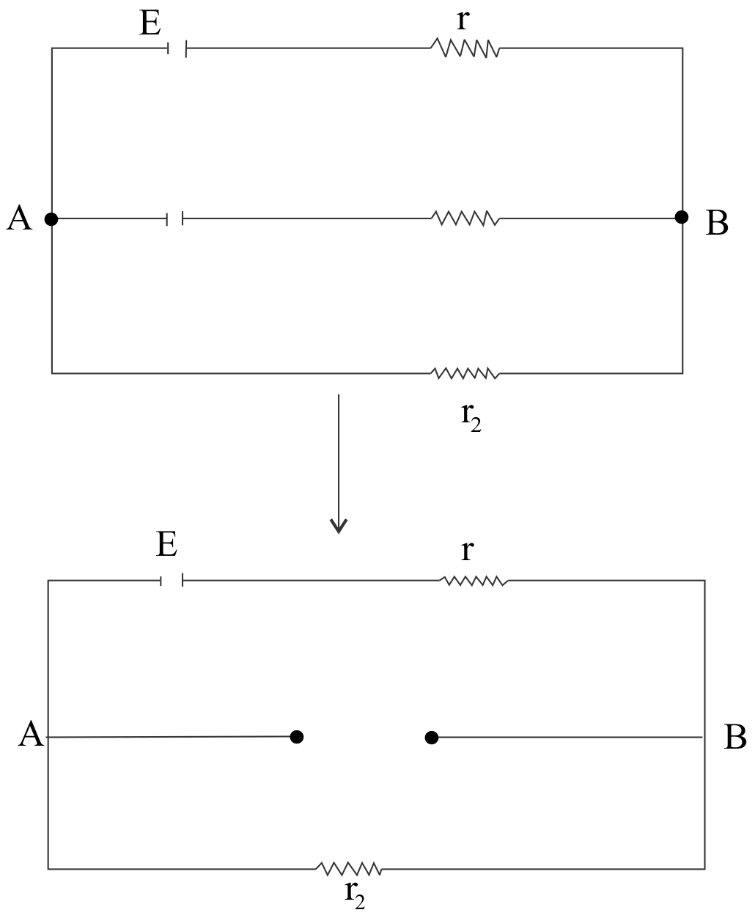
Since it is an open circuit so there will be no use${r_1}$.
By using the current formula,
$i = \dfrac{v}{r}$
Since the total potential difference across the entire circuit is $E$ and the total resistance will be${r_1} + {r_2}$, as they are in series.
Therefore, mathematically it can be written as
$ \Rightarrow i = \dfrac{E}{{{r_1} + {r_2}}}$
So now we have to find the potential difference. By applying Kirchhoff’s law, we will able to get the potential difference across the ${P_2}$
Therefore,
$ \Rightarrow V = i{r_2}$
Now we will put the value of $i$ which we had calculated earlier, we get
$ \Rightarrow V = \dfrac{{E{r_2}}}{{r + {r_2}}}$
Therefore the charge stored on the capacitor will be
As we know,
$Q = CV$
Now substituting the values of $V$, we get
$ \Rightarrow Q = CE\dfrac{{{r_2}}}{{r + {r_2}}}$
Therefore, the option $D$ is the correct choice.
Note The two laws are which helps to determine the current and potential difference in the circuit are:
Current law or junction law - junction is any purpose within the circuit wherever the current will split. Statement: the algebraically total of electrical current at any junction is often adequate zero.
Voltage law loop theorem- in an exceedingly closed-loop system of electrical network the algebraically total of potential variations for all elements and the algebraically total of all voltage is adequate zero.
Formula:
Charge,
$Q = CV$
Here,
$Q$, will be the charge
$C$, will be the capacitance
$V$, will be the potential difference
Complete Step by Step Solution As we know at a steady-state the capacitor behaves as an open circuit. That means it will produce an infinite resistance to the path of the current and it can be replaced by an open circuit.
Since it is an open circuit so there will be no use${r_1}$.
By using the current formula,
$i = \dfrac{v}{r}$
Since the total potential difference across the entire circuit is $E$ and the total resistance will be${r_1} + {r_2}$, as they are in series.
Therefore, mathematically it can be written as
$ \Rightarrow i = \dfrac{E}{{{r_1} + {r_2}}}$
So now we have to find the potential difference. By applying Kirchhoff’s law, we will able to get the potential difference across the ${P_2}$
Therefore,
$ \Rightarrow V = i{r_2}$
Now we will put the value of $i$ which we had calculated earlier, we get
$ \Rightarrow V = \dfrac{{E{r_2}}}{{r + {r_2}}}$
Therefore the charge stored on the capacitor will be
As we know,
$Q = CV$
Now substituting the values of $V$, we get
$ \Rightarrow Q = CE\dfrac{{{r_2}}}{{r + {r_2}}}$
Therefore, the option $D$ is the correct choice.
Note The two laws are which helps to determine the current and potential difference in the circuit are:
Current law or junction law - junction is any purpose within the circuit wherever the current will split. Statement: the algebraically total of electrical current at any junction is often adequate zero.
Voltage law loop theorem- in an exceedingly closed-loop system of electrical network the algebraically total of potential variations for all elements and the algebraically total of all voltage is adequate zero.
Recently Updated Pages
Internet data is broken up as A Length packets B Variable class 12 physics JEE_Main

A plastic hemisphere has a radius of curvature of 8 class 12 physics JEE_Main
Which of the following is not true in the case of motion class 12 physics JEE_Main
In the given circuit the current through the 5mH inductor class 12 physics JEE_Main
The sensitivity of galvanometer depends upon which class 12 physics JEE_Main
If an electron is going in the direction of magnetic class 12 physics JEE_Main
Trending doubts
JEE Main 2026: Exam Dates, Session 2 Updates, City Slip, Admit Card & Latest News
Hybridisation in Chemistry – Concept, Types & Applications
Understanding the Electric Field of a Uniformly Charged Ring
Derivation of Equation of Trajectory Explained for Students
Understanding Collisions: Types and Examples for Students
Ideal and Non-Ideal Solutions Explained for Class 12 Chemistry
Other Pages
CBSE Class 12 Physics Question Paper 2026: Download SET-wise PDF with Answer Key & Analysis
JEE Advanced Marks vs Ranks 2025: Understanding Category-wise Qualifying Marks and Previous Year Cut-offs
JEE Advanced 2026 - Exam Date (Released), Syllabus, Registration, Eligibility, Preparation, and More
JEE Advanced Weightage 2025 Chapter-Wise for Physics, Maths and Chemistry
Understanding Average and RMS Value in Electrical Circuits
Understanding Excess Pressure Inside a Liquid Drop