




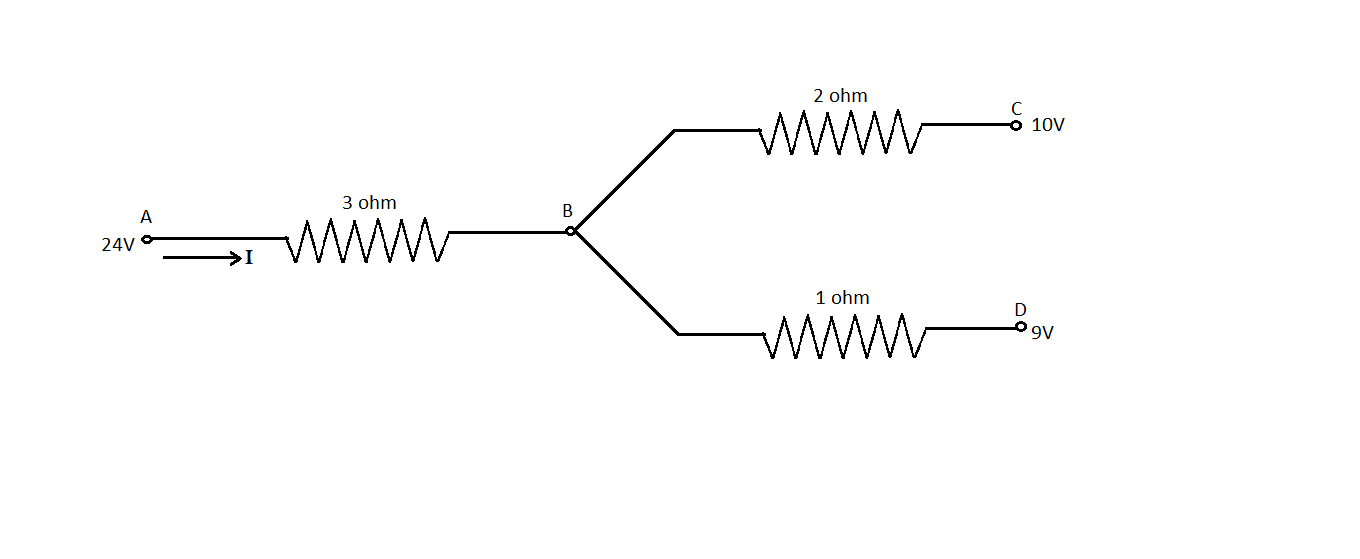
In the circuit shown in the figure, the current $I$ is
 A) 6 A
B) 2 A
C) 4 A
D) 7 A
Answer
 Verified
256.8k+ views
Hint: Use Kirchhoff’s junction rule. Kirchhoff’s junction rule says that the total current into a junction equals the total current out of the junction. A junction is the Intersection of three or more pathways in a circuit. This is also called Kirchhoff’s first law.
Complete step by step solution:
Step 1: In the figure, we can see clearly that the current flowing through the 3-ohm resistor is further divided into two branches. Therefore by Kirchhoff’s law, the current flowing through the 3-ohm resistor will be equal to the sum of the current flowing through 1 ohm and 2-ohm resistors. Therefore we can write
${I_{AB}} = {I_{BC}} + {I_{BD}}$
Step 2: We know that the current flowing through a resistor when a potential difference \[V\] is applied is $I = \dfrac{V}{R}$ . Now if we suppose that the potential at point B is $V$ then we can write
$\therefore \dfrac{{24 - V}}{3} = \dfrac{{V - 10}}{2} + \dfrac{{V - 9}}{1}$
Step 3: Now add the two terms on the right-hand side
$\therefore \dfrac{{24 - V}}{3} = \dfrac{{V - 10 + 2V - 18}}{2}$
$ \Rightarrow \dfrac{{24 - V}}{3} = \dfrac{{3V - 28}}{2}$
Step 4: simplify the above equation and find the value of $V$
$\therefore 48 - 2V = 9V - 84$
$ \Rightarrow 11V = 48 + 84$
$ \Rightarrow 11V = 132$
$ \Rightarrow V = 12volt$
Step 5: Now we know the potential at point B which is 12V therefore we can calculate the current $I$
${I_{AB}} = \dfrac{{\Delta V}}{{{R_{AB}}}}$ , where $\Delta V = 24 - 12$ is the potential difference between points A and B and ${R_{AB}} = 3\Omega $ is the resistor between points A and B.
$\therefore {I_{AB}} = \dfrac{{24 - 12}}{3}$
$ \Rightarrow {I_{AB}} = \dfrac{{12}}{3}$
$ \Rightarrow {I_{AB}} = 4$
Therefore the current flowing through the resistor $3\Omega $ is 4 A.
Hence the option C is correct.
Note: We can confirm whether Kirchhoff’s law is used correctly or not. We do so by adding the amount of current entering the junction and the amount of current leaving the junction. If the summation is zero then our answer is correct. Since we know the potential at point B therefore we can also calculate the current flowing through the remaining two resistors in the circuit. The current flowing through $2\Omega $ the resistor will be ${I_{BC}} = \dfrac{{10 - 12}}{2} = - 1$ and the current flowing through $1\Omega $ the resistor will be ${I_{BD}} = \dfrac{{9 - 12}}{1} = - 3$ . Here we see that ${I_{AB}} + {I_{BC}} + {I_{BD}} = 4 - 1 - 3 = 0$ . Thus the law is confirmed.
Complete step by step solution:
Step 1: In the figure, we can see clearly that the current flowing through the 3-ohm resistor is further divided into two branches. Therefore by Kirchhoff’s law, the current flowing through the 3-ohm resistor will be equal to the sum of the current flowing through 1 ohm and 2-ohm resistors. Therefore we can write
${I_{AB}} = {I_{BC}} + {I_{BD}}$
Step 2: We know that the current flowing through a resistor when a potential difference \[V\] is applied is $I = \dfrac{V}{R}$ . Now if we suppose that the potential at point B is $V$ then we can write
$\therefore \dfrac{{24 - V}}{3} = \dfrac{{V - 10}}{2} + \dfrac{{V - 9}}{1}$
Step 3: Now add the two terms on the right-hand side
$\therefore \dfrac{{24 - V}}{3} = \dfrac{{V - 10 + 2V - 18}}{2}$
$ \Rightarrow \dfrac{{24 - V}}{3} = \dfrac{{3V - 28}}{2}$
Step 4: simplify the above equation and find the value of $V$
$\therefore 48 - 2V = 9V - 84$
$ \Rightarrow 11V = 48 + 84$
$ \Rightarrow 11V = 132$
$ \Rightarrow V = 12volt$
Step 5: Now we know the potential at point B which is 12V therefore we can calculate the current $I$
${I_{AB}} = \dfrac{{\Delta V}}{{{R_{AB}}}}$ , where $\Delta V = 24 - 12$ is the potential difference between points A and B and ${R_{AB}} = 3\Omega $ is the resistor between points A and B.
$\therefore {I_{AB}} = \dfrac{{24 - 12}}{3}$
$ \Rightarrow {I_{AB}} = \dfrac{{12}}{3}$
$ \Rightarrow {I_{AB}} = 4$
Therefore the current flowing through the resistor $3\Omega $ is 4 A.
Hence the option C is correct.
Note: We can confirm whether Kirchhoff’s law is used correctly or not. We do so by adding the amount of current entering the junction and the amount of current leaving the junction. If the summation is zero then our answer is correct. Since we know the potential at point B therefore we can also calculate the current flowing through the remaining two resistors in the circuit. The current flowing through $2\Omega $ the resistor will be ${I_{BC}} = \dfrac{{10 - 12}}{2} = - 1$ and the current flowing through $1\Omega $ the resistor will be ${I_{BD}} = \dfrac{{9 - 12}}{1} = - 3$ . Here we see that ${I_{AB}} + {I_{BC}} + {I_{BD}} = 4 - 1 - 3 = 0$ . Thus the law is confirmed.
Recently Updated Pages
Electricity and Magnetism Explained: Key Concepts & Applications

JEE Energetics Important Concepts and Tips for Exam Preparation
JEE Isolation, Preparation and Properties of Non-metals Important Concepts and Tips for Exam Preparation
JEE Main Mock Test 2025-26: Electromagnetic Induction & Alternating Currents
JEE Main 2023 (February 1st Shift 1) Maths Question Paper with Answer Key
JEE Main 2023 (February 1st Shift 2) Maths Question Paper with Answer Key
Trending doubts
JEE Main 2026: Exam Dates, Session 2 Updates, City Slip, Admit Card & Latest News
JEE Main Participating Colleges 2026 - A Complete List of Top Colleges
JEE Main 2026 Application Login: Direct Link, Registration, Form Fill, and Steps
JEE Main Colleges 2026: Complete List of Participating Institutes
JEE Main Marking Scheme 2026- Paper-Wise Marks Distribution and Negative Marking Details
Hybridisation in Chemistry – Concept, Types & Applications
Other Pages
CBSE Class 12 Physics Question Paper 2026: Download SET-wise PDF with Answer Key & Analysis
JEE Advanced 2026 - Exam Date (Released), Syllabus, Registration, Eligibility, Preparation, and More
JEE Advanced Marks vs Ranks 2025: Understanding Category-wise Qualifying Marks and Previous Year Cut-offs
JEE Advanced Weightage 2025 Chapter-Wise for Physics, Maths and Chemistry
Understanding the Electric Field of a Uniformly Charged Ring
Derivation of Equation of Trajectory Explained for Students