




If half part of a convex lens is covered, the focal length____ charge, but the intensity of the image___.
(A) Does, increase
(B) Does not, increase
(C) Does, decreases
(D) Does not, decreases
Answer
 Verified
266.7k+ views
Hint: In this question, the concept of the brightness of the image of the convex lens will be used, that is brightness of the image decreases when some part of the lens is blocked so we can see that the lesser number of rays passes through the lens.
Complete step by step answer:
In this question, we have given half part of the convex lens and we have to consider the focal length and the intensity of the image.
We know that the focal length is shown as the distance from poles and center of curvature. The intensity of the image is shown the size of the image.
From the experiment we have observations that, smaller lens can also form a complete image of an object placed in front of it. However, brightness of the image decreases when some part of the lens is blocked so we can see that the lesser number of rays passes through the lens.
Now we consider that the half part of a convex lens is covered as shown in the figure (1)
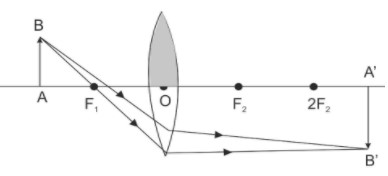
Figure (1)
Therefore, the half part of a convex lens is covered; the focal length does not change, but the intensity of the image decreases.
Hence, the black of the given statement is filled with does not and decreases.
Thus, the correct option is (D).
Note: We have recognized the convex lens focal length does not change, if we change focal length of the lens then that image intensity will increase. So a convex lens always has the same focal length that shows whether the image of the object is converted or not.
Complete step by step answer:
In this question, we have given half part of the convex lens and we have to consider the focal length and the intensity of the image.
We know that the focal length is shown as the distance from poles and center of curvature. The intensity of the image is shown the size of the image.
From the experiment we have observations that, smaller lens can also form a complete image of an object placed in front of it. However, brightness of the image decreases when some part of the lens is blocked so we can see that the lesser number of rays passes through the lens.
Now we consider that the half part of a convex lens is covered as shown in the figure (1)
Figure (1)
Therefore, the half part of a convex lens is covered; the focal length does not change, but the intensity of the image decreases.
Hence, the black of the given statement is filled with does not and decreases.
Thus, the correct option is (D).
Note: We have recognized the convex lens focal length does not change, if we change focal length of the lens then that image intensity will increase. So a convex lens always has the same focal length that shows whether the image of the object is converted or not.
Recently Updated Pages
States of Matter Chapter For JEE Main Chemistry

Circuit Switching vs Packet Switching: Key Differences Explained
Mass vs Weight: Key Differences Explained for Students
[Awaiting the three content sources: Ask AI Response, Competitor 1 Content, and Competitor 2 Content. Please provide those to continue with the analysis and optimization.]
Sign up for JEE Main 2026 Live Classes - Vedantu
JEE Main 2026 Helpline Numbers - Center Contact, Phone Number, Address
Trending doubts
JEE Main 2026: Exam Dates, Session 2 Updates, City Slip, Admit Card & Latest News
JEE Main Participating Colleges 2026 - A Complete List of Top Colleges
Hybridisation in Chemistry – Concept, Types & Applications
Understanding the Electric Field of a Uniformly Charged Ring
Derivation of Equation of Trajectory Explained for Students
Understanding Atomic Structure for Beginners
Other Pages
JEE Advanced 2026 Notification Out with Exam Date, Registration (Extended), Syllabus and More
JEE Advanced Percentile vs Marks 2026: JEE Main Cutoff, AIR & IIT Admission Guide
CBSE Notes Class 11 Physics Chapter 1 - Units And Measurements - 2025-26
JEE Advanced 2026 Marks vs Rank: Estimate IIT Rank from Your Score
NCERT Solutions For Class 11 Physics Chapter 1 Units And Measurements - 2025-26
Important Questions For Class 11 Physics Chapter 1 Units and Measurement - 2025-26