




Given diagram shows a railway compartment 16 m long, 3.2 m high and 2.4 m wide. If it is moving with a velocity v .A particle moving horizontally with a velocity of u, perpendicular to the velocity v, enters through a hole at an upper corner A and strikes the diagonally opposite corner B. which of the following value of v and u is (are) correct? Assume g =10 m/s
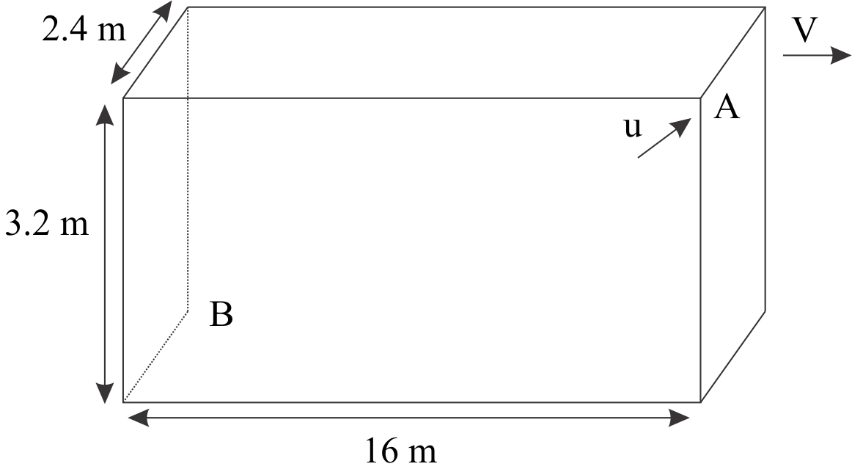
(A) v = 20 m/s
(B) u = 3 m/s
(C) v = 15 m/s
(D) v = 2 m/s
Answer
 Verified
257.1k+ views
Hint There are three equations of motion that can be used to derive components such as displacement(s), velocity (initial and final), time (t) and acceleration (a). The following are the three equation of motion:
First Equation of Motion: $v = u + at$
Second Equation of Motion: $s = ut + \dfrac{1}{2}a{t^2}$
Third Equation of Motion: ${v^2} = {u^2} + 2as$
Complete step by step answer
Consider the vertical motion of the particle after entering the compartment. Let it reach the floor in time t. By using the second equation of motion.
$s = ut + \dfrac{1}{2}a{t^2}$ Here, s =$3.2m$ , a = $g = 10m/s$
Substituting values in the equation. (The u = 0 because the direction is perpendicular)
$3.2 = \dfrac{1}{2}\left( {10} \right){t^2}$
${t^2} = \dfrac{{3.2*2}}{{10}} = 0.64$
$t = 0.8\sec $.
Due to the velocity component u it covers $2.4m$ in this time.
Hence , $\
\\
\\
\ $
$u = \dfrac{{2.4}}{{0.8}} = 3m/s$
Also , the distance moved by the train in this time is the length of the train with speed v
Hence , $v = \dfrac{{16}}{{0.8}} = 20m/s$
Hence, (a) and (b) options are correct.
Note At the highest point of a projectile the acceleration is perpendicular to velocity, and after that the acceleration is downwards velocity may increase or decrease depending on the object also same happens when there is upward motion of the object.
First Equation of Motion: $v = u + at$
Second Equation of Motion: $s = ut + \dfrac{1}{2}a{t^2}$
Third Equation of Motion: ${v^2} = {u^2} + 2as$
Complete step by step answer
Consider the vertical motion of the particle after entering the compartment. Let it reach the floor in time t. By using the second equation of motion.
$s = ut + \dfrac{1}{2}a{t^2}$ Here, s =$3.2m$ , a = $g = 10m/s$
Substituting values in the equation. (The u = 0 because the direction is perpendicular)
$3.2 = \dfrac{1}{2}\left( {10} \right){t^2}$
${t^2} = \dfrac{{3.2*2}}{{10}} = 0.64$
$t = 0.8\sec $.
Due to the velocity component u it covers $2.4m$ in this time.
Hence , $\
\\
\\
\ $
$u = \dfrac{{2.4}}{{0.8}} = 3m/s$
Also , the distance moved by the train in this time is the length of the train with speed v
Hence , $v = \dfrac{{16}}{{0.8}} = 20m/s$
Hence, (a) and (b) options are correct.
Note At the highest point of a projectile the acceleration is perpendicular to velocity, and after that the acceleration is downwards velocity may increase or decrease depending on the object also same happens when there is upward motion of the object.
Recently Updated Pages
Circuit Switching vs Packet Switching: Key Differences Explained

Dimensions of Pressure in Physics: Formula, Derivation & SI Unit
JEE General Topics in Chemistry Important Concepts and Tips
JEE Extractive Metallurgy Important Concepts and Tips for Exam Preparation
JEE Atomic Structure and Chemical Bonding important Concepts and Tips
JEE Amino Acids and Peptides Important Concepts and Tips for Exam Preparation
Trending doubts
JEE Main 2026: Exam Dates, Session 2 Updates, City Slip, Admit Card & Latest News
JEE Main Participating Colleges 2026 - A Complete List of Top Colleges
JEE Main 2026 Application Login: Direct Link, Registration, Form Fill, and Steps
JEE Main Colleges 2026: Complete List of Participating Institutes
JEE Main Marking Scheme 2026- Paper-Wise Marks Distribution and Negative Marking Details
Hybridisation in Chemistry – Concept, Types & Applications
Other Pages
JEE Advanced 2026 - Exam Date (Released), Syllabus, Registration, Eligibility, Preparation, and More
JEE Advanced Marks vs Ranks 2025: Understanding Category-wise Qualifying Marks and Previous Year Cut-offs
CBSE Notes Class 11 Physics Chapter 1 - Units And Measurements - 2025-26
NCERT Solutions For Class 11 Physics Chapter 1 Units And Measurements - 2025-26
Important Questions For Class 11 Physics Chapter 1 Units and Measurement - 2025-26
JEE Advanced Weightage 2025 Chapter-Wise for Physics, Maths and Chemistry