




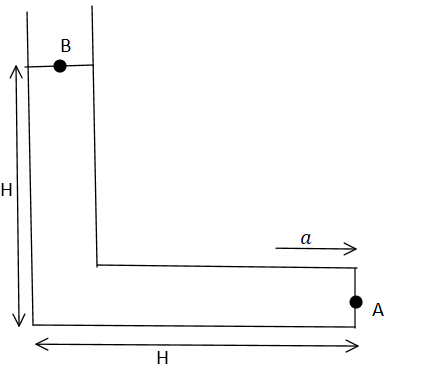
For the $L - $ shaped vessel shown in the figure, determine the value of acceleration $a$ so that the pressure at point $A$ becomes equal to $\dfrac{{{p_0}}}{2}$? (${p_0}$ is atmospheric pressure)
A) $g$
B) $\dfrac{g}{2} + \dfrac{{{p_0}}}{{2\rho H}}$
C) $\dfrac{{{p_0}}}{{2\rho H}} + g$
D) $\dfrac{{3{p_0}}}{{2\rho H}} + g$
Answer
 Verified
242.1k+ views
Hint: The pressure at which the atmosphere is in directly in contact with the surface is known as atmospheric pressure. Bernoulli’s theorem is based upon the conservation of total energy in a system.
Complete step by step answer:
Bernoulli’s theorem states that the total energy (pressure energy, potential energy and kinetic energy) per unit volume or mass of an incompressible and non-viscous fluid in steady flow through a pipe remains constant throughout the flow, provided there is no source or sink of the fluid along the length of the pipe.
$P + \rho gh + \dfrac{1}{2}\rho {v^2} = $ constant
Where, $P = $Pressure energy per unit volume
$\rho gh = $ Potential energy per unit volume
$\dfrac{1}{2}\rho {v^2} = $ Kinetic Energy per unit volume
In the above case the total energy at $A$is equal to total energy at $B$. So,
${P_A} + \rho aH + \rho gH = {P_B}$
Where, ${P_A} = $ Pressure energy per unit volume at $A$
$\rho aH = $ Kinetic Energy per unit volume at $A$
$\rho gH = $ Potential energy per unit volume at $A$
${P_B} = $ Total energy per unit volume at $B$
Now, given in the question that,
$\Rightarrow {P_A} = \dfrac{{{p_0}}}{2}$
$\Rightarrow {P_B} = {p_0}$
So, $\dfrac{{{p_0}}}{2} + \rho aH - \rho gH = {p_0}$
$\Rightarrow \rho H\left( {a - g} \right) = \dfrac{{{p_0}}}{2}$
$\Rightarrow a - g = \dfrac{{{p_0}}}{{2\rho H}}$
Therefore, $a = \dfrac{{{p_0}}}{{2\rho H}} + g$
Hence, option C is the correct answer.
Note: The atmosphere exerts the same pressure all over the earth’s surface. That pressure is known as atmospheric pressure. Its value is $1atm$. Bernoulli’s theorem is another form of proof for the Law of conservation of energy.
Complete step by step answer:
Bernoulli’s theorem states that the total energy (pressure energy, potential energy and kinetic energy) per unit volume or mass of an incompressible and non-viscous fluid in steady flow through a pipe remains constant throughout the flow, provided there is no source or sink of the fluid along the length of the pipe.
$P + \rho gh + \dfrac{1}{2}\rho {v^2} = $ constant
Where, $P = $Pressure energy per unit volume
$\rho gh = $ Potential energy per unit volume
$\dfrac{1}{2}\rho {v^2} = $ Kinetic Energy per unit volume
In the above case the total energy at $A$is equal to total energy at $B$. So,
${P_A} + \rho aH + \rho gH = {P_B}$
Where, ${P_A} = $ Pressure energy per unit volume at $A$
$\rho aH = $ Kinetic Energy per unit volume at $A$
$\rho gH = $ Potential energy per unit volume at $A$
${P_B} = $ Total energy per unit volume at $B$
Now, given in the question that,
$\Rightarrow {P_A} = \dfrac{{{p_0}}}{2}$
$\Rightarrow {P_B} = {p_0}$
So, $\dfrac{{{p_0}}}{2} + \rho aH - \rho gH = {p_0}$
$\Rightarrow \rho H\left( {a - g} \right) = \dfrac{{{p_0}}}{2}$
$\Rightarrow a - g = \dfrac{{{p_0}}}{{2\rho H}}$
Therefore, $a = \dfrac{{{p_0}}}{{2\rho H}} + g$
Hence, option C is the correct answer.
Note: The atmosphere exerts the same pressure all over the earth’s surface. That pressure is known as atmospheric pressure. Its value is $1atm$. Bernoulli’s theorem is another form of proof for the Law of conservation of energy.
Recently Updated Pages
WBJEE 2026 Registration Started: Important Dates Eligibility Syllabus Exam Pattern

Dimensions of Charge: Dimensional Formula, Derivation, SI Units & Examples
How to Calculate Moment of Inertia: Step-by-Step Guide & Formulas
Circuit Switching vs Packet Switching: Key Differences Explained
Dimensions of Pressure in Physics: Formula, Derivation & SI Unit
JEE Extractive Metallurgy Important Concepts and Tips for Exam Preparation
Trending doubts
JEE Main 2026: Session 1 Results Out and Session 2 Registration Open, City Intimation Slip, Exam Dates, Syllabus & Eligibility
Ideal and Non-Ideal Solutions Explained for Class 12 Chemistry
JEE Main Participating Colleges 2026 - A Complete List of Top Colleges
Degree of Dissociation: Meaning, Formula, Calculation & Uses
Understanding the Angle of Deviation in a Prism
Hybridisation in Chemistry – Concept, Types & Applications
Other Pages
JEE Advanced Marks vs Ranks 2025: Understanding Category-wise Qualifying Marks and Previous Year Cut-offs
CBSE Notes Class 11 Physics Chapter 4 - Laws of Motion - 2025-26
CBSE Notes Class 11 Physics Chapter 14 - Waves - 2025-26
CBSE Notes Class 11 Physics Chapter 9 - Mechanical Properties of Fluids - 2025-26
JEE Advanced Weightage 2025 Chapter-Wise for Physics, Maths and Chemistry
CBSE Notes Class 11 Physics Chapter 11 - Thermodynamics - 2025-26