




For the circle ${{x}^{2}}+{{y}^{2}}+6x-8y+9=0$ which of the following statements is true.
A. Circle passing through the point $(-3,4)$.
B. Circle touches x-axis.
C. Circle touches the y-axis.
D. None of these.
Answer
 Verified
310.5k+ views
Hint: Draw the graph of the circle by finding the center and radius of the circle and then check each of the options if it is correct or not.
Formula Used: The general equation of the circle is ${{x}^{2}}+{{y}^{2}}+2gx+2fy+c=0$ where center is $(-g,-f)$ and radius is $r=\sqrt{{{g}^{2}}+{{f}^{2}}-c}$.
Complete step by step solution: We are given an equation of circle ${{x}^{2}}+{{y}^{2}}+6x-8y+9=0$ and we have to select the true statement for this circle from the options given.
We will first compare the given equation of circle with the general equation to determine the value of $g,f$ and $c$.
${{x}^{2}}+{{y}^{2}}+2gx+2fy+c={{x}^{2}}+{{y}^{2}}+6x-8y+9$
$\begin{align}
& 2g=6 \\
& g=3
\end{align}$
$\begin{align}
& 2f=-8 \\
& f=-4
\end{align}$
$c=9$
The center of the circle will be $\left( -g,-f \right)=\left( -3,4 \right)$.
Now finding the radius,
$\begin{align}
& r=\sqrt{{{\left( 3 \right)}^{2}}+{{\left( -4 \right)}^{2}}-9} \\
& =\sqrt{9+16-9} \\
& =\sqrt{16} \\
& =4
\end{align}$
We will now draw the graph of the circle using center and radius.
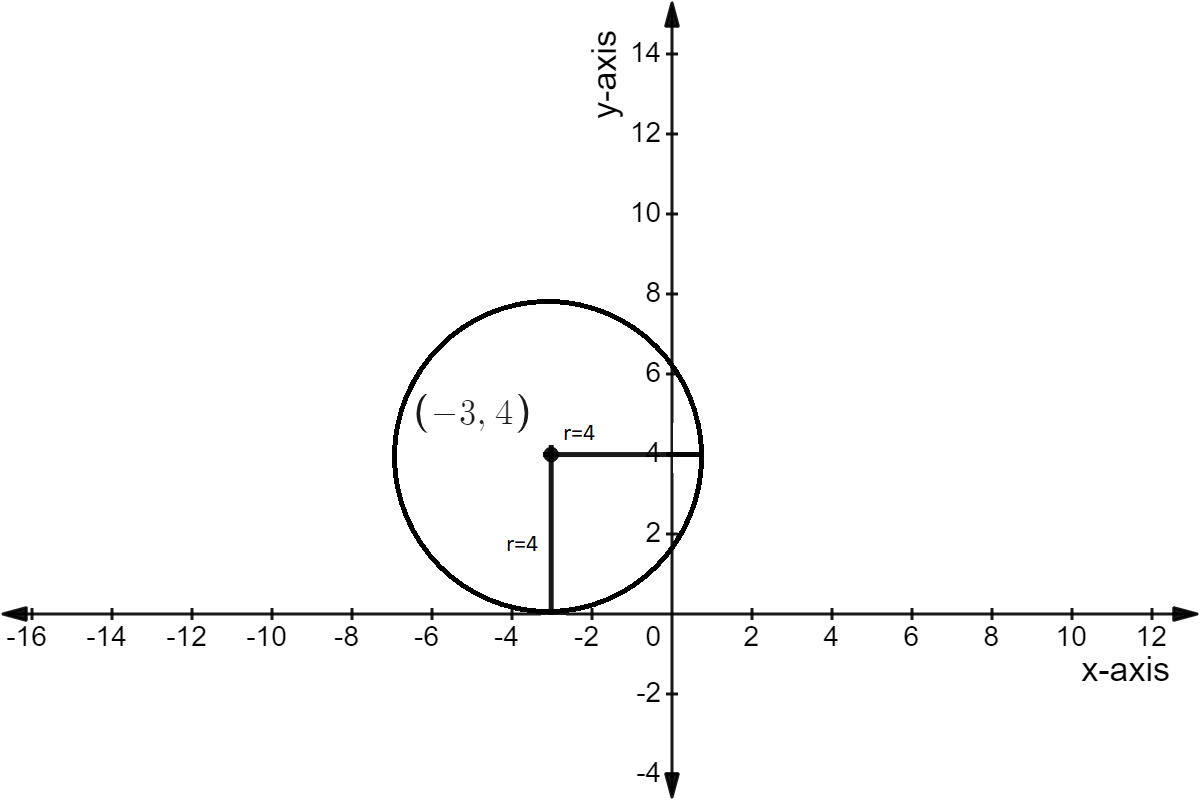
The first statement is that the circle passes through the point $(-3,4)$ but as we have derived and can see on the graph that the center of the circle is $(-3,4)$ hence it cannot pass through it so this statement is false.
We can see on the graph of the circle that it crosses the y-axis but touches the x-axis hence the correct statement will be option (B).
So, Option ‘B’ is correct
Note: The first statement must not be considered true as it seems that it is passing through the point $(-3,4)$ because it is the center but a circle passing through a point means that it is one of the points on the curve forming the circle.
Formula Used: The general equation of the circle is ${{x}^{2}}+{{y}^{2}}+2gx+2fy+c=0$ where center is $(-g,-f)$ and radius is $r=\sqrt{{{g}^{2}}+{{f}^{2}}-c}$.
Complete step by step solution: We are given an equation of circle ${{x}^{2}}+{{y}^{2}}+6x-8y+9=0$ and we have to select the true statement for this circle from the options given.
We will first compare the given equation of circle with the general equation to determine the value of $g,f$ and $c$.
${{x}^{2}}+{{y}^{2}}+2gx+2fy+c={{x}^{2}}+{{y}^{2}}+6x-8y+9$
$\begin{align}
& 2g=6 \\
& g=3
\end{align}$
$\begin{align}
& 2f=-8 \\
& f=-4
\end{align}$
$c=9$
The center of the circle will be $\left( -g,-f \right)=\left( -3,4 \right)$.
Now finding the radius,
$\begin{align}
& r=\sqrt{{{\left( 3 \right)}^{2}}+{{\left( -4 \right)}^{2}}-9} \\
& =\sqrt{9+16-9} \\
& =\sqrt{16} \\
& =4
\end{align}$
We will now draw the graph of the circle using center and radius.
The first statement is that the circle passes through the point $(-3,4)$ but as we have derived and can see on the graph that the center of the circle is $(-3,4)$ hence it cannot pass through it so this statement is false.
We can see on the graph of the circle that it crosses the y-axis but touches the x-axis hence the correct statement will be option (B).
So, Option ‘B’ is correct
Note: The first statement must not be considered true as it seems that it is passing through the point $(-3,4)$ because it is the center but a circle passing through a point means that it is one of the points on the curve forming the circle.
Recently Updated Pages
JEE Main 2023 (February 1st Shift 2) Physics Question Paper with Answer Key

JEE Main 2023 (February 1st Shift 1) Physics Question Paper with Answer Key
JEE Main 2023 (February 1st Shift 1) Maths Question Paper with Answer Key
Apparent Frequency Explained: Formula, Uses & Examples
JEE Main 2023 (February 1st Shift 2) Chemistry Question Paper with Answer Key
Hydrogen and Its Type Important Concepts and Tips for JEE Exam Preparation
Trending doubts
JEE Main 2026: Exam Dates, Session 2 Updates, City Slip, Admit Card & Latest News
Understanding the Electric Field of a Uniformly Charged Ring
Derivation of Equation of Trajectory Explained for Students
Understanding Atomic Structure for Beginners
Electron Gain Enthalpy and Electron Affinity Explained
Hybridisation in Chemistry – Concept, Types & Applications
Other Pages
NCERT Solutions For Class 11 Maths Chapter 9 Straight Lines - 2026-27 Free PDF Download (Sign-in Required)
NCERT Solutions For Class 11 Maths Chapter 6 Permutations And Combinations - 2026-27 Free PDF Download (Login Required)
NCERT Solutions For Class 11 Maths Chapter 8 Sequences And Series - 2026-27 Free PDF Download (Login Required)
NCERT Solutions For Class 11 Maths Chapter 4 Complex Numbers And Quadratic Equations - 2026-27 Free PDF Download (Login Required)
NCERT Solutions For Class 11 Maths Chapter 5 Linear Inequalities - 2026-27 Free PDF Download (Sign-in Required)
NCERT Solutions For Class 11 Maths Chapter 6 Permutations And Combinations Exercise 6.4 - 2026-27 Free PDF Download (Login Required)
NCERT Solutions For Class 11 Maths Chapter 9 Straight Lines - 2026-27 Free PDF Download (Sign-in Required)
NCERT Solutions For Class 11 Maths Chapter 6 Permutations And Combinations - 2026-27 Free PDF Download (Login Required)
NCERT Solutions For Class 11 Maths Chapter 8 Sequences And Series - 2026-27 Free PDF Download (Login Required)