



A man on the top of a vertical observation tower observes a car moving at a
uniform speed coming directly towards it. If it takes 12 minutes for the angle of
depression to change from \[{30^0}\] to ${45^0}$. How soon after this will the car reach the
observation tower?
\[
(A){\text{ 14min 3 sec}} \\
(B){\text{ 15min 49sec}} \\
(C){\text{ 16min 23sec}} \\
(D){\text{ 18min 5sec}} \\
\]
Answer
 Verified
309.9k+ views
Hint: Draw figure and then use trigonometry identity $\tan \theta = \dfrac{{Perpendicular}}{{Base}}$.
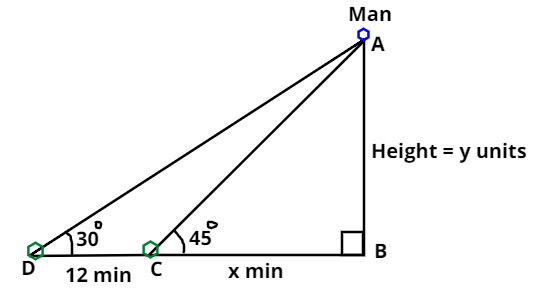
Above figure is drawn with respect to the given conditions in question.
As we can see from the above figure that,
Man is on the top of a vertical tower.
And to change angle of depression from \[{30^0}\] to ${45^0}$ i.e. \[\angle {\text{ADB}}\] to \[\angle {\text{ACB}}\].
It takes 12 minutes,
And it is obvious that when the car will reach the observation tower,
then the angle of depression will be ${90^0}$.
Let the height of the tower be $y$ units.
As we are given that the time taken to travel DC (see in figure) is 12 minutes.
Let the time taken to travel CB will be $x$ minutes.
Here we are known with perpendicular and base of \[\Delta {\text{ABC}}\] and \[\Delta {\text{ABD}}\].
So, we will only use that trigonometric functions, that include perpendicular and base
So, as we know that, $\tan \theta = \dfrac{{Perpendicular}}{{Base}}$.
So, as we can see from the above figure, $\tan {45^0} = \dfrac{{AB}}{{CB}} = \dfrac{y}{x}$.
So, $x = y$ ……………………………………….(1)
And, $\tan 30^\circ = \dfrac{{AB}}{{DB}} = \dfrac{{AB}}{{DC + CB}} = \dfrac{y}{{12 + x}}$.
Now, putting the value of $\tan {30^0}$ and $y$ from equation 1. We get,
$\dfrac{1}{{\sqrt 3 }} = \dfrac{x}{{12 + x}} \Rightarrow \left( {\sqrt 3 - 1} \right)x = 12 \Rightarrow x = \dfrac{{12}}{{\left( {\sqrt 3 - 1} \right)}} \approx 16.38$minutes
Now, as we have defined above that time taken to travel CB is x minutes.
So, time taken to reach the observation tower will be x minutes.
So, according to the options given in the question
the most appropriate answer will be 16min 23 sec.
Hence, the correct Option will be C.
Note: Whenever we come up with these types of problems first, we should draw a figure according to the given conditions in question. And then we will assume time taken to reach the tower as x and then after using trigonometric functions like \[{\text{tan}}\theta \], we can get the value of x using angle of depression and time taken to change angle of depression. This will be the easiest and efficient way to reach the required solution of the problem.
Above figure is drawn with respect to the given conditions in question.
As we can see from the above figure that,
Man is on the top of a vertical tower.
And to change angle of depression from \[{30^0}\] to ${45^0}$ i.e. \[\angle {\text{ADB}}\] to \[\angle {\text{ACB}}\].
It takes 12 minutes,
And it is obvious that when the car will reach the observation tower,
then the angle of depression will be ${90^0}$.
Let the height of the tower be $y$ units.
As we are given that the time taken to travel DC (see in figure) is 12 minutes.
Let the time taken to travel CB will be $x$ minutes.
Here we are known with perpendicular and base of \[\Delta {\text{ABC}}\] and \[\Delta {\text{ABD}}\].
So, we will only use that trigonometric functions, that include perpendicular and base
So, as we know that, $\tan \theta = \dfrac{{Perpendicular}}{{Base}}$.
So, as we can see from the above figure, $\tan {45^0} = \dfrac{{AB}}{{CB}} = \dfrac{y}{x}$.
So, $x = y$ ……………………………………….(1)
And, $\tan 30^\circ = \dfrac{{AB}}{{DB}} = \dfrac{{AB}}{{DC + CB}} = \dfrac{y}{{12 + x}}$.
Now, putting the value of $\tan {30^0}$ and $y$ from equation 1. We get,
$\dfrac{1}{{\sqrt 3 }} = \dfrac{x}{{12 + x}} \Rightarrow \left( {\sqrt 3 - 1} \right)x = 12 \Rightarrow x = \dfrac{{12}}{{\left( {\sqrt 3 - 1} \right)}} \approx 16.38$minutes
Now, as we have defined above that time taken to travel CB is x minutes.
So, time taken to reach the observation tower will be x minutes.
So, according to the options given in the question
the most appropriate answer will be 16min 23 sec.
Hence, the correct Option will be C.
Note: Whenever we come up with these types of problems first, we should draw a figure according to the given conditions in question. And then we will assume time taken to reach the tower as x and then after using trigonometric functions like \[{\text{tan}}\theta \], we can get the value of x using angle of depression and time taken to change angle of depression. This will be the easiest and efficient way to reach the required solution of the problem.
Recently Updated Pages
JEE Main 2023 (February 1st Shift 2) Physics Question Paper with Answer Key

JEE Main 2023 (February 1st Shift 1) Physics Question Paper with Answer Key
JEE Main 2023 (February 1st Shift 1) Maths Question Paper with Answer Key
Apparent Frequency Explained: Formula, Uses & Examples
JEE Main 2023 (February 1st Shift 2) Chemistry Question Paper with Answer Key
Hydrogen and Its Type Important Concepts and Tips for JEE Exam Preparation
Trending doubts
JEE Main 2026: Exam Dates, Session 2 Updates, City Slip, Admit Card & Latest News
Understanding the Electric Field of a Uniformly Charged Ring
Derivation of Equation of Trajectory Explained for Students
Understanding Atomic Structure for Beginners
Electron Gain Enthalpy and Electron Affinity Explained
Hybridisation in Chemistry – Concept, Types & Applications
Other Pages
NCERT Solutions For Class 11 Maths Chapter 9 Straight Lines - 2026-27 Free PDF Download (Sign-in Required)
NCERT Solutions For Class 11 Maths Chapter 6 Permutations And Combinations - 2026-27 Free PDF Download (Login Required)
NCERT Solutions For Class 11 Maths Chapter 8 Sequences And Series - 2026-27 Free PDF Download (Login Required)
NCERT Solutions For Class 11 Maths Chapter 4 Complex Numbers And Quadratic Equations - 2026-27 Free PDF Download (Login Required)
JEE Advanced Percentile vs Marks 2026: JEE Main Cutoff, AIR & IIT Admission Guide
NCERT Solutions For Class 11 Maths Chapter 5 Linear Inequalities - 2026-27 Free PDF Download (Sign-in Required)
NCERT Solutions For Class 11 Maths Chapter 9 Straight Lines - 2026-27 Free PDF Download (Sign-in Required)
NCERT Solutions For Class 11 Maths Chapter 6 Permutations And Combinations - 2026-27 Free PDF Download (Login Required)
NCERT Solutions For Class 11 Maths Chapter 8 Sequences And Series - 2026-27 Free PDF Download (Login Required)