




Consider a body, shown in figure, consisting of two identical balls, each of mass M connected by a light rigid rod of length L. If an impulse J =MV is imparted to the body at one of its ends, what would be its angular velocity?
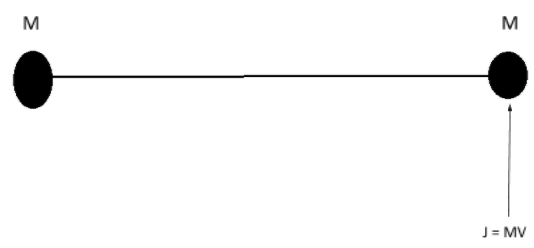
A) V/L
B 2V/L
C) V/3L
D) V/4L
Answer
 Verified
244.2k+ views
Hint: The above problem is based on the centre of mass and change in angular momentum(or conservation of momentum).
Centre of mass is the point where the whole weight of the body is supposed to act.
The angular momentum of a system is conserved if no external torque acts on it.
Using above mentioned two concepts we will solve the problem.
Complete step by step solution:
Let us discuss the centre of mass and conservation of angular momentum in more detail.
Centre of mass of a body is the point where the whole mass of the body can be concentrated and the centre of gravity of a body is the point where the whole weight of the body is supposed to act. When the value of g does not vary for different bodies then centre of mass and centre of gravity coincide with each other.
Centre of mass of the iron rod is at the centre of the rod and the length of the rod for each mass becomes half of the total length of the rod because length is measured from the centre of the rod.
Angular momentum of the body or system is conserved if no external force acts on it. It is denoted by
$L = I\omega $ ( I is the moment of inertia and $\omega $ is the angular velocity)
Now we will do the calculation part.
Linear momentum of the rod is given by;
$\Rightarrow J = MV\dfrac{L}{2}$ (Linear momentum is the product mass, velocity and the radial distance of the mass from the centre of mass of the body)..................1
As per the law of conservation of angular momentum;
$\Rightarrow J = {J_F} - {J_I}$ (Final momentum minus initial momentum).................2
Initial momentum of the system is zero because the system was at rest, thus we will have only final momentum which is given by:
$\Rightarrow {J_F} = I\omega $
Moment of inertia of the rod is given as $2\dfrac{{M{L^2}}}{4}\omega $ (We have taken moment of inertia of both the masses)
On substituting the values final angular momentum in equation 2,
$ \Rightarrow MV\dfrac{L}{2} = 2\dfrac{{M{L^2}}}{4}\omega $
On cancelling the common terms we have
$ \Rightarrow V = 4\dfrac{L}{4}\omega $
$ \Rightarrow \omega = \dfrac{V}{L}$
Thus, option A is correct.
Note: We have many daily life examples in which conservation of angular momentum such as the revolution of earth and other planets around the earth, the speed of the inner layer of the whirlwind in a tornado or cyclone, a diver jumping from a springboard somersault, a ballet dancer can vary her angular speed by spreading her arms.
Centre of mass is the point where the whole weight of the body is supposed to act.
The angular momentum of a system is conserved if no external torque acts on it.
Using above mentioned two concepts we will solve the problem.
Complete step by step solution:
Let us discuss the centre of mass and conservation of angular momentum in more detail.
Centre of mass of a body is the point where the whole mass of the body can be concentrated and the centre of gravity of a body is the point where the whole weight of the body is supposed to act. When the value of g does not vary for different bodies then centre of mass and centre of gravity coincide with each other.
Centre of mass of the iron rod is at the centre of the rod and the length of the rod for each mass becomes half of the total length of the rod because length is measured from the centre of the rod.
Angular momentum of the body or system is conserved if no external force acts on it. It is denoted by
$L = I\omega $ ( I is the moment of inertia and $\omega $ is the angular velocity)
Now we will do the calculation part.
Linear momentum of the rod is given by;
$\Rightarrow J = MV\dfrac{L}{2}$ (Linear momentum is the product mass, velocity and the radial distance of the mass from the centre of mass of the body)..................1
As per the law of conservation of angular momentum;
$\Rightarrow J = {J_F} - {J_I}$ (Final momentum minus initial momentum).................2
Initial momentum of the system is zero because the system was at rest, thus we will have only final momentum which is given by:
$\Rightarrow {J_F} = I\omega $
Moment of inertia of the rod is given as $2\dfrac{{M{L^2}}}{4}\omega $ (We have taken moment of inertia of both the masses)
On substituting the values final angular momentum in equation 2,
$ \Rightarrow MV\dfrac{L}{2} = 2\dfrac{{M{L^2}}}{4}\omega $
On cancelling the common terms we have
$ \Rightarrow V = 4\dfrac{L}{4}\omega $
$ \Rightarrow \omega = \dfrac{V}{L}$
Thus, option A is correct.
Note: We have many daily life examples in which conservation of angular momentum such as the revolution of earth and other planets around the earth, the speed of the inner layer of the whirlwind in a tornado or cyclone, a diver jumping from a springboard somersault, a ballet dancer can vary her angular speed by spreading her arms.
Recently Updated Pages
JEE Main 2026 Session 2 City Intimation Slip Expected Soon: Check How to Download

JEE Main 2026 Session 2 Application Form: Reopened Registration, Dates & Fees
JEE Main 2026 Session 2 Registration (Reopened): Last Date, Fees, Link & Process
WBJEE 2026 Registration Started: Important Dates Eligibility Syllabus Exam Pattern
Dimensions of Charge: Dimensional Formula, Derivation, SI Units & Examples
How to Calculate Moment of Inertia: Step-by-Step Guide & Formulas
Trending doubts
JEE Main 2026: Exam Dates, Session 2 Updates, City Slip, Admit Card & Latest News
Ideal and Non-Ideal Solutions Explained for Class 12 Chemistry
Understanding the Angle of Deviation in a Prism
Understanding Differential Equations: A Complete Guide
Hybridisation in Chemistry – Concept, Types & Applications
Understanding the Electric Field of a Uniformly Charged Ring
Other Pages
JEE Advanced Marks vs Ranks 2025: Understanding Category-wise Qualifying Marks and Previous Year Cut-offs
JEE Advanced 2026 - Exam Date (Released), Syllabus, Registration, Eligibility, Preparation, and More
CBSE Notes Class 11 Physics Chapter 1 - Units And Measurements - 2025-26
Important Questions For Class 11 Physics Chapter 1 Units and Measurement - 2025-26
CBSE Notes Class 11 Physics Chapter 4 - Laws of Motion - 2025-26
CBSE Notes Class 11 Physics Chapter 14 - Waves - 2025-26