




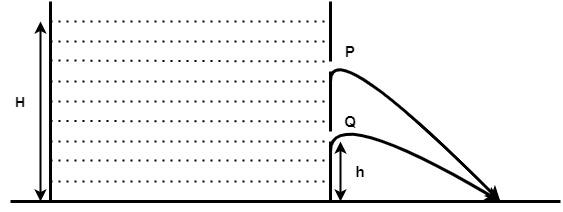
As shown in the figure water squirts horizontally out of two small holes in the side of the cylinder and the two streams strike the ground at the same point. If hole Q is at height ‘h’ above ground and level of water stands to a height H, then the height of p above the ground level is.
A) 2h
B) H/h
C) (H-h)
D) None
Answer
 Verified
244.8k+ views
Hint: Here we have to apply the concept of conservation of energy. The net external energy applied to the system is conserved. So, by this relation the potential energy and the kinetic energy of the system is equal and also the range of squirting water of the two holes are at the same place (Range is equal). Apply the formula of kinematics and conservation of energy (P.E + K.E) and solve.
Complete step by step solution:
Apply conservation of energy
$mg{h_2} = \dfrac{1}{2}m{v_1}^2$ ;
The mass are same so it will cancel out each other,
$g{h_2} = \dfrac{1}{2}{v_1}^2$;
Simplify the above equation
$g{h_2} \times 2 = {v_1}^2$;
${v_1} = {\sqrt {2gh} _2}$;
For hole P
$mg(H - h) = \dfrac{1}{2}m{v_2}^2$;
$g(H - h) = \dfrac{1}{2}{v_2}^2$;
$2g(H - h) = {v_2}^2$;
${v_2} = \sqrt {2g(H - h)} $;
Step 2:
Find out the time taken to reach the surface at the same place for both the holes.
Apply equations of kinematics:
$S = ut + \dfrac{1}{2}a{t^2}$ ;
No initial vertical velocity:
$S = \dfrac{1}{2}g{t^2}$;
For hole P, assume the distance to be${h_2}$.
\[(H - {h_2}) = \dfrac{1}{2}g{t_1}^2\];
$2(H - {h_2}) = g{t_1}^2$;
\[\dfrac{{2(H - {h_2})}}{g} = {t_1}^2\];
\[{t_1} = \sqrt {\dfrac{{2(H - {h_2})}}{g}} \];
For hole Q,
$S = ut + \dfrac{1}{2}a{t^2}$;
Here also the initial velocity is zero:
$S = \dfrac{1}{2}g{t_2}^2$;
$h = \dfrac{1}{2}g{t_2}^2$;
$\dfrac{{2h}}{g} = {t_2}^2$;
${t_2} = \sqrt {\dfrac{{2h}}{g}} $;
Step 3: Here the range of the holes are the same ${R_1} = {R_2}$
$R = vt + \dfrac{1}{2}a{t^2}$.
Here there is no horizontal acceleration so a = 0.
The equation becomes
$R = vt$;
${R_1} = {R_2}$;
${v_1}{t_1} = {v_2}{t_2}$;
Put the values in the above equation:
$\sqrt {2g{h_2}} \times \sqrt {\dfrac{{2(H - {h_2})}}{g}} = \sqrt {2g(H - h)} \times \sqrt {\dfrac{{2h}}{g}} $;
Solve the above equation:
$2g{h_2} \times \dfrac{{2(H - {h_2})}}{g} = 2g(H - h) \times \dfrac{{2h}}{g}$;
Simplify
$2{h_2} \times 2(H - {h_2}) = 2(H - h) \times 2h$;
Simplify it further,
$\Rightarrow {h_2} \times (H - {h_2}) = (H - h) \times h$;
$\Rightarrow (H{h_2} - {h_2}^2) = (Hh - {h^2})$;
$\Rightarrow (H{h_2} - {h_2}^2 - Hh + {h^2}) = 0$;
$\Rightarrow (H{h_2} - Hh) + ( - {h^2} + {h_2}^2) = 0$;
$\Rightarrow H({h_2} - h) + ( - {h^2} + {h_2}^2) = 0$;
Solving the above equation we get,
$\Rightarrow {h_2} = (H - h)$
Option (C) is correct. The height of p above the ground level is $(H - h)$.
Note: Here we have to find out the velocity as well as time taken and then equate the two values together as the distance i.e. the range of the two holes squirting the water is equal. After equating there would be a relation of height H and h.
Complete step by step solution:
Apply conservation of energy
$mg{h_2} = \dfrac{1}{2}m{v_1}^2$ ;
The mass are same so it will cancel out each other,
$g{h_2} = \dfrac{1}{2}{v_1}^2$;
Simplify the above equation
$g{h_2} \times 2 = {v_1}^2$;
${v_1} = {\sqrt {2gh} _2}$;
For hole P
$mg(H - h) = \dfrac{1}{2}m{v_2}^2$;
$g(H - h) = \dfrac{1}{2}{v_2}^2$;
$2g(H - h) = {v_2}^2$;
${v_2} = \sqrt {2g(H - h)} $;
Step 2:
Find out the time taken to reach the surface at the same place for both the holes.
Apply equations of kinematics:
$S = ut + \dfrac{1}{2}a{t^2}$ ;
No initial vertical velocity:
$S = \dfrac{1}{2}g{t^2}$;
For hole P, assume the distance to be${h_2}$.
\[(H - {h_2}) = \dfrac{1}{2}g{t_1}^2\];
$2(H - {h_2}) = g{t_1}^2$;
\[\dfrac{{2(H - {h_2})}}{g} = {t_1}^2\];
\[{t_1} = \sqrt {\dfrac{{2(H - {h_2})}}{g}} \];
For hole Q,
$S = ut + \dfrac{1}{2}a{t^2}$;
Here also the initial velocity is zero:
$S = \dfrac{1}{2}g{t_2}^2$;
$h = \dfrac{1}{2}g{t_2}^2$;
$\dfrac{{2h}}{g} = {t_2}^2$;
${t_2} = \sqrt {\dfrac{{2h}}{g}} $;
Step 3: Here the range of the holes are the same ${R_1} = {R_2}$
$R = vt + \dfrac{1}{2}a{t^2}$.
Here there is no horizontal acceleration so a = 0.
The equation becomes
$R = vt$;
${R_1} = {R_2}$;
${v_1}{t_1} = {v_2}{t_2}$;
Put the values in the above equation:
$\sqrt {2g{h_2}} \times \sqrt {\dfrac{{2(H - {h_2})}}{g}} = \sqrt {2g(H - h)} \times \sqrt {\dfrac{{2h}}{g}} $;
Solve the above equation:
$2g{h_2} \times \dfrac{{2(H - {h_2})}}{g} = 2g(H - h) \times \dfrac{{2h}}{g}$;
Simplify
$2{h_2} \times 2(H - {h_2}) = 2(H - h) \times 2h$;
Simplify it further,
$\Rightarrow {h_2} \times (H - {h_2}) = (H - h) \times h$;
$\Rightarrow (H{h_2} - {h_2}^2) = (Hh - {h^2})$;
$\Rightarrow (H{h_2} - {h_2}^2 - Hh + {h^2}) = 0$;
$\Rightarrow (H{h_2} - Hh) + ( - {h^2} + {h_2}^2) = 0$;
$\Rightarrow H({h_2} - h) + ( - {h^2} + {h_2}^2) = 0$;
Solving the above equation we get,
$\Rightarrow {h_2} = (H - h)$
Option (C) is correct. The height of p above the ground level is $(H - h)$.
Note: Here we have to find out the velocity as well as time taken and then equate the two values together as the distance i.e. the range of the two holes squirting the water is equal. After equating there would be a relation of height H and h.
Recently Updated Pages
NEET UG Exam Countdown 2026 – Days Left, Tracker & Tips

JEE Main 2026 Admit Card OUT LIVE Soon| Session 2 Direct Download Link
JEE Main 2026 Session 2 City Intimation Slip Expected Soon: Check How to Download
JEE Main 2026 Session 2 Application Form: Reopened Registration, Dates & Fees
JEE Main 2026 Session 2 Registration (Reopened): Last Date, Fees, Link & Process
WBJEE 2026 Registration Started: Important Dates Eligibility Syllabus Exam Pattern
Trending doubts
JEE Main 2026: Exam Dates, Session 2 Updates, City Slip, Admit Card & Latest News
Ideal and Non-Ideal Solutions Explained for Class 12 Chemistry
Understanding the Angle of Deviation in a Prism
Understanding Differential Equations: A Complete Guide
Hybridisation in Chemistry – Concept, Types & Applications
Understanding the Electric Field of a Uniformly Charged Ring
Other Pages
JEE Advanced Marks vs Ranks 2025: Understanding Category-wise Qualifying Marks and Previous Year Cut-offs
JEE Advanced 2026 - Exam Date (Released), Syllabus, Registration, Eligibility, Preparation, and More
CBSE Notes Class 11 Physics Chapter 1 - Units And Measurements - 2025-26
Important Questions For Class 11 Physics Chapter 1 Units and Measurement - 2025-26
CBSE Notes Class 11 Physics Chapter 4 - Laws of Motion - 2025-26
CBSE Notes Class 11 Physics Chapter 14 - Waves - 2025-26