




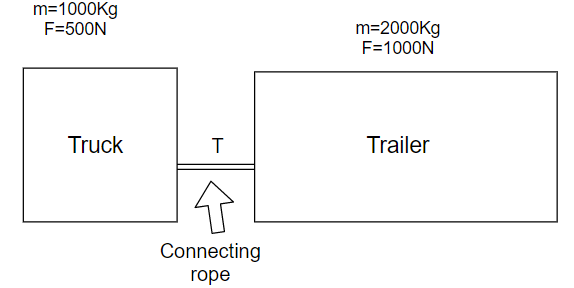
A truck of mass $1000\,Kg$ is pulling a trailer of mass $2000\,Kg$ frictional force on truck is $500\,N$ and on trailer is $1000\,N$. The truck extra force of $6000\,N$. Calculate:-
(A) Acceleration of the truck and the trailer.
(B) The tension in the connecting rope
Answer
 Verified
249.3k+ views
Hint: Use the formula of newton’s second law of motion and substitute the parameters of both truck and trailer to calculate the acceleration of the truck and the trailer. Then in order to calculate the tension in the connecting rope, total force acting on the trailer is considered.
Useful formula:
By the newton’s second law of motion
$F = ma$
Where $F$ is the total force on the truck, $m$ is the mass of the truck and trailer and $a$ is the acceleration of the truck and the trailer.
Complete step by step solution:
Given data from the question are
Mass of the truck, $M = 1000\,Kg$
Mass of the trailer, $m = 2000\,Kg$
Frictional force on the truck, ${F_T} = 500\,N$
Frictional force on the trailer,${F_t} = 1000\,N$
Total force on the truck, $F = 6000\,N$
(A) By considering the formula of newton’s second law,
$F = ma$
mass is taken as the sum of the mass of truck and trailer
$F = \left( {M + m} \right)a$
Substituting the values of masses and force in the above equation.
$6000 - \left( {500 + 1000} \right) = \left( {1000 + 2000} \right)a$
In the above equation, frictional force is subtracted from the total force. This is because some force is lost through friction.
$6000 - 1500 = 3000a$
$4500 = 3000a$
By further simplification,
$a = 1.5\,m{s^{ - 1}}$.
Thus the acceleration of truck and trailer is obtained as $1.5\,m{s^{ - 1}}$.
(B) Let us consider that T be the tension of the connecting rope that connects the truck and the trailer.
Tension in the rope is the sum of the force acting on the trailer and the frictional force acting on it.
$T = {F_t} + force\,on\,trailer$
$T = 1000 + 2000a$
$T = \left( {2000 \times 1.5} \right) + 1000$
By doing arithmetic operation in the above equation,
$T = 4000\,N$
Tension in the connecting rope is obtained as $4000\,N$
Note: For calculating the tension acting on the rope that connects the truck and the trailer, only the total force that acts on the trailer is considered. This is because tension is the horizontal force , and this force in the rope is mainly given by the trailer as it is pulled by it.
Useful formula:
By the newton’s second law of motion
$F = ma$
Where $F$ is the total force on the truck, $m$ is the mass of the truck and trailer and $a$ is the acceleration of the truck and the trailer.
Complete step by step solution:
Given data from the question are
Mass of the truck, $M = 1000\,Kg$
Mass of the trailer, $m = 2000\,Kg$
Frictional force on the truck, ${F_T} = 500\,N$
Frictional force on the trailer,${F_t} = 1000\,N$
Total force on the truck, $F = 6000\,N$
(A) By considering the formula of newton’s second law,
$F = ma$
mass is taken as the sum of the mass of truck and trailer
$F = \left( {M + m} \right)a$
Substituting the values of masses and force in the above equation.
$6000 - \left( {500 + 1000} \right) = \left( {1000 + 2000} \right)a$
In the above equation, frictional force is subtracted from the total force. This is because some force is lost through friction.
$6000 - 1500 = 3000a$
$4500 = 3000a$
By further simplification,
$a = 1.5\,m{s^{ - 1}}$.
Thus the acceleration of truck and trailer is obtained as $1.5\,m{s^{ - 1}}$.
(B) Let us consider that T be the tension of the connecting rope that connects the truck and the trailer.
Tension in the rope is the sum of the force acting on the trailer and the frictional force acting on it.
$T = {F_t} + force\,on\,trailer$
$T = 1000 + 2000a$
$T = \left( {2000 \times 1.5} \right) + 1000$
By doing arithmetic operation in the above equation,
$T = 4000\,N$
Tension in the connecting rope is obtained as $4000\,N$
Note: For calculating the tension acting on the rope that connects the truck and the trailer, only the total force that acts on the trailer is considered. This is because tension is the horizontal force , and this force in the rope is mainly given by the trailer as it is pulled by it.
Recently Updated Pages
JEE Isolation, Preparation and Properties of Non-metals Important Concepts and Tips for Exam Preparation

Isoelectronic Definition in Chemistry: Meaning, Examples & Trends
Ionisation Energy and Ionisation Potential Explained
Iodoform Reactions - Important Concepts and Tips for JEE
Introduction to Dimensions: Understanding the Basics
Instantaneous Velocity Explained: Formula, Examples & Graphs
Trending doubts
JEE Main 2026: Exam Dates, Session 2 Updates, City Slip, Admit Card & Latest News
Hybridisation in Chemistry – Concept, Types & Applications
JEE Main 2026 Application Login: Direct Link, Registration, Form Fill, and Steps
Understanding the Electric Field of a Uniformly Charged Ring
Derivation of Equation of Trajectory Explained for Students
JEE Main Marking Scheme 2026- Paper-Wise Marks Distribution and Negative Marking Details
Other Pages
JEE Advanced Marks vs Ranks 2025: Understanding Category-wise Qualifying Marks and Previous Year Cut-offs
JEE Advanced 2026 - Exam Date (Released), Syllabus, Registration, Eligibility, Preparation, and More
CBSE Notes Class 11 Physics Chapter 1 - Units And Measurements - 2025-26
Important Questions For Class 11 Physics Chapter 1 Units and Measurement - 2025-26
NCERT Solutions For Class 11 Physics Chapter 1 Units And Measurements - 2025-26
CBSE Notes Class 11 Physics Chapter 4 - Laws of Motion - 2025-26