




A transformer steps up an AC supply from 220V to 2200V. if these secondary coil of the transformer has 2000 turns, the number of turns in its primary coil will be:
A) $200$
B) $100$
C) $50$
D) $20$
Answer
 Verified
242.7k+ views
Hint: The power in primary coil is equal to the power in secondary coil and the concept of power in coil is used to give the relationship between the number of turns and voltage of the coil. The number of turns in a coil is directly proportional to the voltage of the coil.
Complete step by step solution:
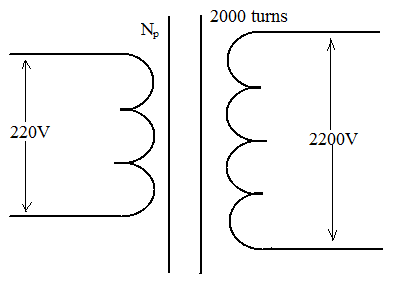
The transformer is of two types: step up transformer and step down transformer.
The step up transformer is used to increase the voltage from primary to secondary voltage. And also, the number of turns in primary winding is less than the number of turns in secondary winding.
The step down transformer is used to decrease the voltage from primary to secondary voltage. And also, the number of turns in primary winding is more than the number of turns in secondary winding.
We can calculate the number of turns in the primary coil with the help of the ratio of voltages.
$\Rightarrow \dfrac{{{N_s}}}{{{N_p}}} = \dfrac{{{V_s}}}{{{V_p}}}$
Here, the number of turns in primary coil is ${N_p}$, the number of turns in secondary coil is ${N_s}$, the voltage of primary coil is ${V_p}$ and the voltage of secondary coil is ${V_s}$.
We will now substitute the known values in the relation between the voltages and the number of turns.
$\Rightarrow \dfrac{{2000}}{{{N_p}}} = \dfrac{{2200}}{{220}}\\
\Rightarrow \dfrac{{2000}}{{{N_p}}} = 10\\
\Rightarrow {N_p} = \dfrac{{2000}}{{10}}\\
\Rightarrow 200$
Thus, the number of turns in the primary coil is calculated to be $200$.
Thus from the given options, only option A is correct.
Note: The output voltage of a transformer changes with the change in load even if the output voltage of the transformer remains constant. The transformer equation is also used to solve the given question.
Complete step by step solution:
The transformer is of two types: step up transformer and step down transformer.
The step up transformer is used to increase the voltage from primary to secondary voltage. And also, the number of turns in primary winding is less than the number of turns in secondary winding.
The step down transformer is used to decrease the voltage from primary to secondary voltage. And also, the number of turns in primary winding is more than the number of turns in secondary winding.
We can calculate the number of turns in the primary coil with the help of the ratio of voltages.
$\Rightarrow \dfrac{{{N_s}}}{{{N_p}}} = \dfrac{{{V_s}}}{{{V_p}}}$
Here, the number of turns in primary coil is ${N_p}$, the number of turns in secondary coil is ${N_s}$, the voltage of primary coil is ${V_p}$ and the voltage of secondary coil is ${V_s}$.
We will now substitute the known values in the relation between the voltages and the number of turns.
$\Rightarrow \dfrac{{2000}}{{{N_p}}} = \dfrac{{2200}}{{220}}\\
\Rightarrow \dfrac{{2000}}{{{N_p}}} = 10\\
\Rightarrow {N_p} = \dfrac{{2000}}{{10}}\\
\Rightarrow 200$
Thus, the number of turns in the primary coil is calculated to be $200$.
Thus from the given options, only option A is correct.
Note: The output voltage of a transformer changes with the change in load even if the output voltage of the transformer remains constant. The transformer equation is also used to solve the given question.
Recently Updated Pages
WBJEE 2026 Registration Started: Important Dates Eligibility Syllabus Exam Pattern

JEE Main 2025-26 Mock Tests: Free Practice Papers & Solutions
JEE Main 2025-26 Experimental Skills Mock Test – Free Practice
JEE Main 2025-26 Electronic Devices Mock Test: Free Practice Online
JEE Main 2025-26 Atoms and Nuclei Mock Test – Free Practice Online
JEE Main 2025-26: Magnetic Effects of Current & Magnetism Mock Test
Trending doubts
JEE Main 2026: Session 1 Results Out and Session 2 Registration Open, City Intimation Slip, Exam Dates, Syllabus & Eligibility
Ideal and Non-Ideal Solutions Explained for Class 12 Chemistry
JEE Main Participating Colleges 2026 - A Complete List of Top Colleges
Understanding the Angle of Deviation in a Prism
Hybridisation in Chemistry – Concept, Types & Applications
Understanding the Electric Field of a Uniformly Charged Ring
Other Pages
CBSE Class 12 Physics Question Paper 2026: Download SET-wise PDF with Answer Key & Analysis
JEE Advanced Marks vs Ranks 2025: Understanding Category-wise Qualifying Marks and Previous Year Cut-offs
Dual Nature of Radiation and Matter Class 12 Physics Chapter 11 CBSE Notes - 2025-26
CBSE Class 10 Sanskrit Set 4 52 Question Paper 2025 – PDF, Solutions & Analysis
JEE Advanced 2026 - Exam Date (Released), Syllabus, Registration, Eligibility, Preparation, and More
JEE Advanced Weightage 2025 Chapter-Wise for Physics, Maths and Chemistry