




A spherical capacitor has an inner sphere of radius $12cm$ and an outer sphere of radius $13cm$. The outer sphere is earthed and the inner sphere is given a charge of $2.5\mu C$. The space between the concentric spheres is filled with liquid of dielectric constant $32.$
A) Determine the capacitance of the capacitor.
B) What is the potential of the inner sphere?
C) Compare the capacitance of the capacitor with that of an isolated sphere of radius $12cm$. Explain why the latter is much smaller.
Answer
 Verified
248.7k+ views
Hint: The capacitance of a system only depends on the geometry and the medium between the two plates/surfaces. An isolated sphere is nothing but a sphere with one spherical surface(outer one) is taken to infinity.
Formula Used:
Capacitance for spherical capacitor
$C=4\pi {{\varepsilon }_{0}}K\dfrac{rR}{R-r}$
Complete step by step answer:
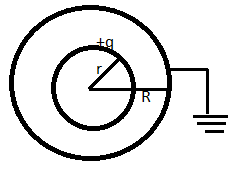
A spherical capacitor consists of a solid or hollow spherical conductor of radius $r$, surrounded by another hollow concentric spherical of radius $R$.
Potential difference between two conductors
$V=\dfrac{q}{4\pi {{\varepsilon }_{0}}K}\dfrac{\left( R-r \right)}{Rr}$ ………….(i)
Capacitance of spherical conductor
$C=\dfrac{q}{V}$
$C=\dfrac{q}{\dfrac{q}{4\pi {{\varepsilon }_{0}}K}\dfrac{\left( R-r \right)}{Rr}}=4\pi {{\varepsilon }_{0}}K\dfrac{Rr}{\left( R-r \right)}$
(a) $C=4\pi {{\varepsilon }_{0}}K\dfrac{\left( R-r \right)}{Rr}$ ………………….(ii)
Where
$R=$ Outer sphere radius
$r=$ Inner sphere radius
$K=$ Dielectric constant
$K=32$
$R=13cm=13\times {{10}^{-2}}m$
$r=12cm=12\times {{10}^{-2}}m$
$C=\dfrac{1}{9\times {{10}^{9}}}\dfrac{32\times 13\times {{10}^{-2}}\times 12\times {{10}^{-2}}}{\left( 13-12 \right)\times {{10}^{-2}}}$
$C=554.66\times {{10}^{-11}}$
$C=5.5\times {{10}^{-9}}F$
(b)
$\begin{align}
& V=\dfrac{q}{C} \\
& \Rightarrow V=\dfrac{2.5\times {{10}^{-6}}}{5.5\times {{10}^{-9}}} \\
& \Rightarrow V=4.5\times {{10}^{2}} \\
& \Rightarrow V=450V \\
\end{align}$
(c)For isolated sphere
$R\to \infty $
$\begin{align}
& C=4\pi {{\varepsilon }_{0}}\dfrac{1}{\left( \dfrac{1}{r}-\dfrac{1}{R} \right)} \\
& C'=4\pi {{\varepsilon }_{0}}r \\
\end{align}$
$\begin{align}
& \Rightarrow C'=\dfrac{1}{9\times {{10}^{9}}}\times 12\times {{10}^{-2}} \\
& \Rightarrow C'=1.33\times {{10}^{-11}}F \\
\end{align}$
The capacity of an isolated sphere is much smaller, because in a capacitor, the outer sphere is earthed, potential difference decreases and capacitance increases.
Note: When we find out the capacitance for hollow spherical capacitors sometimes we use the formula of a single sphere capacitor directly. This is the wrong method first we find out the potential difference between the spheres and then capacitance.
Formula Used:
Capacitance for spherical capacitor
$C=4\pi {{\varepsilon }_{0}}K\dfrac{rR}{R-r}$
Complete step by step answer:
A spherical capacitor consists of a solid or hollow spherical conductor of radius $r$, surrounded by another hollow concentric spherical of radius $R$.
Potential difference between two conductors
$V=\dfrac{q}{4\pi {{\varepsilon }_{0}}K}\dfrac{\left( R-r \right)}{Rr}$ ………….(i)
Capacitance of spherical conductor
$C=\dfrac{q}{V}$
$C=\dfrac{q}{\dfrac{q}{4\pi {{\varepsilon }_{0}}K}\dfrac{\left( R-r \right)}{Rr}}=4\pi {{\varepsilon }_{0}}K\dfrac{Rr}{\left( R-r \right)}$
(a) $C=4\pi {{\varepsilon }_{0}}K\dfrac{\left( R-r \right)}{Rr}$ ………………….(ii)
Where
$R=$ Outer sphere radius
$r=$ Inner sphere radius
$K=$ Dielectric constant
$K=32$
$R=13cm=13\times {{10}^{-2}}m$
$r=12cm=12\times {{10}^{-2}}m$
$C=\dfrac{1}{9\times {{10}^{9}}}\dfrac{32\times 13\times {{10}^{-2}}\times 12\times {{10}^{-2}}}{\left( 13-12 \right)\times {{10}^{-2}}}$
$C=554.66\times {{10}^{-11}}$
$C=5.5\times {{10}^{-9}}F$
(b)
$\begin{align}
& V=\dfrac{q}{C} \\
& \Rightarrow V=\dfrac{2.5\times {{10}^{-6}}}{5.5\times {{10}^{-9}}} \\
& \Rightarrow V=4.5\times {{10}^{2}} \\
& \Rightarrow V=450V \\
\end{align}$
(c)For isolated sphere
$R\to \infty $
$\begin{align}
& C=4\pi {{\varepsilon }_{0}}\dfrac{1}{\left( \dfrac{1}{r}-\dfrac{1}{R} \right)} \\
& C'=4\pi {{\varepsilon }_{0}}r \\
\end{align}$
$\begin{align}
& \Rightarrow C'=\dfrac{1}{9\times {{10}^{9}}}\times 12\times {{10}^{-2}} \\
& \Rightarrow C'=1.33\times {{10}^{-11}}F \\
\end{align}$
The capacity of an isolated sphere is much smaller, because in a capacitor, the outer sphere is earthed, potential difference decreases and capacitance increases.
Note: When we find out the capacitance for hollow spherical capacitors sometimes we use the formula of a single sphere capacitor directly. This is the wrong method first we find out the potential difference between the spheres and then capacitance.
Recently Updated Pages
JEE Isolation, Preparation and Properties of Non-metals Important Concepts and Tips for Exam Preparation

Isoelectronic Definition in Chemistry: Meaning, Examples & Trends
Ionisation Energy and Ionisation Potential Explained
Iodoform Reactions - Important Concepts and Tips for JEE
Introduction to Dimensions: Understanding the Basics
Instantaneous Velocity Explained: Formula, Examples & Graphs
Trending doubts
JEE Main 2026: Exam Dates, Session 2 Updates, City Slip, Admit Card & Latest News
Hybridisation in Chemistry – Concept, Types & Applications
Understanding the Electric Field of a Uniformly Charged Ring
JEE Main 2026 Application Login: Direct Link, Registration, Form Fill, and Steps
Derivation of Equation of Trajectory Explained for Students
Understanding the Angle of Deviation in a Prism
Other Pages
CBSE Class 12 Physics Question Paper 2026: Download SET-wise PDF with Answer Key & Analysis
JEE Advanced Marks vs Ranks 2025: Understanding Category-wise Qualifying Marks and Previous Year Cut-offs
JEE Advanced 2026 - Exam Date (Released), Syllabus, Registration, Eligibility, Preparation, and More
JEE Advanced Weightage 2025 Chapter-Wise for Physics, Maths and Chemistry
Understanding Centrifugal Force in Physics
Understanding Collisions: Types and Examples for Students