




A ring moves in a horizontal circle of radius $r$ with a velocity $\omega $ in free space the tension is:
(A) $2mr{\omega ^2}$
(B) $mr{\omega ^2}$
(C) $\dfrac{{mr{\omega ^2}}}{2}$
(D) $\dfrac{{mr{\omega ^2}}}{{2\pi }}$
Answer
 Verified
244.2k+ views
Hint: We know that in order to move in a circular path we require a centripetal force. Centripetal force is the component of force acting on an object in curvilinear motion which is directed toward the axis of rotation or center of curvature. Now in the above case one of the components of tension is responsible for the centripetal force.
Complete step by step solution:
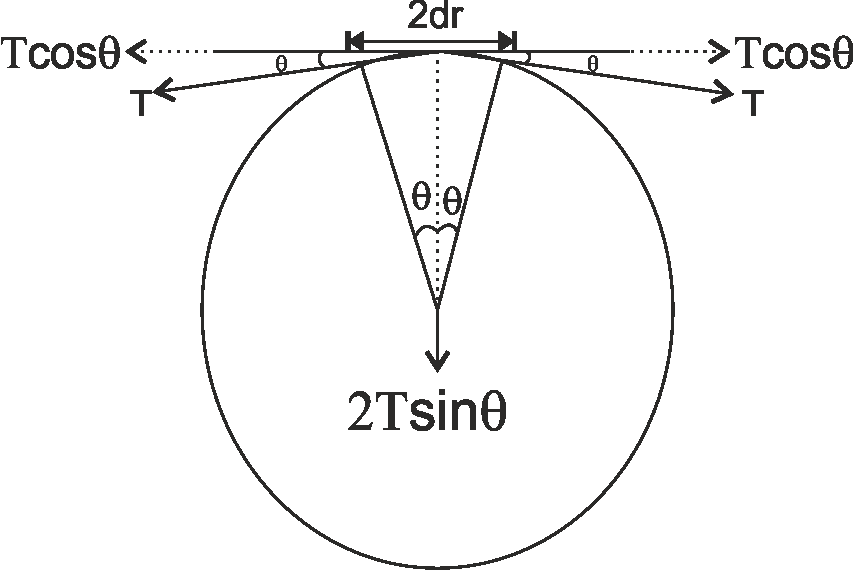
Let us consider a small element of length $2dr$ making angle $2\theta $ at the center and having mass $dm$
Now the centripetal force is given by
$F = mr{\omega ^2}$
Then the centripetal force due to that mass element is,
$F = (dm)r{\omega ^2}......(1)$
Since total mass of ring is $m$ and total length of ring is $2\pi r$ hence we can write
$dm = \dfrac{m}{{2\pi r}}(2dr) = \dfrac{m}{{2\pi }}(2\theta )$
Hence equation (1) becomes
$F = \left( {\dfrac{{2m}}{{2\pi }}\theta } \right)r{\omega ^2}$
Which on further simplification gives
$F = \theta \dfrac{{mr{\omega ^2}}}{\pi }......(2)$
Now on resolving the component of tension we can see that the $T\cos \theta $ components cancels out and we are left with only $T\sin \theta $ components which gives the required centripetal force.
Hence we can write
$F = 2T\sin \theta $
For small $\theta $ we have $\sin \theta \approx \theta $
Hence we have left with,
$F = 2T\theta ......(3)$
Now equating equation (2) and (3) we get
$2T\theta = \dfrac{{\theta mr{\omega ^2}}}{\pi }$
Now on simplification we get,
$T = \dfrac{{mr{\omega ^2}}}{{2\pi }}$
Hence option (D) is correct.
Note: It should be kept in mind that the centripetal force is another word for force toward center. This force must originate from some external source such as gravitation, tension, friction, Coulomb force, etc. Centripetal force is not a new kind of force just as an upward force or downward force is not a new kind of force.
Complete step by step solution:
Let us consider a small element of length $2dr$ making angle $2\theta $ at the center and having mass $dm$
Now the centripetal force is given by
$F = mr{\omega ^2}$
Then the centripetal force due to that mass element is,
$F = (dm)r{\omega ^2}......(1)$
Since total mass of ring is $m$ and total length of ring is $2\pi r$ hence we can write
$dm = \dfrac{m}{{2\pi r}}(2dr) = \dfrac{m}{{2\pi }}(2\theta )$
Hence equation (1) becomes
$F = \left( {\dfrac{{2m}}{{2\pi }}\theta } \right)r{\omega ^2}$
Which on further simplification gives
$F = \theta \dfrac{{mr{\omega ^2}}}{\pi }......(2)$
Now on resolving the component of tension we can see that the $T\cos \theta $ components cancels out and we are left with only $T\sin \theta $ components which gives the required centripetal force.
Hence we can write
$F = 2T\sin \theta $
For small $\theta $ we have $\sin \theta \approx \theta $
Hence we have left with,
$F = 2T\theta ......(3)$
Now equating equation (2) and (3) we get
$2T\theta = \dfrac{{\theta mr{\omega ^2}}}{\pi }$
Now on simplification we get,
$T = \dfrac{{mr{\omega ^2}}}{{2\pi }}$
Hence option (D) is correct.
Note: It should be kept in mind that the centripetal force is another word for force toward center. This force must originate from some external source such as gravitation, tension, friction, Coulomb force, etc. Centripetal force is not a new kind of force just as an upward force or downward force is not a new kind of force.
Recently Updated Pages
JEE Main 2026 Session 2 City Intimation Slip & Exam Date: Expected Date, Download Link

JEE Main 2026 Session 2 Application Form: Reopened Registration, Dates & Fees
JEE Main 2026 Session 2 Registration (Reopened): Last Date, Fees, Link & Process
WBJEE 2026 Registration Started: Important Dates Eligibility Syllabus Exam Pattern
Dimensions of Charge: Dimensional Formula, Derivation, SI Units & Examples
How to Calculate Moment of Inertia: Step-by-Step Guide & Formulas
Trending doubts
JEE Main 2026: Exam Dates, Session 2 Updates, City Slip, Admit Card & Latest News
Ideal and Non-Ideal Solutions Explained for Class 12 Chemistry
Understanding the Angle of Deviation in a Prism
Understanding Differential Equations: A Complete Guide
Hybridisation in Chemistry – Concept, Types & Applications
Understanding the Electric Field of a Uniformly Charged Ring
Other Pages
JEE Advanced Marks vs Ranks 2025: Understanding Category-wise Qualifying Marks and Previous Year Cut-offs
JEE Advanced 2026 - Exam Date (Released), Syllabus, Registration, Eligibility, Preparation, and More
CBSE Notes Class 11 Physics Chapter 1 - Units And Measurements - 2025-26
Important Questions For Class 11 Physics Chapter 1 Units and Measurement - 2025-26
CBSE Notes Class 11 Physics Chapter 4 - Laws of Motion - 2025-26
CBSE Notes Class 11 Physics Chapter 14 - Waves - 2025-26