




a) Illustrate the following name reactions giving suitable example in each case:
i) Clemmensen reduction
ii) Hell-Volhard-Zelinsky reaction
b) How are the following conversions carried out?
(i) Ethyl cyanide to ethanoic acid
(ii) Butan-1-ol to butanoic acid
(iii)Benzoic acid to m-bromobenzoic acid
Answer
 Verified
292.8k+ views
Hint: As we know clemmensen reduction is based on the reduction of ketones, or aldehydes, and the reaction Hell-Volhard-Zelinsky reaction is related to the alpha position addition in the carboxylic acid. If we talk about the conversions, then these conversions will be done with the help of bromine, or potassium permanganate.
Complete step by step answer:
Now, we will talk about all the reactions step by step.
First, we will discuss part (a).
The first (i) reaction is Clemmensen reduction.
As mentioned this reaction includes the reduction of aldehydes or ketones using hydrochloric acid, and zinc amalgam, and it is reduced to the alkanes. So, let us take an example of acetophenone.
The chemical reaction is
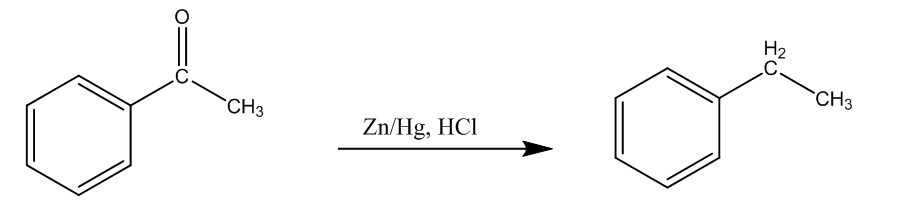
Here, we can see acetophenone is reduced to the Ethyl benzene, or 1-Phenyl Ethane
Now, the second (ii) reaction is Hell- Volhard-Zelinsky, it involves the halogenation of carboxylic acids at the alpha carbon position. This reaction is carried out with the catalytic amount of phosphorus tribromide, and the addition of diatomic bromine.
The chemical reaction is
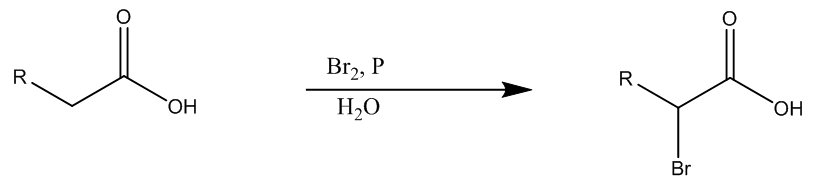
Here we can see the general carboxylic addition forms alpha-bromo carboxylic acid.
Now, we will discuss the part (b).
The first (i) is the conversion of Ethyl cyanide to ethanoic acid.
The conversion will take place thru hydrolysis, then diatomic bromine, and potassium permanganate. The chemical reaction is

Now, the second (ii) is the conversion of butan -1- ol to butanoic acid. It is done by the use of potassium permanganate. The chemical reaction is

The third (iii) is the conversion of benzoic acid to m-bromobenzoic acid. It takes place through the bromination of benzoic acid. The chemical reaction is
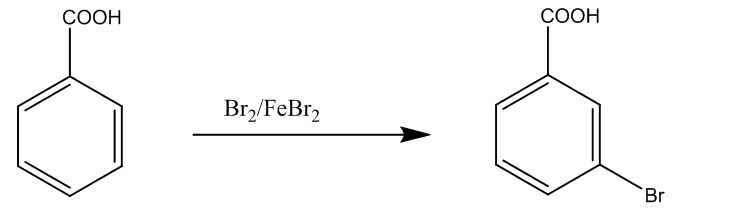
Now, in the end we can conclude that in part (a) (i) the product is alkane, and in (ii) the product is alpha – bromo carboxylic acid. In the part (b) we have shown the conversion reactions.
Note: It is important to know that in the Hell-Volhard- Zelinsky reaction, there is no fluorination, and iodination of carboxylic acids. So, we just consider the bromination of carboxylic acids.
Complete step by step answer:
Now, we will talk about all the reactions step by step.
First, we will discuss part (a).
The first (i) reaction is Clemmensen reduction.
As mentioned this reaction includes the reduction of aldehydes or ketones using hydrochloric acid, and zinc amalgam, and it is reduced to the alkanes. So, let us take an example of acetophenone.
The chemical reaction is
Here, we can see acetophenone is reduced to the Ethyl benzene, or 1-Phenyl Ethane
Now, the second (ii) reaction is Hell- Volhard-Zelinsky, it involves the halogenation of carboxylic acids at the alpha carbon position. This reaction is carried out with the catalytic amount of phosphorus tribromide, and the addition of diatomic bromine.
The chemical reaction is
Here we can see the general carboxylic addition forms alpha-bromo carboxylic acid.
Now, we will discuss the part (b).
The first (i) is the conversion of Ethyl cyanide to ethanoic acid.
The conversion will take place thru hydrolysis, then diatomic bromine, and potassium permanganate. The chemical reaction is
Now, the second (ii) is the conversion of butan -1- ol to butanoic acid. It is done by the use of potassium permanganate. The chemical reaction is
The third (iii) is the conversion of benzoic acid to m-bromobenzoic acid. It takes place through the bromination of benzoic acid. The chemical reaction is
Now, in the end we can conclude that in part (a) (i) the product is alkane, and in (ii) the product is alpha – bromo carboxylic acid. In the part (b) we have shown the conversion reactions.
Note: It is important to know that in the Hell-Volhard- Zelinsky reaction, there is no fluorination, and iodination of carboxylic acids. So, we just consider the bromination of carboxylic acids.
Recently Updated Pages
How will you convert i Propene to propan1ol ii Ethanal class 12 chemistry JEE_Main

Atomic Structure JEE Main Mock Test 2026-27: Free Practice Online
JEE Main 2025-26 Mock Test: Classification of Elements & Periodicity
JEE Main Mock Test 2025-26: Free Practice, Analysis & Tips
JEE Main Mock Test 2026-27: Some Basic Concepts in Chemistry
Class 12 Chemistry Mock Test Series for JEE Main – Free Online Practice
Trending doubts
JEE Main 2026: Exam Dates, Session 2 Updates, City Slip, Admit Card & Latest News
Understanding the Electric Field of a Uniformly Charged Ring
Understanding Atomic Structure for Beginners
Electron Gain Enthalpy and Electron Affinity Explained
Derivation of Equation of Trajectory Explained for Students
Understanding the Different Types of Solutions in Chemistry
Other Pages
NCERT Solutions For Class 12 Chemistry Chapter 2 Electrochemistry - 2026-27 Free PDF Download (Sign-in Required)
NCERT Solutions For Class 12 Chemistry Chapter 1 Solutions - 2026-27 Free PDF Download (Sign-in Required)
NCERT Solutions For Class 12 Chemistry Chapter 3 Chemical Kinetics - 2026-27 Free PDF Download (Login Required)
CBSE Notes Class 12 Chemistry Chapter 1 - Solutions - 2026-27 PDF Download (Login Required)
NCERT Solutions for Class 12 Chemistry Chapter 6 Haloalkanes and Haloarenes - 2026-27 Free PDF Download (Sign-In Required)
NCERT Solutions For Class 12 Chemistry Chapter 7 Alcohol Phenol And Ether - 2026-27 Free PDF Download (Login Required)
NCERT Solutions For Class 12 Chemistry Chapter 2 Electrochemistry - 2026-27 Free PDF Download (Sign-in Required)
NCERT Solutions For Class 12 Chemistry Chapter 1 Solutions - 2026-27 Free PDF Download (Sign-in Required)
NCERT Solutions For Class 12 Chemistry Chapter 3 Chemical Kinetics - 2026-27 Free PDF Download (Login Required)