




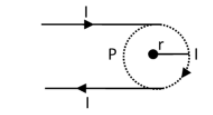
A hairpin-like shape as shown in the figure is made by bending a long current-carrying wire. What is the magnitude of a magnetic field at point P which lies on the centre of the semicircle?
a) \[\dfrac{{{\mu _o}I}}{{4\pi R}}\left( {2 - \pi } \right)\]
b) \[\dfrac{{{\mu _o}I}}{{4\pi R}}\left( {2 + \pi } \right)\]
c) \[\dfrac{{{\mu _o}I}}{{2\pi R}}\left( {2 + \pi } \right)\]
d) \[\dfrac{{{\mu _o}I}}{{2\pi R}}\left( {2 - \pi } \right)\]
Answer
 Verified
264.9k+ views
Hint: Here, we will need to consider three cases to find total magnetic induction at point P which is at distance r from the line and semicircle.
Complete answer:
The magnetic influence on moving electric charges, electric currents, and magnetic materials is described by a magnetic field, which is a vector field. A force perpendicular to the magnetic field and its own velocity acts on a moving charge in a magnetic field.
A second application of the right-hand rule can be used to determine the magnetic field's direction. Your fingers will wrap around the wire in the same way that B does if you hold the wire in your right hand with your thumb pointing along the current.
If you do not recollect the formula, you can derive it using Biot Savarts law, which states that:-
\[dB = \dfrac{{{\mu _O}I\int {\sin \theta dl} }}{{4\pi {r^2}}}\]
By substituting appropriate terms with \[\sin \theta \], and then integrating w.r.t r, one can easily find Magnetic Induction at a point for any mathematically integrable object.
Now,
Magnetic field due to straight wire is, \[\dfrac{{{\mu _o}I}}{{4\pi R}}\]
Magnetic field at centre of semicircle is, \[\dfrac{{{\mu _o}I}}{{4R}}\]
Total Magnetic field at point P(B) = \[\dfrac{{{\mu _o}I}}{{4\pi R}}\]+\[\dfrac{{{\mu _o}I}}{{4\pi R}}\]+\[\dfrac{{{\mu _o}I}}{{4R}}\]
B=\[\dfrac{{{\mu _o}I}}{{4\pi R}}\]+\[\dfrac{{{\mu _o}I}}{{4\pi R}}\]+\[\dfrac{{{\mu _o}I\pi }}{{4\pi R}}\]
B = \[\dfrac{{{\mu _o}I}}{{4\pi R}}(2 + \pi )\]
Hence, The answer is b) \[\dfrac{{{\mu _o}I}}{{4\pi R}}\left( {2 + \pi } \right)\]
Note: To be able to solve this type of sum easily, one should be thorough with all the formulas related to Magnetic field. Some of the important ones are Magnetic field due to infinite wire, Magnetic field due to finite wire, Magnetic field at the centre of circle.
Complete answer:
The magnetic influence on moving electric charges, electric currents, and magnetic materials is described by a magnetic field, which is a vector field. A force perpendicular to the magnetic field and its own velocity acts on a moving charge in a magnetic field.
A second application of the right-hand rule can be used to determine the magnetic field's direction. Your fingers will wrap around the wire in the same way that B does if you hold the wire in your right hand with your thumb pointing along the current.
If you do not recollect the formula, you can derive it using Biot Savarts law, which states that:-
\[dB = \dfrac{{{\mu _O}I\int {\sin \theta dl} }}{{4\pi {r^2}}}\]
By substituting appropriate terms with \[\sin \theta \], and then integrating w.r.t r, one can easily find Magnetic Induction at a point for any mathematically integrable object.
Now,
Magnetic field due to straight wire is, \[\dfrac{{{\mu _o}I}}{{4\pi R}}\]
Magnetic field at centre of semicircle is, \[\dfrac{{{\mu _o}I}}{{4R}}\]
Total Magnetic field at point P(B) = \[\dfrac{{{\mu _o}I}}{{4\pi R}}\]+\[\dfrac{{{\mu _o}I}}{{4\pi R}}\]+\[\dfrac{{{\mu _o}I}}{{4R}}\]
B=\[\dfrac{{{\mu _o}I}}{{4\pi R}}\]+\[\dfrac{{{\mu _o}I}}{{4\pi R}}\]+\[\dfrac{{{\mu _o}I\pi }}{{4\pi R}}\]
B = \[\dfrac{{{\mu _o}I}}{{4\pi R}}(2 + \pi )\]
Hence, The answer is b) \[\dfrac{{{\mu _o}I}}{{4\pi R}}\left( {2 + \pi } \right)\]
Note: To be able to solve this type of sum easily, one should be thorough with all the formulas related to Magnetic field. Some of the important ones are Magnetic field due to infinite wire, Magnetic field due to finite wire, Magnetic field at the centre of circle.
Recently Updated Pages
JEE Main 2025-26 Experimental Skills Mock Test – Free Practice

JEE Main 2025-26 Electronic Devices Mock Test: Free Practice Online
JEE Main 2025-26 Mock Tests: Free Practice Papers & Solutions
JEE Main 2025-26: Magnetic Effects of Current & Magnetism Mock Test
JEE Main 2025-26 Atoms and Nuclei Mock Test – Free Practice Online
JEE Main Mock Test 2025-26: Experimental Skills Chapter Online Practice
Trending doubts
JEE Main 2026: Exam Dates, Session 2 Updates, City Slip, Admit Card & Latest News
JEE Main Participating Colleges 2026 - A Complete List of Top Colleges
Kinematics Mock Test for JEE Main 2025-26: Comprehensive Practice
Kinematics Mock Test for JEE Main 2025-26: Practice & Ace the Exam
Hybridisation in Chemistry – Concept, Types & Applications
Understanding the Electric Field of a Uniformly Charged Ring
Other Pages
CBSE Class 12 Physics Question Paper 2026: Download SET-wise PDF with Answer Key & Analysis
JEE Advanced 2026 Notification Out with Exam Date, Registration (Extended), Syllabus and More
JEE Advanced Percentile vs Marks 2026: JEE Main Cutoff, AIR & IIT Admission Guide
JEE Advanced Weightage Chapter Wise 2026 for Physics, Chemistry, and Mathematics
JEE Advanced Marks vs Rank 2025 - Predict Your IIT Rank Based on Score
Derivation of Equation of Trajectory Explained for Students