




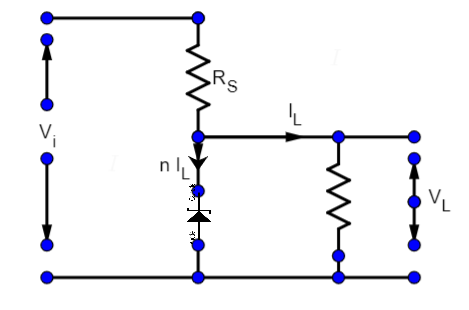
The value of the resistor, $R_S$, needed in the DC voltage regulator circuit shown here, equals:
(A) \[\dfrac{{{V_i} + {V_L}}}{{(n + 1){I_L}}}\]
(B) \[\dfrac{{{V_i} - {V_L}}}{{n{I_L}}}\]
(C) \[\dfrac{{{V_i} + {V_L}}}{{n{I_L}}}\]
(D) \[\dfrac{{{V_i} - {V_L}}}{{(n + 1){I_L}}}\]
Answer
 Verified
249.3k+ views
Hint: We have to use Kirchhoff’s loop Law to calculate the value of the resistor \[{R_S}\] . For this we will use the formula \[{V_i} - {V_L} = I{R_S}\] , where \[{V_i}\] is input voltage and \[{V_L}\] is output voltage.
As we can see in figure the current I break down into two currents i.e. \[n{I_L},{I_L}\] . So, we substitute these two values in the above equation.
After the substitution we will take the equation from both sides and find the value of \[{R_S}\].
Complete step by step solution
The given circuit is a zener diode circuit which is used as a voltage regulator. In this circuit \[{V_i}\] is unregulated input voltage and \[{V_L}\] is regulated output voltage.
Now value of the resistor is calculated i.e. \[{R_S}\] . For this we will use Kirchhoff's loop Law which states that the algebraic sum of all the potential differences along a closed loop in a circuit is zero.
So, the kirchhoff’s equation for the loop will be:
\[{V_i} - {V_L} = I{R_S}\] ,as voltage is equal to current \[ \times \]resistance.
Where current, \[I = n{I_L} + {I_L}\] , as current I is broken into \[n{I_L},{I_L}\] .
So the equation is \[{V_i} - {V_L} = (n{I_L} + {I_L}){R_S}\]
By the above equation we can find \[{R_S}\]
\[{R_S} = \dfrac{{{V_i} - {V_L}}}{{(n{I_L} + {I_L})}}\]
Now if we take \[{I_L}\] common from the denominator in the above equation, then:
\[{R_S} = \dfrac{{{V_i} - {V_L}}}{{(n + 1){I_L}}}\] .
So, option D is the correct option.
Note: The loop laws directly follow the fact that electrostatic force is a conservative force and the word done by it in any closed loop is zero.
While using Kirchhoff’s law also make sure that the positive negative sign is taken correctly, if it goes wrong the answer will be wrong.
Components are connected together in Series if the same current value flows throughout all the components. Components are connected together in Parallel if they have the same voltage across them.
As we can see in figure the current I break down into two currents i.e. \[n{I_L},{I_L}\] . So, we substitute these two values in the above equation.
After the substitution we will take the equation from both sides and find the value of \[{R_S}\].
Complete step by step solution
The given circuit is a zener diode circuit which is used as a voltage regulator. In this circuit \[{V_i}\] is unregulated input voltage and \[{V_L}\] is regulated output voltage.
Now value of the resistor is calculated i.e. \[{R_S}\] . For this we will use Kirchhoff's loop Law which states that the algebraic sum of all the potential differences along a closed loop in a circuit is zero.
So, the kirchhoff’s equation for the loop will be:
\[{V_i} - {V_L} = I{R_S}\] ,as voltage is equal to current \[ \times \]resistance.
Where current, \[I = n{I_L} + {I_L}\] , as current I is broken into \[n{I_L},{I_L}\] .
So the equation is \[{V_i} - {V_L} = (n{I_L} + {I_L}){R_S}\]
By the above equation we can find \[{R_S}\]
\[{R_S} = \dfrac{{{V_i} - {V_L}}}{{(n{I_L} + {I_L})}}\]
Now if we take \[{I_L}\] common from the denominator in the above equation, then:
\[{R_S} = \dfrac{{{V_i} - {V_L}}}{{(n + 1){I_L}}}\] .
So, option D is the correct option.
Note: The loop laws directly follow the fact that electrostatic force is a conservative force and the word done by it in any closed loop is zero.
While using Kirchhoff’s law also make sure that the positive negative sign is taken correctly, if it goes wrong the answer will be wrong.
Components are connected together in Series if the same current value flows throughout all the components. Components are connected together in Parallel if they have the same voltage across them.
Recently Updated Pages
JEE Isolation, Preparation and Properties of Non-metals Important Concepts and Tips for Exam Preparation

Isoelectronic Definition in Chemistry: Meaning, Examples & Trends
Ionisation Energy and Ionisation Potential Explained
Iodoform Reactions - Important Concepts and Tips for JEE
Introduction to Dimensions: Understanding the Basics
Instantaneous Velocity Explained: Formula, Examples & Graphs
Trending doubts
JEE Main 2026: Exam Dates, Session 2 Updates, City Slip, Admit Card & Latest News
Hybridisation in Chemistry – Concept, Types & Applications
JEE Main 2026 Application Login: Direct Link, Registration, Form Fill, and Steps
Understanding the Electric Field of a Uniformly Charged Ring
Derivation of Equation of Trajectory Explained for Students
JEE Main Marking Scheme 2026- Paper-Wise Marks Distribution and Negative Marking Details
Other Pages
CBSE Class 12 Physics Question Paper 2026: Download SET-wise PDF with Answer Key & Analysis
JEE Advanced Marks vs Ranks 2025: Understanding Category-wise Qualifying Marks and Previous Year Cut-offs
JEE Advanced 2026 - Exam Date (Released), Syllabus, Registration, Eligibility, Preparation, and More
JEE Advanced Weightage 2025 Chapter-Wise for Physics, Maths and Chemistry
Understanding the Angle of Deviation in a Prism
Understanding Centrifugal Force in Physics