




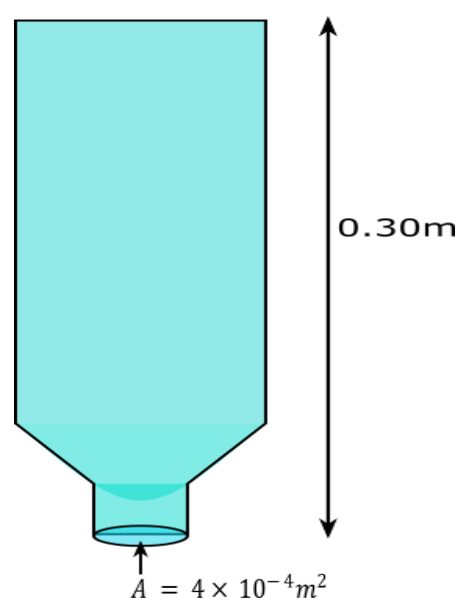
A bottle is filled with water. A cap is put on the bottle and it is turned upside down there is no air inside the bottle. The area of the cap in contact with water is $4.0 \times {10^{ - 4}}{m^2}$. The density of water is $1000kg{m^{ - 3}}$ and the gravitational field strength is $10Nk{g^{ - 1}}$. The water produces a force on the cap. What is the value of this force?
A) $0.075N$
B) $0.12N$
C) $1.2N$
D) $13N$
Answer
 Verified
243.3k+ views
Hint:We can solve this question in simple two steps. First we calculate the pressure on the bottle cap due to liquid and after that we know the definition of pressure. Pressure is the perpendicular force per unit area. By this we can calculate the force on the cap.
Complete step by step solution:
Step 1: We know pressure on a point inside a liquid due to the liquid column is given by ${P_l} = \rho gh$.
Where $\rho \Rightarrow $ density of liquid
And $h \Rightarrow $ height of liquid column or depth of point from free surface
$g \Rightarrow $ Gravitational field strength $10Nk{g^{ - 1}}$ given in question.
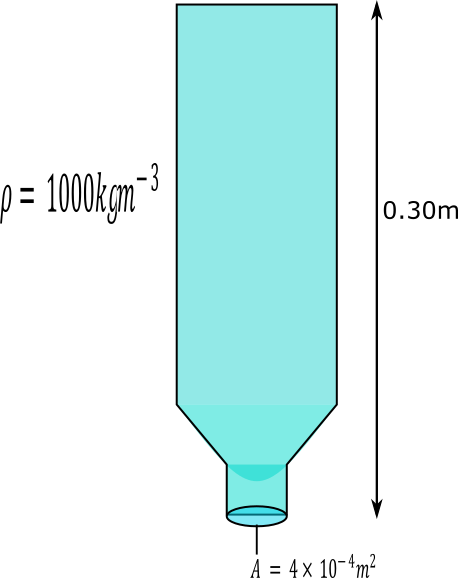
From figure we can see the height cap from free surface is $0.30m$
So pressure on the cap of the bottle.
$ \Rightarrow {P_l} = \rho gh$
Put all values from above equation
$ \Rightarrow {P_l} = 1000 \times 10 \times 0.30$
Solving it
$ \Rightarrow {P_l} = 3 \times {10^3}N/{m^2}$
We get the pressure on cap due to liquid column so the net pressure on cap given by
$P = {P_{atm}} + {P_l}$
Here ${P_{atm}} = 0$ because in question it is given that there is no air inside bottle so atmospheric pressure is zero
So pressure on cap is $P = 3 \times {10^3}N/{m^2}$
Step 2: Now we know from the definition of pressure that the pressure is defined as force per unit area
$P = \dfrac{F}{A}$
So we can write $F = P \times A$
Putting value of pressure and area of cap area of cap given in question \[A = 4 \times {10^{ - 4}}{m^2}\]
$ \Rightarrow F = 3 \times {10^3} \times 4.0 \times {10^{ - 4}}$
$ \Rightarrow F = 12 \times {10^{ - 1}}$
Can written as $F = 1.2N$
$\therefore $ Force on cap is $1.2N$
So option (C) is correct.
Note: We can solve these types of questions in this easy way. If in this question the bottle is open from upside then there must be atmospheric pressure then total pressure is the sum of pressure due to liquid and pressure due to atmosphere.
Complete step by step solution:
Step 1: We know pressure on a point inside a liquid due to the liquid column is given by ${P_l} = \rho gh$.
Where $\rho \Rightarrow $ density of liquid
And $h \Rightarrow $ height of liquid column or depth of point from free surface
$g \Rightarrow $ Gravitational field strength $10Nk{g^{ - 1}}$ given in question.
From figure we can see the height cap from free surface is $0.30m$
So pressure on the cap of the bottle.
$ \Rightarrow {P_l} = \rho gh$
Put all values from above equation
$ \Rightarrow {P_l} = 1000 \times 10 \times 0.30$
Solving it
$ \Rightarrow {P_l} = 3 \times {10^3}N/{m^2}$
We get the pressure on cap due to liquid column so the net pressure on cap given by
$P = {P_{atm}} + {P_l}$
Here ${P_{atm}} = 0$ because in question it is given that there is no air inside bottle so atmospheric pressure is zero
So pressure on cap is $P = 3 \times {10^3}N/{m^2}$
Step 2: Now we know from the definition of pressure that the pressure is defined as force per unit area
$P = \dfrac{F}{A}$
So we can write $F = P \times A$
Putting value of pressure and area of cap area of cap given in question \[A = 4 \times {10^{ - 4}}{m^2}\]
$ \Rightarrow F = 3 \times {10^3} \times 4.0 \times {10^{ - 4}}$
$ \Rightarrow F = 12 \times {10^{ - 1}}$
Can written as $F = 1.2N$
$\therefore $ Force on cap is $1.2N$
So option (C) is correct.
Note: We can solve these types of questions in this easy way. If in this question the bottle is open from upside then there must be atmospheric pressure then total pressure is the sum of pressure due to liquid and pressure due to atmosphere.
Recently Updated Pages
JEE Main 2026 Session 2 City Intimation Slip & Exam Date: Expected Date, Download Link

JEE Main 2026 Session 2 Application Form: Reopened Registration, Dates & Fees
JEE Main 2026 Session 2 Registration (Reopened): Last Date, Fees, Link & Process
WBJEE 2026 Registration Started: Important Dates Eligibility Syllabus Exam Pattern
Dimensions of Charge: Dimensional Formula, Derivation, SI Units & Examples
How to Calculate Moment of Inertia: Step-by-Step Guide & Formulas
Trending doubts
JEE Main 2026: Session 1 Results Out and Session 2 Registration Open, City Intimation Slip, Exam Dates, Syllabus & Eligibility
Ideal and Non-Ideal Solutions Explained for Class 12 Chemistry
Understanding the Angle of Deviation in a Prism
Understanding Differential Equations: A Complete Guide
Hybridisation in Chemistry – Concept, Types & Applications
Understanding the Electric Field of a Uniformly Charged Ring
Other Pages
JEE Advanced Marks vs Ranks 2025: Understanding Category-wise Qualifying Marks and Previous Year Cut-offs
JEE Advanced 2026 - Exam Date (Released), Syllabus, Registration, Eligibility, Preparation, and More
CBSE Notes Class 11 Physics Chapter 1 - Units And Measurements - 2025-26
Important Questions For Class 11 Physics Chapter 1 Units and Measurement - 2025-26
CBSE Notes Class 11 Physics Chapter 4 - Laws of Motion - 2025-26
CBSE Notes Class 11 Physics Chapter 14 - Waves - 2025-26