




A beaker containing water is placed on the platform of a digital weighing machine. It reads $1100\,g$. A metal body of density $8\,g/cc$ and mass $200\,g$ is suspended in water in the beaker (without touching the walls of the beaker). It is attached by a suitable string fixed to some support. Now the reading of the weighing machine will be
A) $1100\,g$
B) $1125\,g$
C) $1275\,g$
D) $1300\,g$
Answer
 Verified
249.6k+ views
Hint: When the block is inserted with the help of a string the water in the beaker will be displaced. Volume of water displaced will be equal to the volume of the body. The weight of the water displaced will exert an upthrust on the body so the body will exert an equal and opposite force to this upthrust which will result in the increase in the value of the reading on the weighing machine.
Complete step by step solution:
It is given that a beaker containing water has a mass $1100\,g$ .
A metal body is suspended in the water using a string which is fixed to a support.
The density of the metal body is given as
${\rho _m} = 8\,g/cc$
Mass of the metal body is given as
$m = 200\,g$
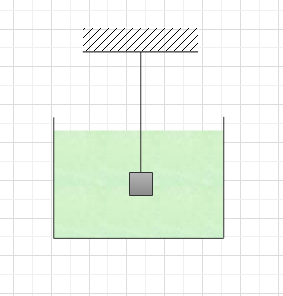
We need to find the new reading of the weighing machine after suspending the metal body in water.
We know that when a body is immersed in water, it will displace an amount of water equal to its volume.
That is, the volume of water displaced ${V_w}$ will be equal to the volume of the metal ${V_m}$.
So, the water will exert a thrust on the body which is equal to the weight of the water displaced.
The body will exert an equal and opposite force downward on the water because according to Newton's third law every action has an equal and opposite reaction.
So, this force acting downwards will add to the weight of the total system and hence the reading of the weighing machine will increase.
Let us find the value of the upthrust.
Upthrust is given by the equation
$U = {V_w}{\rho _w}g$
Where, ${V_w}$ is the volume of the water displaced, ${\rho _w}$ is the density of water and g is the acceleration due to gravity.
$ \Rightarrow U = {V_m}{\rho _w}g$
$\because {V_w} = {V_m}$
We know that the density is mass divided by volume.
$\rho = \dfrac{m}{V}$
Where, m is the mass and V is the volume.
$ \Rightarrow V = \dfrac{m}{\rho }$
Let us substitute the given values of density and volume of the metal block. Then we get
$ \Rightarrow {V_m} = \dfrac{{200}}{8}$
$ \Rightarrow {V_m} = 25\,c{m^3} = 25 \times {10^{ - 6}}{m^3}$
We know the density of water is
${\rho _w} = 1000\,kg/{m^3}$
The acceleration due to gravity can be taken as $g = 10\,m/{s^2}$
Let us substitute all these values in the equation for upthrust.
Then we get
$ \Rightarrow U = 25 \times {10^{ - 6}} \times 1000 \times 10$
$ \Rightarrow U = 0.25\,kg$
same amount of force as the upthrust will be acting downwards.
$W = 0.25\,kg$
We know that weight is the product of mass and acceleration due to gravity
$ \Rightarrow mg = 0.25\,$
$ \Rightarrow m = \dfrac{{0.25\,}}{g}$
$ \Rightarrow m = \dfrac{{0.25\,}}{{10}} = 0.025\,kg$
$ \Rightarrow m = 25\,g$
Hence, the new reading of the weighing machine will be the sum of initial reading and the extra amount added.
Thus, we get new reading as
$1100 + 25 = 1125\,g$
This is the new reading of the weighing machine.
So, the correct answer is option (B).
Note: If the metal block is inserted without the help of a string such that it does not touch the walls, then the total weight will be the sum of weight of the beaker containing water and the weight of the metal body. But when it is supported by a string then the new weight added will be equal in magnitude to the upthrust given as
$U = {V_w}{\rho _w}g$
Where, ${V_w}$ is the volume of the water displaced, ${\rho _w}$ is the density of water and g is the acceleration due to gravity.
Complete step by step solution:
It is given that a beaker containing water has a mass $1100\,g$ .
A metal body is suspended in the water using a string which is fixed to a support.
The density of the metal body is given as
${\rho _m} = 8\,g/cc$
Mass of the metal body is given as
$m = 200\,g$
We need to find the new reading of the weighing machine after suspending the metal body in water.
We know that when a body is immersed in water, it will displace an amount of water equal to its volume.
That is, the volume of water displaced ${V_w}$ will be equal to the volume of the metal ${V_m}$.
So, the water will exert a thrust on the body which is equal to the weight of the water displaced.
The body will exert an equal and opposite force downward on the water because according to Newton's third law every action has an equal and opposite reaction.
So, this force acting downwards will add to the weight of the total system and hence the reading of the weighing machine will increase.
Let us find the value of the upthrust.
Upthrust is given by the equation
$U = {V_w}{\rho _w}g$
Where, ${V_w}$ is the volume of the water displaced, ${\rho _w}$ is the density of water and g is the acceleration due to gravity.
$ \Rightarrow U = {V_m}{\rho _w}g$
$\because {V_w} = {V_m}$
We know that the density is mass divided by volume.
$\rho = \dfrac{m}{V}$
Where, m is the mass and V is the volume.
$ \Rightarrow V = \dfrac{m}{\rho }$
Let us substitute the given values of density and volume of the metal block. Then we get
$ \Rightarrow {V_m} = \dfrac{{200}}{8}$
$ \Rightarrow {V_m} = 25\,c{m^3} = 25 \times {10^{ - 6}}{m^3}$
We know the density of water is
${\rho _w} = 1000\,kg/{m^3}$
The acceleration due to gravity can be taken as $g = 10\,m/{s^2}$
Let us substitute all these values in the equation for upthrust.
Then we get
$ \Rightarrow U = 25 \times {10^{ - 6}} \times 1000 \times 10$
$ \Rightarrow U = 0.25\,kg$
same amount of force as the upthrust will be acting downwards.
$W = 0.25\,kg$
We know that weight is the product of mass and acceleration due to gravity
$ \Rightarrow mg = 0.25\,$
$ \Rightarrow m = \dfrac{{0.25\,}}{g}$
$ \Rightarrow m = \dfrac{{0.25\,}}{{10}} = 0.025\,kg$
$ \Rightarrow m = 25\,g$
Hence, the new reading of the weighing machine will be the sum of initial reading and the extra amount added.
Thus, we get new reading as
$1100 + 25 = 1125\,g$
This is the new reading of the weighing machine.
So, the correct answer is option (B).
Note: If the metal block is inserted without the help of a string such that it does not touch the walls, then the total weight will be the sum of weight of the beaker containing water and the weight of the metal body. But when it is supported by a string then the new weight added will be equal in magnitude to the upthrust given as
$U = {V_w}{\rho _w}g$
Where, ${V_w}$ is the volume of the water displaced, ${\rho _w}$ is the density of water and g is the acceleration due to gravity.
Recently Updated Pages
JEE Isolation, Preparation and Properties of Non-metals Important Concepts and Tips for Exam Preparation

Isoelectronic Definition in Chemistry: Meaning, Examples & Trends
Ionisation Energy and Ionisation Potential Explained
Iodoform Reactions - Important Concepts and Tips for JEE
Introduction to Dimensions: Understanding the Basics
Instantaneous Velocity Explained: Formula, Examples & Graphs
Trending doubts
JEE Main 2026: Exam Dates, Session 2 Updates, City Slip, Admit Card & Latest News
Hybridisation in Chemistry – Concept, Types & Applications
JEE Main 2026 Application Login: Direct Link, Registration, Form Fill, and Steps
Understanding the Electric Field of a Uniformly Charged Ring
Derivation of Equation of Trajectory Explained for Students
JEE Main Marking Scheme 2026- Paper-Wise Marks Distribution and Negative Marking Details
Other Pages
JEE Advanced Marks vs Ranks 2025: Understanding Category-wise Qualifying Marks and Previous Year Cut-offs
JEE Advanced 2026 - Exam Date (Released), Syllabus, Registration, Eligibility, Preparation, and More
CBSE Notes Class 11 Physics Chapter 1 - Units And Measurements - 2025-26
Important Questions For Class 11 Physics Chapter 1 Units and Measurement - 2025-26
NCERT Solutions For Class 11 Physics Chapter 1 Units And Measurements - 2025-26
CBSE Notes Class 11 Physics Chapter 4 - Laws of Motion - 2025-26