






How a Rare Supermoon, Blue Moon, and Total Lunar Eclipse Occur Together
The Super Blue Blood Moon is a rare and fascinating astronomical event that combines three different lunar phenomena - a Supermoon, a Blue Moon, and a Blood Moon. This rare celestial occurrence captures the attention of astronomers, students, and skywatchers worldwide. It is considered significant in General Knowledge and competitive examinations because it represents the intersection of astronomical science and natural phenomena. Understanding the Super Blue Blood Moon helps learners grasp important concepts related to lunar phases, eclipses, and orbital mechanics.
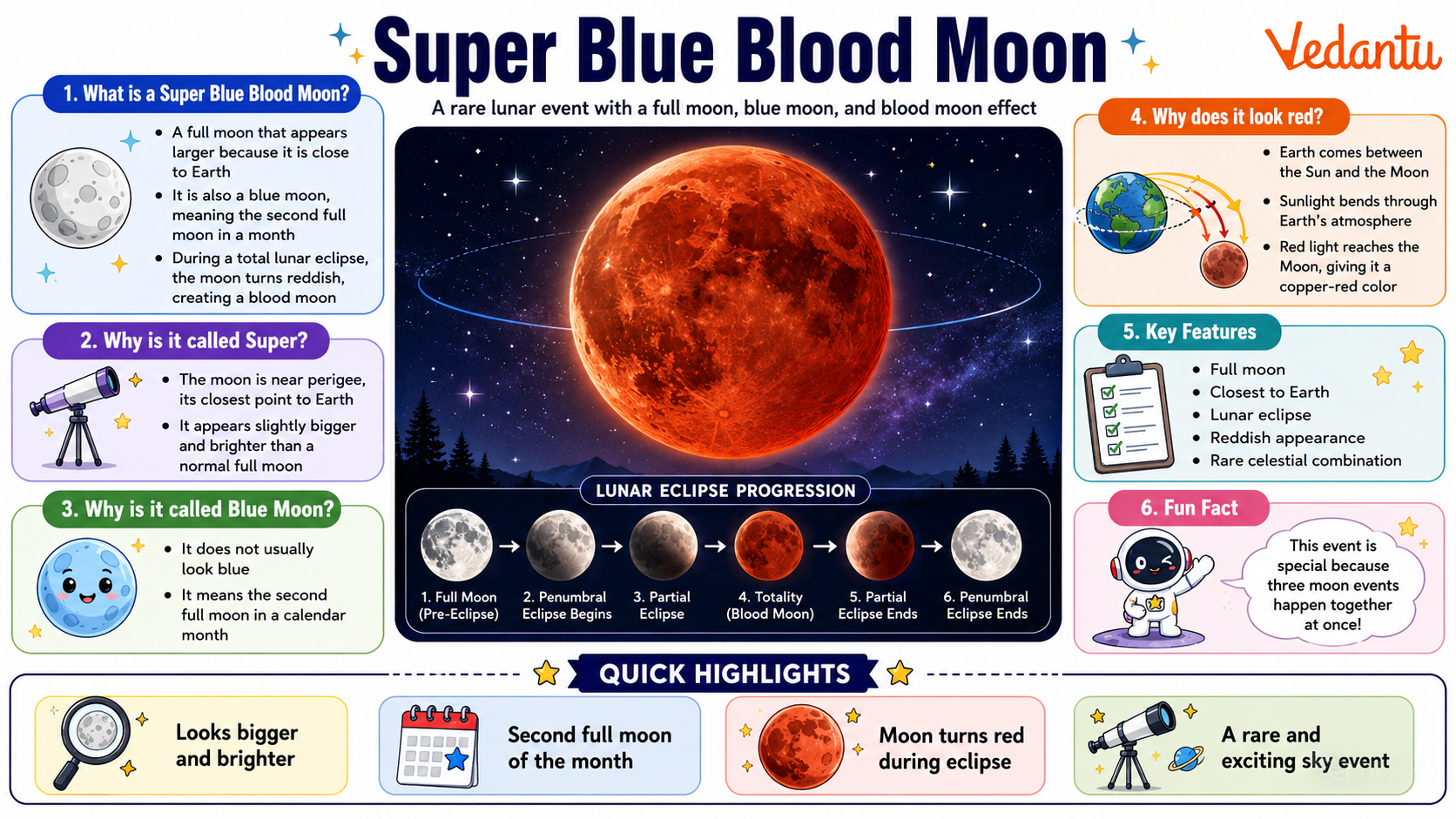
What is a Super Blue Blood Moon?
A Super Blue Blood Moon occurs when three lunar events happen at the same time:
- Supermoon - When the full Moon is closest to Earth in its elliptical orbit, making it appear larger and brighter.
- Blue Moon - The second full Moon occurring within a single calendar month.
- Blood Moon - A total lunar eclipse during which the Moon appears reddish in color.
When all three events occur together, the phenomenon is called a Super Blue Blood Moon. Such an event is extremely rare and scientifically significant.
Scientific Explanation
1. Supermoon
The Moon orbits Earth in an elliptical path. The closest point to Earth is called perigee. When a full Moon occurs near perigee, it appears about 14 percent larger and 30 percent brighter than a normal full Moon. This is known as a Supermoon.
2. Blue Moon
A Blue Moon does not refer to the Moon's color. It simply means the second full Moon in a calendar month. Since a lunar cycle is about 29.5 days long, occasionally two full Moons fit into a single month.
3. Blood Moon
A Blood Moon occurs during a total lunar eclipse. When Earth comes directly between the Sun and the Moon, Earth's shadow falls on the Moon. The reddish color is due to Rayleigh scattering, the same process that makes sunsets appear red. Earth's atmosphere bends and filters sunlight, allowing only red light to reach the Moon.
Key Features of Super Blue Blood Moon
| Feature | Description | Scientific Cause |
|---|---|---|
| Supermoon | Moon appears larger and brighter | Moon near perigee |
| Blue Moon | Second full Moon in a month | Calendar alignment with lunar cycle |
| Blood Moon | Moon appears reddish | Total lunar eclipse and Rayleigh scattering |
The combination of these three rare conditions makes the Super Blue Blood Moon a remarkable astronomical event that does not occur frequently.
When Did It Last Occur?
One of the most notable Super Blue Blood Moons occurred on 31 January 2018. It was visible in many parts of the world, including Asia, Australia, the Pacific region, and parts of North America. The event was especially remarkable because a similar combination had not occurred for more than 150 years.
Importance in Astronomy
- Helps scientists study Earth's atmosphere through light filtering effects.
- Provides opportunities to observe lunar surface features during eclipses.
- Enhances public interest in astronomy and space science.
- Important topic in General Knowledge and competitive exams.
Difference Between Related Lunar Events
- Lunar Eclipse vs Solar Eclipse - In a lunar eclipse, Earth blocks sunlight from reaching the Moon. In a solar eclipse, the Moon blocks sunlight from reaching Earth.
- Supermoon vs Micromoon - A Supermoon occurs at perigee, while a Micromoon occurs when the Moon is farthest from Earth, called apogee.
- Blue Moon - Refers only to the timing of full Moons, not to color.
Why is the Super Blue Blood Moon Rare?
Each of the three phenomena - Supermoon, Blue Moon, and total lunar eclipse - has its own cycle. For all three to align perfectly on the same day requires specific orbital and calendar conditions. Because these cycles do not perfectly match, the event is uncommon and may occur only a few times in a century.
Quick Facts for Competitive Exams
- A Super Blue Blood Moon combines three lunar events.
- The red color is due to Rayleigh scattering of sunlight.
- Blue Moon does not mean the Moon turns blue.
- The event on 31 January 2018 was widely observed.
- It is safe to view a lunar eclipse with the naked eye.
Conclusion
The Super Blue Blood Moon is a rare astronomical phenomenon that beautifully combines three distinct lunar events into one spectacular occurrence. It highlights the dynamic relationship between the Earth, Moon, and Sun. For students and competitive exam aspirants, understanding this event strengthens concepts related to lunar phases, eclipses, and atmospheric science. Its rarity and scientific importance make it a valuable topic in General Knowledge and astronomy studies.
FAQs on Super Blue Blood Moon Explained for Students
1. What is a Super Blue Blood Moon?
A Super Blue Blood Moon is a rare astronomical event when a Supermoon, Blue Moon, and Blood Moon (total lunar eclipse) occur at the same time.
- Supermoon: The Moon appears larger and brighter as it is closest to Earth (perigee).
- Blue Moon: The second full moon in a calendar month.
- Blood Moon: The Moon turns reddish during a total lunar eclipse.
This rare lunar phenomenon is a popular topic in general knowledge, space science, and competitive exams.
2. Why is it called a Blood Moon during a lunar eclipse?
The Moon is called a Blood Moon because it appears reddish during a total lunar eclipse.
- Earth comes between the Sun and the Moon.
- Sunlight passes through Earth’s atmosphere.
- Shorter blue wavelengths scatter, while red light bends toward the Moon.
This process, known as Rayleigh scattering, gives the Moon its copper or red color.
3. What is the difference between a Supermoon and a Blue Moon?
A Supermoon and a Blue Moon are different lunar events based on position and timing.
- Supermoon: Occurs when the Moon is at its closest point to Earth (perigee), appearing larger and brighter.
- Blue Moon: The second full moon within a single month.
Both are full moons, but they differ in astronomical definition and occurrence.
4. How often does a Super Blue Blood Moon occur?
A Super Blue Blood Moon is extremely rare and may occur once in several decades.
- It requires three lunar events to align simultaneously.
- Not every Supermoon is a Blue Moon.
- Not every Blue Moon has a total lunar eclipse.
Such rare celestial events are significant in astronomy and frequently asked in GK exams.
5. When was the last Super Blue Blood Moon observed?
The last widely observed Super Blue Blood Moon occurred on January 31, 2018.
- Visible in parts of Asia, Australia, the Pacific, and North America.
- Combined a Supermoon, Blue Moon, and total lunar eclipse.
This event gained global attention among astronomers, students, and space enthusiasts.
6. Is a Super Blue Blood Moon visible everywhere on Earth?
No, a Super Blue Blood Moon is not visible everywhere because visibility depends on geographic location and timing.
- Only regions experiencing nighttime can see it.
- Cloud cover and weather conditions affect observation.
- The eclipse path determines which continents can view the Blood Moon.
Visibility details are often included in astronomy-related current affairs questions.
7. What causes a total lunar eclipse?
A total lunar eclipse occurs when Earth completely blocks sunlight from reaching the Moon.
- The Sun, Earth, and Moon align in a straight line.
- The Moon passes through Earth’s shadow (umbra).
- The Moon appears red due to atmospheric scattering.
This phenomenon is different from a solar eclipse, where the Moon blocks the Sun.
8. Does a Blue Moon actually appear blue in color?
No, a Blue Moon does not usually appear blue; the term refers to its occurrence in a calendar month.
- It means the second full moon in a month.
- Rare atmospheric conditions (like volcanic ash) can make the Moon look bluish.
The phrase “once in a Blue Moon” indicates a rare event.
9. Why is the Super Blue Blood Moon important in General Knowledge?
The Super Blue Blood Moon is important in GK because it combines multiple astronomical concepts.
- Frequently asked in competitive exams and quizzes.
- Related to topics like lunar phases, eclipses, and celestial events.
- Helps students understand Earth-Sun-Moon alignment.
It is a key topic in space science and current affairs.
10. What is the scientific significance of a Super Blue Blood Moon?
The scientific significance of a Super Blue Blood Moon lies in studying lunar motion and Earth’s atmosphere.
- Helps scientists observe Earth’s atmospheric composition through scattered light.
- Demonstrates orbital mechanics of the Moon.
- Encourages public interest in astronomy and space science.
Such rare celestial alignments enhance understanding of lunar cycles and astronomical phenomena.
