






Key Causes Behind the Rise and Expansion of the Magadha Kingdom
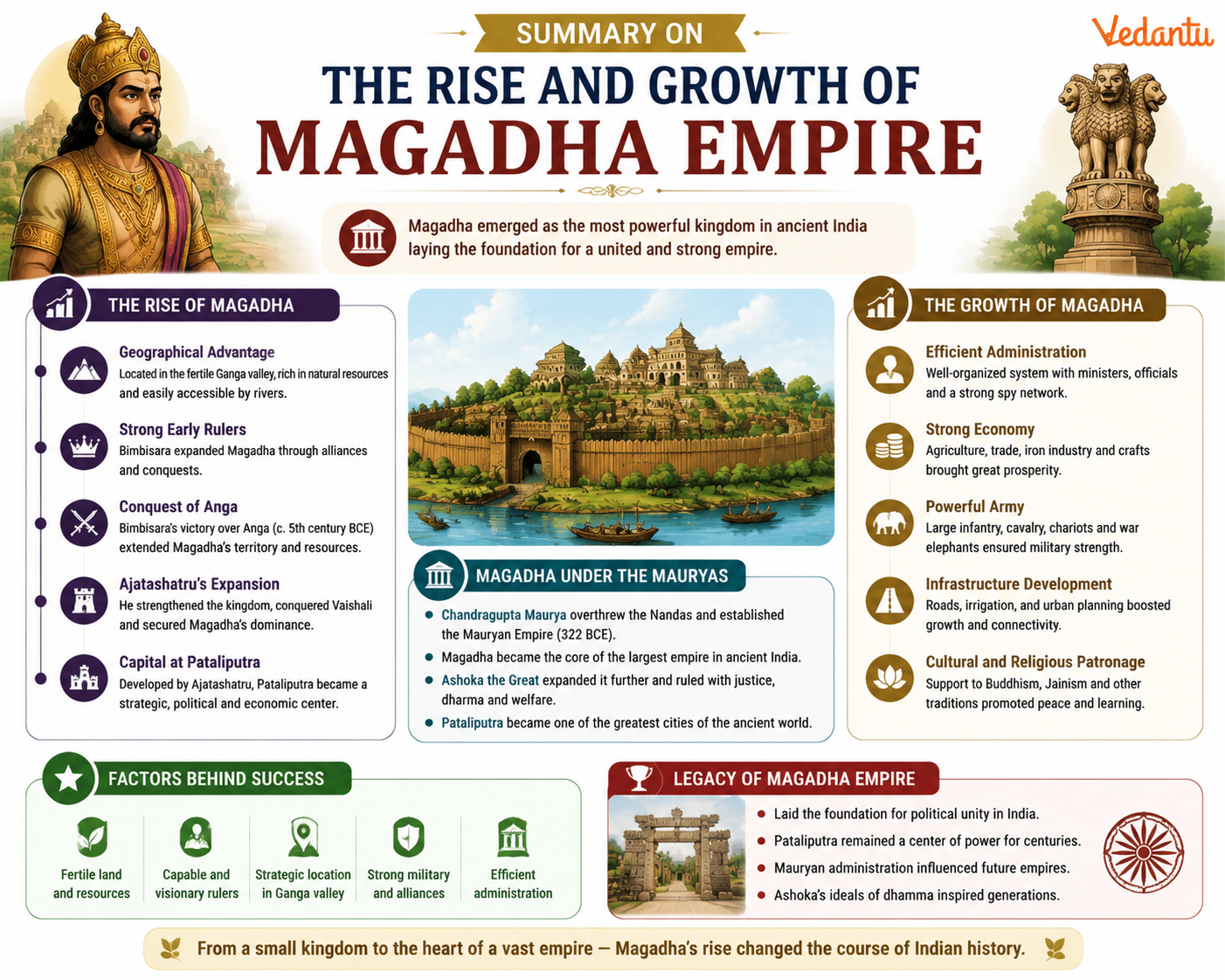
The Rise and Growth of the Magadha Empire is one of the most important chapters in ancient Indian history. Magadha, located in present-day Bihar and parts of eastern Uttar Pradesh, emerged as a powerful kingdom in the 6th century BCE. Over time, it expanded its territory through strong leadership, military strength, economic prosperity, and administrative efficiency. The growth of Magadha laid the foundation for the first large empires in India, including the Mauryan Empire. Understanding the rise of Magadha helps students grasp the political and economic developments of early historic India and is highly relevant for competitive examinations.
Geographical Advantages of Magadha
The geographical location of Magadha played a crucial role in its rise. It was situated in the fertile Gangetic plains, which supported agriculture and population growth. Natural resources and river systems also strengthened its economy and defense.
- Fertile alluvial soil of the Ganga basin increased agricultural production.
- Availability of iron ore in nearby regions like Chotanagpur helped in making strong weapons and tools.
- Rivers such as Ganga, Son, and Champa provided natural defense and trade routes.
- Dense forests supplied timber and war elephants for the army.
Important Rulers and Their Contributions
The growth of Magadha was mainly due to the efforts of capable and ambitious rulers. Each dynasty contributed to its expansion and consolidation.
Haryanka Dynasty
- Bimbisara - Strengthened Magadha through matrimonial alliances and military conquests.
- Ajatashatru - Expanded the empire by defeating the Lichchhavis and introduced new war techniques.
Shishunaga Dynasty
- Shifted the capital temporarily to Vaishali.
- Strengthened control over Avanti.
Nanda Dynasty
- Mahapadma Nanda - Expanded the empire extensively and is often called the first great empire builder.
- Maintained a large standing army, which increased Magadha's military dominance.
Major Dynasties of Magadha
| Dynasty | Important Rulers | Key Contributions |
|---|---|---|
| Haryanka | Bimbisara, Ajatashatru | Territorial expansion and military reforms |
| Shishunaga | Shishunaga, Kalashoka | Defeat of Avanti and consolidation |
| Nanda | Mahapadma Nanda, Dhanananda | Large army and financial strength |
These dynasties gradually transformed Magadha from a regional kingdom into a dominant political power in northern India. Their administrative skills and military strategies prepared the ground for the Mauryan Empire.
Administrative and Military Strength
Magadha's rulers focused on building a strong administrative system and a powerful army. Efficient governance ensured internal stability and economic growth.
- Well-organized taxation system increased state revenue.
- Large standing army consisting of infantry, cavalry, chariots, and elephants.
- Use of advanced weapons and war machines.
- Strong fortifications at Rajagriha and later at Pataliputra.
Economic Prosperity
Economic strength was another important factor in the growth of Magadha. Agriculture formed the backbone of the economy, while trade and commerce expanded steadily.
- Surplus agricultural production supported a large population.
- Strategic location encouraged inland trade.
- Use of punch-marked coins facilitated commercial activities.
- Control over trade routes enhanced revenue collection.
Role of Capital Cities
The capitals of Magadha were strategically chosen to ensure safety and administrative convenience.
- Rajagriha - Surrounded by hills, it provided natural defense.
- Pataliputra - Located at the confluence of rivers, it became an important political and trade center.
Reasons for the Success of Magadha
The combined effect of geographical, political, military, and economic factors led to the remarkable rise of Magadha.
- Strategic geographical position.
- Efficient and ambitious rulers.
- Strong military organization.
- Economic prosperity and resource availability.
- Effective administrative system.
Historical Significance of Magadha
The rise of Magadha marked the beginning of large territorial states in India. It paved the way for the establishment of the Mauryan Empire under Chandragupta Maurya. Magadha became a center of political power, culture, and learning. It also played a significant role in the spread of Buddhism and Jainism. The administrative and military models developed during this period influenced later Indian empires.
In conclusion, the rise and growth of the Magadha Empire was the result of favorable geography, strong leadership, economic prosperity, and military strength. Its success changed the political landscape of ancient India and laid the foundation for future imperial powers.
FAQs on Summary of the Rise and Growth of the Magadha Empire in Ancient India
1. What was the Magadha Empire and why was it important in ancient Indian history?
The Magadha Empire was one of the most powerful kingdoms of ancient India that laid the foundation for large imperial rule.
- Located in present-day Bihar with capitals at Rajagriha (Rajgir) and later Pataliputra.
- Became dominant between the 6th century BCE and 4th century BCE.
- Gave rise to major dynasties like the Haryanka, Shishunaga, Nanda, and Maurya.
- Played a key role in the spread of Buddhism and Jainism.
2. What were the main reasons for the rise and growth of the Magadha Empire?
The rise of the Magadha Empire was due to strong leadership, geography, and military power.
- Fertile land of the Ganga plains supported agriculture.
- Availability of iron ore in nearby regions.
- Efficient rulers like Bimbisara and Ajatashatru.
- Strategic location with river routes for trade and transport.
- Strong army with elephants and advanced weapons.
3. Who was Bimbisara and what was his contribution to the growth of Magadha?
Bimbisara was the founder of the Haryanka dynasty who strengthened Magadha’s political power.
- Ruled from around 544 BCE.
- Expanded territory through marriage alliances and conquest.
- Annexed the kingdom of Anga.
- Maintained friendly relations with Gautama Buddha.
4. How did Ajatashatru contribute to the expansion of Magadha?
Ajatashatru, son of Bimbisara, expanded Magadha through military strength and strategic warfare.
- Defeated the powerful kingdom of Vajji (Vrijji).
- Introduced war machines like the Rathamusala and Mahashilakantaka.
- Strengthened the capital at Rajagriha.
5. Which dynasties ruled Magadha before the Mauryan Empire?
Before the rise of the Mauryan Empire, Magadha was ruled by three important dynasties.
- Haryanka Dynasty – Founded by Bimbisara.
- Shishunaga Dynasty – Shifted capital to Vaishali temporarily.
- Nanda Dynasty – Known for immense wealth and a strong army under Dhanananda.
6. Why was Pataliputra important for the Magadha Empire?
Pataliputra became the political and administrative center of Magadha due to its strategic location.
- Situated at the confluence of Ganga, Son, and Gandak rivers.
- Facilitated trade, communication, and defense.
- Later became the capital of the Mauryan Empire.
7. How did geographical factors help in the rise of the Magadha Empire?
Geography played a crucial role in the growth of the Magadha Kingdom.
- Fertile alluvial soil boosted agricultural production.
- Dense forests provided timber and elephants for the army.
- Rivers ensured natural defense and transport facilities.
- Access to iron mines improved weapon-making.
8. What role did the Nanda Dynasty play in the expansion of Magadha?
The Nanda Dynasty greatly expanded the territory and wealth of Magadha before the Mauryas.
- Founded by Mahapadma Nanda.
- Built a vast empire across northern India.
- Maintained a large standing army with thousands of soldiers and elephants.
- Accumulated immense wealth through efficient taxation.
9. How did Magadha become the most powerful Mahajanapada?
Magadha emerged as the strongest Mahajanapada due to military, economic, and political advantages.
- Powerful rulers with expansionist policies.
- Control over fertile agricultural land.
- Strategic trade routes along the Ganga River.
- Use of advanced military techniques and war elephants.
10. How did the rise of Magadha lead to the formation of the Mauryan Empire?
The strong political and military base of Magadha directly led to the rise of the Mauryan Empire.
- The fall of the Nanda Dynasty enabled Chandragupta Maurya to seize power.
- Magadha’s capital Pataliputra became the Mauryan headquarters.
- Established the first large-scale pan-Indian empire.
