






How Many Ramsar Wetland Sites in India and Why They Matter?
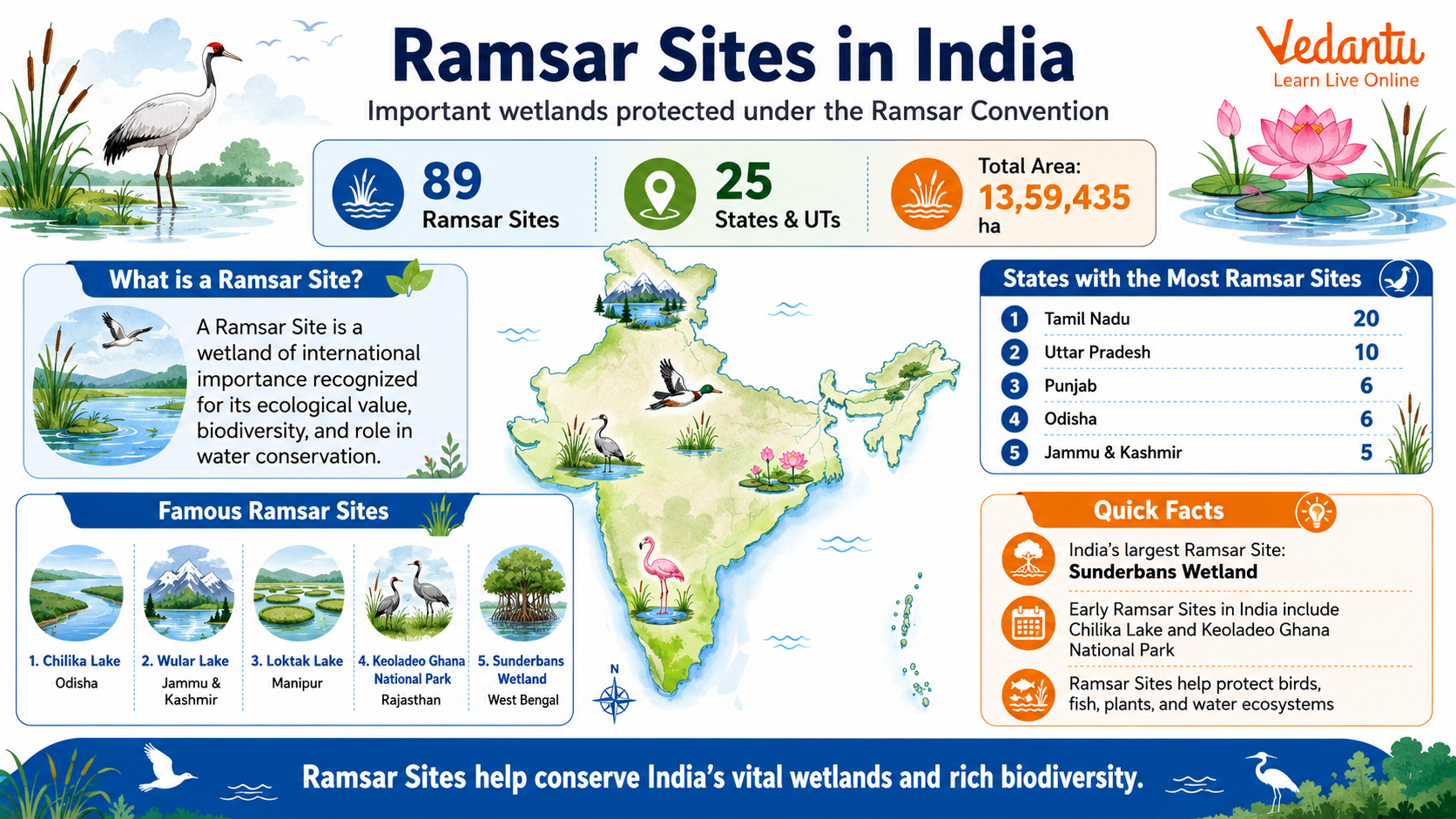
Ramsar Sites in India are wetlands of international importance designated under the Ramsar Convention on Wetlands, an international treaty adopted in 1971 in the Iranian city of Ramsar. These sites are recognized for their ecological significance, biodiversity richness, and role in maintaining environmental balance. Wetlands support a wide range of plant and animal species, including migratory birds, and provide essential ecosystem services such as water purification, flood control, and groundwater recharge. Ramsar Sites in India are frequently asked in competitive exams and are an important topic in General Knowledge and Environmental Studies.
What is the Ramsar Convention?
The Ramsar Convention is an intergovernmental treaty established in 1971 for the conservation and wise use of wetlands. India became a signatory to the Convention on 1 February 1982. The Convention provides a framework for national action and international cooperation for the conservation and sustainable use of wetlands and their resources.
- Adopted in 1971 in Ramsar, Iran
- India joined in 1982
- Focuses on conservation and sustainable use of wetlands
- Encourages international cooperation for shared water systems and migratory species
What are Wetlands?
Wetlands are areas of land that are saturated with water either permanently or seasonally. They form a transition zone between terrestrial and aquatic ecosystems. Wetlands include lakes, rivers, marshes, mangroves, floodplains, and even man made reservoirs.
Importance of Wetlands
- Habitat for diverse flora and fauna
- Support migratory birds
- Control floods by absorbing excess water
- Recharge groundwater
- Improve water quality by filtering pollutants
- Support livelihoods like fishing and agriculture
Ramsar Sites in India - Key Facts
- India has more than 75 Ramsar Sites
- Tamil Nadu has one of the highest numbers of Ramsar Sites in India
- Sundarbans Wetland in West Bengal is the largest Ramsar Site in India
- Chilika Lake in Odisha was the first Indian wetland to be designated as a Ramsar Site in 1981
Major Ramsar Sites in India
| Ramsar Site | State | Special Feature |
|---|---|---|
| Chilika Lake | Odisha | Largest coastal lagoon in India |
| Keoladeo National Park | Rajasthan | Famous bird sanctuary |
| Sundarbans Wetland | West Bengal | Largest mangrove forest |
| Loktak Lake | Manipur | Floating phumdis |
| Wular Lake | Jammu and Kashmir | One of the largest freshwater lakes in India |
These Ramsar Sites are ecologically sensitive and are protected due to their biodiversity and environmental importance. Many of them are important habitats for endangered species and migratory birds.
Criteria for Ramsar Site Designation
To be designated as a Ramsar Site, a wetland must meet at least one of the criteria set by the Ramsar Convention. These criteria are based on ecological, botanical, zoological, limnological, or hydrological importance.
- Supports vulnerable or endangered species
- Supports significant numbers of waterbirds
- Represents rare or unique wetland types
- Plays an important role in maintaining biological diversity
Threats to Ramsar Sites in India
Despite legal protection, many Ramsar Sites in India face environmental challenges. Human activities and climate change are major threats to wetland ecosystems.
- Urbanization and encroachment
- Pollution from industrial and domestic waste
- Overexploitation of resources
- Climate change and rising temperatures
- Invasive species
Why Ramsar Sites are Important for Competitive Exams
Ramsar Sites in India are frequently asked in exams like UPSC, State PSC, SSC, Banking, Railways, and other competitive examinations. Questions are commonly based on the number of sites, the state with the highest number, the largest or first Ramsar Site, and unique features of specific wetlands. Students preparing for exams should regularly update themselves with the latest additions to the Ramsar list.
Conclusion
Ramsar Sites in India play a crucial role in conserving wetlands and protecting biodiversity. They help maintain ecological balance, support livelihoods, and preserve natural heritage for future generations. Understanding the significance, features, and distribution of Ramsar Sites is essential for students, competitive exam aspirants, and anyone interested in environmental conservation. Proper awareness and sustainable management are key to protecting these valuable ecosystems.
FAQs on Ramsar Sites in India: Complete Guide for Students
1. What are Ramsar Sites in India?
Ramsar Sites in India are wetlands designated as internationally important under the Ramsar Convention of 1971.
• The Ramsar Convention on Wetlands is an international treaty for wetland conservation and sustainable use.
• These sites protect ecosystems, biodiversity, migratory birds, and aquatic life.
• India became a signatory to the Ramsar Convention in 1982.
• Ramsar Sites are also known as Wetlands of International Importance (People Also Ask: What is Ramsar Convention? What is a wetland?).
2. How many Ramsar Sites are there in India in 2026?
As of 2026, India has over 75 Ramsar Sites, making it one of the leading countries in wetland conservation.
• Tamil Nadu has the highest number of Ramsar Wetlands in India.
• These sites cover lakes, rivers, mangroves, and marshlands.
• The number is updated periodically by the Ministry of Environment, Forest and Climate Change (MoEFCC).
• Common search queries include: How many Ramsar Sites are in India? Latest Ramsar Sites list 2026.
3. Which is the first Ramsar Site in India?
Chilika Lake in Odisha and Keoladeo National Park in Rajasthan were the first Ramsar Sites of India, designated in 1981.
• Chilika Lake is Asia’s largest brackish water lagoon.
• Keoladeo National Park is famous for migratory birds.
• Both sites are important for biodiversity conservation and eco-tourism.
• People also search: First wetland of India, Oldest Ramsar Site in India.
4. Which Indian state has the highest number of Ramsar Sites?
Tamil Nadu has the highest number of Ramsar Sites in India.
• It has designated multiple wetlands under the Ramsar Convention.
• These wetlands protect coastal ecosystems, mangroves, and bird habitats.
• Other states with many sites include Uttar Pradesh and Punjab.
• Common query: State with most Ramsar Sites in India.
5. What is the importance of Ramsar Sites in India?
Ramsar Sites are important for conserving biodiversity, maintaining ecological balance, and supporting livelihoods.
• Protect endangered species and migratory birds.
• Prevent floods, soil erosion, and climate change impacts.
• Support fishing, agriculture, and eco-tourism.
• Enhance awareness about wetland conservation (PAS: Importance of wetlands, Benefits of Ramsar Sites).
6. What is the Ramsar Convention?
The Ramsar Convention is an international treaty signed in 1971 in Ramsar, Iran, for the conservation of wetlands.
• Officially called the Convention on Wetlands of International Importance.
• Came into force in 1975.
• Focuses on sustainable use and protection of wetlands.
• India joined in 1982.
• People also ask: Where was Ramsar Convention signed? What is the aim of Ramsar Convention?
7. Which is the largest Ramsar Site in India?
Sundarbans Wetland in West Bengal is the largest Ramsar Site in India.
• It is part of the world’s largest mangrove forest.
• Habitat of the Royal Bengal Tiger.
• Recognized for its unique delta ecosystem.
• Common searches: Largest wetland in India, Biggest Ramsar Site.
8. Which is the smallest Ramsar Site in India?
Renuka Wetland in Himachal Pradesh is one of the smallest Ramsar Sites in India.
• It is a small natural lake with cultural significance.
• Supports freshwater biodiversity.
• Important for local ecosystem balance.
• People also search: Smallest Ramsar Site in India GK question.
9. What types of wetlands are included under Ramsar Sites in India?
Ramsar Sites in India include diverse types of wetlands such as lakes, rivers, marshes, and mangroves.
• Inland wetlands – lakes, reservoirs, floodplains.
• Coastal wetlands – lagoons, estuaries, mangrove forests.
• Man-made wetlands – tanks and reservoirs.
• These ecosystems support aquatic plants, birds, and fish species (PAA: Types of wetlands in India).
10. Why are Ramsar Sites important for competitive exams?
Ramsar Sites are frequently asked in competitive exams like UPSC, SSC, Banking, and State PSC exams.
• Questions focus on number of sites, largest/smallest sites, and first Ramsar Site.
• Important under Environment and Ecology GK section.
• Linked with topics like Biodiversity, Climate Change, and International Treaties.
• People also ask: Ramsar Sites GK questions, Important wetlands for UPSC.
