






Why the 1991 Economic Reforms (Liberalization, Privatization, Globalization) Were Introduced in India
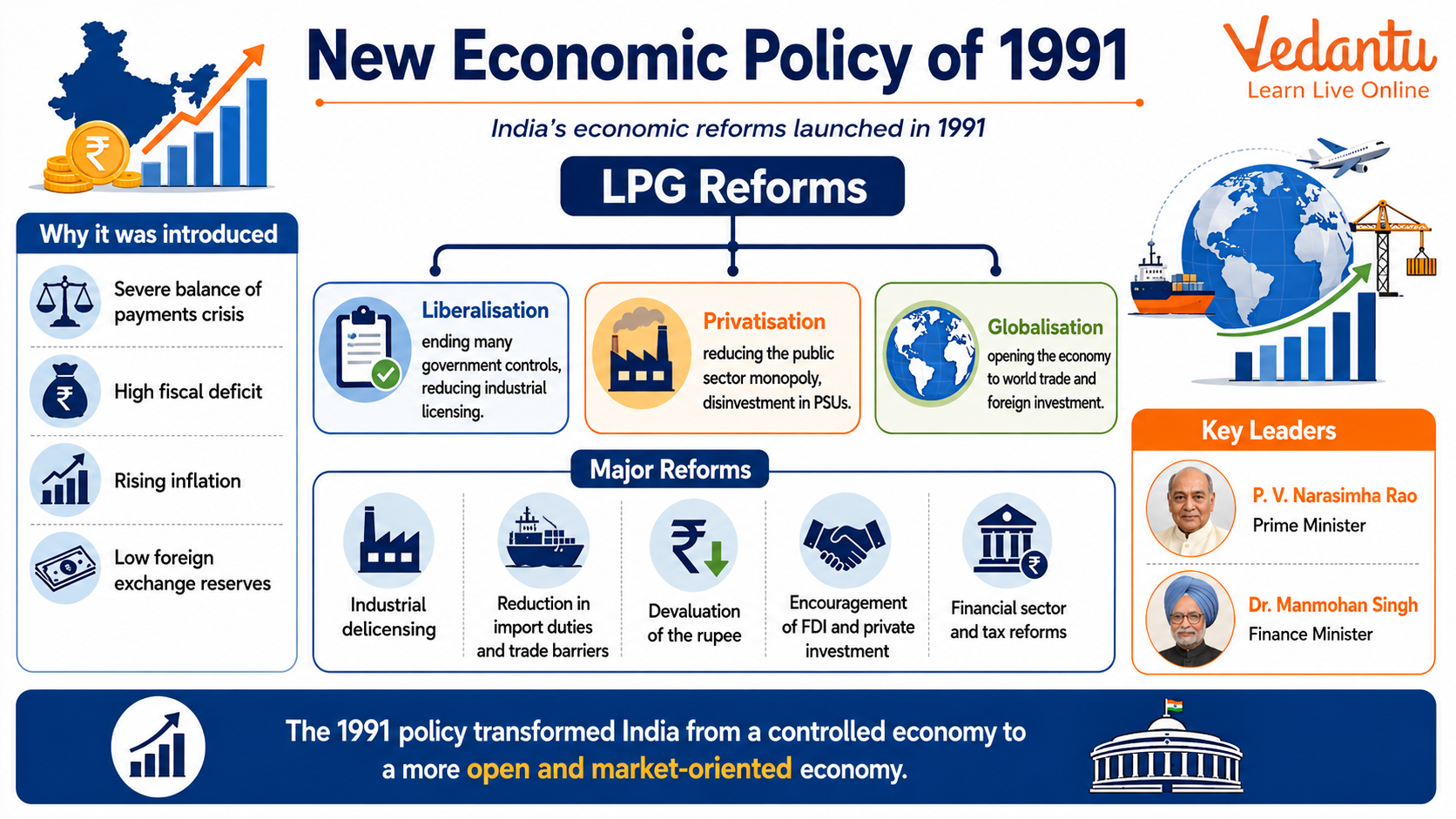
The New Economic Policy of 1991 was a landmark reform introduced by the Government of India to overcome a severe economic crisis and to transform the Indian economy. Announced in July 1991 under the leadership of Prime Minister P.V. Narasimha Rao and Finance Minister Dr. Manmohan Singh, this policy marked a shift from a state controlled economy to a more market oriented system. The reforms focused on Liberalization, Privatization, and Globalization, commonly known as LPG reforms. The New Economic Policy aimed to improve economic growth, reduce poverty, attract foreign investment, and integrate India with the global economy.
Background of the New Economic Policy 1991
Before 1991, India followed a mixed economic model with strong government control over industries, trade, and investment. By 1990 to 1991, the country faced a serious balance of payments crisis. Foreign exchange reserves had fallen drastically and were barely sufficient to cover a few weeks of imports. High fiscal deficit, rising inflation, and low economic growth worsened the situation.
- Declining foreign exchange reserves
- High fiscal deficit and public debt
- Low industrial growth
- High inflation rate
- Pressure from international institutions like IMF and World Bank
To stabilize the economy and restore confidence, the government introduced structural reforms known as the New Economic Policy of 1991.
Main Objectives of New Economic Policy 1991
- To reduce government control and promote private sector participation
- To increase foreign direct investment and foreign exchange reserves
- To modernize industries and improve efficiency
- To control inflation and reduce fiscal deficit
- To integrate the Indian economy with the global market
Key Components of New Economic Policy 1991
1. Liberalization
Liberalization refers to the removal of government restrictions and regulations in the economy. Before 1991, industries required licenses to operate and expand. This system was known as the License Raj. The policy reduced such controls and allowed businesses more freedom.
- Abolition of industrial licensing for most industries
- Reduction in import tariffs and duties
- Devaluation of Indian currency to boost exports
- Simplification of tax structure
2. Privatization
Privatization aimed to reduce the role of the public sector and increase the participation of private enterprises. Many public sector units were either sold partially or opened for private investment.
- Disinvestment of government shares in public sector enterprises
- Encouragement of private sector competition
- Improvement in efficiency and productivity
3. Globalization
Globalization refers to the integration of the Indian economy with the world economy. It encouraged foreign investment, technology transfer, and international trade.
- Permission for foreign direct investment in various sectors
- Reduction in trade barriers
- Encouragement to multinational companies to invest in India
Comparison of Indian Economy Before and After 1991 Reforms
| Aspect | Before 1991 | After 1991 |
|---|---|---|
| Industrial Policy | License Raj and heavy control | Reduced licensing and deregulation |
| Foreign Investment | Very limited | Encouraged and liberalized |
| Public Sector | Dominant role | Increased private participation |
The reforms significantly changed the structure and functioning of the Indian economy, leading to higher growth rates and increased global integration.
Impact of New Economic Policy 1991
Positive Impacts
- Higher GDP growth rate in the following decades
- Increase in foreign exchange reserves
- Growth of IT and service sectors
- Improvement in industrial productivity
Criticisms and Challenges
- Increase in income inequality
- Job insecurity in some sectors
- Dependence on global markets
Importance of New Economic Policy 1991 for Competitive Exams
The New Economic Policy of 1991 is an important topic in General Knowledge and Economics. It is frequently asked in competitive exams, school examinations, and interviews. Students should remember the year 1991, the LPG model, the names of key leaders involved, and the main objectives of the reforms. Understanding the background and impact helps in answering both objective and descriptive questions effectively.
Conclusion
The New Economic Policy of 1991 was a turning point in India’s economic history. By introducing Liberalization, Privatization, and Globalization, the government shifted towards a market oriented economy. These reforms helped India overcome an economic crisis and set the foundation for rapid growth in the following decades. The policy continues to influence India’s economic strategies and remains a crucial topic in General Knowledge and economic studies.
FAQs on New Economic Policy 1991: Meaning, Objectives and Impact on India
1. What is the New Economic Policy of 1991?
The New Economic Policy (NEP) of 1991 was a set of economic reforms introduced to liberalize, privatize, and globalize the Indian economy.
- Launched in July 1991 during a severe economic crisis
- Introduced by Finance Minister Dr. Manmohan Singh under Prime Minister P.V. Narasimha Rao
- Focused on Liberalization, Privatization, and Globalization (LPG reforms)
- Aimed to reduce government control and boost economic growth
It marked a major shift from a mixed economy with state control to a more market-oriented economic system in India.
2. Why was the New Economic Policy introduced in 1991?
The New Economic Policy was introduced to overcome the 1991 balance of payments crisis.
- India faced a severe foreign exchange crisis
- High fiscal deficit and rising inflation
- Declining foreign reserves (barely enough for two weeks of imports)
- Low economic growth and inefficient public sector
These reforms aimed to stabilize the economy, attract foreign investment, and integrate India into the global economy.
3. What are the main features of the New Economic Policy 1991?
The main features of the New Economic Policy are Liberalization, Privatization, and Globalization.
- Liberalization: Removal of industrial licensing and reduction of government controls
- Privatization: Disinvestment of public sector enterprises
- Globalization: Encouraging foreign trade and Foreign Direct Investment (FDI)
- Tax reforms and financial sector reforms
These structural reforms modernized India’s economic framework and promoted competition and efficiency.
4. What is meant by Liberalization in the 1991 Economic Reforms?
Liberalization refers to reducing government restrictions on economic activities.
- Abolition of License Raj
- Reduction in import tariffs and duties
- Simplification of tax structure
- Freedom for private sector expansion
It encouraged private entrepreneurship, increased production, and improved India's ease of doing business.
5. What is Privatization under the New Economic Policy?
Privatization means transferring ownership or management of public sector enterprises to the private sector.
- Disinvestment in Public Sector Undertakings (PSUs)
- Reduction in government monopoly
- Improved efficiency and profitability
- Encouragement of private investment
It aimed to reduce the burden on the government and enhance economic efficiency and competitiveness.
6. What does Globalization mean in the context of NEP 1991?
Globalization refers to integrating the Indian economy with the global market.
- Encouragement of Foreign Direct Investment (FDI)
- Reduction in import restrictions
- Participation in World Trade Organization (WTO)
- Expansion of exports and international trade
It helped India become part of the global trading system and increased foreign exchange earnings.
7. Who introduced the New Economic Policy in India?
The New Economic Policy was introduced by Dr. Manmohan Singh in 1991.
- He was the Finance Minister of India
- Worked under Prime Minister P.V. Narasimha Rao
- Presented the reform-oriented Budget in July 1991
Their leadership played a crucial role in transforming India into a liberalized and globally connected economy.
8. What were the objectives of the New Economic Policy 1991?
The main objective of NEP 1991 was to revive and stabilize the Indian economy.
- Control inflation and reduce fiscal deficit
- Increase foreign exchange reserves
- Promote private sector participation
- Enhance economic growth and development
The reforms aimed at achieving sustainable economic growth and improving India's global competitiveness.
9. What are the impacts of the New Economic Policy on the Indian economy?
The New Economic Policy significantly accelerated India’s economic growth.
- Higher GDP growth rate
- Rise in foreign investment and IT sector growth
- Expansion of middle class and consumer market
- Increased competition and improved quality of goods
However, it also led to challenges like income inequality and regional disparities.
10. How did the New Economic Policy end the License Raj?
The New Economic Policy ended the License Raj by removing industrial licensing requirements.
- Most industries no longer required government approval
- Reduced bureaucratic delays
- Encouraged ease of doing business
- Boosted private sector confidence
This reform reduced excessive state control and promoted a free-market economy in India.
