






Maharatna vs Navratna Companies in India: Key Differences and Benefits
Maharatna and Navratna companies are special categories of Central Public Sector Enterprises (CPSEs) in India that are granted enhanced financial and operational autonomy by the Government of India. These companies play a crucial role in the country's economic development and contribute significantly to sectors such as energy, mining, steel, telecommunications, and infrastructure. Understanding the List Of Maharatna And Navratna Companies In India is important for students preparing for competitive exams like UPSC, SSC, Banking, Railways, and other state level examinations.
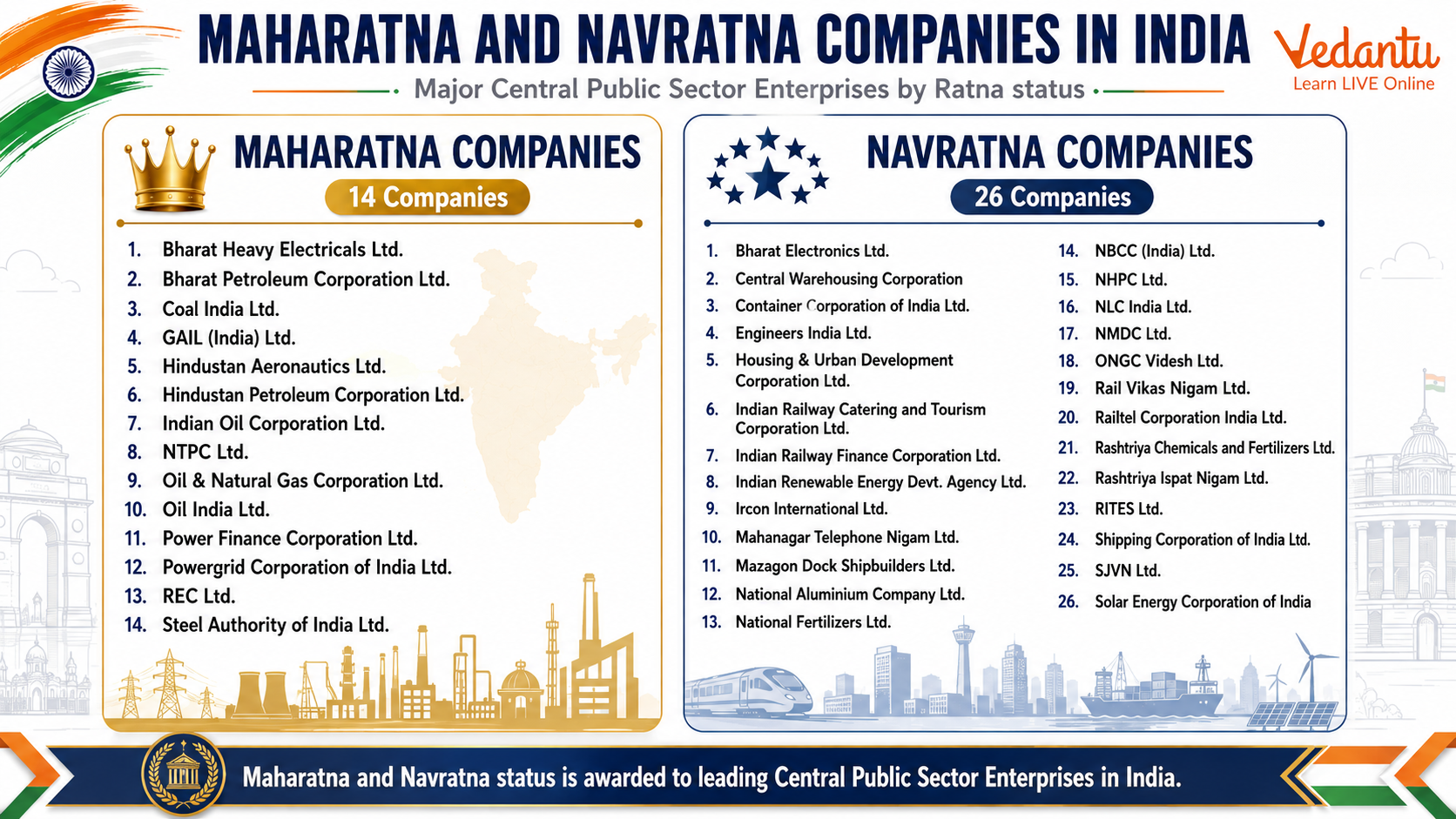
What Are Maharatna and Navratna Companies?
Maharatna and Navratna are status classifications given to top performing Public Sector Undertakings based on their financial performance, size, and global presence. The objective is to empower these companies to compete globally and operate with greater independence in investment decisions.
Maharatna Companies
Maharatna status is the highest recognition granted to CPSEs. These companies have greater autonomy in making investment decisions without seeking government approval up to a certain limit.
- Can invest up to Rs 5000 crore or 15 percent of net worth in a project
- Must be listed on Indian stock exchange with minimum public shareholding
- Should have significant global presence and consistent profitability
Navratna Companies
Navratna companies are high performing CPSEs that enjoy financial autonomy but at a lower level compared to Maharatna companies.
- Can invest up to Rs 1000 crore or 15 percent of net worth in a single project
- Must meet specific performance criteria based on net profit, net worth, and turnover
- Greater operational freedom compared to Miniratna companies
List Of Maharatna Companies In India
| S No | Company Name | Sector |
|---|---|---|
| 1 | Bharat Heavy Electricals Limited - BHEL | Engineering and Manufacturing |
| 2 | Bharat Petroleum Corporation Limited - BPCL | Oil and Gas |
| 3 | Coal India Limited - CIL | Mining |
| 4 | GAIL India Limited | Natural Gas |
| 5 | Hindustan Petroleum Corporation Limited - HPCL | Oil and Gas |
| 6 | Indian Oil Corporation Limited - IOCL | Oil and Gas |
| 7 | NTPC Limited | Power Generation |
| 8 | Oil and Natural Gas Corporation - ONGC | Oil Exploration |
| 9 | Power Grid Corporation of India Limited | Power Transmission |
| 10 | Steel Authority of India Limited - SAIL | Steel Production |
| 11 | Oil India Limited | Oil Exploration |
| 12 | Power Finance Corporation - PFC | Financial Services |
| 13 | Rural Electrification Corporation - REC Limited | Financial Services |
These Maharatna companies are among the largest and most profitable public sector enterprises in India. They contribute significantly to GDP, employment, and infrastructure development.
List Of Navratna Companies In India
| S No | Company Name | Sector |
|---|---|---|
| 1 | Bharat Electronics Limited - BEL | Defence Electronics |
| 2 | Container Corporation of India - CONCOR | Logistics |
| 3 | Engineers India Limited - EIL | Engineering Consultancy |
| 4 | Hindustan Aeronautics Limited - HAL | Aerospace and Defence |
| 5 | Mahanagar Telephone Nigam Limited - MTNL | Telecommunications |
| 6 | National Aluminium Company Limited - NALCO | Mining and Metals |
| 7 | National Buildings Construction Corporation - NBCC | Construction |
| 8 | Neyveli Lignite Corporation - NLC India | Mining and Power |
| 9 | Oil India Limited | Oil Exploration |
| 10 | Rashtriya Ispat Nigam Limited - RINL | Steel |
| 11 | Shipping Corporation of India - SCI | Shipping |
| 12 | Rail Vikas Nigam Limited - RVNL | Rail Infrastructure |
Navratna companies have demonstrated consistent financial strength and operational efficiency. They are important contributors to India's industrial and service sectors.
Key Differences Between Maharatna and Navratna Companies
- Maharatna is a higher status than Navratna
- Maharatna companies have higher investment limits without government approval
- Maharatna companies usually have larger turnover and global presence
- Navratna companies must first qualify as Miniratna and meet performance criteria
Importance Of Maharatna And Navratna Companies In India
These companies strengthen India's economic foundation by generating revenue, creating employment, and building strategic infrastructure. They also enhance India's global competitiveness in sectors such as energy, defence, steel, and engineering.
- Boost industrial growth
- Support government welfare and development programs
- Contribute significantly to export earnings
- Strengthen strategic sectors like defence and energy
Conclusion
The List Of Maharatna And Navratna Companies In India reflects the strength and scale of India's public sector enterprises. These companies enjoy special autonomy due to their outstanding financial and operational performance. For competitive exam aspirants, memorizing major companies along with their sectors is highly important as questions are frequently asked from this topic in General Awareness sections. Understanding their role also provides insight into India's economic structure and development strategy.
FAQs on List of Maharatna and Navratna Companies in India with Key Details
1. What are Maharatna and Navratna companies in India?
Maharatna and Navratna companies are top-performing Public Sector Undertakings (PSUs) in India granted special financial and operational autonomy by the Government of India.
• Maharatna Companies – Largest PSUs with greater investment and expansion powers.
• Navratna Companies – High-performing PSUs with moderate financial autonomy.
• These companies operate under the Ministry of Heavy Industries and other ministries.
• They contribute significantly to India’s GDP, infrastructure, and economic growth.
2. What are the eligibility criteria for Maharatna status?
To become a Maharatna PSU, a company must meet strict financial and performance criteria set by the Government of India.
• Must already have Navratna status.
• Average annual turnover of over ₹25,000 crore (last 3 years).
• Average annual net worth of over ₹15,000 crore.
• Average annual net profit of over ₹5,000 crore.
• Significant global presence and listing on Indian stock exchange.
3. What are the eligibility criteria for Navratna status?
Navratna status is granted to high-performing CPSEs based on financial strength and operational efficiency.
• Must be a Miniratna Category-I company.
• Must have obtained at least 60 out of 100 composite score.
• Positive net profit for the last three consecutive years.
• Good performance in parameters like net profit, net worth, manpower cost, and earnings per share (EPS).
4. How many Maharatna companies are there in India?
As of recent updates, India has 13 Maharatna companies recognized by the Government of India.
Some major Maharatna PSUs include:
• ONGC (Oil and Natural Gas Corporation)
• Indian Oil Corporation Limited (IOCL)
• Coal India Limited (CIL)
• NTPC Limited
• Steel Authority of India Limited (SAIL)
5. How many Navratna companies are there in India?
India currently has around 16 Navratna companies operating across key sectors.
Examples of Navratna PSUs include:
• Bharat Electronics Limited (BEL)
• Hindustan Aeronautics Limited (HAL)
• Rural Electrification Corporation (REC)
• Shipping Corporation of India (SCI)
• Engineers India Limited (EIL)
6. What is the difference between Maharatna and Navratna companies?
The main difference between Maharatna and Navratna companies lies in their financial powers and scale of operations.
• Maharatna PSUs can invest up to ₹5,000 crore or 15% of net worth without government approval.
• Navratna PSUs can invest up to ₹1,000 crore or 15% of net worth.
• Maharatna companies are generally larger in turnover and global presence.
• Both categories enjoy operational autonomy compared to regular PSUs.
7. Who grants Maharatna and Navratna status in India?
The Government of India grants Maharatna and Navratna status based on recommendations from the Department of Public Enterprises (DPE).
• DPE evaluates financial performance and eligibility criteria.
• Approval is given by the Union Cabinet.
• The status enhances autonomy in investment and strategic decisions.
8. Why are Maharatna and Navratna companies important for India?
Maharatna and Navratna PSUs play a vital role in strengthening India’s economy and infrastructure.
• Major contributors to energy, steel, oil, power, and defense sectors.
• Generate large-scale employment.
• Contribute significantly to government revenue and exports.
• Support India’s goal of becoming a $5 trillion economy.
9. What are Miniratna companies in India?
Miniratna companies are smaller but profit-making Public Sector Enterprises granted limited financial autonomy.
• Classified into Category I and Category II.
• Must have continuous profits for the last three years.
• Can make investments up to a prescribed financial limit without government approval.
• Serve as a stepping stone to Navratna status.
10. Which sectors have the maximum Maharatna and Navratna companies?
The majority of Maharatna and Navratna companies in India belong to core infrastructure and energy sectors.
• Oil and Gas – ONGC, IOCL, BPCL
• Power and Energy – NTPC, Power Grid
• Mining and Metals – Coal India, SAIL
• Defense and Aerospace – HAL, BEL
These sectors are crucial for national development and strategic growth.
