






Timeline of Attorney Generals in India with Tenure and Key Details
The Attorney General of India is the highest law officer of the country and serves as the chief legal advisor to the Government of India. The position is established under Article 76 of the Constitution of India. The Attorney General represents the Union Government in the Supreme Court and provides legal advice on important matters referred by the President of India. Understanding the List of Attorney Generals of India is important for students preparing for competitive exams such as UPSC, SSC, State PSC, and other government examinations, as it is a frequently asked General Knowledge topic.
Constitutional Provision of Attorney General of India
The office of the Attorney General of India is mentioned in Article 76 of the Indian Constitution. It lays down the appointment process, qualifications, and duties of the Attorney General.
Appointment
The Attorney General is appointed by the President of India. The person appointed must be qualified to be appointed as a Judge of the Supreme Court.
Qualifications
- Must be a citizen of India.
- Must have been a Judge of a High Court for at least 5 years, or
- Must have been an advocate of a High Court for at least 10 years, or
- Must be a distinguished jurist in the opinion of the President.
Tenure and Removal
The Constitution does not fix a specific tenure for the Attorney General. The Attorney General holds office during the pleasure of the President. This means that the President can remove the Attorney General at any time. There is no formal impeachment process for removal.
Duties and Powers of Attorney General of India
The Attorney General performs several important legal functions for the Union Government.
- Gives legal advice to the Government of India upon request.
- Appears on behalf of the Government in the Supreme Court and High Courts.
- Performs duties assigned by the President.
- Has the right of audience in all courts within India.
- Has the right to participate in the proceedings of Parliament but cannot vote.
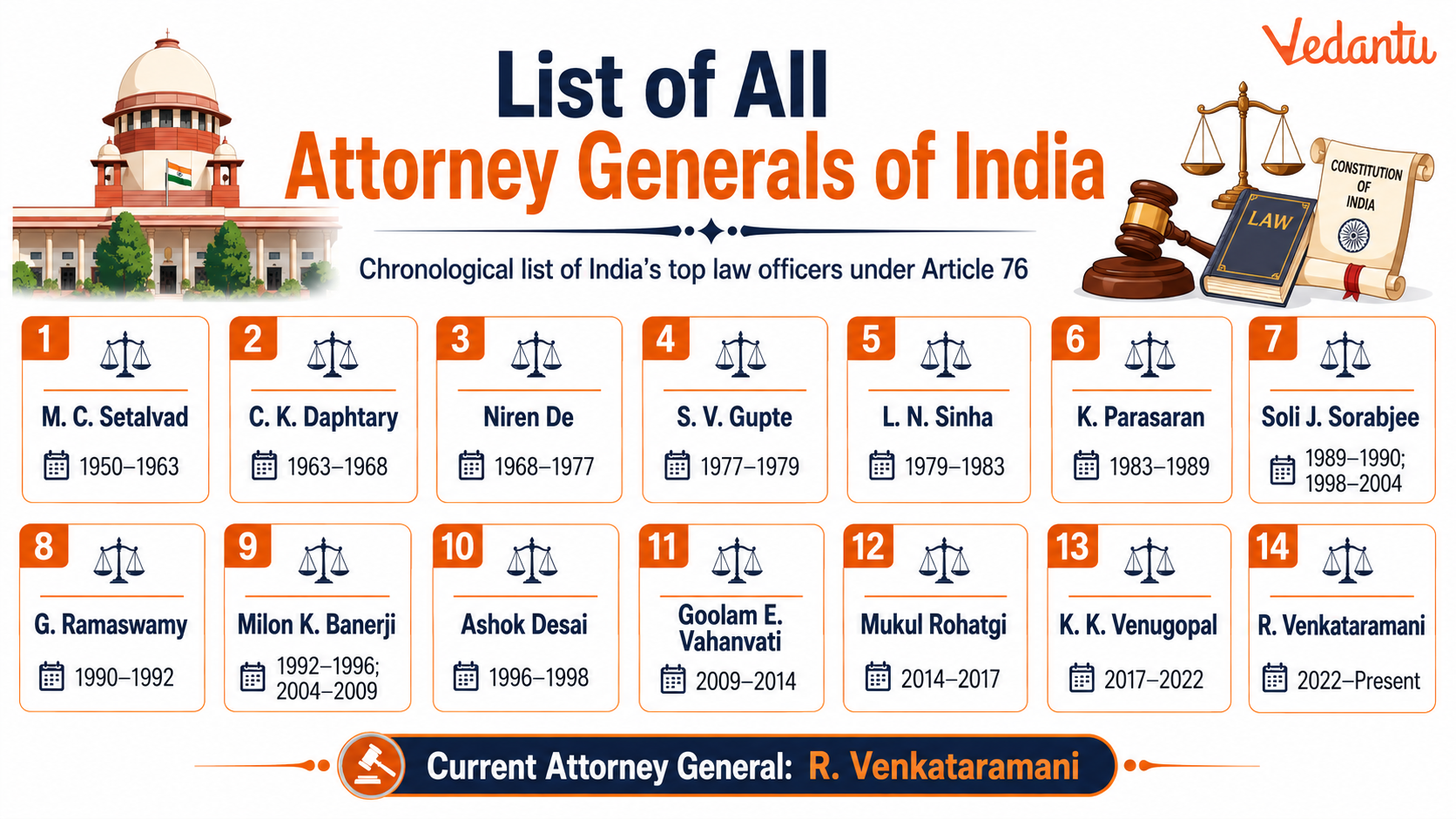
List of Attorney Generals of India
| Name | Tenure | Remarks |
|---|---|---|
| M. C. Setalvad | 1950 - 1963 | First Attorney General of India |
| C. K. Daphtary | 1963 - 1968 | Second Attorney General |
| Niren De | 1968 - 1977 | Served during Emergency period |
| Soli Sorabjee | 1989 - 1990, 1998 - 2004 | Served two terms |
| K. Parasaran | 1983 - 1989 | Senior constitutional expert |
| Goolam E. Vahanvati | 2009 - 2014 | Represented government in major cases |
| Mukul Rohatgi | 2014 - 2017 | Served two separate terms |
| K. K. Venugopal | 2017 - 2022 | Senior advocate of Supreme Court |
| R. Venkataramani | 2022 - Present | Current Attorney General of India |
The above table highlights some of the most important Attorney Generals of India from 1950 to the present. M. C. Setalvad was the first Attorney General of independent India. R. Venkataramani is the current Attorney General as of 2026.
Difference Between Attorney General and Solicitor General
Students often confuse the Attorney General with the Solicitor General of India. However, there are clear differences between the two positions.
- The Attorney General is the highest law officer of India, while the Solicitor General assists the Attorney General.
- The Attorney General is appointed under Article 76 of the Constitution, whereas the Solicitor General is not a constitutional post.
- The Attorney General has the right to participate in Parliamentary proceedings, but the Solicitor General does not have this right.
Importance of List of Attorney Generals of India for Exams
Questions related to the Attorney General of India are frequently asked in competitive examinations. Candidates should remember:
- First Attorney General of India.
- Current Attorney General of India.
- Constitutional Article related to the post.
- Duties and powers of the Attorney General.
- Difference between Attorney General and Advocate General of State.
Conclusion
The List of Attorney Generals of India reflects the legal history and constitutional development of the country. As the chief legal advisor to the Government of India, the Attorney General plays a crucial role in safeguarding constitutional values and representing the nation in important legal matters. For students and aspirants, knowing the names, tenures, and constitutional provisions related to the Attorney General is essential for strengthening General Knowledge and performing well in competitive examinations.
FAQs on List of Attorney Generals of India from 1950 to Present
1. Who is the Attorney General of India?
The Attorney General of India is the highest law officer of the Government of India and the chief legal advisor to the Union Government.
• Appointed by the President of India under Article 76 of the Indian Constitution
• Must be qualified to be appointed as a Judge of the Supreme Court
• Represents the Government of India in the Supreme Court and High Courts
• Advises the government on legal matters and constitutional issues
This post is often searched under terms like chief legal advisor of India, top law officer, and Article 76 Attorney General.
2. Who was the first Attorney General of India?
M. C. Setalvad was the first Attorney General of India.
• Served from 1950 to 1963
• Appointed soon after the Constitution came into force on 26 January 1950
• Played a key role in shaping early constitutional law in India
He is frequently mentioned in GK questions related to first Attorney General and legal history of India.
3. Who appoints the Attorney General of India?
The President of India appoints the Attorney General of India on the advice of the Union Government.
• Appointment is made under Article 76 of the Constitution
• No fixed tenure is prescribed
• Holds office during the pleasure of the President
This is a common question in Polity GK, UPSC, and SSC exams.
4. What are the duties of the Attorney General of India?
The main duty of the Attorney General is to advise and represent the Government of India in legal matters.
Key functions include:
• Giving legal advice to the Central Government
• Appearing before the Supreme Court of India
• Representing the government in important constitutional cases
• Performing duties assigned by the President
These responsibilities are often searched as powers and functions of Attorney General and role of AGI.
5. What qualifications are required to become the Attorney General of India?
The Attorney General must be qualified to become a Judge of the Supreme Court.
Qualifications include:
• Must be a citizen of India
• Must have served as a High Court Judge for 5 years, or
• Must have been an advocate in a High Court for 10 years, or
• Must be a distinguished jurist in the opinion of the President
This is a key topic in Indian Constitution and eligibility criteria questions.
6. What is the term of office of the Attorney General of India?
There is no fixed term for the Attorney General of India.
• Serves at the pleasure of the President
• Can resign at any time
• Can be removed by the President
This flexible tenure system is important for understanding constitutional posts in India and executive appointments.
7. Can the Attorney General of India participate in Parliament?
Yes, the Attorney General can participate in Parliamentary proceedings but cannot vote.
• Has the right to speak in both Houses of Parliament
• Can participate in committee meetings
• Does not have the right to vote
This feature makes the role unique among constitutional authorities in India.
8. Who is the current Attorney General of India?
As of recent updates, R. Venkataramani serves as the Attorney General of India.
• Appointed in 2022
• Succeeded K. K. Venugopal
• Represents the Union Government in major constitutional matters
Students often search this under present Attorney General of India and current AGI name.
9. How many Attorney Generals have served in India?
India has had several distinguished Attorney Generals since 1950.
Some notable names include:
• M. C. Setalvad (First AG)
• Niren De
• Soli J. Sorabjee
• Goolam E. Vahanvati
• Mukul Rohatgi
• K. K. Venugopal
Questions about the list of Attorney Generals of India are common in GK and competitive exams.
10. What is the difference between the Attorney General and the Solicitor General of India?
The Attorney General is the highest law officer, while the Solicitor General assists in legal matters.
Key differences:
• Attorney General: Constitutional post under Article 76
• Solicitor General: Statutory post, not mentioned in the Constitution
• AG advises the government and appears in top constitutional cases
• SG assists the AG and represents the government in courts
This comparison is frequently searched as AG vs SG and law officers of India.
