






Key Differences in Roles, Rights, and Qualifications of Advocates and Lawyers
The terms Advocate and Lawyer are often used interchangeably, but they do not have exactly the same meaning. Both are legal professionals connected with the field of law, yet there are specific differences in their qualifications, roles, and rights to represent clients in court. Understanding the difference between Advocate and Lawyer is important for students, competitive exam aspirants, and general readers who want clarity about legal terminology in India and other legal systems.
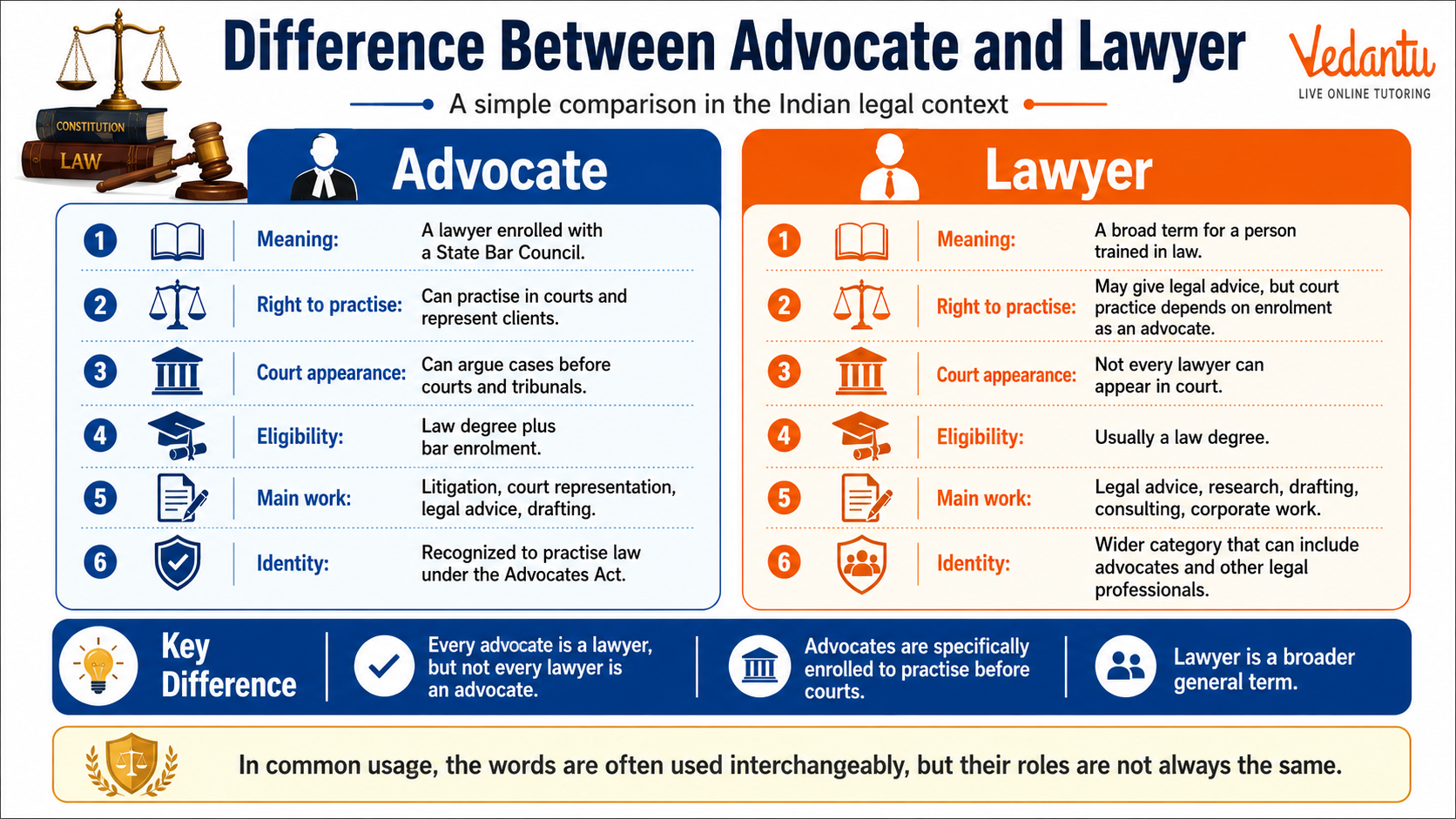
Who is a Lawyer?
A Lawyer is a person who has completed a degree in law, such as LLB, from a recognized university. The term lawyer is broad and includes anyone who is trained in law and provides legal advice or assistance. A lawyer may or may not practice in a court of law.
Main Functions of a Lawyer
- Giving legal advice to clients
- Drafting legal documents such as agreements, wills, and contracts
- Providing legal opinions on disputes
- Working in companies as legal advisors
Who is an Advocate?
An Advocate is a lawyer who is officially enrolled with the Bar Council of a state and is legally permitted to practice law in courts. In India, according to the Advocates Act, 1961, only advocates have the right to appear and argue cases in a court of law.
Main Functions of an Advocate
- Representing clients in court
- Presenting arguments before judges
- Filing cases and legal petitions
- Cross-examining witnesses
Difference Between Advocate And Lawyer
| Basis of Comparison | Lawyer | Advocate |
|---|---|---|
| Definition | Person with a law degree | Lawyer enrolled with Bar Council |
| Right to Practice in Court | Not always allowed | Allowed to practice in court |
| Enrollment | No mandatory enrollment required | Must be enrolled with Bar Council |
| Scope | Broader term | Specific category under lawyer |
| Example of Work | Legal consultant in company | Arguing case before judge |
From the table above, it is clear that all advocates are lawyers, but all lawyers are not advocates. The key difference lies in enrollment with the Bar Council and the legal right to represent clients in court.
Process to Become an Advocate in India
To become an advocate in India, a person must follow a structured process after completing legal education.
- Complete a 3-year or 5-year LLB degree from a recognized university
- Enroll with the State Bar Council
- Clear the All India Bar Examination conducted by the Bar Council of India
- Receive the Certificate of Practice to appear in court
Why Understanding the Difference is Important
Knowing the difference between advocate and lawyer helps in understanding legal news, court proceedings, and career options in the field of law. For competitive exams, questions are often asked about legal terms and their definitions. Clear conceptual knowledge prevents confusion and improves accuracy in exams.
- Useful for General Knowledge and legal awareness
- Important for law entrance exams
- Helps in understanding court related news
Conclusion
In simple terms, a lawyer is anyone who has studied law, while an advocate is a lawyer who is legally authorized to practice in court. The difference mainly lies in professional recognition and the right to represent clients before a judge. Understanding this distinction enhances legal literacy and ensures clarity in academic and competitive examinations.
FAQs on Difference Between an Advocate and a Lawyer in Legal Practice
1. What is the main difference between an advocate and a lawyer?
The main difference between an advocate and a lawyer is that an advocate can represent clients in court, while a lawyer may or may not have this right.
• A lawyer is anyone who has completed a law degree (LLB).
• An advocate is a lawyer who is enrolled with the Bar Council and is legally allowed to practice in court.
• All advocates are lawyers, but not all lawyers are advocates.
This distinction is important in understanding legal professions, court representation, and legal practice in India.
2. Who is called a lawyer?
A lawyer is a person who has completed a law degree and has knowledge of legal matters.
• Holds a degree like LLB (Bachelor of Laws).
• Can provide legal advice and draft legal documents.
• May work as a legal advisor, corporate consultant, or academic.
• Cannot represent clients in court unless enrolled as an advocate.
The term lawyer is broader and includes advocates, attorneys, and legal consultants.
3. Who is called an advocate?
An advocate is a lawyer who is officially enrolled with the State Bar Council and is authorized to appear in court.
• Must pass the All India Bar Examination (AIBE).
• Has the right to argue cases before a court of law.
• Represents clients in civil, criminal, or constitutional matters.
In simple terms, an advocate is a qualified court-practicing lawyer under the Advocates Act, 1961.
4. Can a lawyer practice in court without being an advocate?
No, a lawyer cannot practice in court without being registered as an advocate.
• Court representation requires Bar Council enrollment.
• Passing the AIBE exam is mandatory in India.
• Without enrollment, a lawyer can only provide legal consultancy.
This rule ensures professional standards and regulation of court practice under Indian law.
5. What is the role of the Bar Council in the advocate profession?
The Bar Council of India (BCI) regulates and governs the legal profession in India.
• Enrolls qualified lawyers as advocates.
• Conducts the All India Bar Examination.
• Sets professional standards and ethics.
• Takes disciplinary action against misconduct.
The Bar Council ensures that only qualified advocates can practice law in courts.
6. Is every advocate a lawyer?
Yes, every advocate is a lawyer because an advocate must first complete a law degree.
• Advocate = Lawyer + Bar Council enrollment.
• Must meet eligibility under the Advocates Act, 1961.
• Authorized for courtroom representation.
This means advocate is a specialized category within the broader term lawyer.
7. What qualifications are required to become an advocate in India?
To become an advocate in India, specific academic and professional requirements must be fulfilled.
• Complete a 3-year or 5-year LLB degree.
• Enroll with the State Bar Council.
• Pass the All India Bar Examination (AIBE).
After fulfilling these steps, a person receives a Certificate of Practice to appear in court.
8. What is the difference between advocate, attorney, and lawyer?
The terms advocate, attorney, and lawyer are related but differ by usage and jurisdiction.
• Lawyer: General term for someone with a law degree.
• Advocate: A lawyer authorized to argue in court (common in India, UK).
• Attorney: Term mainly used in the USA for a practicing lawyer.
These legal titles vary by country but relate to legal professionals and court practice.
9. Who earns more: an advocate or a lawyer?
Income depends on experience, specialization, and area of practice rather than just the title.
• Advocates earn through court cases and client representation.
• Lawyers in corporate firms may earn fixed salaries.
• Senior advocates and Supreme Court lawyers often earn higher fees.
Thus, earnings vary based on legal expertise, reputation, and practice area.
10. Why is understanding the difference between advocate and lawyer important?
Understanding the difference helps in choosing the right legal professional for specific needs.
• For court cases, you need an advocate.
• For legal advice or documentation, a lawyer may suffice.
• Important for competitive exams, general knowledge, and legal awareness.
This clarity improves legal understanding and avoids confusion in professional terminology.
