






Who Were the Presidents of India from 1950 to Present?
The President of India is the constitutional head of the Republic of India and the supreme commander of the Indian Armed Forces. Although the Prime Minister and the Council of Ministers exercise executive powers, the President plays a crucial role in safeguarding the Constitution, appointing key officials, and ensuring the smooth functioning of the democratic system. Since India became a republic on 26 January 1950, several distinguished personalities have served as Presidents. This page provides a complete and updated list of all Presidents of India along with their tenure and key highlights, making it useful for students, competitive exam aspirants, and general readers.
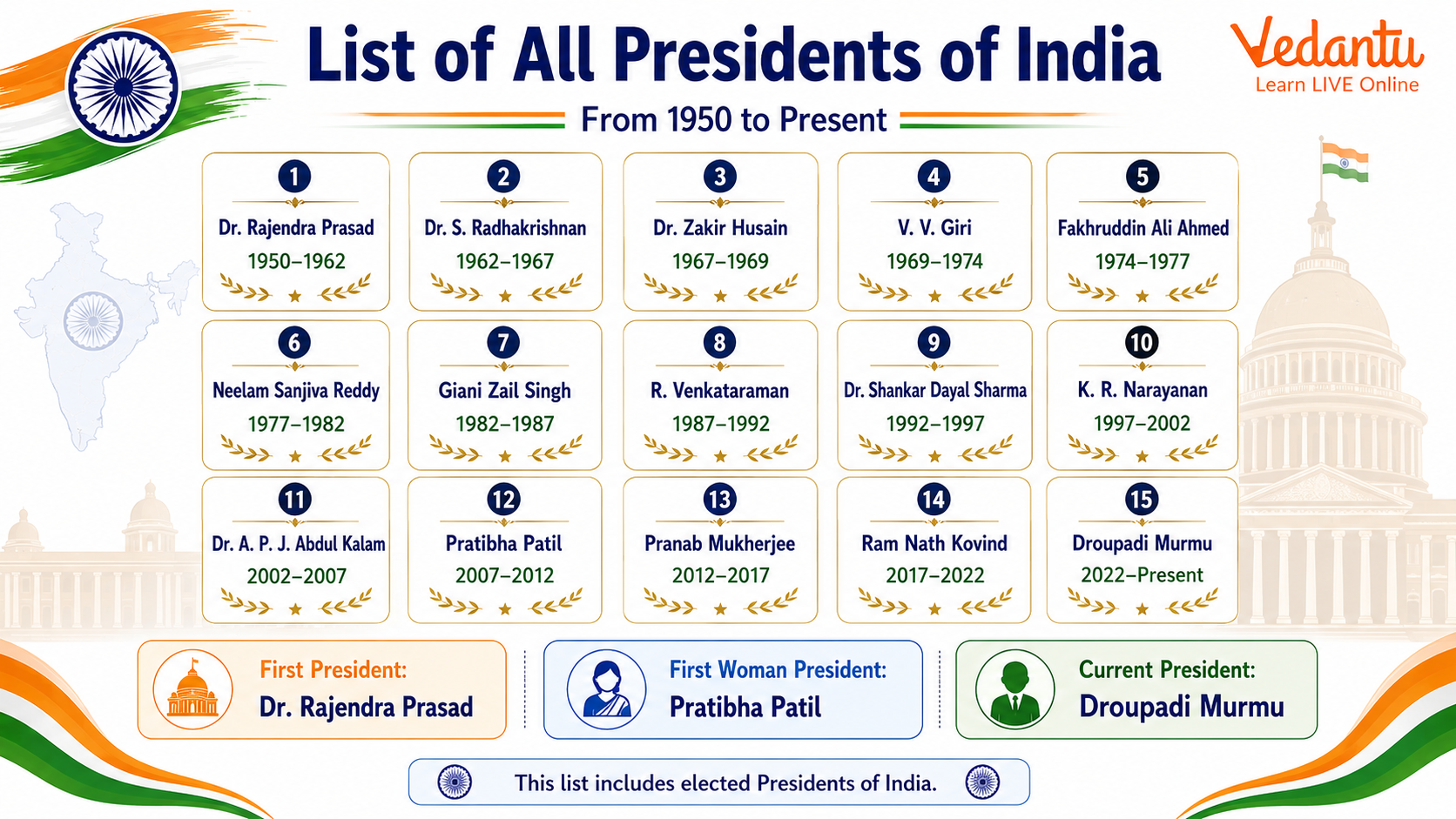
List of All Presidents of India (1950 - Present)
| S.No | Name of the President | Tenure |
|---|---|---|
| 1 | Dr. Rajendra Prasad | 1950 - 1962 |
| 2 | Dr. Sarvepalli Radhakrishnan | 1962 - 1967 |
| 3 | Dr. Zakir Husain | 1967 - 1969 |
| 4 | Varahagiri Venkata Giri | 1969 - 1974 |
| 5 | Fakhruddin Ali Ahmed | 1974 - 1977 |
| 6 | Neelam Sanjiva Reddy | 1977 - 1982 |
| 7 | Giani Zail Singh | 1982 - 1987 |
| 8 | Ramaswamy Venkataraman | 1987 - 1992 |
| 9 | Dr. Shankar Dayal Sharma | 1992 - 1997 |
| 10 | K. R. Narayanan | 1997 - 2002 |
| 11 | Dr. A. P. J. Abdul Kalam | 2002 - 2007 |
| 12 | Pratibha Devisingh Patil | 2007 - 2012 |
| 13 | Pranab Mukherjee | 2012 - 2017 |
| 14 | Ram Nath Kovind | 2017 - 2022 |
| 15 | Droupadi Murmu | 2022 - Present |
Dr. Rajendra Prasad was the first President of India and the only President to serve two full terms. Droupadi Murmu is the current President of India and assumed office on 25 July 2022. She is the first tribal woman to hold the highest constitutional office in the country.
Key Facts About the Presidents of India
- The President of India is elected for a term of five years.
- Dr. Rajendra Prasad served the longest tenure from 1950 to 1962.
- Dr. Zakir Husain and Fakhruddin Ali Ahmed died while in office.
- Neelam Sanjiva Reddy was elected unopposed in 1977.
- Pratibha Patil was the first woman President of India.
- Droupadi Murmu is the youngest President of India at the time of taking office.
- Dr. A. P. J. Abdul Kalam was popularly known as the Missile Man of India.
Powers and Functions of the President of India
Executive Powers
The President appoints the Prime Minister, Council of Ministers, Governors, Chief Justice of India, and other important officials. All executive actions of the Government of India are carried out in the name of the President.
Legislative Powers
The President summons and prorogues Parliament sessions and gives assent to bills passed by Parliament. A bill becomes law only after the President's approval. The President can also promulgate ordinances when Parliament is not in session.
Judicial Powers
The President has the power to grant pardons, reprieves, respites, or remissions of punishment. This includes the power to commute death sentences under Article 72 of the Constitution.
Emergency Powers
The President can declare National Emergency, State Emergency, or Financial Emergency under specific constitutional provisions. These powers are exercised based on the advice of the Council of Ministers.
Eligibility Criteria to Become President of India
- Must be a citizen of India.
- Must have completed 35 years of age.
- Must be qualified to become a member of the Lok Sabha.
- Must not hold any office of profit under the Government of India or any state government.
Election Process of the President of India
The President is elected indirectly by an Electoral College. The election follows the system of proportional representation by means of the single transferable vote and voting is conducted by secret ballot.
- The Electoral College consists of elected members of both Houses of Parliament.
- It also includes elected members of the Legislative Assemblies of States and Union Territories of Delhi and Puducherry.
- Votes are counted based on a value system to ensure uniform representation.
Why the List of Presidents of India is Important for Exams
Questions related to the list of Presidents of India frequently appear in competitive examinations such as UPSC, SSC, Banking, Railways, and various state-level exams. Students are often asked about the first President, current President, tenure periods, and important milestones. Memorizing the chronological order and understanding key facts helps in scoring better in General Knowledge and Current Affairs sections.
Conclusion
The Presidents of India have played a vital role in upholding the Constitution and maintaining the democratic structure of the nation. From Dr. Rajendra Prasad to Droupadi Murmu, each President has contributed uniquely to the country's development. Learning the complete list along with important facts not only strengthens General Knowledge but also helps in competitive exam preparation and understanding India's political system more clearly.
FAQs on List of All Presidents of India and Their Tenure Details
1. Who is the current President of India?
The current President of India is Droupadi Murmu, who assumed office on 25 July 2022.
• She is the 15th President of India.
• She is the first tribal woman to hold the highest constitutional office.
• She succeeded Ram Nath Kovind.
• The President is the Head of State and the First Citizen of India.
2. Who was the first President of India?
The first President of India was Dr. Rajendra Prasad, who served from 1950 to 1962.
• He was elected after India became a Republic on 26 January 1950.
• He is the only President to serve two full terms.
• He played a key role in the Indian freedom struggle.
• His tenure is important in Indian polity and constitutional history.
3. How many Presidents of India have served so far?
India has had 15 Presidents since 1950.
• The list starts with Dr. Rajendra Prasad (1950).
• The current President is Droupadi Murmu (2022–present).
• Some served as Acting Presidents, such as B. D. Jatti.
• This question is common in GK, UPSC, SSC, and competitive exams.
4. Who was the first woman President of India?
The first woman President of India was Pratibha Devisingh Patil, who served from 2007 to 2012.
• She was the 12th President of India.
• She represented a milestone in women empowerment in Indian politics.
• She was elected on 25 July 2007.
• Her tenure is frequently asked in general knowledge questions.
5. Who was the youngest President of India?
The youngest President of India was Neelam Sanjiva Reddy.
• He became President at the age of 64 years in 1977.
• He was the 6th President of India.
• He was elected unopposed, a rare event in Indian political history.
• His presidency followed the Emergency period (1975–77).
6. Who was the first Muslim President of India?
The first Muslim President of India was Dr. Zakir Husain.
• He served from 1967 to 1969.
• He was the 3rd President of India.
• He was also a noted educationist and Vice-Chancellor of AMU.
• He was the first President to die in office.
7. What is the tenure of the President of India?
The tenure of the President of India is 5 years from the date of assuming office.
• The term is defined under Article 56 of the Indian Constitution.
• A President can be re-elected for multiple terms.
• He or she can resign by addressing the Vice President of India.
• The President continues until a successor takes charge.
8. Who was the first Acting President of India?
The first Acting President of India was Varahagiri Venkata Giri (V. V. Giri).
• He served as Acting President in 1969 after the death of Dr. Zakir Husain.
• Later, he became the 4th President of India.
• Acting Presidents assume office during a vacancy or emergency.
• This is a key topic in Indian Polity GK.
9. Who was known as the ‘Missile Man’ among the Presidents of India?
The President known as the ‘Missile Man of India’ was Dr. A. P. J. Abdul Kalam.
• He served as the 11th President of India (2002–2007).
• He was a renowned aerospace scientist.
• He played a major role in India’s missile and nuclear programs.
• He is widely admired by students and youth.
10. Where can I find the complete list of all Presidents of India with their tenure?
The complete list of all Presidents of India includes names from Dr. Rajendra Prasad (1950) to Droupadi Murmu (2022–present).
• Total Presidents: 15.
• Includes notable leaders like Dr. S. Radhakrishnan, Fakhruddin Ali Ahmed, K. R. Narayanan, and Ram Nath Kovind.
• Each served a 5-year term unless interrupted.
• This list is important for GK, UPSC, SSC, Railways, and school exams.
