






Causes and Effects of Pakistan’s Freedom Movement and Partition
The Independence of Pakistan marks one of the most significant events in the history of South Asia. Pakistan emerged as an independent nation on 14 August 1947 after the end of British rule in the Indian subcontinent. The creation of Pakistan was the result of a long political struggle led by the All India Muslim League under the leadership of Quaid-e-Azam Muhammad Ali Jinnah. The demand for a separate homeland for Muslims was based on the Two-Nation Theory, which stated that Muslims and Hindus were two distinct nations with different religious, cultural, and social identities. The independence of Pakistan reshaped the political map of South Asia and had lasting effects on regional and global politics.
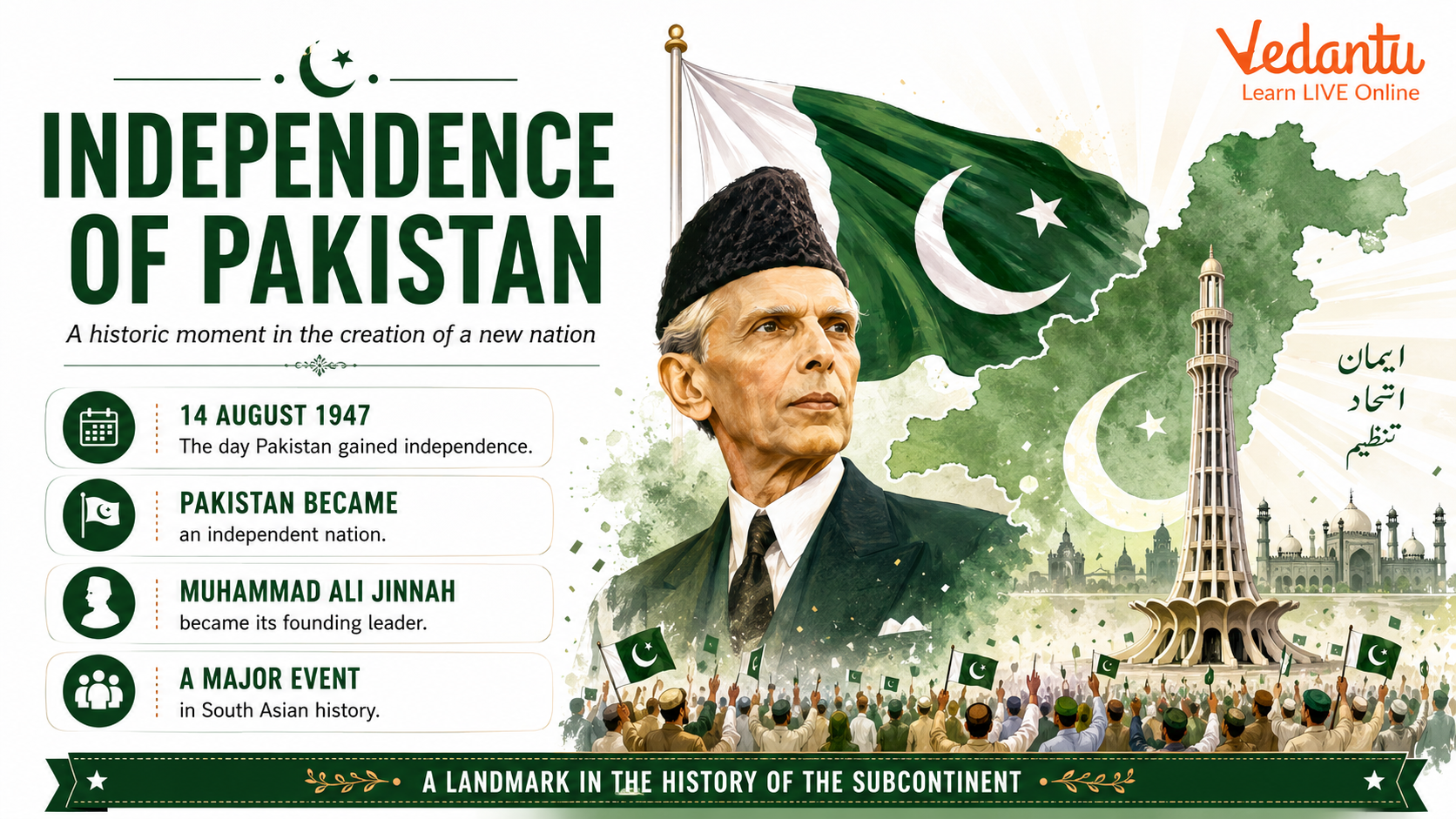
Background of the Pakistan Movement
The roots of Pakistan’s independence can be traced back to the decline of the Mughal Empire and the rise of British rule in India. After the War of Independence in 1857, Muslims faced political and economic challenges. Over time, Muslim leaders realized the need for political representation and protection of their rights.
- Formation of the All India Muslim League in 1906 at Dhaka.
- Separate electorates granted under the Morley-Minto Reforms of 1909.
- Lahore Resolution passed on 23 March 1940 demanding separate states for Muslims.
- Growing Hindu-Muslim political differences during the 1937 provincial elections.
These developments strengthened the demand for a separate Muslim state, ultimately leading to the creation of Pakistan.
Role of Muhammad Ali Jinnah
Muhammad Ali Jinnah played a central role in the independence of Pakistan. Initially a member of the Indian National Congress, he later joined the Muslim League and became its most prominent leader. He advocated constitutional methods and negotiations to secure Muslim rights.
- Presented the Fourteen Points in 1929 to safeguard Muslim interests.
- Led the Muslim League to electoral success in the 1946 elections.
- Negotiated with British authorities for the creation of Pakistan.
- Became the first Governor-General of Pakistan on 14 August 1947.
Due to his leadership and vision, he is honored as Quaid-e-Azam, meaning Great Leader.
Important Events Leading to Independence
Lahore Resolution 1940
Passed on 23 March 1940, this resolution formally demanded independent states for Muslims in northwestern and eastern zones of India. It laid the foundation for the Pakistan Movement.
Cabinet Mission Plan 1946
The British government sent a mission to propose a united India with provincial autonomy. However, disagreements between Congress and the Muslim League led to its failure.
Mountbatten Plan 1947
Announced on 3 June 1947, this plan proposed the partition of British India into two independent dominions - India and Pakistan. The plan was accepted by major political parties.
Key Facts About Independence of Pakistan
| Event | Date | Significance |
|---|---|---|
| Lahore Resolution | 23 March 1940 | Demand for separate Muslim state |
| Mountbatten Plan | 3 June 1947 | Approval of partition plan |
| Independence of Pakistan | 14 August 1947 | Creation of Pakistan as a sovereign state |
Pakistan initially consisted of two geographically separate regions - West Pakistan and East Pakistan. In 1971, East Pakistan became the independent state of Bangladesh.
Challenges After Independence
The newly formed state of Pakistan faced several immediate challenges after independence.
- Mass migration and refugee crisis across borders.
- Division of financial and military assets with India.
- Establishment of administrative institutions.
- Kashmir conflict between India and Pakistan.
Despite these difficulties, Pakistan managed to establish its government and frame its first constitution in 1956.
Significance of Independence
The independence of Pakistan had deep political, social, and cultural significance. It provided Muslims of the subcontinent with a homeland where they could practice their religion freely and develop according to their own cultural values.
- End of British colonial rule in the region.
- Emergence of Pakistan as a sovereign Muslim-majority state.
- Reshaping of South Asian geopolitics.
- Influence on future independence movements worldwide.
Conclusion
The Independence of Pakistan on 14 August 1947 was the result of decades of political struggle, leadership, and sacrifice. Guided by Muhammad Ali Jinnah and supported by millions of Muslims, the demand for a separate homeland became a reality. The event not only created a new nation but also transformed the history of South Asia. Understanding the independence of Pakistan is essential for students and competitive exam aspirants as it highlights themes of nationalism, constitutional development, and political leadership.
FAQs on Independence of Pakistan in 1947: Complete Guide for Students
1. What is meant by the Independence of Pakistan?
The Independence of Pakistan refers to the creation of Pakistan as a separate sovereign state on 14 August 1947 after the end of British rule in India.
Key points include:
• Establishment of Pakistan as an independent Muslim-majority state
• Partition of British India into India and Pakistan
• Leadership of Quaid-e-Azam Muhammad Ali Jinnah
• Implementation of the Indian Independence Act 1947
This historic event is also known as the Partition of India or creation of Pakistan, a major turning point in South Asian history.
2. When did Pakistan gain independence?
Pakistan gained independence on 14 August 1947 under the Indian Independence Act passed by the British Parliament.
Important facts:
• Independence declared at midnight of 14–15 August 1947
• British rule ended after nearly 200 years
• Pakistan became a dominion under the British Commonwealth
• First Governor-General: Muhammad Ali Jinnah
This date is celebrated annually as Independence Day of Pakistan.
3. Who was the founder of Pakistan?
The founder of Pakistan was Quaid-e-Azam Muhammad Ali Jinnah, who led the movement for a separate Muslim homeland.
His contributions include:
• Leadership of the All-India Muslim League
• Advocacy of the Two-Nation Theory
• Negotiations with the British government and Indian National Congress
• Becoming Pakistan’s first Governor-General
He is regarded as the Father of the Nation in Pakistan.
4. What was the Two-Nation Theory?
The Two-Nation Theory was the idea that Muslims and Hindus were two separate nations with distinct religions, cultures, and identities.
Main features:
• Presented strongly by Allama Iqbal and later adopted by Muhammad Ali Jinnah
• Argued for a separate Muslim state
• Became the ideological foundation of Pakistan Movement
• Emphasized religious and political differences
This theory played a central role in the demand for the creation of Pakistan.
5. What was the Pakistan Movement?
The Pakistan Movement was a political struggle aimed at establishing an independent Muslim state in South Asia.
Key developments:
• Led by the All-India Muslim League
• Lahore Resolution (1940) demanding separate states
• Mass political campaigns and negotiations
• Culminated in independence in 1947
It is also known as the Freedom Movement of Pakistan or Tehreek-e-Pakistan.
6. What was the Lahore Resolution of 1940?
The Lahore Resolution, passed on 23 March 1940, formally demanded separate states for Muslims in British India.
Important points:
• Adopted at Minto Park (now Iqbal Park), Lahore
• Presented by A.K. Fazlul Huq
• Supported by Muhammad Ali Jinnah
• Laid the foundation for Pakistan’s independence
This resolution is also called the Pakistan Resolution and is celebrated as Pakistan Day.
7. What was the role of the Indian Independence Act 1947?
The Indian Independence Act 1947 legally approved the partition of British India into two independent dominions, India and Pakistan.
Main provisions:
• Creation of India and Pakistan
• End of British sovereignty
• Division of provinces like Punjab and Bengal
• Power transferred on 14–15 August 1947
This Act marked the official end of British colonial rule in South Asia.
8. Why was the Partition of India important in Pakistan’s independence?
The Partition of India was crucial because it divided British India into two independent nations based on religious majority areas.
Key outcomes:
• Creation of Pakistan and India
• Mass migration of millions of Muslims, Hindus, and Sikhs
• Communal violence and refugee crisis
• Redrawing of boundaries by the Radcliffe Commission
Partition remains one of the most significant events in South Asian history.
9. Who were the major leaders of the Pakistan Movement?
Several prominent leaders played vital roles in the Pakistan Movement.
Major figures include:
• Muhammad Ali Jinnah – Leader of Muslim League
• Allama Muhammad Iqbal – Ideological inspiration
• Liaquat Ali Khan – Close associate of Jinnah
• Chaudhry Rehmat Ali – Coined the name “Pakistan”
These leaders shaped the political struggle for independence of Pakistan.
10. What challenges did Pakistan face after independence?
After independence, Pakistan faced serious political, economic, and social challenges.
Major difficulties included:
• Refugee crisis due to Partition migration
• Shortage of financial and administrative resources
• Division of military and assets with India
• Conflict over Kashmir issue
Despite these hardships, Pakistan began building its national institutions and identity as a new independent state.
