






Chronological List of Foreign Travellers and Envoys to India
Foreign travellers and envoys have played a crucial role in shaping our understanding of Indian history. Their accounts provide valuable information about the political system, society, economy, religion, culture, and administration of different periods. From ancient India to the Mughal era, several visitors from Greece, China, Arab countries, and Europe documented their observations. These records are extremely important for students preparing for competitive exams and for anyone interested in General Knowledge. Below is a complete and well-structured list of important foreign travellers and envoys in Indian history along with their contributions.
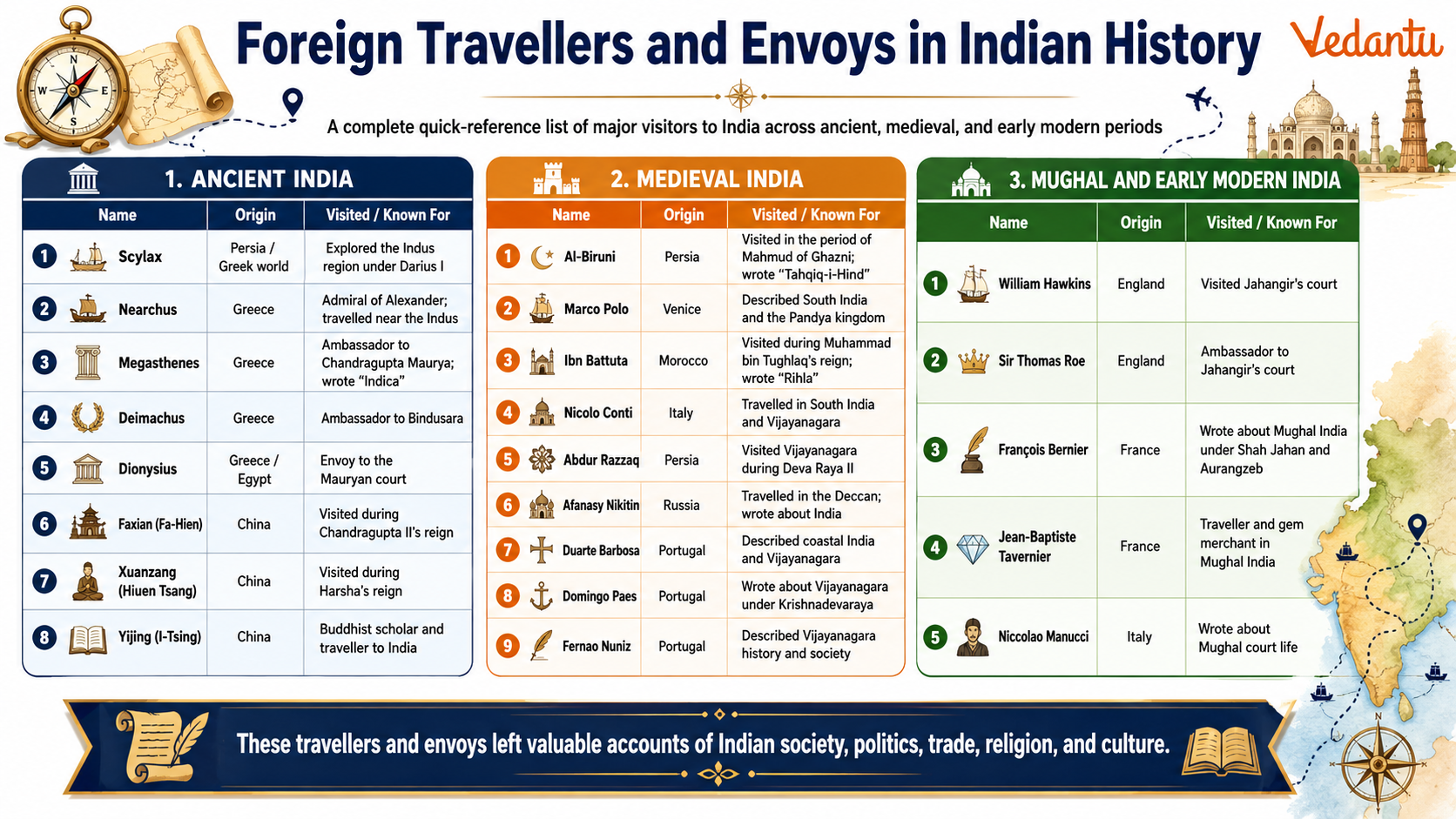
Importance of Foreign Travellers in Indian History
Foreign accounts help historians reconstruct events and daily life in India, especially when Indian sources are limited. These travellers recorded details about:
- Political administration and governance
- Social customs and traditions
- Economic activities and trade
- Religious practices and education systems
- Urban planning and architecture
Their writings serve as primary historical sources and are frequently asked about in competitive examinations.
Foreign Travellers in Ancient India
Major Foreign Travellers of Ancient India
| Name | Country | Period and Contribution |
|---|---|---|
| Megasthenes | Greece | Ambassador of Seleucus to Chandragupta Maurya - Wrote Indica |
| Deimachus | Greece | Ambassador to Bindusara |
| Dionysius | Greece | Sent to Ashoka's court |
| Fa Hien | China | Visited during Chandragupta II - Focused on Buddhism |
| Hiuen Tsang | China | Visited during Harsha's reign - Detailed account of India |
| I Tsing | China | Provided details about Nalanda and Buddhist practices |
Megasthenes described the Mauryan administration, society, and Pataliputra city in detail. Chinese travellers mainly focused on Buddhism, monasteries, and universities like Nalanda and Vikramashila.
Foreign Travellers in Medieval India
Major Foreign Travellers of Medieval India
| Name | Country | Period and Contribution |
|---|---|---|
| Al Beruni | Persia | Visited during Mahmud of Ghazni - Wrote Tahqiq-i-Hind |
| Marco Polo | Italy | Visited during Pandya rule - Described South India |
| Ibn Battuta | Morocco | Visited during Muhammad bin Tughlaq - Wrote Rihla |
| Abdur Razzaq | Persia | Visited Vijayanagara kingdom |
| Nicolo Conti | Italy | Visited Vijayanagara and South India |
Al Beruni provided scientific and cultural insights into Indian society. Ibn Battuta gave detailed information about the Delhi Sultanate administration. Abdur Razzaq and Nicolo Conti described the prosperity of the Vijayanagara Empire.
Foreign Travellers in Mughal India
Major Foreign Travellers of Mughal Period
| Name | Country | Period and Contribution |
|---|---|---|
| Ralph Fitch | England | Visited during Akbar's reign |
| Sir Thomas Roe | England | Ambassador of James I to Jahangir |
| Francois Bernier | France | Visited during Aurangzeb - Described Mughal economy |
| Jean Baptiste Tavernier | France | Described trade and diamonds |
| Niccolao Manucci | Italy | Wrote Storia do Mogor |
These European travellers documented Mughal administration, court life, trade practices, and social structure. Their writings are important sources for understanding Mughal India.
Quick Revision Points
- Megasthenes - Indica - Mauryan administration
- Fa Hien - Gupta period - Buddhism
- Hiuen Tsang - Harsha's court - Detailed cultural account
- Al Beruni - Tahqiq-i-Hind - Indian sciences and religion
- Ibn Battuta - Rihla - Delhi Sultanate
- Sir Thomas Roe - Jahangir's court - Trade relations
Conclusion
The accounts of foreign travellers and envoys are essential sources for understanding Indian history. They provide first-hand observations about administration, economy, religion, and daily life across different periods. For competitive exams, it is important to remember the traveller's name, country, time of visit, and the ruler during whose reign they visited. A systematic study of these travellers helps in quick revision and better retention of historical facts.
FAQs on Foreign Travellers in Indian History – Complete List & Timeline
1. Who were the most important foreign travellers in Indian history?
The most important foreign travellers in Indian history were scholars, envoys, and merchants who recorded valuable details about India’s society, economy, and politics.
• Megasthenes – Ambassador of Seleucus I to Chandragupta Maurya
• Fa-Hien (Faxian) – Chinese Buddhist monk during Gupta period
• Hiuen Tsang (Xuanzang) – Visited during Harsha’s reign
• Al-Biruni – Persian scholar during Mahmud of Ghazni’s time
• Ibn Battuta – Moroccan traveler in Delhi Sultanate
• Marco Polo – Venetian merchant in South India
These travellers are frequently asked in GK, UPSC, SSC, and history exams.
2. Who was Megasthenes and what did he write about India?
Megasthenes was a Greek ambassador who wrote the famous book ‘Indica’ describing Mauryan India.
• Visited India during the reign of Chandragupta Maurya (4th century BCE)
• Described administration, caste system, and Pataliputra
• Provided details about Mauryan governance and society
His work is an important source for understanding the Mauryan Empire and early Indian polity.
3. What information did Fa-Hien provide about Gupta India?
Fa-Hien provided detailed information about the Gupta Empire, especially its religious and social conditions.
• Visited during the reign of Chandragupta II
• Focused on Buddhism in India
• Described law, punishment system, and public welfare
• Wrote the travel account ‘Record of Buddhist Kingdoms’
His writings highlight the prosperity and peace of the Golden Age of India.
4. Why is Hiuen Tsang important in Indian history?
Hiuen Tsang is important because he gave a detailed account of India during the reign of Harshavardhana.
• Visited India in the 7th century CE
• Studied at Nalanda University
• Wrote ‘Si-Yu-Ki’ (Records of the Western World)
• Described political administration and education system
His writings are key sources for understanding Harsha’s empire and ancient Indian education.
5. Who was Al-Biruni and what was his contribution to Indian history?
Al-Biruni was a Persian scholar who studied Indian culture and wrote the famous book ‘Kitab-ul-Hind’.
• Came to India with Mahmud of Ghazni
• Studied Sanskrit texts and Hindu philosophy
• Described Indian science, mathematics, and religion
His work is a major source for understanding medieval Indian society and culture.
6. What did Ibn Battuta write about India?
Ibn Battuta described the political and social life of India under the Delhi Sultanate.
• Visited during the reign of Muhammad bin Tughlaq
• Appointed as Qazi (judge) in Delhi
• Wrote his travel account in ‘Rihla’
• Mentioned trade, administration, and royal court life
His writings are important for understanding 14th-century India.
7. Who were the Chinese travellers to India in ancient times?
The major Chinese travellers to India were Buddhist monks who visited for religious studies.
• Fa-Hien – Gupta period
• Hiuen Tsang – Harsha’s reign
• I-Tsing – Visited Nalanda in 7th century CE
They documented Buddhism, education, administration, and Indian culture, making them crucial sources for ancient Indian history.
8. Why are foreign travellers important sources of Indian history?
Foreign travellers are important because they provide unbiased and detailed accounts of Indian society and governance.
• Described political systems and rulers
• Recorded economic activities and trade routes
• Gave insights into religion and culture
• Helped historians verify Indian sources
Their writings are essential for reconstructing ancient and medieval Indian history.
9. Who was Marco Polo and what did he observe in India?
Marco Polo was a Venetian merchant who visited South India and wrote about its trade and culture.
• Visited during the rule of the Pandya Kingdom
• Described pearl trade and coastal commerce
• Mentioned social customs and wealth
His account is useful for studying medieval South Indian trade and economy.
10. What are the most commonly asked foreign travellers in competitive exams?
The most commonly asked foreign travellers in GK and competitive exams include those linked to major dynasties.
• Megasthenes – Mauryan Empire
• Fa-Hien – Gupta Empire
• Hiuen Tsang – Harsha’s rule
• Al-Biruni – Ghaznavid period
• Ibn Battuta – Delhi Sultanate
Questions often focus on their books, rulers visited, and historical contributions in UPSC, SSC, Railways, and State PSC exams.
