






Indian Tejas vs JF-17 Thunder – Speed, Weapons, Technology and Power Comparison
The Indian Tejas Fighter Jet and the JF-17 Thunder of the Pakistan Air Force are lightweight multi-role combat aircraft developed to strengthen the air power of their respective countries. Both jets represent major milestones in indigenous defense production and strategic military capability in South Asia. While Tejas is developed by India’s Hindustan Aeronautics Limited - HAL, the JF-17 is jointly developed by Pakistan Aeronautical Complex - PAC and China’s Chengdu Aircraft Corporation. This comparison provides a detailed General Knowledge overview of their development, specifications, features, combat roles, and strategic importance.
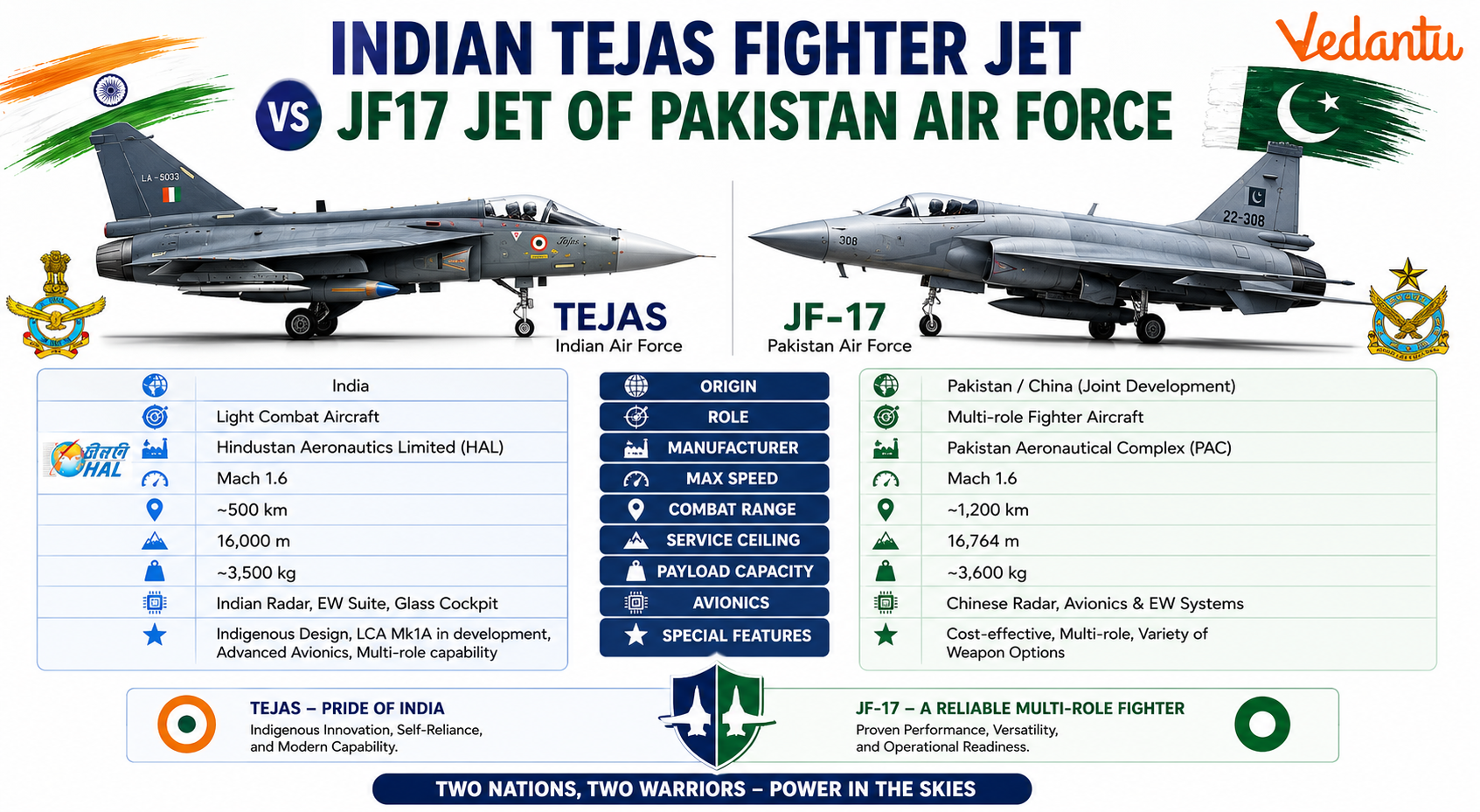
Overview of Indian Tejas Fighter Jet
The HAL Tejas is a single-engine, delta-wing, multirole light combat aircraft developed for the Indian Air Force - IAF and Indian Navy. It was designed to replace the aging MiG-21 aircraft. Tejas is known for its modern avionics, fly-by-wire system, and lightweight composite structure.
Key Features of Tejas
- Fourth generation light multirole fighter aircraft
- Powered by GE F404 or GE F414 engine depending on variant
- Advanced fly-by-wire flight control system
- Equipped with Active Electronically Scanned Array - AESA radar in newer variants
- High use of composite materials for reduced weight
- Capable of carrying air-to-air, air-to-ground, and anti-ship missiles
Overview of JF-17 Thunder Fighter Jet
The JF-17 Thunder is a lightweight, single-engine, multi-role combat aircraft developed jointly by Pakistan and China. It was created to replace older aircraft such as the Mirage III and F-7 in the Pakistan Air Force - PAF. The aircraft focuses on affordability, modern avionics, and operational flexibility.
Key Features of JF-17
- Fourth generation multirole combat aircraft
- Powered by Russian RD-93 engine
- Equipped with KLJ-7 radar and AESA radar in Block III variant
- Capable of carrying beyond visual range - BVR missiles
- Designed for cost-effective production and export
- Improved avionics and helmet mounted display system in advanced versions
Tejas vs JF-17 Comparison Table
| Parameter | HAL Tejas | JF-17 Thunder |
|---|---|---|
| Country | India | Pakistan - China |
| Engine | GE F404 or F414 | RD-93 |
| Generation | 4th Generation | 4th Generation |
| Maximum Speed | Approx 1.6 Mach | Approx 1.6 Mach |
| Radar | AESA - New Variants | AESA - Block III |
| Primary Role | Air Superiority and Strike | Multi-role Combat |
Both aircraft have similar speed and generation classification. However, differences exist in engine type, avionics architecture, and development philosophy. Tejas emphasizes indigenous technology and composite structure, while JF-17 focuses on cost-effective production with Chinese support.
Combat Capabilities Comparison
Air-to-Air Combat
Tejas is equipped with advanced air-to-air missiles such as Astra and Derby, along with modern radar systems that enhance beyond visual range combat capability. The JF-17 uses PL-12 and PL-15 missiles in newer variants, offering strong BVR performance.
Air-to-Ground and Strike Role
Both aircraft can perform ground attack missions using guided bombs and precision strike weapons. Tejas supports laser guided bombs and anti-ship missiles, while JF-17 can carry various Chinese precision guided munitions.
Avionics and Technology
Tejas uses a digital fly-by-wire control system and glass cockpit with multifunction displays. The JF-17 Block III features modern avionics, helmet mounted display, and upgraded electronic warfare systems. Both aircraft are being upgraded continuously to match evolving combat requirements.
Strategic Importance
The Tejas program strengthens India's self-reliance in defense manufacturing under the Make in India initiative. It reduces dependence on foreign fighter aircraft imports and enhances technological expertise.
The JF-17 program enhances Pakistan’s defense production capability and provides an affordable fighter option for export markets. It strengthens defense cooperation between Pakistan and China.
Advantages and Limitations
Advantages of Tejas
- High composite material usage reduces weight
- Modern indigenous avionics and radar upgrades
- Strong government support and expansion plans
Advantages of JF-17
- Cost-effective production
- Export oriented fighter aircraft
- Continuous upgrades with Block I, II, and III variants
Conclusion
The Indian Tejas Fighter Jet and the JF-17 Thunder are significant achievements in indigenous defense production for India and Pakistan respectively. Both aircraft belong to the fourth generation category and are designed as lightweight multirole fighters. While Tejas focuses on technological self-reliance and advanced composites, the JF-17 emphasizes affordability and export potential. Understanding their differences and similarities is important for General Knowledge, defense studies, and competitive examinations. Their development reflects the strategic priorities and defense ambitions of both nations in South Asia.
FAQs on Indian Tejas Fighter Jet vs JF-17 Thunder: Detailed Comparison for Students
1. What is the main difference between Indian Tejas and JF-17 fighter jets?
The main difference between HAL Tejas and JF-17 Thunder lies in their design origin, technology, and avionics systems.
• Tejas is an indigenously developed Indian light combat aircraft by HAL (Hindustan Aeronautics Limited).
• JF-17 is jointly developed by Pakistan Aeronautical Complex (PAC) and China’s Chengdu Aircraft Corporation.
• Tejas uses advanced Israeli and Western avionics, while JF-17 primarily uses Chinese systems.
• Tejas features a higher percentage of composite materials, making it lighter and stealthier.
This comparison is often searched under topics like Tejas vs JF-17 comparison, India vs Pakistan fighter jets, and light combat aircraft differences.
2. Which jet is more advanced: Tejas or JF-17?
The HAL Tejas is generally considered more technologically advanced than the JF-17 Thunder.
• Tejas has a modern Glass Cockpit and Fly-by-Wire system.
• It uses advanced AESA radar (in Tejas Mk1A).
• Higher use of carbon-fiber composites enhances durability and stealth.
• JF-17 Block III also features AESA radar but relies heavily on Chinese components.
In defense analysis and competitive exams, Tejas is often highlighted for its superior avionics and electronic warfare capabilities.
3. What is the maximum speed of Tejas and JF-17?
Both Tejas and JF-17 have similar top speeds of around Mach 1.6 (approximately 1,975 km/h).
• Tejas: Maximum speed ≈ Mach 1.6.
• JF-17: Maximum speed ≈ Mach 1.6.
• Both are classified as supersonic light combat aircraft.
Speed comparison is commonly asked in GK exams, defense awareness tests, and topics like fighter jet speed comparison.
4. Which country manufactures Tejas and JF-17?
The Tejas fighter jet is manufactured by India, while the JF-17 Thunder is produced by Pakistan with China’s support.
• Tejas is developed by HAL under India’s DRDO program.
• JF-17 is jointly developed by PAC Pakistan and Chengdu Aircraft Corporation, China.
• Tejas reflects India’s Make in India defense initiative.
This is a key question in topics related to indigenous fighter jets and India-Pakistan defense comparison.
5. What are the weapon capabilities of Tejas and JF-17?
Both jets are multirole fighters capable of carrying air-to-air and air-to-ground weapons.
• Tejas can carry Derby missiles, Astra missiles, bombs, and rockets.
• JF-17 can carry PL-12 missiles, anti-ship missiles, and guided bombs.
• Both support beyond-visual-range (BVR) missiles.
• Tejas Mk1A enhances India’s air superiority and strike capability.
Weapon comparison is frequently searched as Tejas vs JF-17 firepower and missile capability comparison.
6. Which jet has better radar technology?
The latest variant Tejas Mk1A is equipped with a more advanced AESA radar compared to earlier JF-17 versions.
• Tejas Mk1A uses Active Electronically Scanned Array (AESA) radar.
• JF-17 Block III also features AESA but with Chinese systems.
• AESA improves target detection, tracking, and electronic warfare.
Radar capability is a major factor in modern air combat and fighter jet performance analysis.
7. What is the role of Tejas and JF-17 in their respective air forces?
Both aircraft serve as light combat multirole fighters in their respective air forces.
• Tejas strengthens the Indian Air Force (IAF) by replacing older MiG-21 jets.
• JF-17 is a backbone aircraft of the Pakistan Air Force (PAF).
• Both perform air defense, ground attack, and reconnaissance missions.
This topic is commonly covered under IAF vs PAF comparison and defense modernization programs.
8. Which jet is more cost-effective: Tejas or JF-17?
The JF-17 is generally considered slightly more cost-effective, while Tejas offers advanced technology at a competitive price.
• Estimated cost of Tejas: Around $40–45 million.
• Estimated cost of JF-17: Around $25–35 million.
• Tejas provides better Western avionics and composite structure.
Cost comparison is important in discussions about defense budget and fighter jet procurement.
9. Why is Tejas important for India’s defense sector?
The Tejas fighter jet is crucial for strengthening India’s indigenous defense manufacturing capabilities.
• Promotes self-reliance (Atmanirbhar Bharat).
• Reduces dependence on foreign aircraft imports.
• Enhances India’s aerospace technology and research.
• Boosts exports and global defense partnerships.
Tejas is often discussed in exams under Make in India defense projects and Indian military modernization.
10. Can Tejas and JF-17 be exported to other countries?
Yes, both Tejas and JF-17 are export-oriented fighter jets offered to friendly nations.
• JF-17 has been exported to countries like Myanmar and Nigeria.
• Tejas has received interest from countries such as Malaysia and Argentina.
• Export deals enhance geopolitical influence and defense cooperation.
This topic is relevant in discussions on fighter jet exports, global arms market, and India-Pakistan defense competition.
