






Why the August 1940 British Proposal Failed and Its Key Features
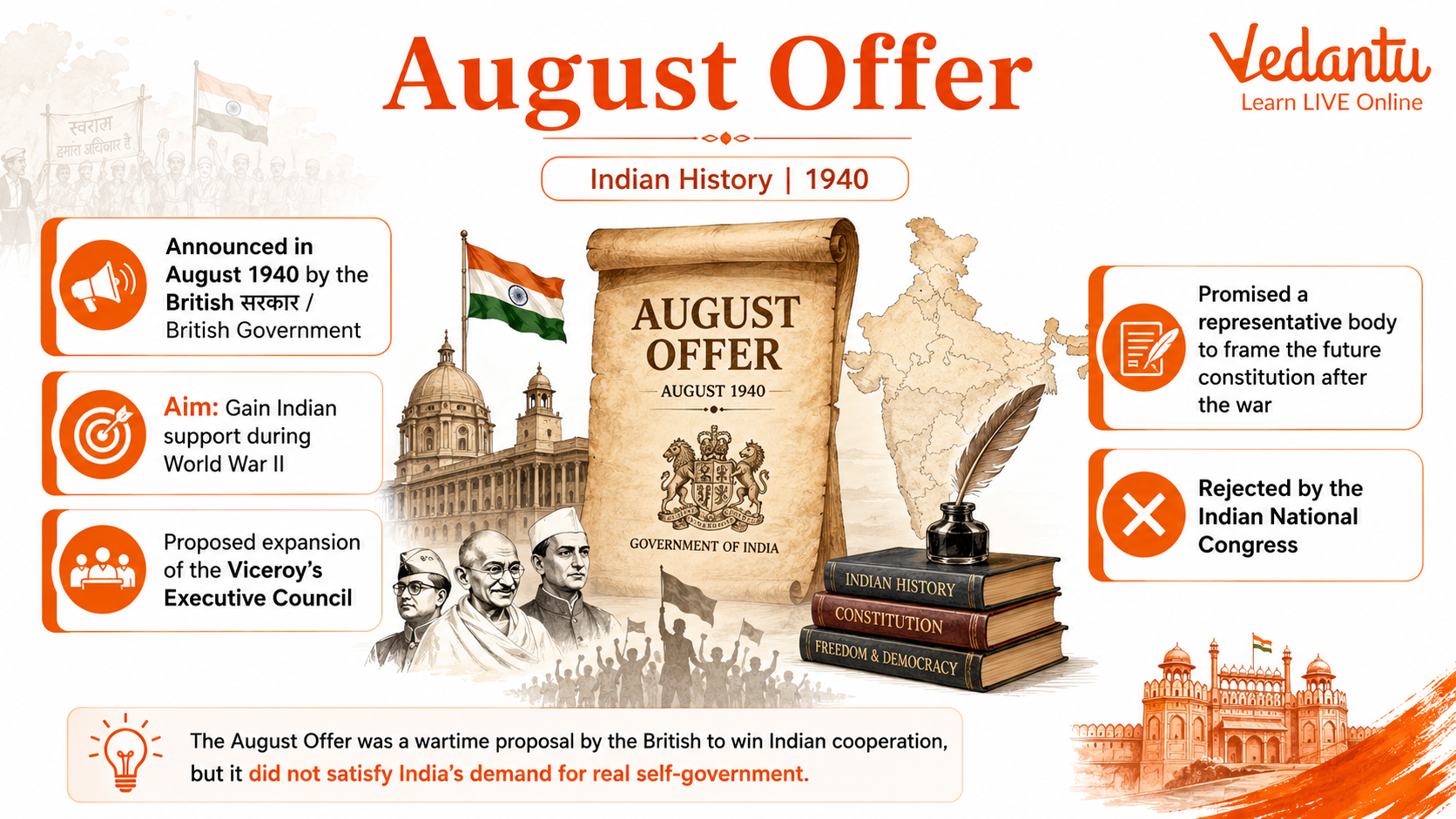
The August Offer was a significant constitutional proposal made by the British Government in 1940 during the Second World War. It was announced by the then Viceroy of India, Lord Linlithgow, on 8 August 1940. The offer aimed to secure Indian support for the British war effort by promising certain political concessions. However, it failed to satisfy Indian political leaders, especially the Indian National Congress, and played an important role in shaping the course of India’s freedom struggle. The August Offer is an important topic in modern Indian history and is frequently asked in competitive examinations.
Background of the August Offer
In September 1939, Britain declared war on Germany, marking the beginning of the Second World War. Without consulting Indian leaders, the British Government declared India a participant in the war. This unilateral decision angered Indian political parties, particularly the Indian National Congress.
In response, Congress ministries resigned from provincial governments in October 1939. The British Government realized the need to gain Indian cooperation for the war effort. To address the growing political unrest and secure support, the August Offer was introduced in 1940.
Key Provisions of the August Offer
The August Offer included several constitutional assurances and political proposals. The main provisions were as follows:
- Expansion of the Viceroy’s Executive Council to include more Indians.
- Establishment of a War Advisory Council consisting of Indian representatives.
- Promise of Dominion Status for India after the war.
- Formation of a representative body after the war to frame a new constitution for India.
- No future constitution would be adopted without the consent of minorities.
These provisions were intended to reassure Indian leaders about constitutional reforms after the war.
Objectives of the August Offer
The British Government introduced the August Offer with specific goals in mind:
- To gain political support from Indian leaders during World War II.
- To prevent large-scale protests and political instability in India.
- To assure minorities, especially Muslims, that their interests would be protected.
- To delay immediate transfer of power while making future promises.
Reaction of Indian Political Parties
Indian National Congress
The Indian National Congress rejected the August Offer. Congress demanded complete independence instead of Dominion Status. It also opposed the provision that minorities could veto constitutional decisions, as this could delay the formation of a strong central government.
Muslim League
The Muslim League welcomed the clause that no constitution would be framed without the consent of minorities. However, it was not fully satisfied because the demand for Pakistan was not clearly accepted.
August Offer 1940 - Key Facts at a Glance
| Aspect | Details | Importance |
|---|---|---|
| Date | 8 August 1940 | During World War II |
| Announced By | Lord Linlithgow | Viceroy of India |
| Main Promise | Dominion Status after war | Future constitutional reform |
The table above summarizes the essential points of the August Offer that are frequently asked in examinations.
Failure of the August Offer
The August Offer failed primarily because it did not meet the immediate demand for full independence. Congress leaders believed that the offer provided vague promises without concrete steps toward self-rule. The insistence on minority consent also created political complications.
As a result, the Congress launched the Individual Satyagraha Movement in 1940 under Mahatma Gandhi to assert the right to free speech and oppose British policies.
Significance of the August Offer
Despite its failure, the August Offer holds historical significance:
- It was the first time the British Government acknowledged that Indians would frame their own constitution.
- It strengthened the Muslim League’s political position by recognizing minority consent.
- It paved the way for later proposals such as the Cripps Mission of 1942.
- It highlighted the growing demand for complete independence.
Comparison with Other Constitutional Proposals
The August Offer was one of several constitutional proposals made by the British Government during the freedom struggle. Compared to earlier reforms, it offered more recognition of Indian participation but still fell short of granting immediate self-government.
Its limited scope and conditional promises made it unacceptable to major political groups, which eventually intensified the demand for complete independence.
Conclusion
The August Offer of 1940 was an important event in modern Indian history. Announced during World War II, it attempted to secure Indian cooperation by promising constitutional reforms and Dominion Status after the war. However, its vague assurances and failure to address the demand for full independence led to its rejection by the Indian National Congress. Although unsuccessful, the August Offer marked a significant step in the constitutional negotiations between the British Government and Indian leaders and contributed to the momentum of the freedom movement.
FAQs on August 1940 Offer: Explanation, Background and Impact on Indian Freedom Movement
1. What was the August Offer of 1940?
The August Offer (1940) was a proposal made by the British government to secure Indian support during World War II.
- Announced on 8 August 1940 by Lord Linlithgow, the Viceroy of India.
- Promised expansion of the Viceroy’s Executive Council.
- Assured that Indians would frame their own Constitution after the war.
- Recognized the right of minorities to be consulted in constitutional reforms.
It is an important event in the history of the Indian National Movement and is often asked in competitive exams.
2. Why was the August Offer introduced by the British government?
The main purpose of the August Offer was to gain Indian cooperation in World War II.
- Britain needed political and military support from India.
- The Indian National Congress had demanded greater self-governance.
- Rising nationalist movements pressured the British administration.
- The war situation forced Britain to make constitutional promises.
Thus, the offer was a strategic move to manage the growing demand for Indian independence.
3. What were the main features of the August Offer?
The key features of the August Offer focused on constitutional reforms and minority safeguards.
- Expansion of the Viceroy’s Executive Council to include more Indians.
- Establishment of a War Advisory Council.
- Promise of a Constitution-making body after the war.
- Assurance that no future constitution would be imposed without minority consent.
These provisions aimed to address demands for self-government and political representation.
4. Who announced the August Offer and when?
The August Offer was announced by Lord Linlithgow on 8 August 1940.
- He was the Viceroy of India during World War II.
- The declaration was made on behalf of the British Government.
- It came after consultations in London regarding India’s role in the war.
This announcement marked a significant phase in the constitutional developments of colonial India.
5. How did the Indian National Congress respond to the August Offer?
The Indian National Congress rejected the August Offer as inadequate.
- It did not grant immediate self-rule (Swaraj).
- Defense powers remained under British control.
- The promise of constitution-making was vague and post-war.
- Leaders like Mahatma Gandhi opposed the proposal.
This rejection eventually led to the launch of the Individual Satyagraha Movement (1940).
6. What was the reaction of the Muslim League to the August Offer?
The All-India Muslim League accepted the August Offer more positively than Congress.
- It welcomed the recognition of minority rights.
- The clause ensuring no constitution without minority consent supported its demand.
- Strengthened the League’s demand for separate representation.
This response further widened the political gap between the Congress and the Muslim League.
7. What is the significance of the August Offer in Indian history?
The August Offer (1940) is significant as it marked the first official recognition of Indians framing their own constitution.
- Acknowledged the principle of constitution-making by Indians.
- Highlighted the importance of minority safeguards.
- Led to the Individual Satyagraha movement.
- Set the stage for later proposals like the Cripps Mission (1942).
It remains a crucial topic in the study of the freedom struggle of India.
8. How did the August Offer differ from the Cripps Mission?
The August Offer (1940) and the Cripps Mission (1942) were both wartime proposals but differed in scope and clarity.
- August Offer promised constitutional reforms after the war; Cripps Mission offered Dominion Status.
- Cripps provided a clearer framework for a Constituent Assembly.
- August Offer focused more on minority consent and executive expansion.
Both proposals aimed to secure Indian support in World War II but failed to satisfy Congress demands.
9. What was the Individual Satyagraha Movement related to the August Offer?
The Individual Satyagraha Movement (1940) was launched by Congress after rejecting the August Offer.
- Initiated by Mahatma Gandhi.
- First Satyagrahi was Vinoba Bhave.
- Focused on the right to free speech against war.
- Aimed to show peaceful opposition to British policies.
This movement highlighted dissatisfaction with the August Offer proposals.
10. Why did the August Offer fail?
The August Offer failed because it did not meet the core demands of Indian leaders.
- No promise of immediate complete independence.
- Defense remained under British authority.
- Congress found the constitutional promises vague.
- Political divisions between Congress and the Muslim League persisted.
As a result, the offer could not resolve the growing demand for Swaraj and self-governance in India.
