






Major Kingdoms and Cultural Heritage in Ancient Bihar
Ancient History of Bihar holds a central place in Indian civilization. The region, known in ancient times as Magadha and Videha, was the cradle of powerful empires, major religious movements like Buddhism and Jainism, and renowned educational centers such as Nalanda and Vikramshila. Bihar played a decisive role in shaping India’s political structure, culture, economy, and spiritual traditions. Understanding the ancient history of Bihar is important for students, competitive exam aspirants, and general readers as it frequently appears in General Knowledge and state-level examinations.
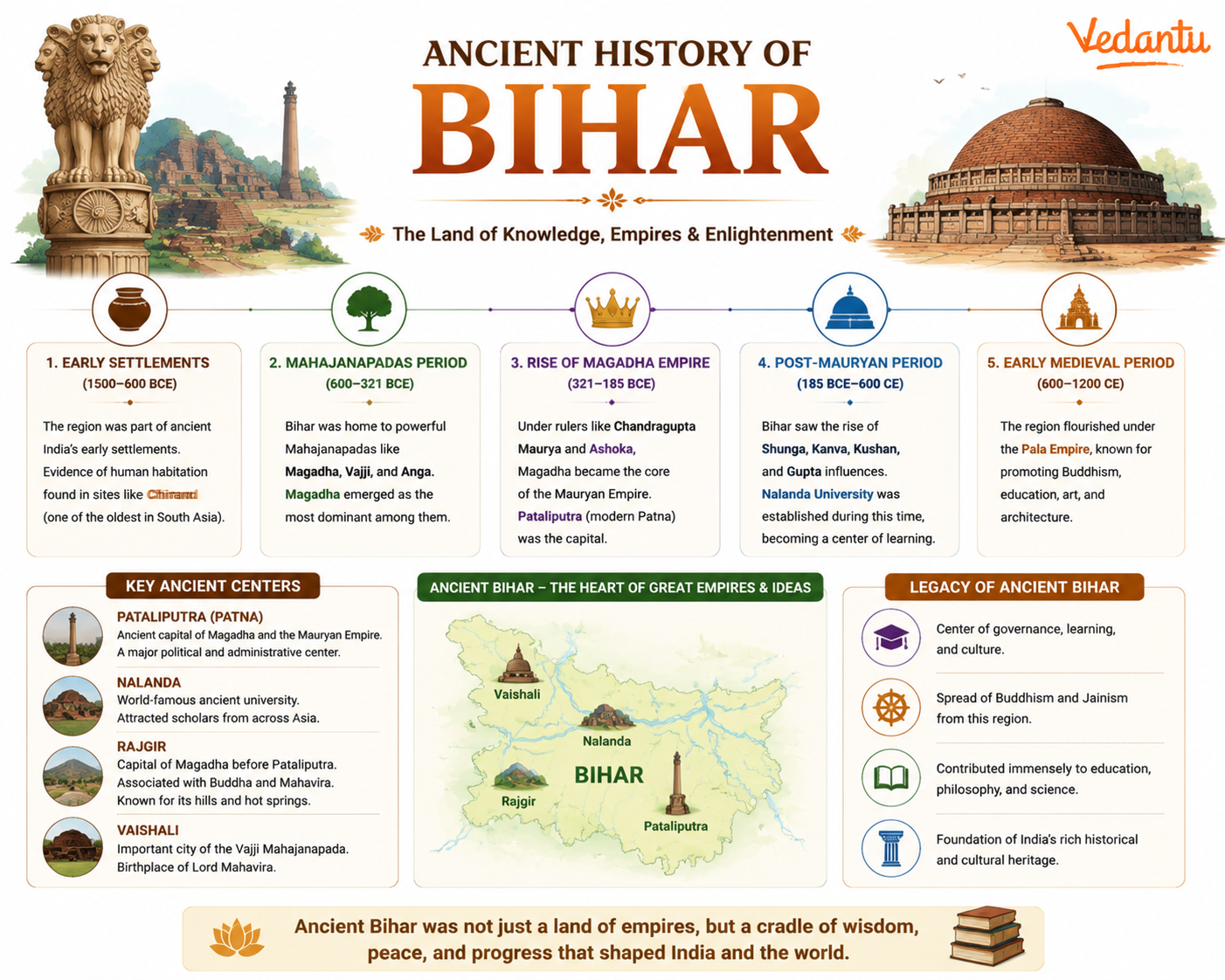
Geographical Importance of Ancient Bihar
Ancient Bihar was strategically located in the fertile Gangetic plains. The presence of rivers like the Ganga, Son, Gandak, and Kosi made agriculture prosperous and supported early settlements. The region’s natural resources, fertile soil, and trade routes helped Magadha emerge as a dominant political power.
- Fertile alluvial soil suitable for agriculture
- Availability of iron ore in nearby regions
- River transport and trade facilities
- Natural defense due to rivers and forests
Early Kingdoms in Bihar
Kingdom of Videha
Videha, with its capital at Mithila, was one of the earliest kingdoms in ancient Bihar. It is mentioned in the Vedic texts and is associated with King Janaka, who is referred to in the Ramayana. Mithila became a center of learning and philosophy.
Kingdom of Magadha
Magadha emerged as the most powerful kingdom in ancient India. With capitals at Rajgir and later Pataliputra, Magadha expanded under various dynasties and laid the foundation for large empires.
Major Dynasties of Ancient Bihar
| Dynasty | Founder | Capital |
|---|---|---|
| Haryanka Dynasty | Bimbisara | Rajgir |
| Shishunaga Dynasty | Shishunaga | Vaishali |
| Nanda Dynasty | Mahapadma Nanda | Pataliputra |
| Maurya Dynasty | Chandragupta Maurya | Pataliputra |
| Gupta Dynasty | Sri Gupta | Pataliputra |
These dynasties transformed Bihar into a political and cultural center of ancient India. The Maurya and Gupta empires, in particular, are considered golden periods in Indian history.
Rise of the Mauryan Empire
The Mauryan Empire was founded by Chandragupta Maurya in 322 BCE with Pataliputra as its capital. Under Ashoka, the empire reached its greatest extent. After the Kalinga War, Ashoka embraced Buddhism and spread it across Asia.
- Centralized administration system
- Efficient taxation and revenue policies
- Spread of Buddhism through missions
- Construction of pillars and stupas
Gupta Period - The Golden Age
The Gupta dynasty, originating in Bihar, marked a golden age in Indian history. Significant advancements were made in science, mathematics, astronomy, literature, and art. Scholars like Aryabhata belonged to this period.
- Development of the decimal system
- Growth of classical Sanskrit literature
- Peace and prosperity under Chandragupta II
Religious Significance of Ancient Bihar
Buddhism
Bihar is closely associated with Buddhism. Gautama Buddha attained enlightenment at Bodh Gaya. Important Buddhist councils were held in Rajgir and Vaishali.
Jainism
Lord Mahavira, the 24th Tirthankara of Jainism, was born in Vaishali. Bihar became an important center for the spread of Jain teachings.
Ancient Universities of Bihar
Nalanda University
Nalanda was one of the world’s first residential universities. It attracted students from China, Korea, Tibet, and other regions. Subjects like medicine, astronomy, philosophy, and grammar were taught here.
Vikramshila University
Established by the Pala rulers, Vikramshila was another major center of Buddhist learning. It contributed significantly to the spread of Tantric Buddhism.
Important Ancient Sites in Bihar
- Bodh Gaya - Enlightenment place of Buddha
- Rajgir - Ancient capital of Magadha
- Vaishali - Early republic and Jain center
- Nalanda - Ancient educational hub
Importance for Competitive Exams
Ancient History of Bihar is important for state PSC exams, SSC, UPSC, railway exams, and other competitive tests. Questions are commonly asked about Magadha, Mauryan rulers, Ashoka’s policies, Gupta achievements, and ancient universities.
- Focus on timelines and dynasties
- Remember capitals and founders
- Understand religious contributions
- Revise important archaeological sites
Conclusion
Ancient Bihar was a powerful political center, a cradle of major religions, and a hub of education and culture. From the rise of Magadha to the glory of the Mauryas and Guptas, Bihar significantly influenced Indian and world history. A clear understanding of its dynasties, religious movements, and educational institutions helps build strong General Knowledge and prepares students effectively for competitive examinations.
FAQs on Ancient History of Bihar – Complete Guide for Students
1. What is the importance of Bihar in Ancient Indian History?
Bihar was the political, cultural, and religious center of Ancient India, shaping early Indian civilization and empires.
• It was home to powerful dynasties like the Magadha Empire, Maurya Empire, and Gupta Empire.
• Major religions like Buddhism and Jainism originated here.
• Ancient universities such as Nalanda and Vikramshila were located in Bihar.
• Cities like Pataliputra became major political capitals.
Due to these contributions, Ancient Bihar is often called the cradle of Indian civilization (People Also Ask: Why is Bihar important in ancient history?).
2. Which ancient kingdom was the most powerful in Bihar?
The Magadha Kingdom was the most powerful ancient kingdom in Bihar and played a key role in Indian history.
• Founded by rulers like Bimbisara and Ajatashatru.
• Expanded under the Nanda Dynasty.
• Became the base of the Mauryan Empire under Chandragupta Maurya.
• Capital city: Rajgir and later Pataliputra.
Magadha’s military strength, fertile land, and strategic location helped it dominate northern India.
3. What was the role of Bihar in the rise of Buddhism?
Bihar was the birthplace and main center of Buddhism in ancient times.
• Gautama Buddha attained enlightenment at Bodh Gaya.
• He delivered sermons at Rajgir and Vaishali.
• The first Buddhist Council was held at Rajgir.
• Nalanda University became a global Buddhist learning center.
Because of these events, Bihar remains a major Buddhist pilgrimage site (People also search: significance of Bodh Gaya).
4. How is Jainism connected to Ancient Bihar?
Jainism has deep roots in Ancient Bihar as it was the region where Lord Mahavira preached.
• Mahavira, the 24th Tirthankara, was born in Vaishali.
• He attained Nirvana at Pawapuri.
• Early Jain councils were held in this region.
Bihar is therefore considered a sacred land in Jain religious history and spiritual traditions.
5. What was Pataliputra in Ancient Bihar?
Pataliputra was the ancient capital city of powerful Indian empires located in present-day Bihar.
• Capital of the Magadha, Maurya, and Gupta Empires.
• Ruled by famous kings like Ashoka and Chandragupta Maurya.
• Described by Greek ambassador Megasthenes in his book Indica.
It was one of the largest and most advanced cities of the ancient world.
6. What were the major ancient universities of Bihar?
Nalanda and Vikramshila were the most famous ancient universities in Bihar.
• Nalanda University (5th century CE) attracted students from China, Korea, and Tibet.
• Subjects included Buddhism, philosophy, astronomy, and medicine.
• Vikramshila University was established by the Pala rulers.
These institutions made Bihar a global center of ancient education and learning (PAS: ancient universities in India).
7. Who were the major rulers of Ancient Bihar?
Several powerful rulers shaped the history of Ancient Bihar through political expansion and reforms.
• Bimbisara and Ajatashatru (Magadha rulers).
• Chandragupta Maurya (Founder of Maurya Empire).
• Emperor Ashoka (Spread Buddhism worldwide).
• Samudragupta (Gupta Empire expansion).
These kings strengthened Bihar’s role in ancient Indian political history.
8. What was the contribution of the Mauryan Empire to Bihar?
The Mauryan Empire made Bihar the center of a vast Indian empire.
• Founded by Chandragupta Maurya in 322 BCE.
• Capital at Pataliputra.
• Ashoka promoted Buddhism and built stupas and pillars.
• Established efficient administration and governance.
The Mauryan period marked the golden phase of political unity in ancient Bihar.
9. What was the role of the Gupta Empire in Ancient Bihar?
The Gupta Empire brought a cultural and intellectual golden age to Bihar.
• Founded by Chandragupta I.
• Samudragupta expanded the empire widely.
• Growth of science, mathematics, art, and literature.
• Development of classical Sanskrit culture.
This period is known as the Golden Age of Ancient India (People Also Ask: Why is Gupta period important?).
10. Why is Bodh Gaya historically significant?
Bodh Gaya is historically significant as the place where Gautama Buddha attained enlightenment.
• Located in present-day Bihar.
• Site of the sacred Bodhi Tree.
• Home to the Mahabodhi Temple (UNESCO World Heritage Site).
• Major pilgrimage center for Buddhists worldwide.
Bodh Gaya remains one of the most important religious and historical sites in Ancient Bihar.
