



Prepare Class 9 Social Science Chapter 7 Elections with Solved Questions
A candidate can win a constituency without receiving more than half the votes—but how? Work through the questions below to understand electoral rules, interpret voting situations and support your answers with clear reasons.
Class 9 Social Science Chapter 7 Important MCQs with Answers
Q1. Four candidates receive the following votes: A—4,200, B—3,600, C—1,500 and D—700. Who wins under the First-Past-The-Post system?
A. Candidate A
B. Candidate B
C. Candidates A and B jointly
D. No one, because no candidate received more than half the votes
Answer: A. Candidate A.
Q2. Which pair consists of representatives directly elected by citizens in India?
A. President and Vice President
B. Lok Sabha members and Vidhan Sabha members
C. President and Rajya Sabha members
D. Vice President and Rajya Sabha members
Answer: B. Lok Sabha members and Vidhan Sabha members.
Q3. Why are electoral rolls arranged polling station-wise?
A. To record the promises made by candidates
B. To identify the voters assigned to each polling station
C. To decide which party will form the government
D. To publish the choices made by individual voters
Answer: B. To identify the voters assigned to each polling station.
Q4. Which action prevents voters from making a free electoral choice?
A. Comparing candidates’ policies
B. Attending a public debate
C. Threatening someone to vote for a particular candidate
D. Checking information about a candidate
Answer: C. Threatening someone to vote for a particular candidate.
Q5. What is psephology?
A. The study of population distribution
B. The scientific study of elections
C. The study of parliamentary buildings
D. The preparation of government budgets
Answer: B. The scientific study of elections.
Class 9 Social Science Chapter 7 Very Short Answer Questions
Q6. What is an electoral constituency?
Answer:
An electoral constituency is a defined area whose voters elect a representative to a legislative body, such as the Lok Sabha or a Vidhan Sabha.
Q7. Who is an independent candidate?
Answer:
An independent candidate contests an election without affiliation to a political party.
Q8. What does a voter indicate in a preferential voting system?
Answer:
A voter ranks candidates in order of preference, such as first choice, second choice and third choice, instead of marking only one preferred candidate.
Q9. Why must the electoral roll be checked before polling day?
Answer:
A person’s name must appear on the relevant electoral roll to vote. Checking it in advance gives the voter an opportunity to correct missing or incorrect details.
Class 9 Social Science Chapter 7 Short Answer Questions with Answers
Q10. Explain how delimitation supports fair representation.
Answer:
Population changes can make constituencies unequal in size.
Without adjustment, one representative may serve far more people than another.
Delimitation determines constituency boundaries and seat distribution within the applicable constitutional framework.
Its aim is to keep the relationship between population and representation as equal as possible.
Q11. Why must an election schedule consider factors beyond the end of a legislature’s term?
Answer:
Elections require voters, officials, security personnel and polling facilities to be available.
The Election Commission therefore considers:
Weather: Severe conditions can affect access to polling stations.
Agricultural seasons: Farming commitments can affect participation.
Examinations: Schools and staff may have educational responsibilities.
Festivals: Major celebrations can affect arrangements and attendance.
Considering these factors helps organise polling effectively.
Q12. How do political parties help voters compare their choices?
Answer:
They present policies and programmes on public issues.
They explain their development priorities through campaigns.
They communicate candidates’ positions through rallies, discussions and media.
They organise public opinion around different approaches to governance.
Voters can compare these proposals before choosing a representative.
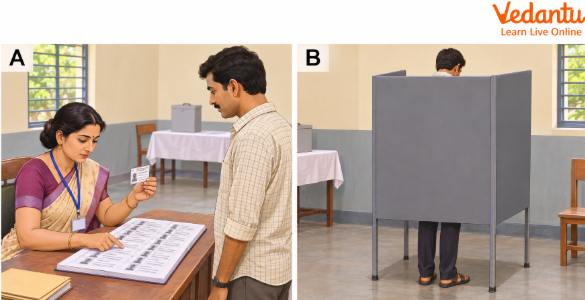
Q13. Observe pictures A and B. What is being checked in A, and what is the purpose of the arrangement in B? Why are both important?
Answer:
Picture A: The official is checking the voter’s identity and entry on the electoral roll. This helps ensure that the person votes against the correct entry.
Picture B: The voting compartment protects the secrecy of the voter’s choice.
Importance: Verification supports the integrity of polling, while privacy allows voters to choose without exposing their preference to others.
Class 9 Social Science Chapter 7 Long Answer Questions on Elections
Q14. Compare First-Past-The-Post with a party-list proportional representation system. Explain how votes are converted into seats in each.
Answer:
A party’s nationwide vote share does not automatically give it the same percentage of seats under FPTP. Also, winning one constituency is different from securing enough legislative seats to form a government
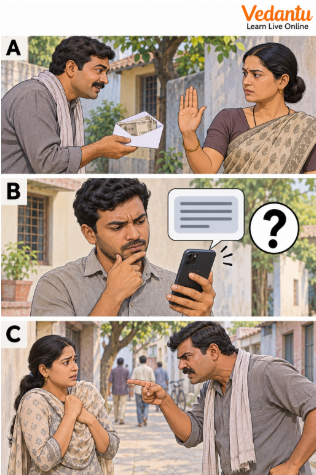
Q15. Observe the three scenes labelled A, B and C. Explain the electoral problem shown in each and suggest a suitable response.
Answer:
A—Offering money to influence a vote:
This attempts to replace an independent decision with a financial inducement. The voter should refuse the offer and report the incident through an appropriate election complaint channel.
B—Circulation of unverified information:
False or misleading messages can distort voters’ understanding. The recipient should check reliable sources and avoid forwarding the message without verification.
C—Voter intimidation:
Threats interfere with a person’s freedom to choose. The incident should be reported to election authorities or security personnel.
Free elections require voters to make choices without bribery, deception or fear. Officials and citizens both have a role in protecting these conditions.
Q16. An election is approaching. The electoral roll includes duplicate entries and names of deceased voters, while some newly eligible citizens are missing. Explain how these errors should be addressed and why the correction process must allow claims and objections.
Answer:
Verify entries: Officials should check records carefully before making changes.
Add eligible voters: Newly eligible citizens should have an opportunity to enrol.
Correct mistakes: Correct wrong personal details through the prescribed process.
Remove invalid entries: Remove verified duplicate entries and the names of deceased voters.
Allow claims and objections: People must be able to report omissions, challenge errors and respond to proposed changes.
Publish the final roll: Settle claims and objections before finalising the revised roll.
An accurate roll helps prevent invalid voting while protecting eligible citizens from wrongful exclusion.
Avoid Common Mistakes in Class 9 Social Science Chapter 7 Elections Answers
Use these Class 9 Social Science Chapter 7 important questions and answers to check the details that can change an answer.
Most votes does not mean a majority: An FPTP winner may receive less than 50% of the votes.
Votes and seats are different: A party’s vote percentage and seat percentage need not match.
Direct and indirect describe who elects: Identify whether citizens vote for the office-holder or elected representatives make the choice.
An identity document does not replace enrolment: Remember the importance of the electoral roll.
Explain the effect of unfair practices: Connect bribery with distorted choice, intimidation with fear, and misinformation with unreliable judgement.
How Vedantu’s Elections Questions Help You Practise Independently
Vedantu’s practice set combines election calculations, comparisons and real-life situations so you can check more than factual recall.
Test a rule with numbers: Solve the FPTP question before reading the answer.
Organise a comparison: Recreate the voting-systems table from memory.
Read pictures carefully: Identify the visible action, name the issue and explain its effect.
Check your reasoning: Compare your explanation with the solution and add missing links.
Revisit weak areas: Use the Class 9 Social Science Chapter 7 important questions PDF to reattempt questions you could not explain confidently.
Class 9 Social Science Chapter 7 Elections Study Materials
Use these resources alongside the solved questions for fuller explanations and textbook practice.
Class 9 Social Science Chapter-wise Important Questions
Continue with related chapters to connect elections with democracy, governance and other Social Science topics.
Important Study Materials for CBSE Class 9 Social Science
FAQs on Important Questions for Class 9 Social Science Chapter 7 Elections | 2026-27
1. Which topics should I prepare first in Class 9 Social Science Chapter 7 Elections?
Start with FPTP, direct and indirect elections, electoral rolls and delimitation. Then study election administration, political parties, voting safeguards and practices that interfere with free choice.
2. Can a candidate win an election without receiving more than half the votes?
Yes. Under FPTP, the candidate receiving the most votes in a constituency wins. For example, a candidate with 40% wins if every other candidate receives a smaller share.
3. Does a party receiving 40% of the votes automatically win 40% of Lok Sabha seats?
No. Lok Sabha seats are won constituency by constituency under FPTP. The distribution of support across constituencies affects how many seats a party wins.
4. How are direct and indirect elections different?
In direct elections, citizens choose their representatives, as in Lok Sabha elections. In indirect elections, an electoral college chooses the office-holder, as in the election of India’s President.
5. What should I include in an answer about free and fair elections?
Explain that voters need genuine choices, freedom from threats and inducements, accurate electoral rolls, voting privacy and impartial administration. Connect each safeguard with the problem it helps prevent.
6. How should I practise with the Class 9 Social Science Chapter 7 question-answer PDF?
Attempt the questions independently, then compare your answers with the solutions. Rework numerical examples, rebuild comparison tables and explain image-based situations in your own words. Use your textbook to review any concept you still find unclear.
