



Important Questions for Class 9 Social Science Chapter 3 – Atmosphere and Climate
Practise these solved questions on atmospheric composition, weather elements, India's seasonal winds, climate variations and environmental challenges.
Class 9 Social Science Chapter 3 Important Questions MCQ with Answers
Q1. A student observes that an atmospheric sample contains approximately 78% nitrogen and 21% oxygen. Which statement correctly describes the remaining portion?
(a) It consists entirely of carbon dioxide.
(b) It contains argon, carbon dioxide and other gases in smaller amounts.
(c) It consists only of water vapour.
(d) It contains equal quantities of helium and hydrogen.
Answer: (b) It contains argon, carbon dioxide and other gases in smaller amounts.
Explanation:
Nitrogen and oxygen are the two major gases in the atmosphere.
The remaining dry air contains approximately:
Argon – 0.93%
Carbon dioxide – 0.04%
Other gases – 0.03%
Water vapour is also present, but its amount varies with atmospheric conditions.
Q2. An aircraft travels through a layer of the atmosphere that has relatively stable conditions and contains the ozone layer. Which atmospheric layer is it?
(a) Troposphere
(b) Mesosphere
(c) Stratosphere
(d) Exosphere
Answer: (c) Stratosphere
Explanation:
The stratosphere lies above the troposphere and extends to approximately 50 km above the Earth's surface.
It contains the ozone layer, which absorbs harmful ultraviolet radiation.
Its relatively stable conditions make it suitable for many high-altitude aircraft operations.
Q3. During the daytime, a coastal town experiences winds blowing from the sea towards the land. What causes this movement?
(a) The sea becomes hotter than the land.
(b) The land heats faster, creating lower pressure over land.
(c) Air pressure becomes equal over land and sea.
(d) Cold air from the land rises over the sea.
Answer: (b) The land heats faster, creating lower pressure over land.
Explanation:
During the day, land heats faster than seawater.
The warm air above the land rises, creating a low-pressure area.
Cooler air from the relatively high-pressure region over the sea moves towards the land.
This movement is called a sea breeze.
Q4. Which factor mainly explains why places near the equator generally receive more solar energy than places near the poles?
(a) Greater distance from the Earth's core
(b) Higher atmospheric pressure
(c) More direct angle of incoming sunlight
(d) Greater concentration of nitrogen
Answer: (c) More direct angle of incoming sunlight.
Explanation:
Near the equator, the Sun's rays strike the Earth's surface more directly.
The energy is concentrated over a smaller area.
Towards the poles, sunlight arrives at a lower angle and spreads over a larger area.
This contributes to lower temperatures towards the poles.
Q5. Assertion–Reason Question
Assertion (A): Tamil Nadu receives significant rainfall during the retreating or north-east monsoon season.
Reason (R): North-east monsoon winds can collect moisture while passing over the Bay of Bengal and bring rainfall to the south-eastern coast of India.
Choose the correct option.
(a) Both A and R are true, and R correctly explains A.
(b) Both A and R are true, but R does not explain A.
(c) A is true, but R is false.
(d) A is false, but R is true.
Answer: (a) Both A and R are true, and R correctly explains A.
Explanation:
During the north-east monsoon, winds generally move from land towards the sea.
When these winds pass over the Bay of Bengal, they collect moisture.
They can then bring rainfall to Tamil Nadu and other parts of India's south-eastern coast.
Class 9 Social Science Chapter 3 Very Short Answer Questions
Q6. What is the atmosphere? Mention two ways it supports life on Earth.
Answer:
The atmosphere is the blanket of gases surrounding the Earth, held in place by gravity.
It supports life by:
Providing essential gases such as oxygen for living organisms.
Protecting the Earth from harmful solar radiation and helping regulate temperature.
It also plays an important role in weather and climate.
Q7. What is the difference between weather and climate?
Answer:
Weather refers to the day-to-day or hour-to-hour conditions of the atmosphere at a particular place.
Climate refers to the average weather conditions of a region over a long period, usually 30 years or more.
For example, heavy rainfall on one day describes weather, while a region having hot and dry summers describes its climate.
Q8. What is insolation? How does it influence temperature?
Answer:
Insolation is the incoming solar energy received by the Earth.
It is an important factor affecting temperature.
Areas receiving more direct sunlight generally receive more concentrated solar energy.
This helps explain why temperatures are usually higher near the equator than near the poles.
Q9. What is a carbon footprint? Give two ways to reduce it.
Answer:
A carbon footprint is the total amount of greenhouse gases released directly or indirectly through human activities.
Two ways to reduce it are:
Walking, cycling or using public transport instead of private vehicles where practical.
Switching off unused electrical appliances and reducing energy consumption.
Class 9 Social Science Chapter 3 Short Answer Questions
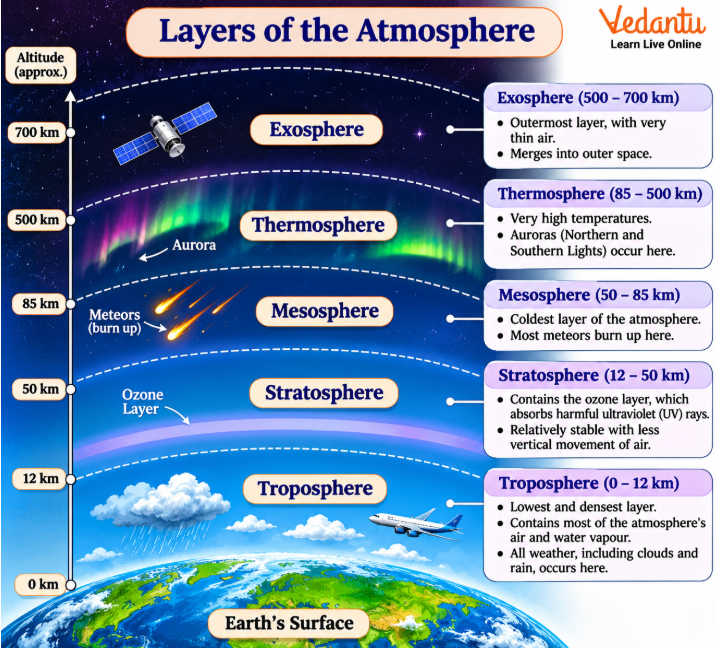
Q10. Explain the role of the five layers of the atmosphere in protecting and supporting life on Earth.
Answer:
The atmosphere consists of five major layers, each having different characteristics.
Explanation:
The troposphere supports weather processes such as rainfall, clouds and winds.
The stratosphere protects life through the ozone layer.
The mesosphere helps protect the Earth as many incoming meteors burn up there.
The thermosphere absorbs high-energy solar radiation and supports atmospheric phenomena such as auroras.
The exosphere gradually merges into outer space.
Q11. Why does atmospheric pressure decrease with altitude? Explain how temperature affects air pressure.
Answer:
Atmospheric pressure is the force exerted by the weight of air.
It generally decreases as altitude increases because there is less air above a location.
Effect of temperature:
When air becomes warm, it expands, becomes less dense and tends to rise.
Rising warm air is commonly associated with lower surface pressure.
Cold air is denser and tends to sink, often contributing to higher surface pressure.
Example:
A warm region may develop a low-pressure area, while a relatively cool region may develop higher pressure.
These pressure differences help produce winds.
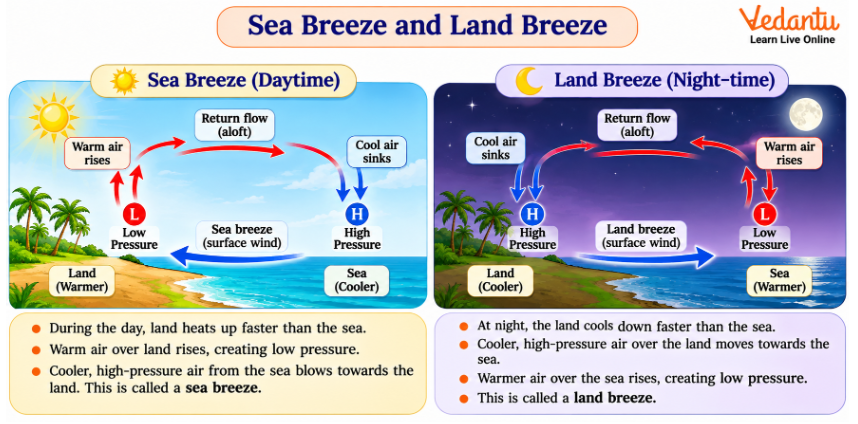
Q12. Compare sea breeze and land breeze based on their formation and direction.
Answer:
Sea breeze and land breeze are local winds caused by unequal heating and cooling of land and seawater.
Sea Breeze:
During the day, warm air rises over land.
Cooler air moves from the sea towards the land to replace it.
Land Breeze:
At night, land cools faster than seawater.
The relatively warmer air over the sea rises, and cooler air moves from land towards the sea.
Conclusion:
Both winds influence the weather of coastal areas and help moderate local temperatures.
Q13. How do humidity, temperature and precipitation affect weather conditions? Explain with examples.
Answer:
Humidity, temperature and precipitation are important elements of weather.
1. Temperature
Temperature indicates how hot or cold the air is.
It varies with seasons, altitude, and the amount of solar energy received.
2. Humidity
Humidity refers to the amount of water vapour present in the air.
High humidity makes sweat evaporate more slowly and may cause discomfort.
3. Precipitation
Precipitation occurs when moisture in the atmosphere falls to the Earth's surface.
It includes rain, snow, sleet and hail.
Example:
A warm, humid day may feel uncomfortable because sweat evaporates slowly.
When moist air cools sufficiently, water vapour can condense into clouds and may later produce rainfall.
Conclusion:
These atmospheric elements interact to determine the weather experienced at a particular place.
Q14. Explain the four major seasons of India and their general climatic characteristics.
Answer:
India has a tropical monsoon climate.
The chapter describes four major seasons recognised by the India Meteorological Department.
Explanation:
Winter: Temperatures remain relatively low, especially in north and north-western India.
Summer: Strong heating causes high temperatures over much of the country.
Monsoon: Moist south-west winds bring rainfall to large parts of India.
Post-monsoon: Rainfall reduces over most regions, while parts of southern India receive rain associated with the north-east monsoon.
Conclusion:
The seasonal movement of winds and changes in temperature influence agriculture, water availability and daily life in India.
Q15. Why does India receive rainfall from both south-west and north-east monsoons?
Answer:
The Indian monsoon is characterised by a seasonal reversal of wind direction caused largely by differences in heating and atmospheric pressure between land and sea.
South-West Monsoon:
During summer, the Indian landmass becomes warmer than the surrounding oceans.
This creates relatively low pressure over land.
Moist winds move from the Indian Ocean towards India, bringing rainfall from June to September.
North-East Monsoon:
During the cooler months, the land cools faster than the sea.
Winds generally blow from land towards the sea.
When these winds cross the Bay of Bengal, they collect moisture and can bring rainfall to India's south-eastern coast.
Comparison:
Conclusion:
India receives monsoon rainfall in different seasons because the direction and moisture content of seasonal winds change.
Q16. How does the ozone layer protect the Earth, and why is it important for living organisms?
Answer:
The ozone layer is located mainly in the stratosphere.
It protects life on Earth by absorbing much of the Sun's harmful ultraviolet radiation.
Importance of the ozone layer:
Reduces the amount of harmful ultraviolet radiation reaching the Earth's surface.
Helps protect humans and animals from excessive UV exposure.
Supports the survival of plants and other living organisms by limiting harmful radiation.
Without this protective layer, more ultraviolet radiation would reach the Earth's surface and increase risks to living organisms.
Conclusion: The ozone layer acts as an important protective shield within the atmosphere.
Q17. Explain the effects of climate change on agriculture, water resources and human life.
Answer:
Climate change refers to long-term changes in temperature, rainfall and other climate patterns.
Human activities such as burning fossil fuels, deforestation and industrial pollution increase greenhouse gas concentrations.
These gases trap additional heat in the atmosphere.
Major effects include:
1. Agriculture
Changes in rainfall and temperature can affect crop growth and agricultural production.
2. Water Resources
Changing rainfall patterns and melting glaciers can affect rivers, reservoirs and water availability.
3. Extreme Weather
Some regions may experience more intense heat, heavy rainfall, droughts or floods.
4. Human Health
High temperatures, water shortages and extreme weather can affect people's health and well-being.
5. Biodiversity
Changes in temperature and habitats can threaten plants, animals and ecosystems.
Conclusion:
Climate change affects both natural systems and human livelihoods. Reducing greenhouse gas emissions and adapting to climate risks are important responses.
Class 9 Social Science Chapter 3 Long Answer and Application-Based Questions
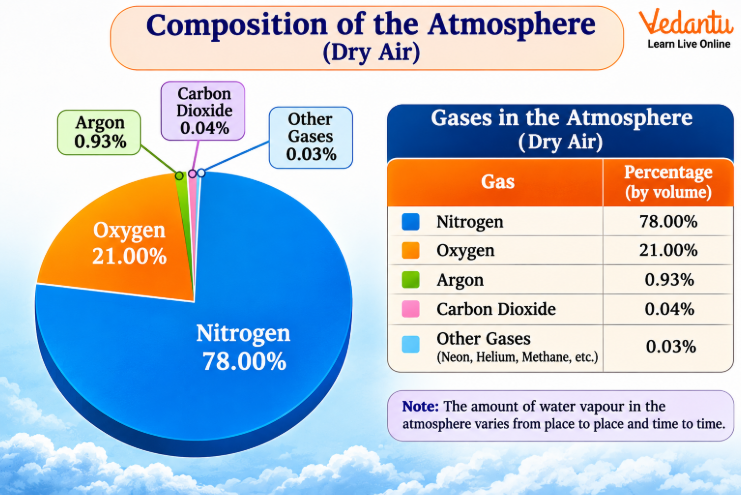
Q18. Explain the composition of the atmosphere and the importance of its major gases.
Answer:
The Earth's atmosphere contains a mixture of gases that support life and influence weather and climate.
Composition of Dry Air:
Water vapour and dust particles are also present in varying amounts.
Importance of Major Components
1. Nitrogen
Nitrogen is the most abundant gas in the atmosphere.
It is important for plant growth through the nitrogen cycle and helps maintain the balance of atmospheric gases.
2. Oxygen
Oxygen is essential for respiration in most living organisms.
It also supports combustion.
3. Carbon Dioxide
Carbon dioxide is required by plants for photosynthesis.
It is also a greenhouse gas that helps retain heat in the atmosphere.
4. Argon and Other Gases
Argon and other trace gases form a small part of atmospheric composition.
Although present in small amounts, some atmospheric gases have important roles in natural processes.
5. Water Vapour
Water vapour contributes to humidity, cloud formation and precipitation.
Its quantity changes with temperature, location and weather conditions.
Conclusion:
The atmosphere supports life through its gases and helps regulate the Earth's temperature and water cycle.
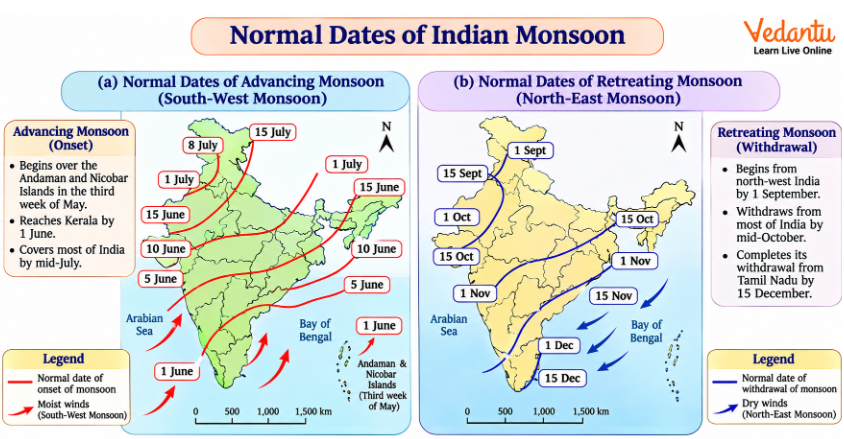
Q19. Map-Based Question: Understanding the Advance and Retreat of the Indian Monsoon
Two maps show the normal dates of the advancing south-west monsoon and retreating monsoon across India.
The first map shows monsoon winds gradually spreading across India from late May or early June.
The second map shows monsoon conditions retreating from north-western India towards other regions during September and October.
Answer the following questions:
(a) From which broad regions does the advancing south-west monsoon enter India?
(b) Why does the monsoon not arrive everywhere on the same date?
(c) Which part of India generally experiences the early withdrawal of the monsoon?
(d) Why does the south-eastern coast receive rainfall after the monsoon begins withdrawing from northern India?
Solution:
(a) Arrival of the South-West Monsoon
The south-west monsoon approaches India through the Arabian Sea and Bay of Bengal branches.
It brings moisture from surrounding water bodies.
(b) Different Arrival Dates
The monsoon advances gradually across the country.
Atmospheric circulation, landforms, and prevailing weather conditions influence its progress.
Therefore, different regions receive monsoon rainfall at different times.
(c) Early Withdrawal
The retreating monsoon generally begins withdrawing from north-western India before moving towards other regions.
(d) Rainfall in South-Eastern India
During the north-east monsoon, winds moving across the Bay of Bengal collect moisture.
These winds can bring significant rainfall to Tamil Nadu and other parts of the south-eastern coast.
Conclusion:
The advance and retreat of monsoon winds explain India's seasonal rainfall differences.
Q20. Climate Data-Based Question: Comparing Rainfall and Temperature in Indian Cities
The following table presents selected climatic data from the chapter's representative station data.
Answer the following questions:
(a) Which city receives the highest annual rainfall?
(b) Which city receives the lowest annual rainfall?
(c) Which city has the greatest difference between its January and June temperatures?
(d) Why does Mumbai have a smaller temperature difference than Delhi?
(e) Why does Chennai receive considerable rainfall during October and November?
Solution:
(a) Highest Annual Rainfall
Shillong receives the highest rainfall among these cities.
Annual rainfall = 225.3 cm
(b) Lowest Annual Rainfall
Jodhpur receives the lowest rainfall.
Annual rainfall = 36.6 cm
(c) Greatest Temperature Difference
Calculate the June minus January temperature for each city:
Mumbai: 28.9 − 24.4 = 4.5°C
Delhi: 33.3 − 14.4 = 18.9°C
Chennai: 32.5 − 24.5 = 8.0°C
Shillong: 20.5 − 9.8 = 10.7°C
Jodhpur: 33.9 − 16.8 = 17.1°C
Answer: Delhi has the greatest difference, 18.9°C, between the two selected months.
(d) Mumbai and Delhi Temperature Difference
Mumbai is located near the Arabian Sea.
The sea heats and cools more slowly than land, which moderates coastal temperatures.
Delhi is farther inland and experiences greater seasonal temperature variation.
(e) Chennai Rainfall
Chennai receives significant rainfall during October and November because of the north-east monsoon.
Moisture-bearing winds crossing the Bay of Bengal bring rainfall to the region.
Conclusion:
Climatic differences across Indian cities are influenced by latitude, altitude, distance from the sea and monsoon winds.
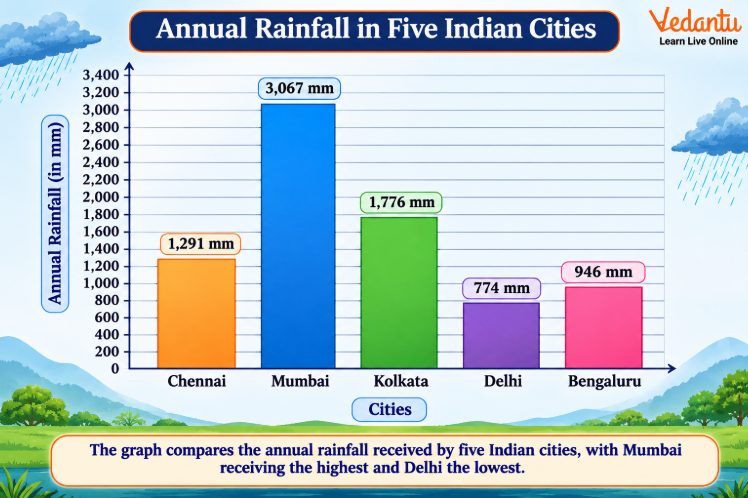
Q21. Explain the mechanism of the Indian monsoon and its importance for agriculture, water supply and the economy.
Answer:
The monsoon is a seasonal reversal of wind direction.
India's monsoon is strongly influenced by unequal heating of land and sea and related changes in atmospheric pressure.
Mechanism of the South-West Monsoon
Step 1: Summer Heating
During summer, the Indian landmass heats faster than the surrounding seas.
Step 2: Pressure Difference
A relatively low-pressure area develops over the land, while pressure over the surrounding ocean remains comparatively higher.
Step 3: Movement of Moist Winds
Moisture-bearing winds move from the ocean towards the Indian landmass.
Step 4: Rainfall
As moist air rises and cools, condensation produces clouds and rainfall.
The south-west monsoon brings rainfall to large parts of India between June and September.
Importance of Monsoon
1. Agriculture
Monsoon rainfall supplies water for sowing and growing crops.
Many farming activities depend on the timing and amount of rainfall.
2. Water Resources
Rainfall helps replenish rivers, reservoirs, lakes and groundwater.
3. Economic Activities
Agriculture-related employment, food production and rural incomes depend partly on monsoon conditions.
4. Daily Life
Monsoons influence transport, festivals, water availability and other activities.
5. Natural Hazards
Weak monsoons can contribute to droughts, while excessive rainfall can produce floods.
Conclusion:
The monsoon is a major feature of India's climate and influences agriculture, water resources and economic life across the country.
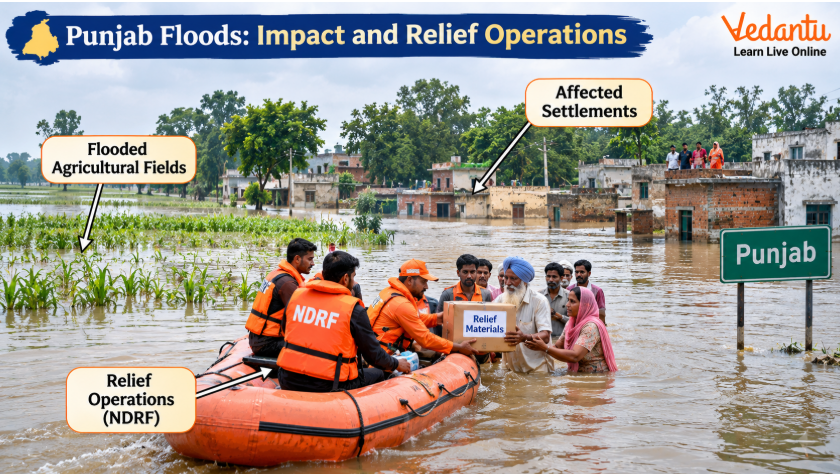
Q22. Case-Based Question: Punjab Floods of 2025
In 2025, Punjab experienced severe flooding following heavy monsoon rainfall.
The Satluj, Beas, Ravi and Ghaggar rivers carried large quantities of water.
Heavy rainfall also occurred in nearby hilly regions, increasing river flows.
The floods damaged agricultural land, homes, roads and other infrastructure.
Answer the following questions:
(a) Identify two natural factors that contributed to the floods.
(b) Explain two human-made factors that increased the damage.
(c) How did the floods affect agriculture and livestock?
(d) What health problems can develop after severe flooding?
(e) Suggest three measures that can improve flood preparedness.
Solution:
(a) Natural Factors
Two important natural causes were:
Heavy monsoon rainfall over Punjab and surrounding regions.
Increased river flows caused by rainfall in upstream areas.
Western disturbances also contributed additional rainfall during the period described in the chapter.
(b) Human-Made Factors
The chapter identifies several factors that aggravated the floods:
Weak or ageing river embankments.
Construction of houses and farms close to rivers.
Accumulation of silt in rivers and dams.
Delayed or unclear flood warnings in some areas.
These conditions increased the vulnerability of settlements and infrastructure.
(c) Effects on Agriculture and Livestock
Floodwater covered large agricultural areas and damaged crops, including paddy.
Poultry and dairy farms also suffered losses.
Some animals became sick or died, affecting rural livelihoods.
(d) Health Problems
Standing and contaminated water can create sanitation problems and increase the risk of waterborne diseases.
Displacement and damage to water supplies can also affect public health.
(e) Three Preparedness Measures
Strengthen flood monitoring, warning systems and communication.
Maintain embankments and improve river and drainage management.
Prepare evacuation plans and avoid unsafe construction in highly flood-prone areas.
Conclusion:
The Punjab floods show how intense rainfall and human-made vulnerabilities can combine to increase disaster damage.
Q23. A school wants to reduce its carbon footprint. Prepare a climate action plan focusing on transport, electricity, water and waste management. Explain how each action helps the environment.
Answer:
A carbon footprint measures greenhouse gas emissions associated with human activities.
Schools can reduce their environmental impact through changes in daily habits and resource use.
1. Transport
Encourage walking, cycling, carpooling, and using public transport where safe and practical.
Benefit: Reduces fuel consumption and emissions associated with travelling.
2. Electricity
Switch off lights, fans and electrical appliances when they are not required.
Use energy-efficient equipment whenever possible.
Benefit: Reduces electricity consumption and associated greenhouse gas emissions.
3. Water Conservation
Repair leaking taps, avoid unnecessary water use and encourage rainwater harvesting where suitable.
Benefit: Conserves water and can reduce the energy used to pump and supply it.
4. Waste Management
Encourage reusable bottles and containers.
Separate recyclable materials and reduce single-use plastics.
Benefit: Reduces waste and emissions associated with producing and disposing of materials.
5. Green Spaces
Protect existing trees and plant suitable native species where space and maintenance allow.
Benefit: Supports biodiversity, shade and environmental quality.
School Climate Action Plan
Conclusion:
Small, regular changes in school activities can help reduce emissions and build environmentally responsible habits among students.
Important Topics to Revise for Class 9 Social Science Chapter 3
Use this quick-reference table to revise the key concepts before practising the important questions.
How to Prepare Class 9 Social Science Chapter 3 Important Questions
Practise diagrams of atmospheric layers, temperature zones and local winds.
Revise the difference between weather, climate and monsoon seasons.
Read climate graphs and compare temperature and rainfall data.
Prepare cause-and-effect answers on climate change and floods.
Exam Tip: For map-based and data-based questions, read the labels, dates and units carefully before writing your answer.
Download Class 9 Social Science Chapter 3 Important Questions PDF
Download the Class 9 Social Science Chapter 3 Important Questions PDF once it is available. Until then, practise the solved MCQs, short-answer, map-based and application-based questions provided on this page.
CBSE Class 9 Social Science Chapter 3 Study Materials
Explore these study materials to strengthen your understanding of Atmosphere and Climate.
CBSE Class 9 Social Science Chapter-wise Important Questions
Practise important questions from the other chapters of Class 9 Social Science Book 1 to strengthen your understanding of Geography, History, Political Science and Economics.
Important Study Materials for CBSE Class 9 Social Science
FAQs on Important Questions and Answers for Class 9 Social Science Chapter 3 – Atmosphere and Climate | 2026–27
1. What are the main topics covered in Class 9 Social Science Chapter 3 important questions?
The main topics include the composition and layers of the atmosphere, weather and climate, temperature, humidity, air pressure, winds, Indian seasons, monsoons and climate change. Students should also practise climate data interpretation and case-based questions on environmental issues.
2. Which gas is present in the largest amount in the Earth's atmosphere?
Nitrogen is the most abundant gas, making up approximately 78% of dry air. Oxygen accounts for about 21%, while argon, carbon dioxide, and other gases make up the remaining small portion.
3. What are the five layers of the atmosphere in Class 9 Geography?
The five layers are the troposphere, stratosphere, mesosphere, thermosphere and exosphere. Each has different characteristics. For example, most weather occurs in the troposphere, the ozone layer lies mainly in the stratosphere, and auroras occur in the thermosphere.
4. Why does temperature decrease from the equator towards the poles?
The Sun's rays strike the Earth's surface more directly near the equator, concentrating solar energy over a smaller area. Towards the poles, sunlight arrives at a lower angle and spreads over a larger area. This contributes to lower temperatures in polar regions.
5. What is the difference between weather and climate in Chapter 3 Atmosphere and Climate?
Weather refers to the atmospheric conditions experienced over short periods, such as hours or days. Climate refers to the average weather conditions of a region over a longer period, usually 30 years or more. Weather changes frequently, while climate describes long-term patterns.
6. What is the difference between sea breeze and land breeze?
Sea breeze blows from sea to land during the day because land heats faster and develops lower pressure. Land breeze blows from land to sea at night because land cools faster than the sea. Both are local winds caused by temperature and pressure differences.
7. Why is the ozone layer important for life on Earth?
The ozone layer absorbs much of the Sun's harmful ultraviolet radiation. It reduces excessive UV exposure at the Earth's surface and helps protect humans, animals and plants from harmful effects.
8. What are the four main seasons of India explained in Class 9 Social Science Chapter 3?
The four main seasons are winter, summer or pre-monsoon, south-west monsoon and post-monsoon. These seasons differ in temperature, rainfall and prevailing wind patterns. The monsoon season brings much of India's annual rainfall.
9. Why does Chennai receive considerable rainfall during October and November?
Chennai receives significant rainfall during the north-east monsoon. Winds moving across the Bay of Bengal collect moisture and bring rainfall to Tamil Nadu and other parts of the south-eastern coast after the south-west monsoon begins retreating.
10. Why is the monsoon important for India's agriculture and economy?
Monsoon rainfall provides water for crop cultivation and replenishes rivers, reservoirs and groundwater. It influences agricultural production, employment and rural incomes. Excessive rainfall may cause floods, while insufficient rainfall can contribute to droughts.
11. What types of map-based questions are important in Class 9 Social Science Chapter 3?
Students should practise reading maps showing the normal advance and retreat of monsoon winds across India. Questions may ask about monsoon arrival dates, withdrawal patterns and regional rainfall differences. Understanding map legends, directions and dates is important.
12. How do I solve climate graph questions from Atmosphere and Climate?
Read the graph's temperature and rainfall scales carefully. Identify the months with the highest and lowest values, compare seasonal patterns and calculate differences when required. Then relate the observations to location, altitude, distance from the sea and monsoon winds.
13. What are the main causes of climate change explained in Chapter 3?
The chapter explains that activities such as burning fossil fuels, deforestation and industrial pollution increase greenhouse gas concentrations. These gases trap additional heat, contributing to long-term warming and changes in climate patterns.
14. How can students reduce their carbon footprint?
Students can reduce their carbon footprint by saving electricity, using shared or non-motorised transport, reducing unnecessary consumption, reusing materials and avoiding waste. These actions support a more sustainable lifestyle.
15. What caused the Punjab floods of 2025 according to the Chapter 3 case study?
The textbook identifies heavy monsoon rainfall, additional rain associated with western disturbances and rising river levels as major natural causes. Weak embankments, construction near rivers, sediment accumulation and delayed warnings aggravated the damage.
16. How should I prepare Class 9 Social Science Chapter 3 important questions and answers for school exams?
Begin with atmospheric composition and layers, followed by weather elements and local winds. Then revise Indian seasons, monsoons and climate change. Practise diagrams, climate data questions and case-based answers to strengthen your understanding.
17. Where can I get the Class 9 Social Science Chapter 3 important questions PDF download?
The Class 9 Social Science Chapter 3 important questions PDF download section will provide solved questions for offline revision once the PDF is published. Until then, students can practise the questions and answers available on this page.
18. Which textbook contains Class 9 Social Science Chapter 3 Atmosphere and Climate?
Chapter 3, Atmosphere and Climate, is included in Understanding Society: India and Beyond – Part I. It covers atmospheric composition, weather elements, Indian monsoons, regional climate differences and environmental challenges.
