



Important Questions for Class 9 Social Science Chapter 4 – Early Humans and Beginning of Civilisation
Practise these solved questions on early human life, archaeological evidence, farming communities, writing systems, river-valley civilisations and their contributions.
Class 9 Social Science Chapter 4 Important Questions MCQ with Answers
Q1. Archaeologists discover handaxes, cleavers and animal fossils at an ancient settlement. What can these findings mainly reveal about early humans?
(a) Their system of written laws
(b) Their hunting practices, tools and ways of living
(c) Their use of paper currency
(d) Their knowledge of modern machines
Answer: (b) Their hunting practices, tools and ways of living.
Explanation:
Stone tools and fossils provide physical evidence of early human activities. Handaxes and cleavers were used for cutting, scraping and processing food.
Such discoveries help archaeologists reconstruct how humans survived before writing was invented.
Q2. Which development was the most important feature of the Neolithic Revolution?
(a) The beginning of long-distance sea trade
(b) The shift from food gathering to food production
(c) The invention of iron weapons
(d) The construction of large empires
Answer: (b) The shift from food gathering to food production.
Explanation:
During the Neolithic Revolution, humans began cultivating crops and domesticating animals.
This encouraged permanent settlements, food production, pottery making and the growth of early villages.
Q3. Which archaeological site is associated with an early agricultural village dating to about 7000 BCE in the northwestern Indian subcontinent?
(a) Bhimbetka
(b) Mehrgarh
(c) Lothal
(d) Dholavira
Answer: (b) Mehrgarh
Explanation:
Mehrgarh, located near the Bolan River in present-day Pakistan, was an important early agricultural settlement.
Its inhabitants cultivated wheat and barley, domesticated animals and built houses using sun-dried bricks.
Q4. Which early civilisation developed cuneiform writing using wedge-shaped marks on clay tablets?
(a) Egyptian civilisation
(b) Chinese civilisation
(c) Sumerian civilisation
(d) Sindhu–Sarasvatī civilisation
Answer: (c) Sumerian civilisation
Explanation:
The Sumerians developed cuneiform writing around 3200 BCE.
Scribes pressed wedge-shaped marks into damp clay tablets to record economic activities, laws, stories and other information.
Q5. Assertion–Reason Question
Assertion (A): River valleys played an important role in the growth of early Bronze Age civilisations.
Reason (R): Rivers provided water, fertile soil and opportunities for agriculture, transport and settlement.
Choose the correct option.
(a) Both A and R are true, and R correctly explains A.
(b) Both A and R are true, but R does not explain A.
(c) A is true, but R is false.
(d) A is false, but R is true.
Answer: (a) Both A and R are true, and R correctly explains A.
Explanation:
The Sindhu–Sarasvatī, Mesopotamian, Egyptian and Chinese civilisations developed in fertile river valleys.
Water availability and agricultural production supported population growth, trade and the development of cities.
Class 9 Social Science Chapter 4 Very Short Answer Questions
Q6. What is the difference between prehistory and history?
Answer:
Prehistory refers to the period before the development of writing. It is studied mainly through archaeological evidence such as tools, fossils and other material remains.
History includes periods for which written records are available, along with archaeological evidence.
Writing developed at different times in different regions, so the beginning of the historical period was not the same everywhere.
Q7. What are fossils, and why are they important for studying early humans?
Answer:
Fossils are preserved remains, traces or impressions of living organisms from the distant past.
Human fossils help researchers understand the physical features and biological evolution of our ancestors.
Together with stone tools, they provide evidence of early human life.
Q8. Who were Homo erectus and Homo sapiens?
Answer:
Homo erectus was an early human ancestor associated with upright walking, handaxes and cleavers. It was among the earliest hominins to migrate out of Africa.
Homo sapiens is the species to which modern humans belong. It developed complex technologies and gradually spread across different continents.
Q9. What are microliths? During which period were they commonly used?
Answer:
Microliths are small stone tools or blades used for activities such as hunting, cutting and processing food.
They were especially important during the Mesolithic period.
Some microliths were fixed into wooden or bone handles to create more useful tools.
Q10. What were the main writing systems of the Harappan, Sumerian and Egyptian civilisations?
Answer:
Harappan civilisation: Harappan script, also called Sindhu lipi.
Sumerian civilisation: Cuneiform script.
Egyptian civilisation: Hieroglyphic script.
The Harappan script remains undeciphered, while cuneiform and Egyptian hieroglyphs have been deciphered.
Class 9 Social Science Chapter 4 Short Answer Questions
Q11. How do archaeologists study early human life when written records are unavailable?
Answer:
Archaeologists study early human life by examining material remains discovered at ancient sites.
Important sources include:
Stone tools: Reveal hunting, cutting and food-processing activities.
Fossils: Provide evidence of human evolution and physical characteristics.
Animal bones: Help identify the animals hunted or used by early communities.
Cave paintings: Offer clues about activities, beliefs and symbolic communication.
Settlement remains: Reveal how people built shelters and organised their lives.
Archaeologists also recreate and use ancient tools experimentally to understand their possible functions.
Conclusion: Archaeological evidence helps us reconstruct human life before the invention of writing.
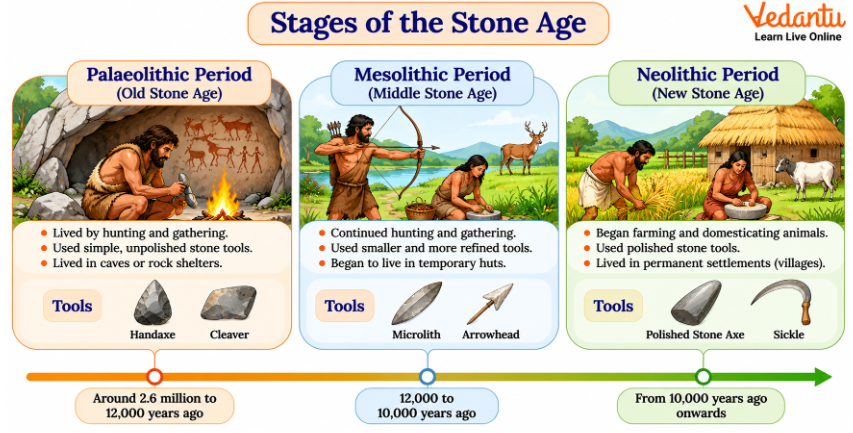
Q12. Compare the Palaeolithic, Mesolithic and Neolithic periods based on tools, food and settlements.
Answer:
The Stone Age is divided into different periods based on changes in tools, food sources and ways of living.
Conclusion: These periods show how human lifestyles gradually changed from dependence on wild resources to organised food production and settled communities.
Q13. Why is Bhimbetka important for understanding the life of early humans?
Answer:
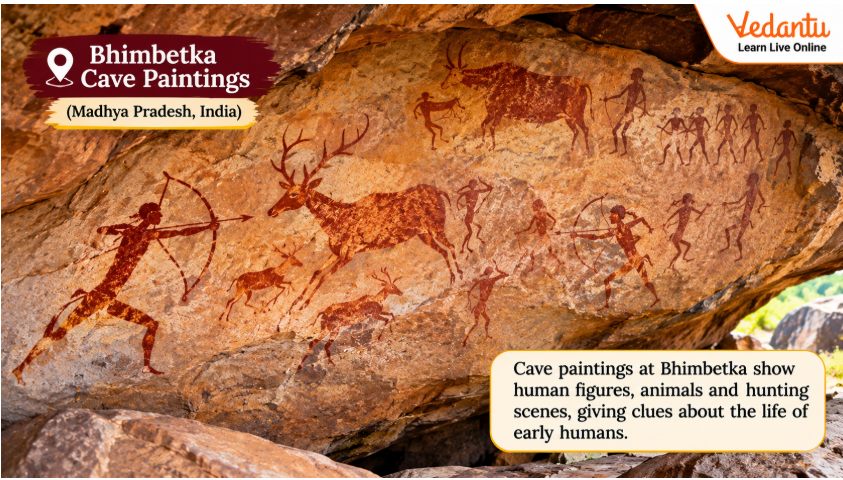
Bhimbetka in Madhya Pradesh is an important archaeological site containing hundreds of painted rock shelters.
Its importance includes:
Rock paintings provide evidence of early artistic expression.
The paintings offer clues about animals, hunting and community activities.
The shelters contain evidence of Mesolithic and earlier human occupation.
They show that early humans developed forms of symbolic communication.
Bhimbetka helps historians and archaeologists understand aspects of early human culture that cannot be studied through stone tools alone.
Q14. Why is the shift to agriculture called the Neolithic Revolution rather than a simple change?
Answer:
The Neolithic Revolution refers to the gradual transition from hunting and gathering to agriculture and animal domestication.
It is called a revolution because it changed several aspects of human life.
Major changes included:
Food production: Humans began growing crops rather than depending only on wild food.
Animal domestication: Animals were raised for food and other uses.
Permanent settlements: Farming encouraged people to remain near cultivated land.
New technologies: Polished tools, pottery and food-processing equipment developed.
Community growth: Food production supported larger settlements and greater cooperation.
These developments later contributed to the rise of towns and civilisations.
Conclusion: Although the transition occurred gradually, its long-term effects changed the course of human history.
Q15. Describe the main features of the Neolithic settlement at Mehrgarh.
Answer:
Mehrgarh was one of the earliest agricultural villages in the north-western Indian subcontinent, dating to around 7000 BCE.
Important features:
People cultivated wheat and barley.
They domesticated sheep, goats and cattle.
Houses were constructed using handmade sun-dried bricks.
Granaries were used for storing agricultural produce.
Ornaments were made from shells and semi-precious stones.
Burial practices provide evidence of social and cultural life.
By around 4000 BCE, copper objects were also being produced, marking the beginning of Chalcolithic developments at the site.
Conclusion: Mehrgarh provides evidence of the transition from farming villages towards more advanced settlements.
Q16. How did standard weights and craft production contribute to the growth of the Sindhu–Sarasvatī civilisation?
Answer:
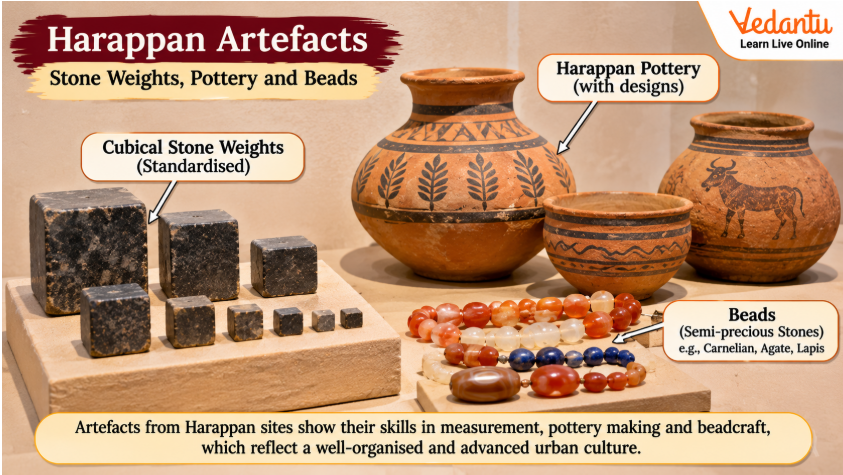
Standard weights and specialised crafts supported trade and economic organisation in the Sindhu–Sarasvatī civilisation.
1. Standard weights
Harappans used carefully made stone weights, including a binary system for smaller units.
Common units followed multiples such as 1, 2, 4, 8 and 16.
These helped merchants measure goods consistently.
2. Craft production
Harappans produced:
Pottery with different shapes and designs.
Semi-precious stone beads.
Shell bangles and ornaments.
Copper objects and tools.
3. Trade
Standard measurements supported the exchange of goods between settlements.
Specialised crafts also encouraged trade with distant regions.
Conclusion: These developments helped the growth of organised markets and early urban centres.
Q17. Explain the importance of ziggurats and cuneiform writing in Sumerian civilisation.
Answer:
Ziggurats and cuneiform writing were important features of Sumerian civilisation.
Ziggurats
A ziggurat was a large, stepped temple built in Sumerian cities.
It served as a religious centre and was closely connected with administration and economic activities.
The surrounding temple complex included important buildings and storage areas.
Cuneiform Writing
Cuneiform was developed by Sumerians around 3200 BCE.
Wedge-shaped marks were pressed into damp clay tablets.
These tablets were used to record:
Agricultural and craft activities.
Trade and other economic transactions.
Myths and religious hymns.
Laws and literary works.
Conclusion: Ziggurats organised religious and economic life, while cuneiform helped preserve information and maintain records.
Q18. How did early civilisations develop trade connections despite being located far apart? Explain with reference to Mesopotamia and the Harappans.
Answer:
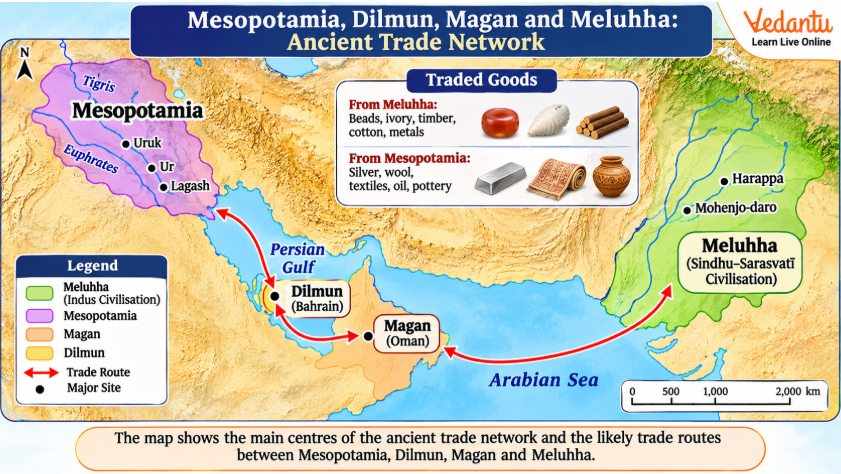
Early civilisations developed trade networks by exchanging goods through land and sea routes.
The Harappan and Mesopotamian civilisations maintained important commercial connections.
Evidence of trade:
Akkadian records mention trade with Dilmun, Magan and Meluhha.
Meluhha is generally identified with the Sindhu–Sarasvatī civilisation.
Dilmun corresponds to present-day Bahrain.
Magan is associated with the Oman peninsula.
Trade included materials such as semi-precious stone beads, ivory, timber and other valuable goods.
Importance:
Trade encouraged the movement of goods, materials and ideas between regions.
It also supported specialised crafts and economic growth.
Conclusion: The Harappan–Mesopotamian trade network shows that early civilisations were connected through commercial exchange.
Class 9 Social Science Chapter 4 Long Answer and Application-Based Questions
Q19. Explain the biological and cultural evolution of early humans. How did toolmaking and migration contribute to human development?
Answer:
Early human history involves both biological and cultural evolution.
1. Biological Evolution
Biological evolution refers to gradual physical and genetic changes across generations.
Early human ancestors evolved in Africa over millions of years.
Different hominin groups existed at different times, including Homo habilis, Homo erectus and Homo sapiens.
2. Cultural Evolution
Cultural evolution refers to changes in tools, technology, behaviour and ways of living.
Humans gradually developed:
Stone tools for cutting and processing food.
Improved hunting equipment.
Symbolic communication and cave paintings.
Farming and animal domestication.
More organised settlements.
3. Importance of Toolmaking
Stone tools helped humans perform tasks more efficiently.
Handaxes, cleavers and scrapers were used to cut meat, scrape animal hides and process materials.
Later, microliths and blades allowed more specialised activities.
4. Human Migration
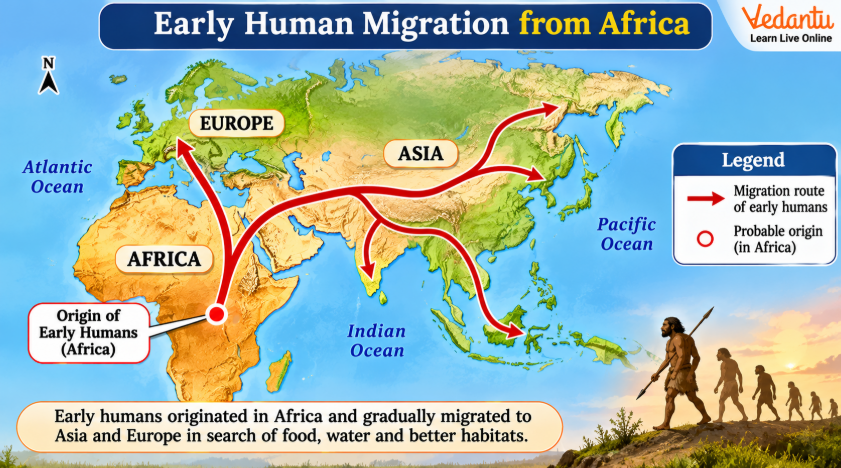
The chapter explains that Homo erectus was among the earliest human ancestors to migrate out of Africa around two million years ago.
Homo sapiens later spread across different continents.
Migration allowed humans to occupy new environments and adapt to different resources and climatic conditions.
5. Evidence of Evolution
Archaeologists study fossils, tools, settlement remains and other discoveries to understand these developments.
Conclusion:
Biological evolution changed human physical characteristics, while cultural evolution improved the ways humans adapted to their surroundings.
Q20. Explain how the Neolithic and Chalcolithic developments contributed to the emergence of the Sindhu–Sarasvatī civilisation.
Answer:
The Sindhu–Sarasvatī civilisation developed through several stages of agricultural, technological and economic growth.
Step 1: Neolithic Farming Communities
Agriculture developed at Mehrgarh around 7000 BCE.
People cultivated crops, domesticated animals and established village settlements.
Step 2: Growth of Settlements
As agricultural activities expanded, settlements became more organised.
People developed pottery, food storage and specialised tools.
Step 3: Chalcolithic Developments
Copper working developed in parts of the northwestern Indian subcontinent around 4000 BCE.
The use of copper alongside stone tools improved craft production and other activities.
Step 4: Early Harappan Phase
Early Harappan communities developed regional pottery traditions, bead-making, shell work and copper crafts.
Evidence also suggests the early development of seals, symbols and settlement walls.
Step 5: Mature Harappan Phase
By around 2600 BCE, large urban centres had emerged.
The Mature Harappan period is associated with planned settlements, trade, crafts and water-management systems.
Important Timeline
Conclusion:
The growth of farming, metalworking, trade and specialised crafts gradually created the foundation for the Sindhu–Sarasvatī urban civilisation.
Q21. Compare the four major Bronze Age civilisations based on location, writing systems and contributions.
Answer:
Four major Bronze Age civilisations developed in different river valleys.
Although they emerged independently, they shared several features such as agriculture, trade, urban settlements and specialised crafts.
Common Features
1. River-Based Agriculture
River water and fertile soils supported crop production.
2. Urban Settlements
Food production and trade encouraged the growth of towns and cities.
3. Craft Specialisation
Different communities developed pottery, metallurgy, ornaments and other crafts.
4. Administration
Growing settlements required systems for managing resources and organising society.
5. Writing Systems
Writing helped record transactions, events and cultural knowledge.
Differences
Each civilisation developed distinctive architecture, religious practices, administration and artistic traditions.
Conclusion:
The four civilisations developed independently but shared important features that shaped early urban societies.
Q22. Source-Based Question: Understanding Ancient Writing Systems
An archaeological museum displays four objects:
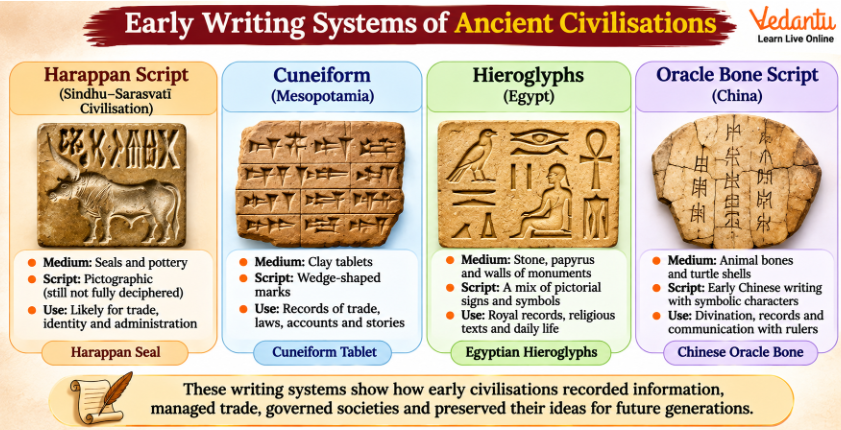
Source A: A Harappan seal containing symbols and an animal figure.
Source B: A Mesopotamian clay tablet containing wedge-shaped marks.
Source C: An Egyptian inscription containing picture-like symbols.
Source D: A Chinese animal bone with carved symbols.
Answer the following questions:
(a) Identify the writing system or source represented by each object.
(b) Which script has not yet been deciphered?
(c) How did the Rosetta Stone help scholars understand Egyptian writing?
(d) What can Chinese oracle bones reveal about early society?
(e) Why is deciphering ancient writing important for historians?
Solution:
(a) Identification
(b) Undeciphered Script
The Harappan script has not yet been deciphered.
This limits historians' ability to understand its written content.
(c) Rosetta Stone
The Rosetta Stone contained writing in three scripts, including Greek.
Because Greek could be read, scholars could compare the texts.
Jean-François Champollion made a breakthrough in deciphering Egyptian hieroglyphs in 1822.
(d) Chinese Oracle Bones
Oracle bones were used in divination practices.
Their inscriptions provide information about the beliefs, concerns and activities of early Chinese society.
(e) Importance of Decipherment
Deciphering scripts allows historians to study names, events, laws, religious beliefs and economic activities recorded by ancient people.
Conclusion:
Ancient writing provides valuable evidence about early civilisations, while undeciphered scripts leave important gaps in historical understanding.
Q23. How did the Nile River influence the development of Egyptian civilisation? Explain the role of Pharaohs, pyramids and mummification.
Answer:
The Nile River played a central role in the growth of ancient Egyptian civilisation.
1. Agriculture and Fertile Soil
The Nile flooded periodically, depositing fertile mud along its banks.
This supported crop cultivation and settlement growth.
2. Irrigation
Egyptian farmers developed ditches and reservoirs to divert and store river water.
These systems helped manage agricultural activities.
3. Organisation of Society
Large irrigation projects required cooperation and administration.
Over time, powerful rulers called Pharaohs emerged.
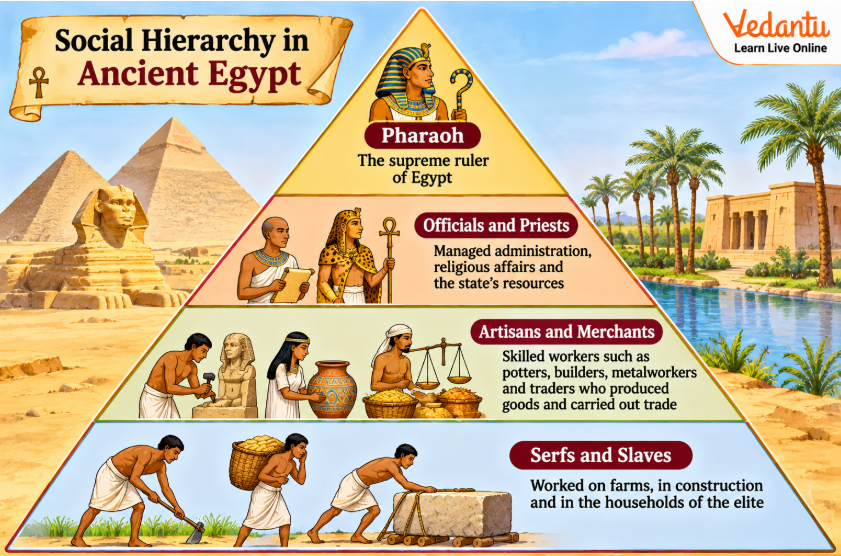
4. Pharaohs
Pharaohs were the rulers of ancient Egypt.
They occupied the highest position in the Egyptian social hierarchy.
5. Pyramids
Pyramids developed as monumental burial structures associated with powerful rulers.
The Step Pyramid at Saqqara is an important example.
6. Mummification
Egyptians believed in life after death and the survival of a spiritual double called the ka.
They preserved bodies through mummification as part of their burial practices.
7. Social Hierarchy
Egyptian society included different social groups.
Conclusion:
The Nile supported agriculture and settlement growth, while political institutions, religious beliefs and monumental architecture became important features of Egyptian civilisation.
Q24. Explain the development of Chinese civilisation and the major contributions of the Shang, Zhou, Qin and Han dynasties.
Answer:
Early Chinese civilisation developed along the Huang He and Yangtze River valleys.
Agriculture, metallurgy and craft production contributed to the growth of settlements.
1. Shang Dynasty
The Shang dynasty ruled approximately from 1600 to 1046 BCE.
Important features included:
Bronze metallurgy.
Ritual vessels and specialised crafts.
Early writing recorded on oracle bones.
Organised political and social institutions.
2. Zhou Dynasty
The Zhou dynasty ruled from approximately 1046 to 256 BCE.
The chapter describes rulers who were regarded as having authority connected with heaven.
It also mentions the careful selection of public officials.
3. Qin Dynasty
The Qin dynasty ruled from 221 to 206 BCE.
It is associated with the unification of China under an imperial system.
4. Han Dynasty
The Han dynasty lasted from 206 BCE to 220 CE.
During this period, silk became an important product in external trade.
The Silk Route helped connect China with distant regions.
Other Contributions of Chinese Civilisation
Jade carving and ornaments.
Advanced bronze objects and ritual vessels.
Development of writing.
Expansion of trade and administrative systems.
Construction and expansion of defensive walls.
Timeline
Conclusion:
Chinese civilisation developed through changes in agriculture, technology, governance and trade, leaving a lasting historical legacy.
Q25. Case-Based Question: The Opportunities and Challenges of Settling Near Rivers
A group of early farming communities decides to establish permanent settlements near a large river.
The river provides water for crops and fertile soil, but occasional floods damage homes and farmland.
As the population grows, the communities begin constructing irrigation canals, storing food and exchanging goods with nearby settlements.
Answer the following questions:
(a) Why did early communities prefer settling near rivers?
(b) What problems could floods create?
(c) How did food production support population growth?
(d) Why did irrigation systems encourage cooperation?
(e) Explain how these developments could eventually lead to civilisation.
Solution:
(a) Reasons for River Settlements
Rivers provided:
Water for drinking and agriculture.
Fertile land for crop cultivation.
Resources for daily life.
Routes for transport and trade.
(b) Problems Caused by Floods
Floods could damage houses, crops and stored food.
They could also disturb settlements and threaten people's safety.
(c) Role of Food Production
Agriculture allowed communities to produce and store food.
A more dependable food supply supported population growth and permanent settlements.
(d) Need for Cooperation
Irrigation canals and water storage systems required collective work.
Communities needed to plan construction, share water, and maintain the systems.
This encouraged organised decision-making.
(e) Development of Civilisation
As settlements expanded:
Agriculture produced food surpluses.
Different occupations and specialised crafts developed.
Trade increased between settlements.
Larger communities needed administration.
Writing and record-keeping developed in many early civilisations.
Conclusion:
Rivers offered important opportunities for agriculture and settlement, while challenges such as flooding encouraged cooperation, planning and organised community life.
Important Topics to Revise for Class 9 Social Science Chapter 4
Use this quick-reference table to recall important historical developments and civilisations.
How to Prepare Class 9 Social Science Chapter 4 Important Questions
Practise timelines showing the Stone Age and major early civilisations.
Identify tools, inscriptions, seals and artefacts from images.
Revise the differences between the four Bronze Age civilisations.
Use maps to locate major archaeological sites, rivers and trade routes.
Exam Tip: For source-based questions, first identify the object or script, then explain what historical information it provides.
Download Class 9 Social Science Chapter 4 Important Questions PDF
Download the Class 9 Social Science Chapter 4 Important Questions PDF with answers covering early human evolution, the Stone Age, the Neolithic Revolution and ancient civilisations. The PDF includes solved MCQs, short-answer, long-answer and source-based questions for offline practice and exam preparation.
CBSE Class 9 Social Science Chapter 4 Study Materials
Explore these study materials to improve your understanding of Early Humans and the Beginning of Civilisation.
CBSE Class 9 Social Science Chapter-wise Important Questions
Practise questions from other chapters to strengthen your preparation across Geography, History, Political Science and Economics.
Important Study Materials for CBSE Class 9 Social Science
FAQs on Important Questions and Answers for Class 9 Social Science Chapter 4 – Early Humans and Beginning of Civilisation | 2026–27
1. What are the most important topics in Class 9 Social Science Chapter 4?
The important topics include early human evolution, archaeological evidence, Stone Age cultures, the Neolithic Revolution, Mehrgarh, the Sindhu–Sarasvatī civilisation and the Bronze Age civilisations of Mesopotamia, Egypt and China. Students should also revise writing systems, trade connections and major historical developments.
2. What types of MCQs are important for Class 9 Social Science Chapter 4?
Important MCQs cover early human ancestors, stone tools, archaeological sites, the Neolithic Revolution, writing systems, major rivers and ancient civilisations. Assertion–reason and image-based MCQs are useful for checking conceptual understanding.
3. Why is archaeology important for understanding early human history?
Archaeology helps reconstruct human life before written records were available. Archaeologists examine fossils, stone tools, cave paintings, pottery and settlement remains to understand how people lived, worked and adapted to their surroundings.
4. What is the difference between Homo erectus and Homo sapiens?
Homo erectus was an early human ancestor associated with upright walking, stone tools and migration out of Africa. Homo sapiens is the species of modern humans, associated with increasingly complex technologies, symbolic communication and cultural developments.
5. Why is the Neolithic Revolution important in Class 9 History?
The Neolithic Revolution marked the transition from hunting and gathering to agriculture and animal domestication. It encouraged permanent settlements, food storage, specialised tools and the development of early farming communities.
6. Which archaeological sites are important in Chapter 4 Early Humans and Beginning of Civilisation?
Important sites include Bhimbetka in Madhya Pradesh, Attirampakkam in Tamil Nadu, Isampur in Karnataka, Mehrgarh in present-day Pakistan and Harappan sites such as Kalibangan, Dholavira, Harappa and Mohenjo-daro.
7. Why is Mehrgarh considered important in the history of agriculture?
Mehrgarh provides early evidence of agriculture and settled village life in the north-western Indian subcontinent. Its inhabitants cultivated wheat and barley, domesticated animals and constructed houses and storage facilities.
8. What are the differences between the Palaeolithic, Mesolithic and Neolithic periods?
The Palaeolithic period is associated with hunting, gathering and large stone tools. The Mesolithic period saw greater use of microliths and wider food resources. The Neolithic period marked the development of agriculture, domestication and increasingly permanent villages.
9. Why has the Harappan script not been deciphered?
The Harappan script remains undeciphered because scholars have not established a widely accepted interpretation of its signs. Many inscriptions are short, and no generally accepted bilingual inscription has been found to provide a reliable translation.
10. What were the major achievements of the Sumerian civilisation?
The Sumerians developed cuneiform writing, irrigation canals, ziggurats, wheeled transport and important mathematical practices. Their cities became centres of administration, trade, religion and specialised crafts.
11. What is the significance of the Code of Hammurabi?
The Code of Hammurabi was a collection of laws associated with the Babylonian ruler Hammurabi. It regulated aspects of social and civil life and provides historians with important evidence about law, justice and social differences in ancient Babylonia.
12. How did the Rosetta Stone help decipher Egyptian hieroglyphs?
The Rosetta Stone contained writing in three scripts, including Greek. Comparing the texts helped scholars understand Egyptian writing. Jean-François Champollion made a breakthrough in deciphering hieroglyphs in 1822.
13. What role did oracle bones play in early Chinese civilisation?
Oracle bones were animal bones or tortoise shells used in divination practices. Symbols were carved on them, and cracks produced by heating were interpreted. Their inscriptions provide important evidence about early Chinese beliefs and society.
14. Why did major ancient civilisations develop near rivers?
Rivers provided water, fertile soil and opportunities for agriculture, transport and trade. Food production supported permanent settlements and population growth, contributing to the development of towns, cities and administration.
15. Are map-based and source-based questions important for Class 9 Social Science Chapter 4?
Yes. Students should practise locating major early civilisations, archaeological sites, rivers and trade routes. They should also identify stone tools, Harappan seals, cuneiform tablets, Egyptian inscriptions and Chinese oracle bones from images.
16. How should students prepare Class 9 Social Science Chapter 4 important questions and answers for exams?
Begin with the stages of early human history and the Neolithic Revolution. Then revise the Harappan, Mesopotamian, Egyptian and Chinese civilisations. Practise timelines, comparison tables, maps and source-based answer questions of Social Science Class 9 Chapter 4 before attempting long answers.
17. Where can I download the Class 9 Social Science Chapter 4 Important Questions PDF?
Download the Class 9 Social Science Chapter 4 Important Questions PDF from the PDF download section on this page. It includes solved MCQs, short-answer, long-answer and source-based questions for offline practice.
18. Which textbook contains Class 9 Social Science Chapter 4 Early Humans and Beginning of Civilisation?
Chapter 4, Early Humans and Beginning of Civilisation, is part of Understanding Society: India and Beyond – Part I. It explains early human history, archaeological discoveries, the transition to farming and the development of major ancient civilisations.
