



Important Questions for Class 9 Social Science Chapter 1 – Understanding Social Science
Practise these solved questions on the four Social Science disciplines, Indian knowledge traditions, historical sources and real-life applications.
Class 9 Social Science Chapter 1 Important Questions MCQ with Answers
Q1. Which of the following best describes Social Science?
(a) The study of physical substances and chemical reactions
(b) The systematic study of human society and its interactions
(c) The study of living organisms and their biological processes
(d) The study of mathematical calculations and scientific formulas
Answer: (b) The systematic study of human society and its interactions.
Explanation:
Social Science studies how people live together and interact with their surroundings, institutions, cultures and economies.
It helps explain how societies function, develop and change over time.
Q2. A researcher studies why villages near a river depend mainly on agriculture while nearby cities focus on trade and industry. Which Social Science discipline is most directly involved?
(a) History
(b) Political Science
(c) Geography
(d) Psychology
Answer: (c) Geography
Explanation:
Geography examines how physical surroundings influence human activities.
The availability of water, fertile land, transport facilities and natural resources can affect settlement patterns and occupations.
Q3. Which of the following is an example of an epigraphic source?
(a) A handwritten travelogue
(b) An inscription carved on a stone pillar
(c) A traditional folk song
(d) An ancient coin used for trade
Answer: (b) An inscription carved on a stone pillar.
Explanation:
Epigraphic sources are inscriptions made on durable materials such as stone, metal plates and rocks.
These inscriptions provide historical information about rulers, administration, society and important events.
Q4. Assertion–Reason Question
Assertion (A): Social Science is studied through several interconnected disciplines.
Reason (R): A social issue can involve geographical, historical, political and economic factors at the same time.
Choose the correct option.
(a) Both A and R are true, and R correctly explains A.
(b) Both A and R are true, but R does not explain A.
(c) A is true, but R is false.
(d) A is false, but R is true.
Answer: (a) Both A and R are true, and R correctly explains A.
Explanation:
Social issues are rarely connected to just one factor.
For example, a drought can affect agricultural production, farmers' incomes, migration and government policies.
Different Social Science disciplines help us understand these connected effects.
Class 9 Social Science Chapter 1 Very Short Answer Questions
Q5. What is Social Science, and why is it important in everyday life?
Answer:
Social Science is the systematic study of human society, institutions, cultures and interactions.
It helps us understand how people live together, how governments function, how resources are used and how the environment influences daily life.
For example, roads, schools and public transport connect government decisions with people's everyday needs.
Q6. Name the four main disciplines of Social Science studied in Classes 9 and 10.
Answer:
The four main disciplines are:
History: Studies the human past and changes in society.
Geography: Studies the Earth, its environments and human interactions with surroundings.
Political Science: Studies governance, power, rights and responsibilities.
Economics: Studies the production, distribution and use of resources.
Together, these disciplines explain different aspects of human society.
Q7. What is the meaning of Vasudhaiva Kuṭumbakam? How does it relate to Social Science?
Answer:
Vasudhaiva Kuṭumbakam means "The world is one family."
It expresses the idea that people and societies are interconnected, even when they belong to different regions and cultures.
This connects with Social Science because the subject studies relationships, cooperation and interdependence among human communities.
Q8. What is the difference between archaeological and numismatic sources?
Answer:
Archaeological sources are physical remains of the past, such as monuments, sculptures, pottery and excavated objects.
Numismatic sources include ancient coins, currency and medals.
Archaeological sources help us understand past lifestyles and cultures, while numismatic sources provide information about trade, rulers, economies and political boundaries.
Class 9 Social Science Chapter 1 Short Answer Questions
Q9. Explain how Social Science is connected to everyday life. Give three examples.
Answer:
Social Science helps us understand the systems and activities that influence our daily lives.
1. Food and economic activities
The food we eat passes through farming, processing, transportation and markets.
These activities connect producers, traders and consumers.
2. Public services and governance
Roads, schools, electricity and water supply depend on planning, policies and public institutions.
3. Environment and settlements
Climate, landforms, water and natural resources influence where people live and what occupations they follow.
Conclusion: Social Science helps us recognise the connections between society, the economy, governance and the environment.
Q10. How did early human societies develop into towns and cities? Explain the role of continuity and change.
Answer:
Early human communities depended directly on nature for food and survival.
Over time, they developed new skills and gradually changed their ways of living.
Important developments included:
Growing crops and domesticating animals.
Developing tools and building permanent settlements.
Exchanging goods through trade.
Organising systems of governance.
Developing new ideas, technologies and cultural practices.
Villages gradually developed into towns, while some towns expanded into cities.
Continuity refers to practices and traditions that continue over time.
Change refers to developments that transform people's ways of living.
Studying both helps us understand how present-day societies developed from the past.
Q11. Explain the idea of Pañchamahābhūtas and its connection with the environment.
Answer:
Pañchamahābhūtas is an idea from Indian philosophical traditions that describes the natural world through five fundamental elements.
These are:
The concept presents nature and human life as interconnected.
It helps us understand how early Indian thinkers explored the relationship between living beings and their surroundings.
The chapter connects this idea with the influence of the environment on settlements, food habits, occupations and architecture.
Note: Pañchamahābhūtas is a philosophical framework, not the modern scientific classification of chemical elements.
Q12. What is the importance of the Arthaśhāstra in understanding Indian political and economic thought?
Answer:
The Arthaśhāstra is an ancient Indian text attributed to Kauṭilya.
It discusses important aspects of governance and economic management.
Its major areas include:
Administration and organisation of the state.
Taxation and economic management.
Defence and the responsibilities of rulers.
Public welfare and effective governance.
The text shows that systematic thinking about politics, economics and administration existed in India long before these developed as modern academic disciplines.
It also reflects the idea that political authority carries responsibilities towards society.
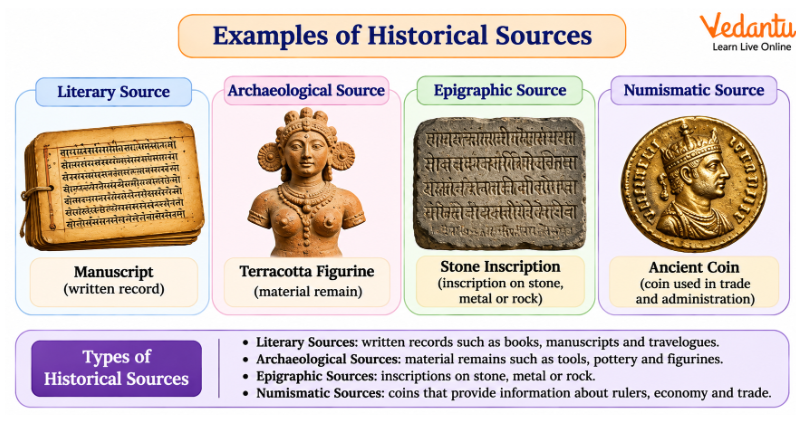
Q13. How do historians study the past using different types of evidence?
Answer:
Historians examine different sources to understand how people lived and how societies changed.
Modern historians may also use archaeological analysis, carbon-14 dating and other scientific methods.
By comparing multiple sources, historians develop explanations supported by evidence.
Q14. Explain the role of Geography in understanding the relationship between people and their surroundings.
Answer:
Geography studies the Earth, its physical features, places and the relationship between people and their environment.
It helps us understand:
Why settlements develop in particular locations.
How climate and landforms influence occupations.
Why agriculture is more suitable in some regions than others.
How transport routes and natural resources influence trade.
How environmental changes affect human life.
Geographers use tools such as maps, globes, atlases and Geographic Information Systems (GIS).
Example:
India's long coastline supported historical connections with Africa, Europe and Southeast Asia.
This shows how geographical location can influence trade and cultural interaction.
Q15. How does the Panchayati Raj system reflect the importance of Political Science in everyday life?
Answer:
Political Science studies governance, power, decision-making and the rights and responsibilities of citizens.
The Panchayati Raj system is an example of local self-governance in rural India.
It supports grassroots democracy by allowing people to participate in local decision-making.
Its importance includes:
Encouraging public participation in village development.
Addressing local needs and community issues.
Connecting citizens with local governing institutions.
Promoting accountability in public administration.
The system shows how political institutions influence everyday life.
It also reflects the importance of responsible governance and citizen participation.
Class 9 Social Science Chapter 1 Long Answer and Application-Based Questions
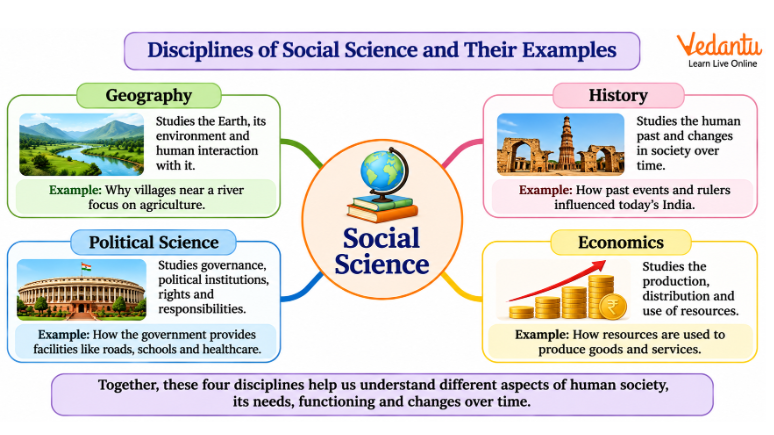
Q16. Explain the four major disciplines of Social Science. How do they work together to help us understand society?
Answer:
Social Science includes different disciplines because human society is complex and cannot be fully understood through a single field of study.
1. Geography
Geography studies the Earth, its environments and the relationships between people and their surroundings.
It explains how location, climate, landforms and resources influence human activities.
2. History
History studies the human past and explains how societies, cultures and institutions change over time.
It uses historical evidence to understand events and developments.
3. Political Science
Political Science examines governance, power, public institutions and citizens' rights and responsibilities.
It helps us understand how decisions are made and implemented.
4. Economics
Economics studies how people and societies use limited resources to meet their needs.
It examines production, distribution, exchange and economic decisions.
How are these disciplines connected?
Consider a region affected by drought.
Conclusion:
The four disciplines provide different but connected perspectives. Together, they help us understand complex social issues more completely.
Q17. A village has changed significantly over the last five years. A new road, school, health centre and market have been built. Explain how a social scientist would study these changes.
Answer:
A social scientist would investigate how the village has changed, why the changes occurred and how they affected people's lives.
Step 1: Observe the changes
The researcher would identify new facilities, changes in transport and economic activities, and developments in public services.
Step 2: Collect information
Information could be gathered through:
Interviews with village residents.
Surveys of households and local businesses.
Old photographs and official records.
Observations of roads, schools and markets.
Step 3: Compare past and present
The researcher would compare the situation five years ago with the current conditions.
For example, travel to a nearby town may have become easier after the road was constructed.
Step 4: Identify the effects
Step 5: Conclude using evidence
The researcher would examine whether these changes benefited all groups equally and identify any remaining challenges.
Conclusion:
Social Science uses observation, evidence and logical reasoning to understand how communities develop and how changes affect different people.
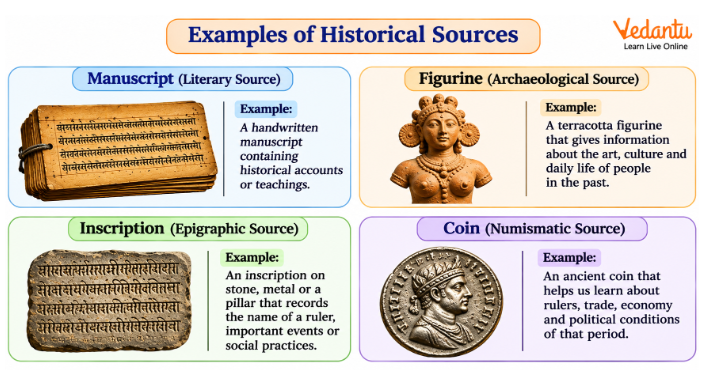
Q18. Study the following historical sources and explain what each can reveal about the past.
A museum displays four objects:
Source A: A manuscript containing religious or philosophical ideas.
Source B: A terracotta figurine discovered during an archaeological excavation.
Source C: A stone inscription recording the activities of a ruler.
Source D: An ancient coin containing a ruler's image and symbols.
Answer the following questions:
(a) Identify the type of each historical source.
(b) Which source can provide information about economic activities and political authority?
(c) Which source is useful for studying ancient art and material culture?
(d) Why should historians compare different sources before concluding?
Solution:
(a) Identify the historical sources
(b) Source D – Ancient coin
Coins can provide information about rulers, trade, currency, political authority and economic activities.
(c) Source B – Terracotta figurine
Terracotta objects can help historians understand craftsmanship, art, beliefs and aspects of daily life.
(d) Importance of comparing sources
A single historical source may provide only a limited view of the past.
Historians compare different types of evidence to check information and develop more reliable explanations.
For example, an inscription may describe a ruler's achievements, while coins and archaeological discoveries may provide additional evidence about the same period.
Conclusion:
Historical sources provide different kinds of information. Studying them together creates a fuller picture of the past.
Q19. Case-Based Question: A Drought-Affected Farming Region
A farming region experiences very little rainfall for two consecutive years. Agricultural production falls, farmers face reduced incomes, and some families move to nearby cities for employment. The government introduces water conservation programmes and financial support for affected households.
Answer the following questions:
(a) Which Social Science discipline studies the environmental causes of drought?
(b) How does drought affect the local economy?
(c) What role does Political Science play in studying government responses?
(d) Why is History useful in understanding this situation?
(e) Explain why studying this problem through only one discipline would be insufficient.
Solution:
(a) Geography
Geography helps explain rainfall patterns, water availability, climate and environmental conditions contributing to drought.
(b) Economic effects
Reduced agricultural production can lower farmers' incomes.
It may also affect employment, food supply and local trade.
(c) Political Science
Political Science examines government policies, relief programmes, public decision-making and how institutions respond to the needs of citizens.
(d) History
History helps researchers study previous droughts and understand how communities responded to water scarcity in earlier periods.
Traditional practices and past decisions may provide useful lessons.
(e) Need for multiple disciplines
Drought is not only an environmental problem.
It affects livelihoods, migration, governance and community life.
Geography explains the environmental conditions, Economics explains financial effects, Political Science examines government responses, and History provides an understanding of past experiences.
Conclusion:
Studying a social problem from different perspectives helps us understand its causes, consequences and possible responses more effectively.
Q20. How does studying Social Science prepare students to become responsible citizens and understand future challenges? Explain with examples.
Answer:
Social Science helps students understand society, recognise different perspectives and make informed decisions.
Its importance extends beyond school examinations.
1. Understanding rights and responsibilities
Political Science teaches students about governance, laws, democratic institutions and civic responsibilities.
This knowledge supports responsible participation in public life.
2. Respecting social and cultural diversity
Studying different communities, languages, traditions and beliefs helps students understand diversity and develop mutual respect.
3. Understanding environmental challenges
Geography helps explain climate change, resource use, environmental protection and sustainable development.
4. Making informed economic decisions
Economics explains how limited resources are used and how decisions affect individuals and communities.
It encourages thoughtful use of resources.
5. Learning from the past
History helps students understand how earlier decisions and developments shaped present-day society.
This knowledge supports better understanding of current challenges.
6. Understanding future changes
Technology, urban growth, migration and global connections are changing society.
Social Science helps students examine these developments through evidence, reasoning and different perspectives.
Conclusion:
Social Science connects the past, present and future. It helps students understand the world around them and become informed, thoughtful and responsible members of society.
Important Topics to Revise for Class 9 Social Science Chapter 1
Use this quick-reference table before attempting the important questions.
How to Prepare Class 9 Social Science Chapter 1 Important Questions
Learn the differences between the four Social Science disciplines.
Practise identifying historical sources from pictures and descriptions.
Use everyday examples when explaining social connections.
Write long answers with clear points and relevant examples.
Exam Tip: For application-based questions, identify the relevant discipline first, then explain its connection with the given situation.
Download Class 9 Social Science Chapter 1 Important Questions PDF
The Class 9 Social Science Chapter 1 Important Questions PDF brings together solved MCQs, short answers and application-based questions for offline revision. The PDF is regularly reviewed and updated to align with the latest syllabus.
CBSE Class 9 Social Science Chapter 1 Study Materials
Explore the following study materials to improve your understanding of Social Science.
CBSE Class 9 Social Science Chapter-wise Important Questions
Practise important questions from the other chapters of Class 9 Social Science Book 1 to strengthen your understanding of Geography, History, Political Science and Economics.
Important Study Materials for CBSE Class 9 Social Science
FAQs on Important Questions and Answers for Class 9 Social Science(Understanding Society India and Beyond PART-I) Chapter 1 – Understanding Social Science | 2026–27
1. What are the main topics in Class 9 Social Science Chapter 1 important questions?
The main topics include the meaning of Social Science, everyday social connections, Indian knowledge traditions, the four Social Science disciplines, historical sources and responsible citizenship. Students should also understand how observation, evidence and logical reasoning are used to study society.
2. Why is Social Science called the systematic study of human society?
Social Science examines human life using observation, evidence, interviews, surveys and logical reasoning. It studies relationships between people, institutions, environments and economies rather than relying only on personal opinions. This makes the study of society organised and evidence-based.
3. What are the four main disciplines covered in Class 9 Social Science Chapter 1?
The four disciplines are Geography, History, Political Science and Economics. Geography focuses on people and their environments, History studies the past, Political Science examines governance, and Economics explores the use of resources. Together, they explain different aspects of society.
4. What is the difference between archaeological, literary, epigraphic and numismatic sources?
Archaeological sources include material remains such as pottery and sculptures. Literary sources include manuscripts and written accounts. Epigraphic sources are inscriptions on durable materials, while numismatic sources include coins and currency. Each provides different evidence about the past.
5. Why are ancient coins important sources for studying history?
Ancient coins can provide information about rulers, trade, economic activities, political boundaries and cultural symbols. Their inscriptions, images and metal content help historians understand the societies that produced and used them.
6. What is the importance of the Arthaśhāstra in Understanding Social Science?
The Arthaśhāstra, attributed to Kauṭilya, discusses administration, taxation, economic management, defence and the responsibilities of rulers. It shows that systematic thinking about governance and public welfare existed in ancient India.
7. How is Geography connected to History, Political Science and Economics?
Geography explains how location, climate and natural resources influence human life. These conditions can affect historical settlements, economic activities and government decisions. For example, the availability of water can influence farming, trade and public planning.
8. What kinds of MCQs should students practise from Class 9 Social Science Chapter 1?
Students should practise MCQs on the meaning of Social Science, the four disciplines, historical sources and Indian knowledge traditions. Assertion–reason and situation-based questions are also useful because they test understanding rather than simple memorisation.
9. Are image-based questions important for Class 9 Social Science Chapter 1?
Yes. Images of manuscripts, ancient coins, inscriptions and archaeological objects can be used to test students' understanding of historical evidence. Students should practise identifying each source and explaining what information historians can obtain from it.
10. How can students write better answers to application-based Social Science questions?
Read the situation carefully and identify the main social issue. Connect it to the relevant Social Science discipline, explain the relationship and support the answer with an example. For questions involving several disciplines, show how their explanations are connected.
11. How can I use Class 9 Social Science Chapter 1 important questions and answers for revision?
Begin with MCQs and very short answers to check basic understanding. Then practise short answers using key points and examples. Finally, attempt long-answer and case-based questions independently before comparing your responses with the solutions.
12. Where can I get Class 9 Social Science Chapter 1 important questions PDF download?
The Class 9 Social Science Chapter 1 important questions PDF download section will provide the solved questions for offline revision once the PDF is published. Students can use the questions on this page until the download becomes available.
13. How does studying Social Science help students become responsible citizens?
Social Science helps students understand rights, responsibilities, democratic institutions and public issues. It also develops awareness of cultural diversity, environmental concerns and economic challenges, supporting informed and responsible participation in society.
14. Which textbook covers Class 9 Social Science Chapter 1 Understanding Social Science?
Class 9 Social Science Chapter 1, Understanding Social Science, is included in the textbook Understanding Society: India and Beyond – Part I. The chapter introduces the main disciplines of Social Science and explains how they help us understand human society, its history, environment, governance and economic activities.
