



Practise Class 9 Social Science Chapter 6 Important Questions on Democracy
Put your understanding of Democracy into practice. Explain why people’s voices matter, connect democratic principles with everyday situations and support your answers with clear reasons. Try each question yourself, then use the solved answers to identify points you missed.
Class 9 Social Science Chapter 6 Important MCQs with Answers
Q1. Which example best illustrates accountability in a democracy?
A. A minister refuses to explain public spending.
B. Government decisions remain hidden from citizens.
C. Elected representatives answer questions about government actions.
D. Citizens cannot question their representatives.
Answer: C. Elected representatives answer questions about government actions.
Q2. Which feature of the Bauddha Sanghas reflected collective decision-making?
A. Leadership passed only through inheritance.
B. Members discussed issues and made decisions through voting.
C. One person made every decision without consultation.
D. Members could not express different opinions.
Answer: B. Members discussed issues and made decisions through voting.
Q3. Which institution conducts elections in India?
A. Central Information Commission
B. Election Commission of India
C. Comptroller and Auditor General
D. Supreme Court
Answer: B. Election Commission of India.
Q4. What is the main purpose of a multi-party system?
A. To ensure that only one viewpoint is represented.
B. To prevent citizens from choosing between alternatives.
C. To allow different interests and viewpoints to compete for representation.
D. To remove the need for an opposition.
Answer: C. To allow different interests and viewpoints to compete for representation.
Q5. What does quorum mean?
A. The total number of registered voters in a country.
B. The minimum number of members required for a valid meeting.
C. The number of political parties contesting an election.
D. The maximum number of questions allowed in Parliament.
Answer: B. The minimum number of members required for a valid meeting.
Class 9 Social Science Chapter 6 Very Short Answer Questions on Democracy
Q6. What is popular sovereignty?
Answer:
Popular sovereignty means that the people are the ultimate source of political power. The government derives its authority from them.
Q7. What is universal adult franchise?
Answer:
Universal adult franchise gives every adult citizen the right to vote, subject to legal eligibility. In India, the minimum voting age is 18 years.
Q8. What is Public Interest Litigation?
Answer:
Public Interest Litigation, or PIL, is legal action initiated in a court to protect public interest. It helps bring issues affecting the wider community before the judiciary.
Q9. Distinguish between accountability and transparency.
Answer:
Accountability means that public authorities must explain and answer for their actions. Transparency means that citizens can access information about government decisions and functioning.
Class 9 Social Science Chapter 6 Short Answer Questions with Answers
Q10. How does an opposition strengthen democratic government?
Answer:
It questions government policies and decisions.
It presents alternative approaches to public problems.
It represents viewpoints outside the ruling party or coalition.
It helps hold the government accountable through debate and scrutiny.
Q11. Explain how the Right to Information supports informed citizenship.
Answer:
The Right to Information Act, 2005, enables citizens to seek information from public authorities.
Citizens can obtain information about government work and public spending.
Access to records helps them ask informed questions.
Public scrutiny encourages transparency and accountability.
The Act includes safeguards and exemptions for certain kinds of information.
Q12. Why is the media called the fourth pillar of democracy?
Answer:
The media connects citizens with public affairs by:
Reporting government decisions and developments.
Bringing public concerns to wider attention.
Providing space for discussion and different opinions.
Scrutinising the actions of those in power.
Accurate reporting helps citizens form informed opinions and evaluate government performance.
Q13. Observe the illustration of a polling station. Identify three arrangements that support equal participation and explain their importance.
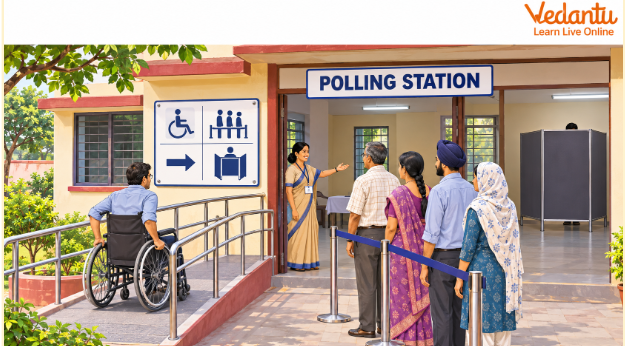
Answer:
Ramp: Helps voters with mobility difficulties enter the polling station.
Private voting compartment: Protects the secrecy of each person’s vote.
Pictorial information: Helps voters understand instructions even if they have difficulty reading.
These arrangements reduce barriers and help citizens vote independently.
Class 9 Social Science Chapter 6 Long Answer Questions on Democracy
Q14. Compare parliamentary and presidential democracy in terms of the executive’s relationship with the legislature, the head of government and accountability. Give one country example of each.
Answer:
Both systems require citizens’ rights, elections and limits on government power.
Q15. Observe the three scenes labelled A, B and C. Identify the organ of government represented in each and explain how their separate roles prevent the concentration of power.
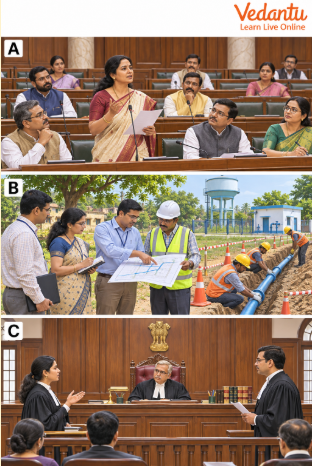
Answer:
A — Legislature: Discusses and makes laws.
B — Executive: Implements laws and carries out government policies.
C — Judiciary: Interprets laws, resolves disputes and protects constitutional rights.
Their separate responsibilities prevent one organ from controlling every stage of governance.
1. The legislature can question the executive about its actions.
2. The executive must operate within the law.
3. The judiciary can review laws and government actions for consistency with the Constitution.
4. An independent judiciary allows disputes to be settled through legal procedures.
Together, these checks and balances limit the misuse of authority.
Q16. Why does equal voting power need to be supported by measures that enable meaningful participation?
Answer:
Equal voting rights provide political equality, but citizens may face practical barriers to participation.
1. Poverty: Limited resources can make it harder to access information or engage in public affairs.
2. Illiteracy: Difficulty reading can restrict access to written information. Symbols and accessible communication help reduce this barrier.
3. Social discrimination: Caste and gender discrimination can prevent some people from expressing their views freely.
4. Misinformation: False information can distort public understanding and influence decisions.
5. Unequal opportunities: Historically disadvantaged groups may need additional support to participate effectively.
Inclusive local meetings, accessible elections, reliable information and measures supporting vulnerable communities help turn formal equality into meaningful participation.
Improve Your Class 9 Social Science Chapter 6 Democracy Answers
Use these Class 9 Social Science Chapter 6 important questions and answers to work on common mistakes:
Go beyond definitions: After defining accountability, explain how questioning ministers helps hold the government responsible.
Keep similar terms separate: Accountability means answering for actions; transparency means making information accessible.
Explain what pictures show: Identify the institution or arrangement, then connect it with a democratic principle.
Make comparisons precise: Compare parliamentary and presidential systems using the same points—leadership, executive–legislature relations and accountability.
Answer the command word: “Identify” needs a name, “explain” needs reasons, and “compare” needs clear differences.
Use Vedantu’s Solved Questions to Find and Fix Learning Gaps
Vedantu’s practice set brings selected questions and answers together so you can check where your understanding needs work.
Correct guesses: If you guessed an MCQ correctly, explain why the other options are unsuitable.
Find missing points: Compare your written answer with the solution and add only the ideas you missed.
Practise without copying: Read a solution, close it and write the answer in your own words.
Check application skills: Use the polling-station and government-scenes questions to apply concepts beyond textbook definitions.
Track difficult questions: Mark questions you cannot explain confidently and reattempt them using the Class 9 Social Science Chapter 6 important questions PDF.
CBSE Class 9 Social Science Chapter 6 Study Materials
Explore these study materials to improve your understanding of Democracy.
CBSE Class 9 Social Science Chapter-wise Important Questions
Practise questions from other chapters to strengthen your preparation across Geography, History, Political Science and Economics.
Important Study Materials for CBSE Class 9 Social Science
FAQs on Important Questions for Class 9 Social Science Chapter 6 Democracy | 2026-27
1. Which topics should I focus on in Class 9 Social Science Chapter 6 Democracy?
Focus on popular sovereignty, universal adult franchise, the rule of law, Fundamental Rights and separation of powers. Also prepare accountability, transparency, types of democracy, citizen participation and barriers to equal participation.
2. How can I distinguish accountability from transparency in an answer?
Accountability means that public authorities must explain and answer for their actions. Transparency means that information about their work is accessible. For example, ministers answering questions shows accountability, while access to government records supports transparency.
3. How should I answer image-based questions on Democracy?
Identify the visible action or arrangement, then explain its democratic purpose. A polling-station ramp supports accessibility, a private voting compartment protects secrecy, and representatives debating a law illustrate the legislature’s work.
4. What is the difference between direct and representative democracy?
In direct democracy, citizens vote directly on public decisions. In representative democracy, citizens elect representatives to make decisions on their behalf. India follows representative democracy, while Switzerland uses direct voting alongside representative institutions.
5. Why are elections alone not enough to make a government democratic?
Democracy also requires rights, equality before the law, freedom to express different opinions and checks on government power. Citizens must be able to question public authorities and participate without discrimination or intimidation.
6. How can Vedantu’s Class 9 Social Science Chapter 6 important questions help me improve my answers?
Use Vedantu’s solved questions to check whether your answers include the main idea, a clear explanation and a relevant example. The comparison table and picture-based questions also help you practise organising differences and applying democratic concepts.
7. How should I use the Class 9 Social Science Chapter 6 important questions and answers PDF?
Attempt the questions without looking at the solutions. Compare your responses, mark missing points and review those concepts in your textbook. Reattempt difficult questions later to check whether you can explain them independently.
