



Class 9 Social Science Chapter 7 Elections Questions and Answers PDF
1. Why are elections essential to a democratic system?
Answer:
Elections are essential to democracy because they allow people to choose who will represent and govern them.
They give citizens the right to choose their representatives.
Regular elections ensure that governments seek the people’s mandate after a fixed period.
They make elected representatives accountable to the people.
Voting gives citizens an equal voice in the formation of the government.
Elections support representation, equality, accountability and legitimacy in a democracy.
Therefore, elections are considered the soul of democracy because they allow citizens to participate in choosing their government.
2. How do electoral systems and rules shape political representation and fairness?
Answer:
Electoral systems decide how votes are converted into seats.
In FPTP, the candidate with the most votes wins.
In Proportional Representation, seats are shared according to the votes received.
Delimitation helps keep representation fair by balancing population and seats across constituencies.
Electoral laws protect the right to vote without discrimination.
Thus, electoral systems and rules help ensure fair representation and equality in elections.
3. What role do institutions and laws play in ensuring free and fair elections?
Answer:
Institutions and laws provide the rules and machinery needed to conduct elections in a free, fair and transparent manner.
The Election Commission of India (ECI) supervises, directs and controls the election process.
The ECI prepares and updates electoral rolls, decides election schedules, registers political parties and allocates symbols.
The Representation of the People Act, 1950 deals with allocation of seats, delimitation and preparation of electoral rolls.
The Representation of the People Act, 1951 provides rules for candidate nominations, election campaigns, voting procedures and election disputes.
The Delimitation Commission helps maintain fair representation by fixing constituency boundaries according to population.
Together, these institutions and laws help maintain the integrity, transparency and accountability of elections.
4. What challenges do elections face in practice, and how can these challenges affect democracy?
Answer: Elections face challenges such as misinformation, fake news, intimidation, unfair influence and accessibility difficulties. If the electoral process is not fair and transparent, public trust can weaken and elections lose their democratic value because citizens may not be able to exercise a free and meaningful choice.
LET’S EXPLORE
1. Different democracies use different electoral systems. Make groups of 5–6 students. Each group will select six countries from different continents. Prepare and present a case study on the type of electoral system(s) operating in those countries, and discuss their latest election results of those countries.
Answer:
Case Study: Comparative Electoral Systems Across Six Continents
1. Asia: India
Electoral System: India mainly uses the First-Past-The-Post (FPTP) system for Lok Sabha and State Legislative Assembly elections. It also uses Proportional Representation through Single Transferable Vote (PR-STV) for indirect elections such as the Rajya Sabha.
Latest Election Context: In general elections, hundreds of millions of voters vote in single-member constituencies. The candidate with the highest number of votes wins the seat, and a coalition government is formed at the Centre.
2. North America: United States
Electoral System: The US uses FPTP for congressional elections and the Electoral College system for presidential elections. States receive electors based on their total representation in Congress.
Latest Election Context: A presidential candidate needs 270 electoral votes to win. Campaigns often focus strongly on highly competitive “swing states.”
3. Europe: Germany
Electoral System: Germany follows a Mixed-Member Proportional (MMP) system. Voters cast two votes: one for a local candidate using FPTP and another for a political party using Proportional Representation.
Latest Election Context: This system helps ensure that a party’s share of seats in the Bundestag matches its share of the second vote. It often leads to stable multi-party coalition governments.
4. Africa: South Africa
Electoral System: South Africa uses Party-List Proportional Representation (Closed List). Voters choose a political party instead of an individual local candidate. Seats in the National Assembly are distributed according to each party’s percentage of the nationwide vote.
Latest Election Context: In the recent election, the long-dominant party did not receive an absolute majority, leading to the formation of a multi-party Government of National Unity (GNU).
5. South America: Brazil
Electoral System: Brazil uses a Two-Round Majority System for presidential elections. If no candidate gets more than 50% of the votes, a runoff is held. For the Chamber of Deputies, it uses Open-List Proportional Representation.
Latest Election Context: In legislative elections, voters can vote for either an individual candidate or a party list. This creates a highly diverse and fragmented parliament, where parties often need to negotiate to pass laws.
6. Oceania: Australia
Electoral System: Australia uses Preferential Voting for the House of Representatives and Single Transferable Vote (STV) for the Senate. Voters rank candidates in order of preference.
Latest Election Context: If no candidate gets an absolute majority of first-preference votes, the candidate with the lowest votes is eliminated. Their votes are then transferred according to the voters’ next preferences until a clear majority winner is found.
Key Conclusion
Different electoral systems produce different political outcomes. FPTP systems, such as those used in India and the US, support single-member representation and accountability. Proportional Representation systems, such as those used in South Africa and Germany, encourage multi-party participation, cooperation and wider representation.
2. Do you know what ETPBS is?
ETPBS stands for Electronically Transmitted Postal Ballot System. It enables service voters to cast their vote on an electronically received postal ballot from their preferred location, which is outside their originally assigned voting constituency.
Find out who are classified as service voters and who can vote using ETPBS?
Answer: Service voters are people who may be unable to vote at their usual polling station because they are posted elsewhere for official duty. Through ETPBS (Electronically Transmitted Postal Ballot System), they can receive and cast their postal ballot from their place of posting.
The following are classified as service voters:
Armed Forces Personnel: Members of the Indian Army, Navy and Air Force.
Paramilitary and Special Forces Personnel: Members of forces covered under the Army Act, 1950.
State Armed Police Personnel: Members of a State armed police force serving outside their home state.
Government Employees Posted Abroad: Government of India employees serving outside India, such as diplomats, ambassadors and staff of Indian Embassies or High Commissions.
Spouses of Service Voters: The husband or wife of a service voter may also use ETPBS if they are staying with the service voter at the place of posting or abroad.
Note: This facility applies to the spouse of a service voter, but not to children or other family members.
3. Find out the number of State parties and Registered Unrecognised Political Parties (RUPP). You may visit the website of ECI.
Answer:
1. Number of Recognised State Parties
Total Number: There are 60 recognised State Parties in India.
Context: These are regional political parties that have met the required vote-share or seat criteria in their respective states. Examples include the DMK in Tamil Nadu, Samajwadi Party in Uttar Pradesh, and Trinamool Congress in West Bengal.
2. Number of Registered Unrecognised Political Parties (RUPPs)
Total Number: There are approximately 2,049 active Registered Unrecognised Political Parties (RUPPs) registered with the ECI.
Context: These include newly registered parties that have not yet contested elections, as well as parties that have not secured enough votes or seats to be recognised as a State or National Party.
Recent System Clean-up: The ECI regularly reviews registered parties and removes those that are inactive, untraceable, non-compliant, or have not contested elections for several years. These clean-up drives have reduced the number of RUPPs from more than 2,800 to around 2,049 active parties.
4. Find out the name and the composition (number and name of the national and state parties) of the alliances that won in the following elections to the Lok Sabha.
Answer:
DON’T MISS OUT
1. Article 82 of the Constitution of India mandates the establishment of a Delimitation Commission. India has had four Delimitation Commissions—in 1952, 1963, 1973, and 2002. Can you find out the reason for the long interval between 1973 and 2002 with the help of your teacher?
Answer: The long gap between the 1973 and 2002 Delimitation Commissions was mainly due to a constitutional freeze on delimitation. The 42nd Constitutional Amendment Act, 1976 kept the allocation of Lok Sabha and State Assembly seats based on the 1971 Census unchanged until after the 2001 Census. As a result, no nationwide Delimitation Commission was set up after the 1981 or 1991 Censuses.
This freeze was intended to avoid disadvantaging states that had successfully controlled their population. After the freeze period, the Delimitation Act, 2002 led to the creation of the fourth Delimitation Commission.
In simple words: The gap occurred because delimitation was temporarily frozen by the Constitution, so the next Commission was formed only in 2002.
THINK ABOUT IT
1. You will turn 18 in a few years. As a responsible citizen, you should register yourself as a voter. Find out the various steps of the procedure for registration and the list of required documents for the same. Discuss, with anyone who has just turned 18 and has registered as a voter, the ease or difficulty faced in the voter registration process.
Answer: To register as a voter after turning 18, a citizen has to apply for inclusion in the electoral roll using Form 6. The Election Commission of India allows this to be done online or through election officials.
Steps for Voter Registration
Visit the ECI Voters’ Service Portal or use the official voter application.
Select New Voter Registration – Form 6.
Enter personal details such as name, date of birth, address and contact details.
Upload a recent photograph and the required age and address proof.
Submit the application.
The details may be verified by the election authorities or Booth Level Officer.
After successful verification, the applicant’s name is added to the electoral roll.
Documents Required
A recent passport-size photograph and documents proving date of birth and ordinary residence are required. Common documents include:
Age proof: Birth Certificate, Aadhaar Card, PAN Card, Driving Licence, Class 10/12 certificate containing date of birth, or Indian Passport.
Address proof: Aadhaar Card, electricity/water/gas bill, bank or post-office passbook, Indian Passport, registered rent agreement, sale deed or land records.
Experience of a Newly Registered Voter
A newly registered voter may find the online process simple and convenient because the application and documents can be submitted digitally. However, difficulties may arise if documents are incomplete, details need correction, or additional verification is required.
Conclusion: Voter registration is a simple but important responsibility. Registering after turning 18 enables citizens to exercise their right to vote and participate in democracy.
LET'S MAP
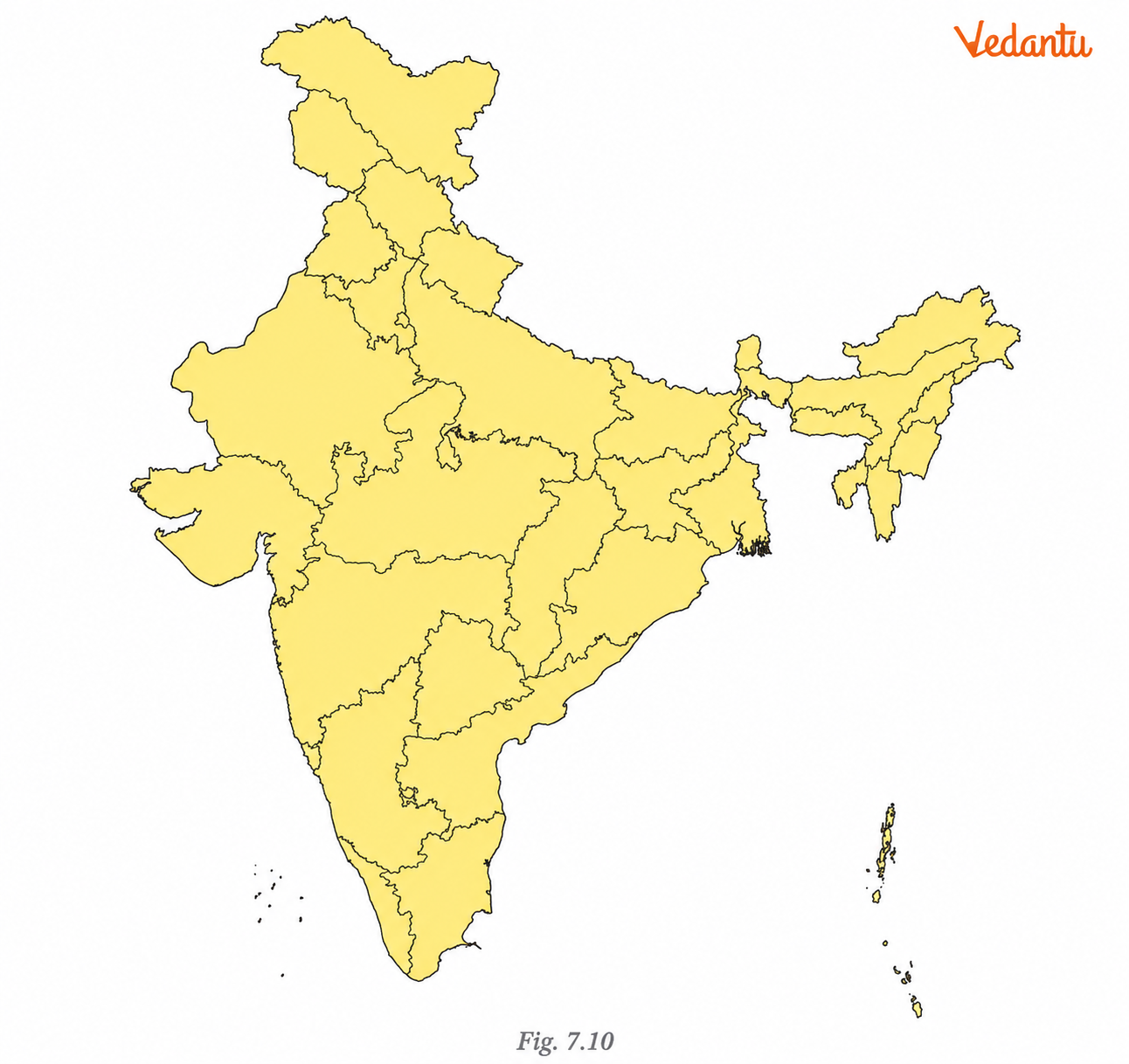
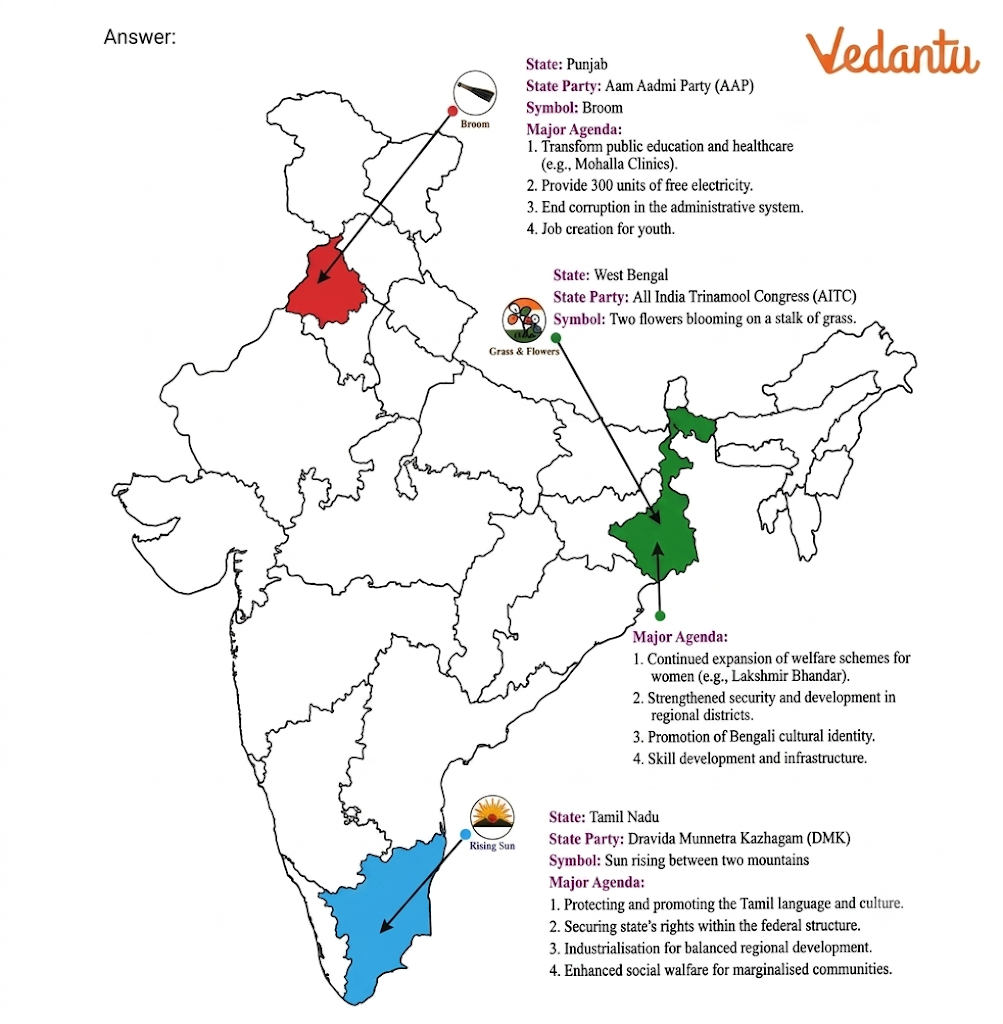
1. Choose any three states (including yours). Find the symbols of state parties belonging to those states and plot them on the given map of India. List down their major agenda, as mentioned in their manifesto in the latest Lok Sabha/Vidhan Sabha/Local Body Elections.
2. Form groups of 4–6 students. Identify and compare the policy preferences on the following parameters for two political parties in the last Lok Sabha Elections using credible sources like party manifestos, newspapers, etc. Present the points of comparison in a poster using bullet points, symbols, colour coding, etc.
Answer:
LET’S ANALYSE
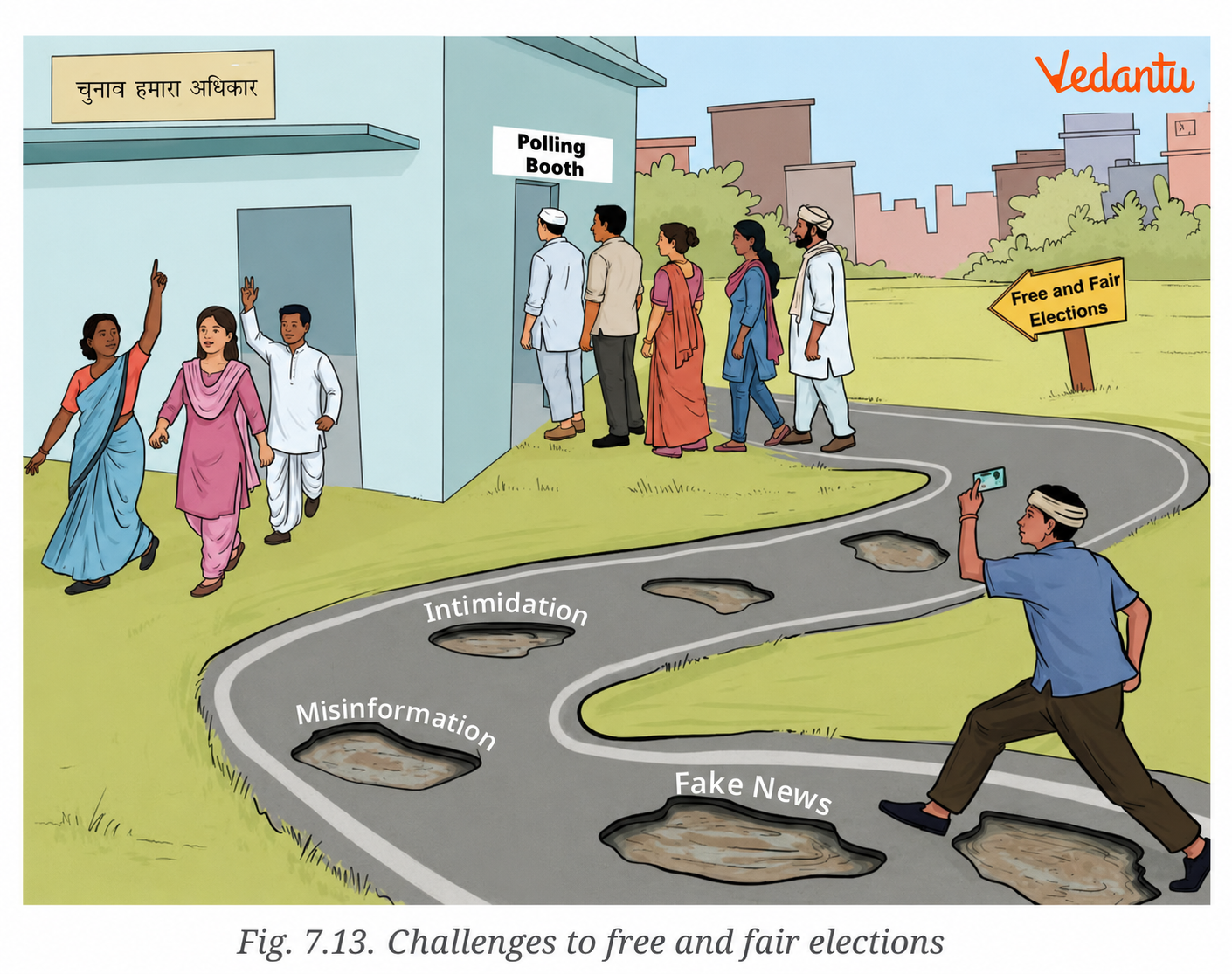
1. Look at the road to free and fair elections above (Fig. 7.13). Fill in the empty potholes with some more challenges after discussing them with your teachers and parents. How can we overcome these challenges?
Answer:
1. Major Challenges
The road to free and fair elections can be affected by several problems:
Misinformation: False or misleading information may be spread intentionally to influence public opinion or damage the image of candidates.
Fake News: Fabricated stories, edited images, or altered videos may be presented as genuine news to mislead voters.
Intimidation: Voters may face threats, social pressure, or force that prevents them from voting freely.
2. How Can These Challenges Be Overcome?
To conduct elections in a free and fair manner, different measures can be taken.
A. Controlling Misinformation and Fake News
Fact-Checking: Independent fact-checking teams and digital tools can be used to identify and verify misleading information during elections.
Digital Awareness: The ECI and educational institutions can teach people how to check whether information is true before sharing it.
Social Media Responsibility: Digital platforms should quickly identify, flag, reduce the reach of, or remove deepfakes and clearly false information.
Legal Action: Strict action can be taken under election laws and cyber laws against those who deliberately spread harmful or false information.
B. Preventing Voter Intimidation
Better Security: Security forces can be deployed at sensitive polling stations so that voters can vote without fear.
Strict Enforcement of the Model Code of Conduct: The ECI can closely monitor violations involving threats, hate speech, or misuse of power.
Secret Voting: EVMs and VVPATs help maintain the secrecy of the vote so that a voter’s individual choice cannot be easily traced.
Easy Reporting of Violations: Citizens can use the cVIGIL app to report election misconduct or voter intimidation by uploading real-time photos or videos for quick action.
QUESTIONS AND ACTIVITIES
1. What reforms have been introduced by the ECI to make voting more inclusive for the following groups?
a. People with Disabilities
b. Service Voters
c. Senior Citizens— above 85 years of age
d. Prisoners
e. Persons in preventive detention
Answer: The ECI has introduced several measures to make elections more accessible and inclusive so that “no voter is left behind.”
(a) People with Disabilities (PwDs): The ECI provides EVMs with Braille, wheelchairs and volunteer assistance at polling stations. The Saksham App also helps PwDs with voter registration and locating polling stations. Persons with a 40% benchmark disability were also given the facility to vote from home during the 2024 General Elections.
(b) Service Voters: The ECI provides the Electronically Transmitted Postal Ballot System (ETPBS). It enables service voters to receive and cast their postal ballots from a location outside their constituency.
(c) Senior Citizens (60 years and above; 80 years and above): Senior citizens are given priority at polling stations through separate queues and necessary assistance. Citizens aged 85 years and above can also opt to vote from home through a postal ballot, making the voting process easier and more accessible.
(d) Prisoners: Under Indian election laws, prisoners serving a sentence or individuals in police custody are generally not permitted to vote. However, persons held under preventive detention are allowed to exercise their right to vote by following the prescribed procedure.
(e) Persons in Preventive Detention: People held under preventive detention retain their right to vote as they have not been convicted of any offence. The Election Commission allows them to vote through a postal ballot, enabling them to participate in the electoral process.
2. What are the various functions of the Election Commission of India? Which of these functions is most important for the conduct of free and fair elections? Explain.
Answer: The Election Commission of India (ECI) supervises, directs and controls the entire election process. Its important functions can be remembered in this order:
Prepares and updates electoral rolls to maintain the list of voters.
Conducts elections and announces the election schedule.
Registers political parties and allots election symbols.
Enforces the Model Code of Conduct to ensure fair campaigning.
Monitors election expenditure of political parties and candidates.
Conducts voter awareness programmes to encourage people to vote.
Ensures peaceful polling at polling stations.
Counts votes and declares election results.
Resolves disputes related to political parties and election symbols.
The most important role of the ECI is to conduct free, fair and impartial elections. This ensures that every vote is counted honestly and that the true will of the people is reflected in the election results.
3. Elections are the soul of a democracy. Do you agree? Why or why not?
Answer: Yes, I agree that elections are the soul of democracy because they allow citizens to choose their representatives and hold them accountable for their actions.
Regular elections make governments responsible to the people and give citizens the power to replace them if they fail to meet public expectations.
Elections also promote equality, participation and transparency, ensuring that the government reflects the wishes of the people. Therefore, free and fair elections are essential for the effective functioning of democracy.
4. Explain at least three differences between the national and state/regional political parties.
Answer:
5. Why should you vote? Arrange the following in the descending order of your choice. Discuss the reasons for your choice.
a. Opportunity to choose my representative
b. Makes me a responsible person
c. Opportunity to change the non-performing representative
d. Strengthens democracy
Answer:
d. Strengthens democracy – Voting gives citizens an equal voice and helps keep democracy strong.
a. Opportunity to choose my representative – It allows people to choose those who will make decisions on their behalf.
c. Opportunity to change the non-performing representative – Regular elections allow voters to replace representatives who do not perform well.
b. Makes me a responsible person – Voting is both a right and a responsibility of every citizen.
Thus, voting strengthens democracy, ensures accountability, and gives citizens a meaningful role in choosing their government.
6. What is the Special Intensive Revision (SIR) initiative of the ECI? Explain the objectives and the necessity of conducting SIR.
Answer: The Special Intensive Revision (SIR) is an exercise carried out by the Election Commission of India (ECI) to check, update, and correct electoral rolls before elections. During this process, officials collect and verify voter details.
Citizens who have become eligible to vote after turning 18 are added to the electoral roll, while names of deceased voters, duplicate entries, people who have changed residence, and ineligible persons are removed.
Voters are also given time to submit claims or objections before the final electoral roll is published.
The main purpose of SIR is to keep the electoral roll accurate, complete, and up to date. It helps ensure that all eligible citizens are included and incorrect or duplicate entries are removed.
This is important for conducting free and fair elections, maintaining correct voter records, and making the electoral process more transparent, inclusive, and trustworthy.
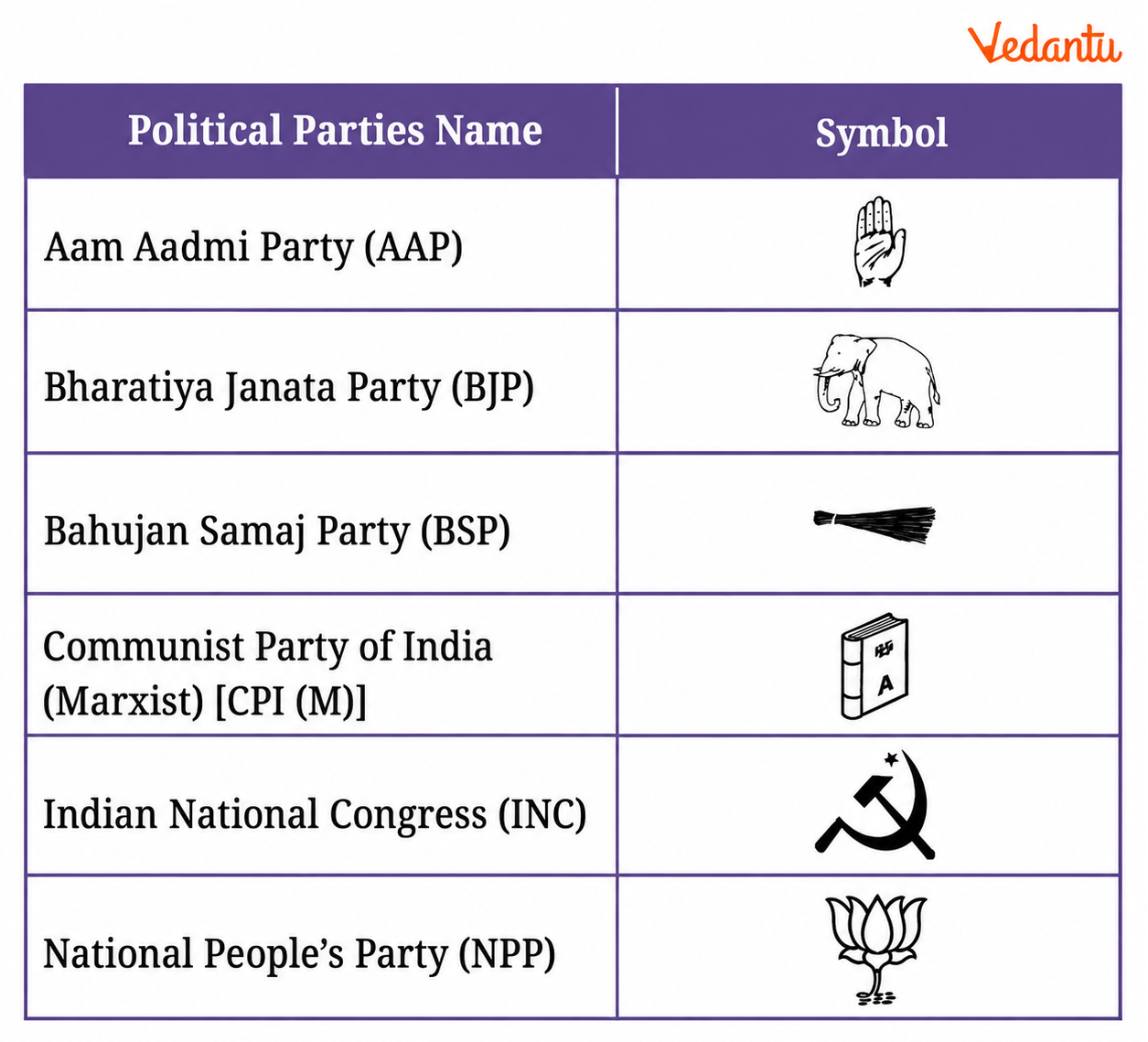
7. Match the political party name with its symbol.
Answer:
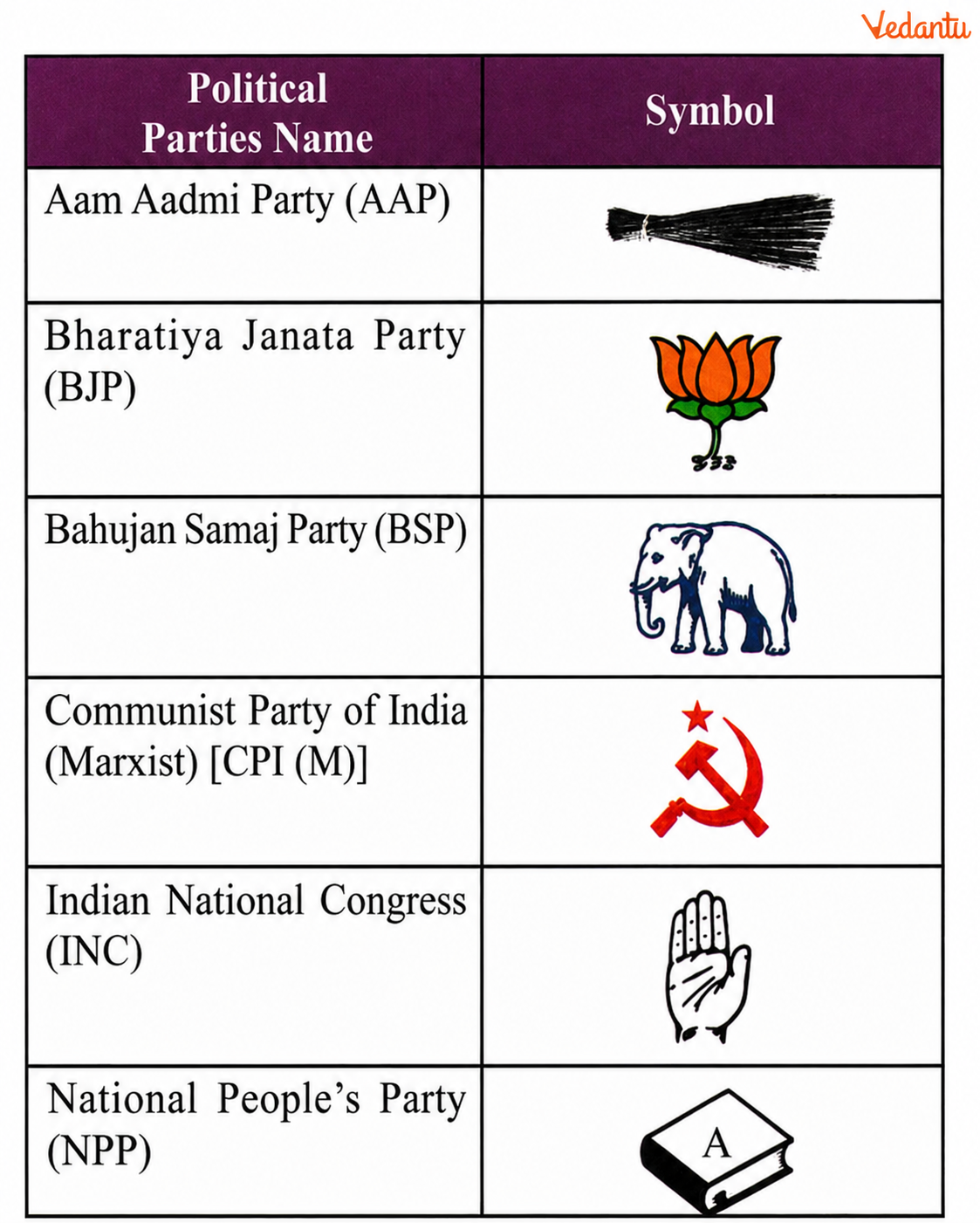
8. Read the case study below and answer the following questions.
Ishani and her mother were in the local market, day before the state assembly elections. She noticed wall writing and campaign posters pasted everywhere. Large groups of campaigners were distributing pamphlets and raising slogans in support of the respective candidates. Ishani has turned 18 and will be voting for the first time. She had registered to vote through the ECI’s online portal. The next morning, she, along with her mother and her disabled elder brother, went to the polling station, which was well guarded by the police personnel. A wheelchair was made available to them, and volunteers guided them to the polling booth. Inside the polling booth, there were only three people who were performing all duties. Ishani had forgotten her voter ID card and Aadhaar card, but her identity was verified with an alternative document. After casting her vote, she was also able to see the VVPAT slip. While leaving, she wondered how the police personnel vote, as they must be on duty from early morning till late evening. When she went home, she narrated her entire experience to her 89-year-old grandmother, who cast her vote from home.
a. What initiatives were taken by the ECI to enable the voters to cast their vote?
b. If Ishani was allowed to vote even without carrying her Voter ID card or Aadhaar card, which other document might she be carrying that is valid for voting?
c. Cite the examples of violations of the Model Code of Conduct.
d. Give a suitable title to the passage.
e. Find out how the police and army personnel cast their votes.
Answer:
(a) The Election Commission of India (ECI) made voting easier and more accessible through online voter registration, security at polling stations, volunteer assistance, wheelchair facilities for persons with disabilities, VVPAT slips for vote verification, and home voting for eligible senior citizens above 85 years of age.
(b) Ishani could use another valid identity document approved for voting, such as a Passport, Driving Licence, PAN Card, MNREGA Job Card, bank or post office passbook with photograph, Pension Document with photograph, NPR Smart Card, Health Insurance Smart Card, or an official identity card issued by the Central/State Government or a Public Sector Undertaking.
(c) Wall writing, pasting campaign posters, distributing pamphlets, and raising slogans in support of candidates a day before polling are examples of violations of the Model Code of Conduct.
(d) A suitable title for the passage is “A Day at the Polling Booth.”
(e) Police and army personnel who are away from their assigned polling stations because of official duty can cast their votes through Postal Ballots or the Electronically Transmitted Postal Ballot System (ETPBS).
9. A comparative chart of three countries is given below. Based on the information given in the chart, answer the questions.
a. What is the difference between having a voting right in a country with a multi-party system and another with a single-party system?
b. In which of the above countries would you like to stay and why?
Answer:
(a) In a multi-party system, voters can choose from different political parties, giving them more options and wider representation. In a single-party system, only one political party is available, so voters have very limited choice.
(b) I would choose to live in Country A because it has a written Constitution, regular elections, voting rights, and a multi-party system. These features support democracy, freedom of choice, and citizen participation in government.
10. What are the challenges to conducting free and fair elections?
Answer: Free and fair elections can be affected by many challenges, including money power, gifts or bribes to influence voters, misuse of government resources, fake news, misinformation, voter intimidation, hate speech based on religion or caste, electoral violence, and low voter awareness.
Another challenge is ensuring that all eligible voters, especially persons with disabilities and senior citizens, are able to vote easily. The Election Commission of India (ECI) addresses these problems by enforcing election laws and the Model Code of Conduct.
11. On the Stage.
Elections are to be held in your school for the posts of Head Girl, Head Boy, and Sports Captain. Assume the roles of an Election Commissioner, Returning Officer, Polling Agent, Candidate, Campaigner, Polling Officer, Police Personnel, and a Journalist, and perform their roles while ensuring free, fair, and transparent elections.
Answer:
Election Commissioner: The election for Head Boy, Head Girl, and Sports Captain will now begin. Everyone must follow the election rules and maintain discipline.
Candidate: I will work sincerely for the welfare of all students. Please vote for me based on my ideas and plans.
Campaigner: Support our candidate for better school facilities and activities. Cast your vote wisely and responsibly.
Returning Officer: All nominations have been checked. The election will be conducted fairly, and the results will be announced after the votes are counted.
Polling Officer: Please verify your identity, sign the register, collect your ballot paper, and cast your vote in secrecy.
Polling Agent: I will observe the voting process and ensure that it is conducted fairly and transparently.
Police Personnel: We will maintain peace and security at the polling station so that every student can vote without fear.
Journalist: The school election is being held peacefully. Students are participating actively, and all rules are being followed to ensure a free and fair election.
12. Try and make videos or audios on topics like: My Vote My Nation; No Voter to be Left Behind; How to Eliminate the Ill of Money Power, etc.
Answer:
This is an activity-based question and does not require a written textbook answer. Students should create their own short video or audio on any one of the suggested topics, such as “My Vote, My Nation,” “No Voter to Be Left Behind,” or “How to Eliminate the Ill of Money Power.”
13. Select one national or state political party. Using authentic and reliable sources such as the Election Commission of India (ECI) website, the official website of the selected political party, and newspapers. Prepare a comparative chart of the last two State Legislative Assembly elections. The chart should include the following details for the chosen party:
a. Some promises made in the Election manifesto
b. Percentage of votes polled
c. Number of seats won
d. Number of women who contested
e. Number of women candidates elected
Present the data for both elections in a clear and comparative format, citing all sources used.
Answer:
The Bharatiya Janata Party (BJP) and the last two Gujarat Legislative Assembly elections—2017 and 2022—have been selected.
Conclusion:
The BJP performed better in the 2022 Gujarat Assembly election than in 2017. Its vote share increased from about 49.1% to 52.5%, while the number of seats won increased from 99 to 156. The number of BJP women candidates elected also increased from 9 to 14.
14. Do you think ‘One Nation, One Election’ can improve the efficiency of the electoral process? Divide the class and discuss into two groups—one to examine its potential advantages and the other to analyse its limitations.
Answer:
This is an activity-based question. Students should divide the class into two groups and conduct a discussion on ‘One Nation, One Election’.
Note: Since this is a classroom discussion activity, a fixed written answer is not provided.
How to Revise the Elections Chapter Effectively Using Vedantu’s NCERT Solutions?
Vedantu’s NCERT Solutions can help students revise the Elections chapter in a structured way. Students can use the Class 9 Social Science Elections solutions PDF download to:
Revise key concepts: Quickly review important topics and understand the main ideas covered in the chapter.
Practise NCERT questions: Use the solved questions to check your understanding and improve answer-writing skills.
Prepare with the PDF: Refer to the Class 9 Elections PDF for convenient revision before tests and exams.
Clear doubts: Go through step-by-step explanations to understand difficult concepts related to elections and democracy.
Review important answers: Revisit questions regularly to strengthen your preparation and recall important points.
Related Study Materials for Class 9 Social Science Chapter 7 Elections
Explore Class 9 Social Science Chapter-Wise NCERT Solutions (Understanding Society India and Beyond Part 1)
Related Study Material for Class 9 Social Science
FAQs on NCERT Solutions for Class 9 Social Science Chapter 7 Elections 2026-27
1. Where can I find NCERT Solutions for Class 9 Social Science Chapter 7 Elections?
Students can find chapter-wise NCERT Solutions for Chapter 7 class 9 social science here at Vedantu, with clear and structured answers to the questions given in the NCERT textbook.
2. Can I download Class 9 Social Science Chapter 7 Questions Answers PDF?
Yes, students can access the Class 9 Social Science Elections solutions PDF download to refer to the chapter-wise questions and answers conveniently.
3. How do Class 9 Social Science Elections NCERT Solutions help answer textbook questions?
The solutions explain the NCERT questions in a simple, step-by-step manner, helping students understand the concepts and frame accurate answers based on the textbook.
4. Why are elections necessary in a democratic country?
Elections allow citizens to choose their representatives and give them an opportunity to replace representatives who do not perform satisfactorily.
5. What is meant by a democratic election in Class 9 Social Science?
A democratic election gives citizens a genuine choice among candidates, allows eligible voters to participate freely, and ensures that the election process is conducted regularly and fairly.
6. What is the role of the Election Commission of India in elections?
The Election Commission conducts and supervises elections, prepares electoral rolls, enforces election rules, and takes measures to ensure that the electoral process is free and fair.
