



Class 9 Social Science Chapter 5: Answer Key Questions on State and Society
Practise questions on State and Society up to 1000 CE from Understanding Society: India and Beyond, Part I. Use the four sections below to practise recalling facts, explaining concepts and writing detailed answers.
Class 9 Social Science Chapter 5 Important MCQs with Answers
Q1. Which Veda arranges hymns mainly for musical recitation?
A. Rigveda
B. Samaveda
C. Atharvaveda
D. Yajurveda
Answer: B. Samaveda
Q2. Which statement correctly describes the relationship between the early Tamil kingdoms and the imperial Cholas?
A. They belonged to exactly the same period.
B. The imperial Cholas ruled before the early Tamil kingdoms.
C. The early Tamil kingdoms existed centuries before the imperial Cholas.
D. Both developed only after 1000 CE.
Answer: C. The early Tamil kingdoms existed centuries before the imperial Cholas.
Q3. Which pair correctly matches a ruler with a public work recorded at Junagadh?
A. Ashoka — Construction of Nalanda
B. Rudradaman I — Repair of Sudarshana Lake
C. Chandragupta II — Construction of Uttaramerur Temple
D. Parantaka I — Repair of Sudarshana Lake
Answer: B. Rudradaman I — Repair of Sudarshana Lake
Q4. A community moves to a new region and gradually begins marrying only within its own group. Which practice does this illustrate?
A. Renunciation
B. Endogamy
C. Maritime trade
D. Revenue assessment
Answer: B. Endogamy
Q5. Which statement about early Indian guilds is correct?
A. They dealt only with religious ceremonies.
B. They prevented all movement between occupations.
C. They regulated crafts and could also perform financial functions.
D. They were departments of the royal army.
Answer: C. They regulated crafts and could also perform financial functions.
Class 9 Social Science Chapter 5 Very Short Answer Questions
Q6. How do literary sources add to the information provided by archaeological evidence?
Answer:
Literary sources reveal ideas, beliefs, social relationships and expectations about governance. They help historians understand aspects of life that material remains alone may not explain.
Q7. What were Brahmadeya villages and agraharams?
Answer:
Brahmadeya villages received tax-free land grants under the Pallavas. Agraharams were Brahmin settlements that received land grants under rulers such as the Chalukyas. Some developed into centres of learning.
Q8. What does the principle of samatva emphasise?
Answer:
Samatva emphasises the underlying sameness of all beings. It holds that bodies share the same material basis and consciousness expresses one supreme consciousness.
Q9. Identify the four ashramas shown in pictures A–D and state the main purpose of each.
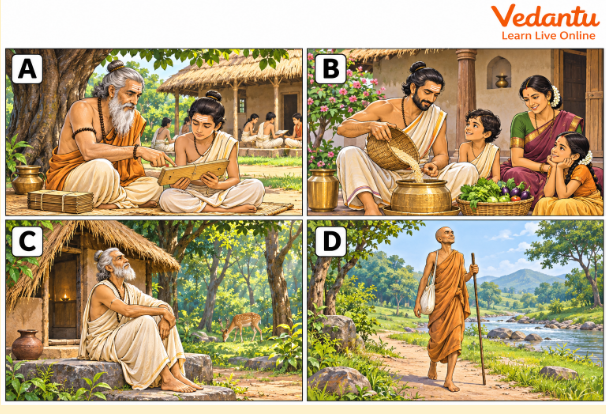
Answer:
A — Brahmacharya: Learning and disciplined studentship.
B — Grihastha: Fulfilling household and family responsibilities.
C — Vanaprastha: Withdrawing from household life towards reflection.
D — Sannyasa: Renouncing worldly attachments.
Class 9 Social Science Chapter 5 Short Answer Questions
Q10. Why was the treasury essential to Kautilya’s State? Explain its connection with two other constituents.
Answer:
The treasury provided the resources needed to run the State.
It supported the army, which defended the kingdom and maintained order.
It helped maintain forts, which protected important settlements.
A well-managed treasury helped these constituents perform their functions.
Kautilya’s Saptanga theory stressed that all seven constituents had to work together.
Q11. How did Gupta district administration involve different economic groups in governance?
Answer:
The Damodarpur copper plates record five members of a district office:
The head district officer.
The chief banker.
The chief caravan trader.
The chief artisan.
The chief of revenue collection.
Including bankers, traders and artisans connected administration with people involved in local economic activities.
Q12. How did the pursuit of artha differ from the unrestricted accumulation of wealth?
Answer:
Artha meant material well-being and was recognised as a goal of life. However, its pursuit had to follow dharma.
People were expected to seek prosperity through ethical conduct consistent with their duties and society’s welfare. The desire for wealth did not justify ignoring moral responsibilities.
Q13. What do the activities of Vidisha’s ivory workers reveal about the wider role of craft guilds?
Answer:
An inscription at Sanchi records the contribution of a guild of ivory workers from Vidisha. These workers carved stone sculptures on the stupa’s gateways and railings.
Their contribution shows that guilds:
Applied their skills beyond their usual craft materials.
Participated in major artistic projects.
Supported religious monuments through collective patronage.
Class 9 Social Science Chapter 5 Long Answer Questions
Q14. Explain how agriculture, taxation and irrigation connected village life with the State’s economy.
Answer:
Agriculture supported livelihoods: Farming sustained rural communities and remained the backbone of the economy.
Land revenue funded administration: The Mauryan basic land tax was generally one-sixth of agricultural produce.
Land classification supported assessment: Land categories included cultivated land, fallow land, high and dry land, and groves.
Agricultural expansion increased production: The State encouraged cultivation while protecting certain categories of forests.
Irrigation required organised management: Village committees managed irrigation, while rulers supported major waterworks.
Waterworks needed maintenance: Repairs to Sudarshana Lake under different rulers show the continuing importance of water infrastructure.
Agricultural production, revenue collection and water management therefore linked local livelihoods with governance.
Q15. Explain how religious life in early India combined changing practices with continuing traditions.
Answer:
Vedic worship: People invoked deities through prayers and yajnas. Many deities represented natural elements such as fire, rain, the sun and dawn.
Continuing nature worship: Festivals such as Chhath and Makar Sankranti preserve traditions of reverence for the sun.
Renunciation: Wandering ascetics became more prominent around the middle of the first millennium BCE. Renunciation also formed part of the ashrama framework.
Personal devotion: Worship increasingly centred on deities such as Vishnu, Shiva and Shakti.
Spread of Bhakti: From the sixth century CE, Alvar and Nayanmar saint-poets spread devotional traditions through Tamil hymns.
Wider participation: Bhakti offered a direct devotional path accessible regardless of class or gender.
New forms of worship developed alongside older beliefs and practices.
Q16. “Education in early India was limited to religious learning.” Assess this statement with examples.
Answer:
Education included religious learning, but it also covered languages, science, literature and practical skills.
Centres such as Takshashila, Nalanda and Vallabhi supported advanced learning. Education combined intellectual development, practical training and moral values.
Class 9 Social Science Chapter 5 Important Questions: Key Topics to Practise
Focus on Vedic assemblies, Kautilya’s Saptanga theory, regional administration and village governance. Connect these topics with dharma, social groups, women’s roles, education and economic life to understand State and Society up to 1000 CE.
Use the Class 9 Social Science Chapter 5 important questions and answers to practise these skills:
Distinguish between related terms, such as varna and jati.
Support written answers with examples from inscriptions and texts.
Explain links between agriculture, taxation, trade and governance.
Practise with Vedantu’s Class 9 Social Science Chapter 5 Important Questions PDF
Use the Class 9 Social Science Chapter 5 important questions PDF to strengthen your answers on State and Society up to 1000 CE.
Check key facts: Attempt MCQs on Vedic texts, royal emblems, administrative offices and guilds.
Clarify important terms: Write brief definitions of dharma, samatva, endogamy and the four ashramas.
Add historical evidence: Support answers with examples from the Junagadh inscriptions, Damodarpur copper plates and Sanchi.
Connect ideas: Explain how agriculture supported taxation, or how guilds linked crafts with trade and finance.
Improve written answers: Compare your response with the solution, identify missing points and rewrite it in your own words.
CBSE Class 9 Social Science Chapter 5 Study Materials
Explore these study materials to improve your understanding of (History) State and Society up to 1000 CE.
CBSE Class 9 Social Science Chapter-wise Important Questions
Practise questions from other chapters to strengthen your preparation across Geography, History, Political Science and Economics.
Important Study Materials for CBSE Class 9 Social Science
FAQs on Important Questions For Class 9 Social Science Chapter 5 State and Society up to 1000 CE | 2026-27
1. Which topics should I prioritise in Class 9 Social Science Chapter 5 important questions?
Focus on Vedic political institutions, the rise of territorial states, kingship, administration and village assemblies. Also prepare dharma, varna and jati, women’s roles, education, Bhakti, agriculture, trade and guilds.
2. What should I practise for Class 9 Social Science Chapter 5 important MCQs?
Practise matching Vedic texts with their features, rulers with inscriptions, and administrative terms with their meanings. Royal emblems, the four ashramas, purusharthas and the functions of guilds are also useful MCQ topics.
3. How should I structure long answers on State and Society up to 1000 CE?
Begin with a direct answer, then explain each point in a logical order. Add relevant examples, such as Gupta district officials, Chola village committees or guild activities. For questions about change over time, organise your answer chronologically.
4. Which historical sources are useful examples in Chapter 5 answers?
Use the Junagadh inscriptions for public works, Damodarpur copper plates for Gupta administration and Uttaramerur inscriptions for village governance. The Mandsaur inscription provides evidence of occupational mobility, while Nashik inscriptions show guilds’ financial activities.
5. Which terms should I distinguish when preparing Chapter 5 question answers?
Learn the differences between jana and janapada, varna and jati, and ashramas and purusharthas. Also distinguish the sabha, samiti and vidhata by their membership and functions.
