



Class 9 Social Science Chapter 5 State and Society up to 1000 CE Solutions
The Big Questions
Question 1. How did society and state organise themselves before 1000 CE?
Answer: Before 1000 CE, communities developed from smaller kinship groups such as kula and jana into larger territorial units called janapadas and mahajanapadas. Social life was guided by customs and traditions, while states developed systems of administration and governance. Local bodies such as village assemblies also played an important role in managing disputes, revenue, and community affairs.
Question 2. How did states and societies emerge and spread to different parts of the Indian subcontinent?
Answer: As populations grew, communities developed common rules and systems to maintain order. Early Vedic communities gradually expanded from the Indus-Sarasvati region towards the fertile Ganga plains, encouraging farming and trade.
Over time, powerful states and kingdoms emerged in different regions, including the Mauryas and Guptas in the north, the Satavahanas in the Deccan, and the Cholas, Cheras, and Pandyas in the south.
Question 3. How did the ideas of dharma and chakravarti samrat help create unity in social values and governance, and promote the idea of the Indian subcontinent as one political entity?
Answer: The idea of dharma provided common values related to duty, justice, and righteous conduct. The concept of a chakravarti samrat represented the ideal of a powerful ruler whose authority extended across a large part of the subcontinent. Practices such as the ashvamedha yajna also expressed ideas of political authority and territorial unity.
Question 4. How did different social, administrative, and occupational groups take shape over time and come together culturally?
Answer: Early society was broadly organised into four varnas—Brahmins, Kshatriyas, Vaishyas, and Shudras. Over time, occupational groups, migration, intermarriage, and other social changes contributed to the development of hereditary jatis. Despite these divisions, people remained connected through shared cultural practices, values, education, trade, and organisations such as shrenis or guilds.
Let’s Explore
Question 1. As you read the chapter, follow the timeline at the bottom of each page. Notice the important events, changes, and connections across time. Think about which event interests you the most and why. By the end of the chapter, share one event you would like to explore further and document: (Page No. 96-97)
1. What happened?2. When did it happen?
3. Why do you think it matters?
Answer:
One Event that Interests Me the Most: The composition of Sangam literature (300 BCE–300 CE) is particularly interesting because it gives insights into the society and culture of ancient southern India. These works describe occupations, trade, warfare, relationships, and everyday life, showing that early Indian society was diverse and active.
One Event I Would Like to Explore More:
What happened and when: In 321 BCE, Chandragupta Maurya established the Mauryan Empire after defeating the Nanda ruler Dhana Nanda. With the guidance of Chanakya, he brought several regions under a large centralised empire.
Why it matters: The rise of the Mauryan Empire was important because it created a strong administrative system and connected several regions politically. It also supported agriculture, trade, security, and organised governance.
Question 2. Read the verse given above and discuss it in groups. As you do so, think like historians- look for clues in the source and use them to understand what life may have been like.
While discussing, keep these questions in mind:
What does the source tell us? (evidence)
What can we understand from it? (interpretation)
What might it not tell us? (limits of the source)
Now answer the following:
What occupations are mentioned in the family described in the verse? What does this indicate about the nature of occupations in Vedic society?
How does the above verse challenge the idea that social status and occupation were fixed by birth?
What different occupations do you find in contemporary society?
After the discussion, compare your group’s responses with those of another group and note the similarities and differences in interpretation. Did all groups interpret the source in the same way? What does this tell us about how historians use evidence to understand the past? (Page No. 118-119)
Answer:
The verse offers a useful glimpse into occupational life in early Vedic society and shows that people within the same family could have different professions.
1. The family includes a poet, a physician, and a person who grinds grain. This suggests that people could follow different occupations and that work was not necessarily limited to one profession within a family.
2. The verse challenges the idea of fixed occupations by showing three family members engaged in completely different kinds of work. It suggests that occupation could depend on a person's abilities and circumstances rather than being determined entirely by birth.
3. Contemporary society has a wide range of occupations, including teachers, doctors, engineers, farmers, business owners, designers, software developers, lawyers, artists, and many others.
Group Discussion: Different groups may interpret the same source differently. While one group may focus on occupational flexibility, another may point out that one verse cannot represent every family in Vedic society. This shows why historians compare different sources before reaching conclusions.
Question 3. Compare your school life with the life of a student in a gurukula in early India. Think about aspects such as daily routine, subjects studied, relationship with teachers, discipline, and living arrangements. What advantages and challenges do you think each system of education might have for students? (Page No. 126)
Answer: A modern student usually attends school from home, follows a fixed timetable, and studies subjects such as science, mathematics, languages, and computers. A student in a gurukula lived with the teacher and learned academic subjects along with practical skills, discipline, and moral values.
The gurukula system encouraged a close teacher-student relationship and focused on character development. However, students had to stay away from their families. Modern schools provide access to a wider range of subjects and facilities, but students may not receive the same level of personal guidance.
Think About It
Question 1. In modern democracies, heads of government exercise power but are bound by constitutions and parliaments, which function as representative bodies that check the powers of elected leaders. Do the roles of the raja and the assemblies in Vedic times suggest a similar principle? Can we say that systems of governance in Indian history—since their early institutionalised forms—were guided by the idea of ensuring people’s participation in the political process? (Page No. 101)
Answer: Yes, the Vedic raja was not always the sole decision-maker. Assemblies such as the Sabha, Samiti, and Vidhata played roles in public affairs and could influence important decisions. Later examples, including village assemblies and the Chola Kudavolai system, also show that local participation was an important feature of some Indian political institutions.
Question 2. Texts such as the Mahabharata and the Arthashastra describe the king’s duties as protecting people and ensuring justice. Why do you think it was important for rulers to protect people and ensure justice? What do these descriptions tell us about ideas of governance and the relationship between rulers and subjects during that period? (Page No. 108)
Answer: Protecting people and maintaining justice were essential for keeping society peaceful and stable. Agriculture, trade, and other economic activities depended on security and proper administration. Texts such as the Mahabharata and Arthashastra show that rulers were expected to follow dharma, protect their subjects, and work for the welfare of the kingdom.
Question 3. Why do you think different rulers chose to record their inscriptions on the same stone instead of a new one? Discuss your answers with your classmates. (Page No. 111)
Answer: Using the same stone could connect a ruler with important events or earlier rulers associated with that site. It could also help a new ruler present himself as a successor to an established political tradition. The Junagadh Rock Inscription, which contains records from different periods, is an example of how the same site could preserve the achievements of successive rulers.
Question 4. How would dividing a kingdom into provinces, districts, and villages have helped rulers manage their empires? What similarities can you identify between these administrative divisions and the system of governance in India today? (Page No. 112)
Answer: Dividing a large kingdom into smaller administrative units made it easier to collect revenue, maintain law and order, manage resources, and respond to local issues. Modern India also uses different levels of administration, including states, districts, blocks, and villages. This division helps governance reach people at the local level.
Question 5. Why do you think irrigation structures like dams and canals were considered so important that their construction was recorded in inscriptions? (Page No. 129)
Answer: Agriculture depended greatly on a reliable supply of water, making dams, canals, and reservoirs important for farming and food production. Such projects could also protect communities from water shortages and support economic growth. Recording them in inscriptions highlighted the ruler's contribution to public welfare and development.
Let’s Recall
Question 1. In previous grades, you have read that the name ‘Bharata’ first appears in the Rig Veda. It is used in reference to the ‘Bharata jana’, or the people who were ruled by the family of the Bharatas. What does this tell us about how early communities identified themselves and their rulers?
Answer: It shows that early communities often identified themselves through kinship, clans, and ruling families. Their sense of belonging was closely connected with shared ancestry and loyalty to a particular group or leader rather than clearly defined territorial boundaries.
Let’s Analyse
Question 1. If you visualise the maps of the Indian subcontinent of the second and first millennium BCE, you will find more settlements concentrated in the Ganga region in the latter map. Archaeological findings from this region during the first millennium BCE provide increasing evidence of the use of iron implements, a wider variety of grain, and the characteristic PGW pottery. Further, in the second half of the first millennium BCE, particularly in the middle Ganga region (from present-day Prayagraj to eastern Bihar), there is evidence of a refined ‘deluxe ware’ called NBPW, known for its smooth, glossy black surface. Archaeologically, this phase marks the emergence of a richer, more advanced material culture. Literary sources from this period also contain numerous references to expanding agricultural activities, increased grain output, greater crop variety— particularly paddy—and the use of iron implements. Can you identify the crucial factors behind this change? (Page No. 102-103)
Answer: The growth of settlements in the Ganga region was supported by fertile land, improved farming techniques, and the wider use of iron tools. Iron implements helped people clear forests and cultivate more land. Increased agricultural production, especially paddy, created food surpluses, which encouraged population growth, larger settlements, and the development of a richer material culture.
Questions and Activities
Question 1. How did political organisation change from the Vedic period to the age of large empires such as the Mauryas and the Guptas? Explain the administrative system of the early Indian states.
Answer: Political organisation developed from smaller kinship-based groups and janas in the Vedic period to larger kingdoms and empires such as those of the Mauryas and Guptas. Early states used several levels of administration to govern their territories. Provinces, districts, and villages were managed by officials and local authorities, while the king remained the central authority.
Question 2. Describe the role of the king, important officers, and the methods used to govern large territories.
Answer:
Role of the King: The king was responsible for protecting the kingdom, maintaining justice, and ensuring the welfare of the people.
Important Officers: Officials such as the purohita, senapati, and samaharta assisted the ruler with religious matters, military affairs, and revenue collection.
Methods of Governance: Large territories were divided into provinces, districts, and villages. Officials managed local administration, while roads, messengers, and intelligence networks helped rulers maintain communication and control.
Question 3. After studying this chapter, what do you think were the most important features of the state and society in India before 1000 CE?
Answer: Important features included the growth of kingdoms and empires, systems of local administration, agricultural development, trade networks, and changing social groups. Ideas such as dharma influenced political and social life, while local institutions and cultural connections helped link different regions of the subcontinent.
Question 4. What do early texts such as the Rig Veda, Arthashastra, and the Mahabharata reveal about political and social life?
Answer:
Rig Veda: It provides information about early communities, kinship, political assemblies, occupations, and social practices.
Arthashastra: It describes administration, taxation, trade, military organisation, law, and the responsibilities of rulers.
Mahabharata: It discusses kingship, justice, dharma, social duties, and the moral responsibilities of rulers.
Together, these texts provide different perspectives on the political and social life of early India.
Question 5. What can we learn from early Indian society about varna and the role of women?
Answer: The varna system changed over time. In its earlier form, social roles could be relatively flexible, but later divisions became more hereditary and developed into various jatis. Women's position also changed across different periods. Early Vedic sources suggest that some women had opportunities for education and participation in religious and social activities, while later social practices placed greater restrictions on their roles.
Question 6. Explain how assemblies like sabha and samiti limited the power of the raja. Which modern institutions perform similar functions today?
Answer: The Sabha and Samiti provided spaces where important matters could be discussed, and the ruler's decisions could be influenced. Their role meant that the raja did not always govern without consultation.
In modern India, institutions such as Parliament and the Judiciary help check the powers of the government. Parliament debates laws and holds the government accountable, while courts ensure that laws and government actions follow the Constitution.
Question 7. What do the terms varna and jati refer to in early Indian society? How were they different, and what factors may have contributed to the formation of various jatis?
Answer: Varna refers to the broad four-fold classification of Brahmins, Kshatriyas, Vaishyas, and Shudras. Jati refers to smaller social groups that developed in different communities and often became hereditary. Factors such as occupation, migration, intermarriage, interaction between communities, and the growth of specialised professions contributed to the formation of different jatis.
Question 8. Why do you think education in early India emphasised both knowledge and moral values? How might this have benefited society?
Answer: Education aimed to develop both knowledge and character. Along with learning, students were taught values such as discipline, responsibility, truthfulness, and dharma. This approach could help individuals use their knowledge responsibly and contribute positively to their families and communities.
Question 9. Look at the major trade routes of early India (Fig below). How do you think these routes helped people in the exchange of goods, skills, beliefs, and cultural practices?
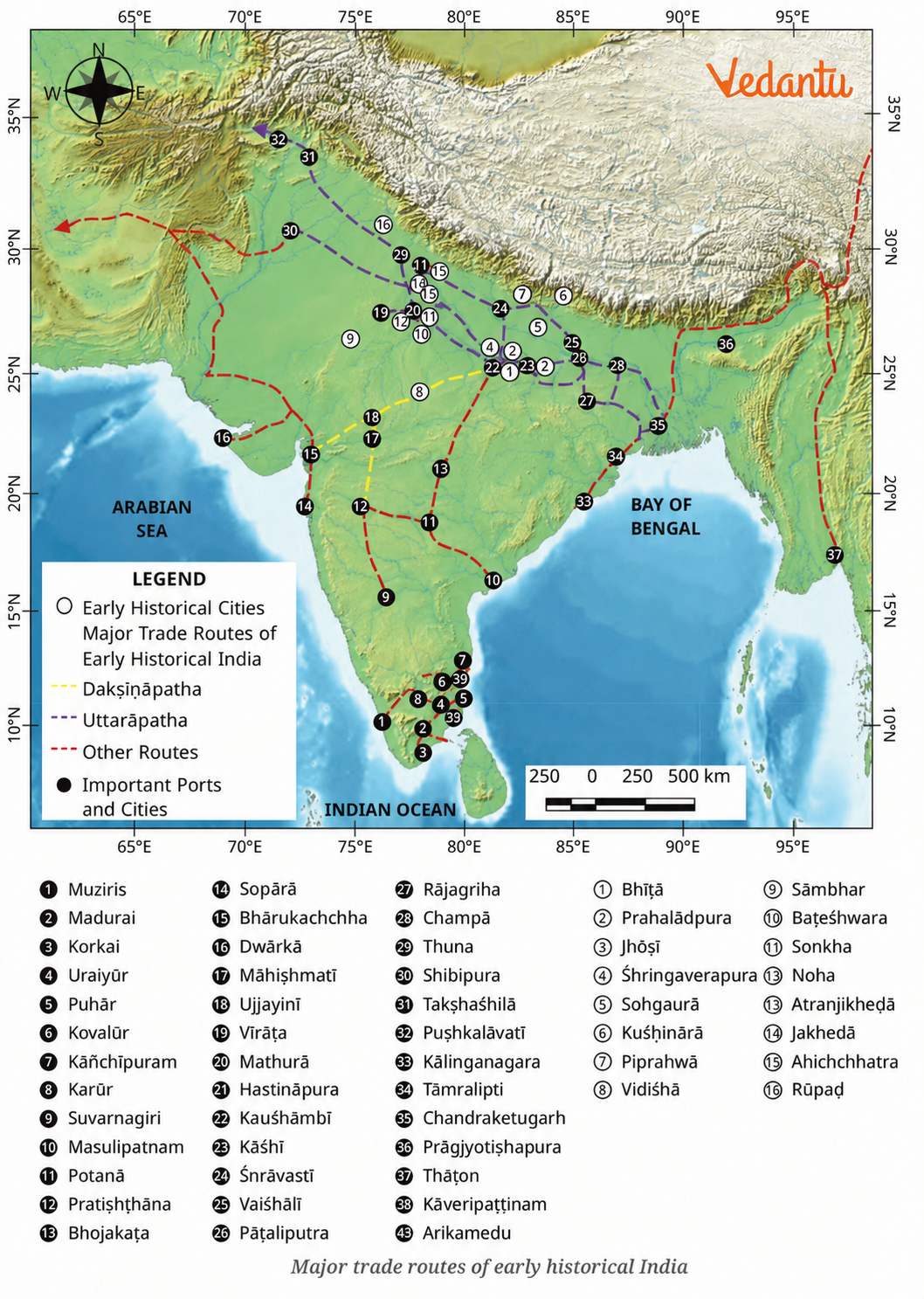
Answer: The Uttarapatha and Dakshinapatha connected different regions of India. Merchants used these routes to transport goods such as textiles, spices, metals, and other products. Travellers, artisans, scholars, and religious teachers also used these networks, allowing skills, ideas, beliefs, and cultural practices to spread between regions.
Question 10. What might have been the advantages and challenges of ruling a large empire in the absence of modern communication systems?
Answer:
Advantages:
Local officials could handle many issues within their regions.
Communities could retain some local customs and practices.
Challenges:
Messages and instructions took a long time to travel.
Rulers could receive delayed information about rebellions, invasions, or local problems.
Maintaining control over distant regions required reliable officials, messengers, and intelligence networks.
Question 11. Many ideas about governance come from texts composed by scholars and advisors of the king. What might be some limitations of relying only on such sources?
Answer: Texts written by royal scholars or advisers may mainly reflect the viewpoint of rulers and elites. They may describe how governance was expected to work rather than how ordinary people actually experienced it. Such sources may also provide limited information about women, workers, farmers, and other less powerful groups. Historians therefore compare written records with archaeological and other evidence.
Question 12. Read the source and answer the questions:
The Nashik cave inscription (2nd century CE) of Ushavadata records:
“Ushavadata, son of Dinika, son-in-law of king Nahapana […] has bestowed this cave on the Suing ha generally; he has also given a perpetual endowment, three thousand—3000 kdhapanas, which, for the members of the San’igha of any sect, and any origin dwelling in this cave, will serve as cloth money and money for outside life (kushana); and those kdhapanas have been invested in guild dwelling at Govadhana—2000 in a weavers’ guild, interest one pratika (monthly) for the hundred, (and) 1000 in another weaver’s guild, interest three quarters of a padika (monthly) for the hundred.”
(a) What does this source tell us about the economic role of guilds?
(b) Why were guilds trusted with money deposits?
(c) Identify the donor and the donees from the given source.
Answer:
(a) The inscription shows that guilds could manage money and investments. Weavers' guilds received deposits and generated interest from them, showing their important role in the economy.
(b) Guilds were organised professional groups with established members and economic activities. Their reputation and structured functioning made them suitable for managing financial deposits.
(c) The donor was Ushavadata, the son of Dinika and son-in-law of King Nahapana. The donees were members of the Buddhist Sangha staying in the Nashik cave.
Question 13. Mark and locate on the map of India the following important centres: Pataliputra, Nashik, Ujjayini, Vikramshila, Kanchipuram, Mathura, Rajgriha.
Answer: Students should mark and label the following centres on an outline map of India:
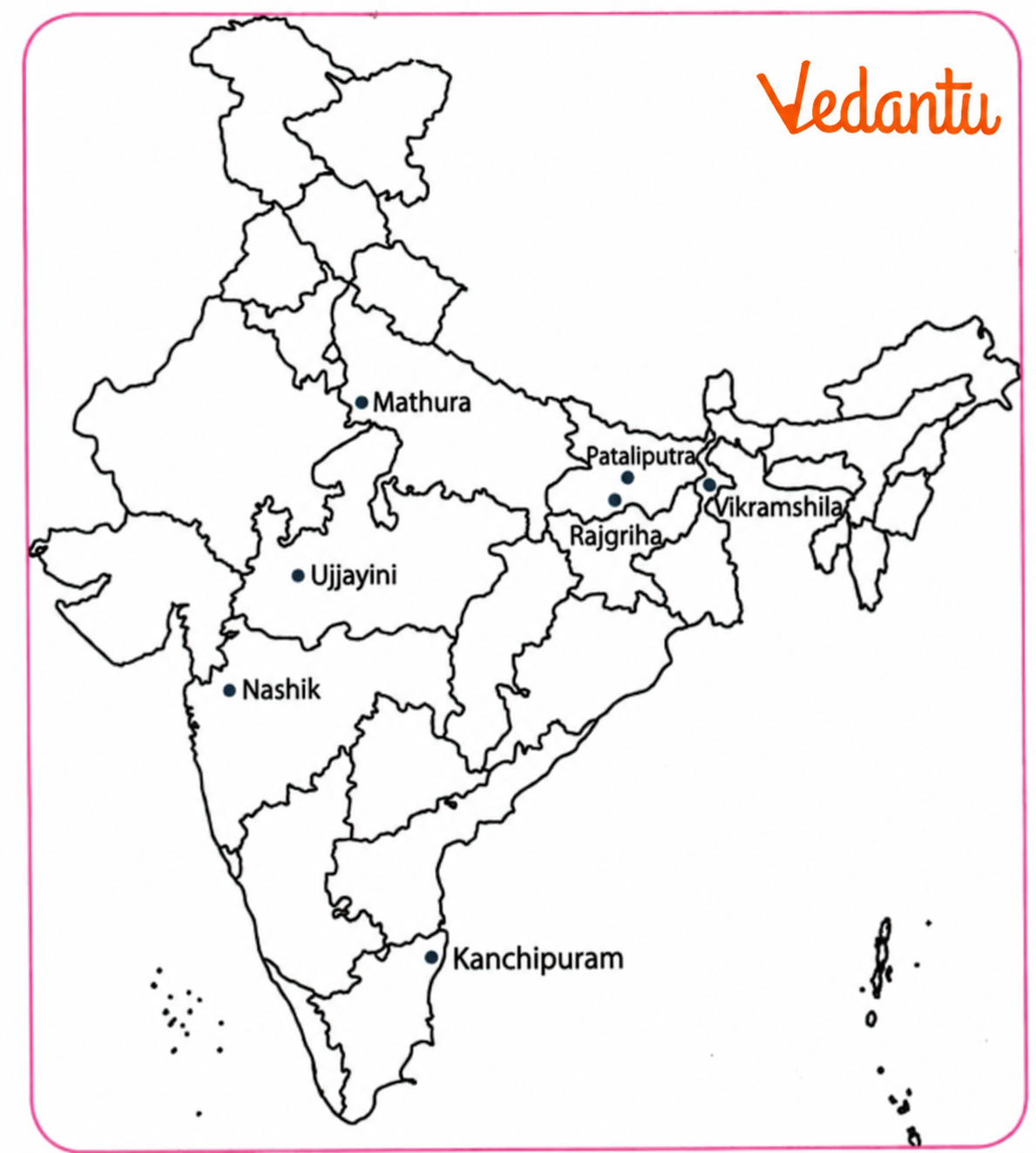
Pataliputra – present-day Patna, Bihar
Nashik – Maharashtra
Ujjayini – present-day Ujjain, Madhya Pradesh
Vikramshila – Bihar
Kanchipuram – Tamil Nadu
Mathura – Uttar Pradesh
Rajgriha – present-day Rajgir, Bihar
Question 14. Prepare a short presentation or poster on one of the following:
(a) Life in the Vedic society
(b) Early education system (gurukula)
(c) Trade and guilds in early India
(d) Role of women in early Indian society
Answer:
(a) Presentation on Life in the Vedic Society
Slide 1 – Social Life: Vedic communities were organised around families, clans, and occupations. Agriculture and pastoral activities were important parts of life.
Slide 2 – Political Life: Assemblies such as the Sabha and Samiti provided opportunities for discussion and participation in community affairs.
Slide 3 – Values: Ideas of dharma, duty, rituals, and respect for nature influenced social and religious life.
(b) Presentation on Early Education System (Gurukula)
Slide 1 – Learning Environment: Students lived with their guru and learned in a close, disciplined environment.
Slide 2 – What Students Learned: Education included texts, practical skills, discipline, values, and responsibilities.
Slide 3 – Teacher-Student Bond: The system emphasised personal guidance and character development. Students traditionally offered gurudakshina after completing their education.
(c) Poster on Trade and Guilds in Early India
Heading: Trade Networks and Shrenis
Trade Routes: The Uttarapatha and Dakshinapatha connected different regions and supported the movement of goods and people.
Guilds: Shrenis were associations of artisans and traders. They helped organise occupations, maintain standards, train workers, and support commercial activities.
Economic Role: Some guilds also managed deposits and investments, showing that they had an important place in the economic life of early India.
(d) Presentation on Role of Women in Early Indian Society
Slide 1 – Early Vedic Period: Some women had access to education and participated in intellectual and religious activities. Figures such as Gargi and Maitreyi are remembered for their learning.
Slide 2 – Social Participation: Women took part in household, religious, and social activities, with their roles varying across communities and periods.
Slide 3 – Changing Position: Women's social position changed over time. In later periods, access to education and public participation became more restricted in many sections of society.
What You Learn from Vedantu’s Solutions for State and Society up to 1000 CE
Trace how early communities grew into kingdoms and larger states through changing systems of governance.
Understand the influence of dharma, varna, jati, assemblies, trade, and education on society before 1000 CE.
Explore how guilds, trade routes, and occupations connected people and supported economic life.
Use these ideas to frame class 9 social science chapter 5 question answers with clear historical reasoning.
Refer to a State and Society up to 1000 CE Class 9 PDF for quick revision after understanding the textbook concepts.
Related Study Materials for Class 9 Social Science Chapter 5 State and Society up to 1000 CE Solutions
Chapter-Wise NCERT Solutions for Class 9 Social Science (Understanding Society India and Beyond Part 1)
Related Study Material for Class 9 Social Science
FAQs on NCERT Solutions for Class 9 Social Science Chapter 5 State and Society up to 1000 CE 2026-27
1. What is covered in the Class 9 Social Science Chapter 5 question answers?
The Class 9 Social Science Chapter 5 question answers cover topics such as the growth of states and societies, Vedic assemblies, administration, occupations, education, trade, guilds, varna, jati, and the role of women before 1000 CE.
2. Why is Chapter 5 Social Science Class 9 important for students?
Chapter 5, Social Science Class 9, State and Society up to 1000 CE, helps students understand how political systems, social groups, occupations, and cultural practices developed in early India.
3. Which important terms should I learn from Social Science Class 9 Chapter 5?
Students should understand terms such as kula, jana, janapada, mahajanapada, dharma, varna, jati, shreni, and chakravarti samrat. Knowing these terms makes the social science Class 9 Chapter 5 questions easier to understand and answer.
4. Why are the Rig Veda, Arthashastra, and Mahabharata important in Chapter 5?
These texts provide different evidence about political organisation, social life, administration, duties of rulers, and ideas of governance in early India. They are useful when preparing Chapter 5 Social Science Class 9 answers.
5. How should I prepare the questions on Vedic assemblies?
Focus on the roles of the Sabha, Samiti, and Vidhata, and understand how these assemblies were connected with the authority of the raja and decision-making in Vedic society.
6. How can I approach source-based questions in Class 9 Social Science Chapter 5 solutions?
First, identify the evidence given in the source and then connect it with the historical context. The Class 9 Social Science Chapter 5 solutions can help you understand how to frame answers without adding information that the source does not support.
7. Why are varna and jati discussed separately in this chapter?
Varna refers to the broad four-fold classification of society, while jati refers to smaller social groups that developed in different communities. The chapter explains how social classifications changed over time.
8. What can I learn from the gurukula questions in Chapter 5?
These questions help students compare early education with modern schooling by considering daily life, discipline, subjects, teacher-student relationships, and living arrangements.
9. Why are Uttarapatha and Dakshinapatha mentioned in the Class 9 Social Science Chapter 5 question answers?
These trade routes connected different regions and supported the movement of goods, people, skills, ideas, and cultural practices. Understanding them is useful for answering questions on trade and economic connections.
10. What does the Nashik cave inscription teach us about early Indian society?
The inscription provides information about donations, guilds, investments, and economic activities. It helps students understand how historical sources can reveal details about the economic life of early India.
11. How should I prepare for the map-based questions from Chapter 5?
Practise locating Pataliputra, Nashik, Ujjayini, Vikramshila, Kanchipuram, Mathura, and Rajgriha on an outline map of India. Regular practice makes these questions easier to answer during exams.
12. How can I improve my answers using the State and Society up to 1000 CE Class 9 PDF?
Use a State and Society up to 1000 CE Class 9 PDF for quick revision, but first read the textbook and understand the concepts. While writing answers, mention the key historical idea, explain it clearly, and add a relevant example where required.
