



Class 9 Social Science Chapter 4 NCERT Solutions PDF Download
The Big Questions
Question 1. How did humans live on Earth before the beginning of civilisation?
Answer: Before the rise of civilisations, humans mainly lived as hunter-gatherers. They travelled from one place to another in search of food, water, and suitable shelter. They used simple stone tools and stayed in caves or temporary shelters. With the development of agriculture, some groups gradually began living in permanent settlements.
Question 2. How did humans communicate before writing was invented?
Answer: Before the invention of writing, humans communicated through speech, gestures, facial expressions, and sounds. They also used symbols, drawings, and paintings on rocks and cave walls to convey ideas, record experiences, and communicate with others.
Question 3. How is archaeology helpful in understanding our past?
Answer: Archaeology helps us reconstruct the past by examining fossils, tools, pottery, buildings, burials, and other archaeological remains. These discoveries provide evidence about how early humans lived, worked, organised communities, and developed their cultures and technologies.
Question 4. How did early civilisations interact with each other?
Answer: Early civilisations came into contact through trade, migration, travel, and cultural exchange. People exchanged goods as well as ideas, technologies, skills, and knowledge. Such interactions helped different societies influence one another and contributed to their development.
Let’s Explore
Question 1. You have studied the Harappan script in your previous grades. Observe this seal and discuss why the script has not yet been deciphered. Also, find out what efforts have been made to decipher it. You can use your textbook, consult your teacher, or refer to online sources.
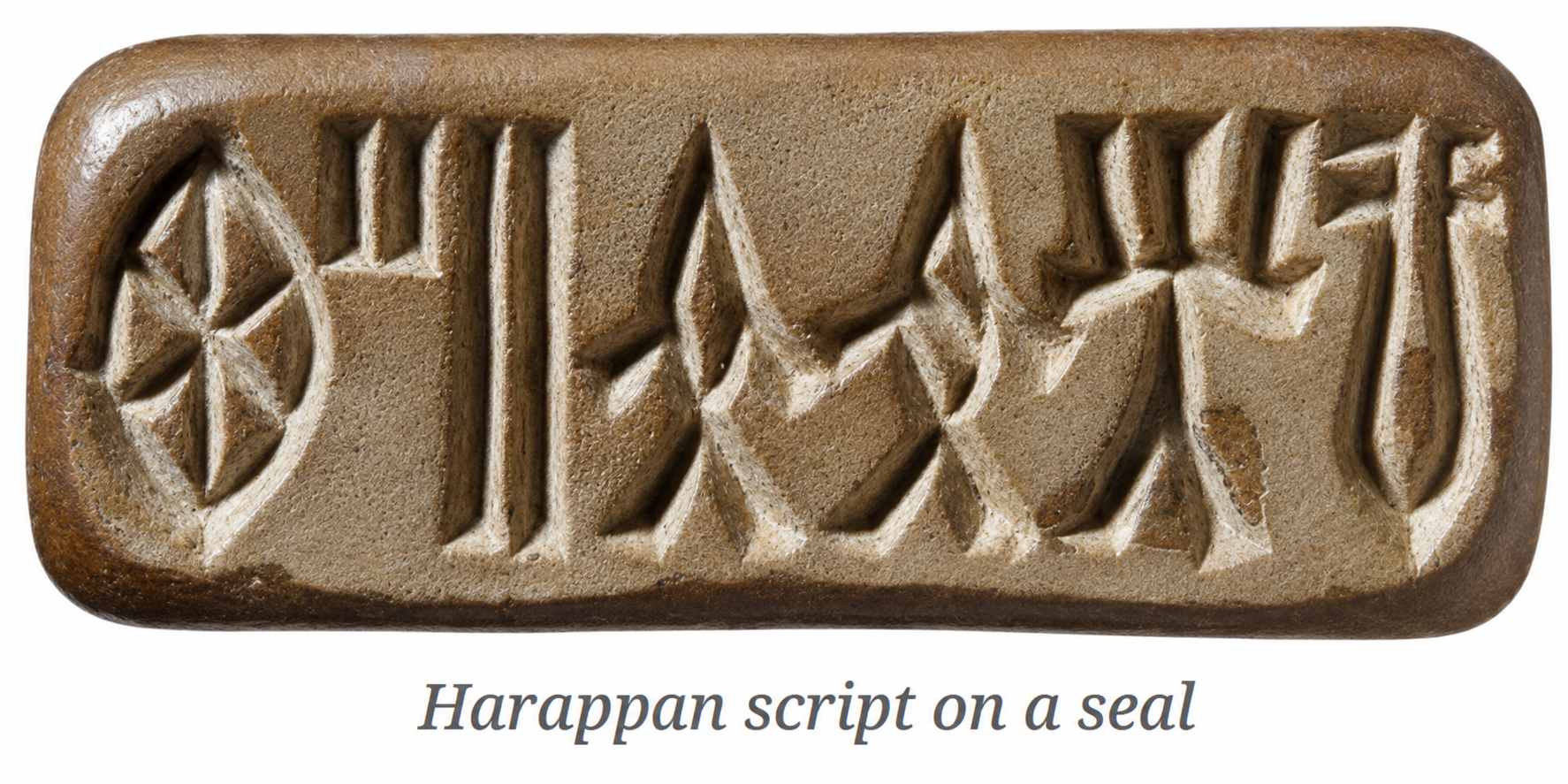
Answer: The Harappan script remains undeciphered mainly because the inscriptions are very short, the language represented by the signs is unknown, and no bilingual inscription has been discovered to provide a clear comparison with a known language. Researchers have examined seals and inscriptions and have used linguistic studies, archaeological evidence, computer-based analysis, and other modern methods, but the script has not yet been conclusively understood.
Question 2. Let us observe the images given below and answer the following questions.
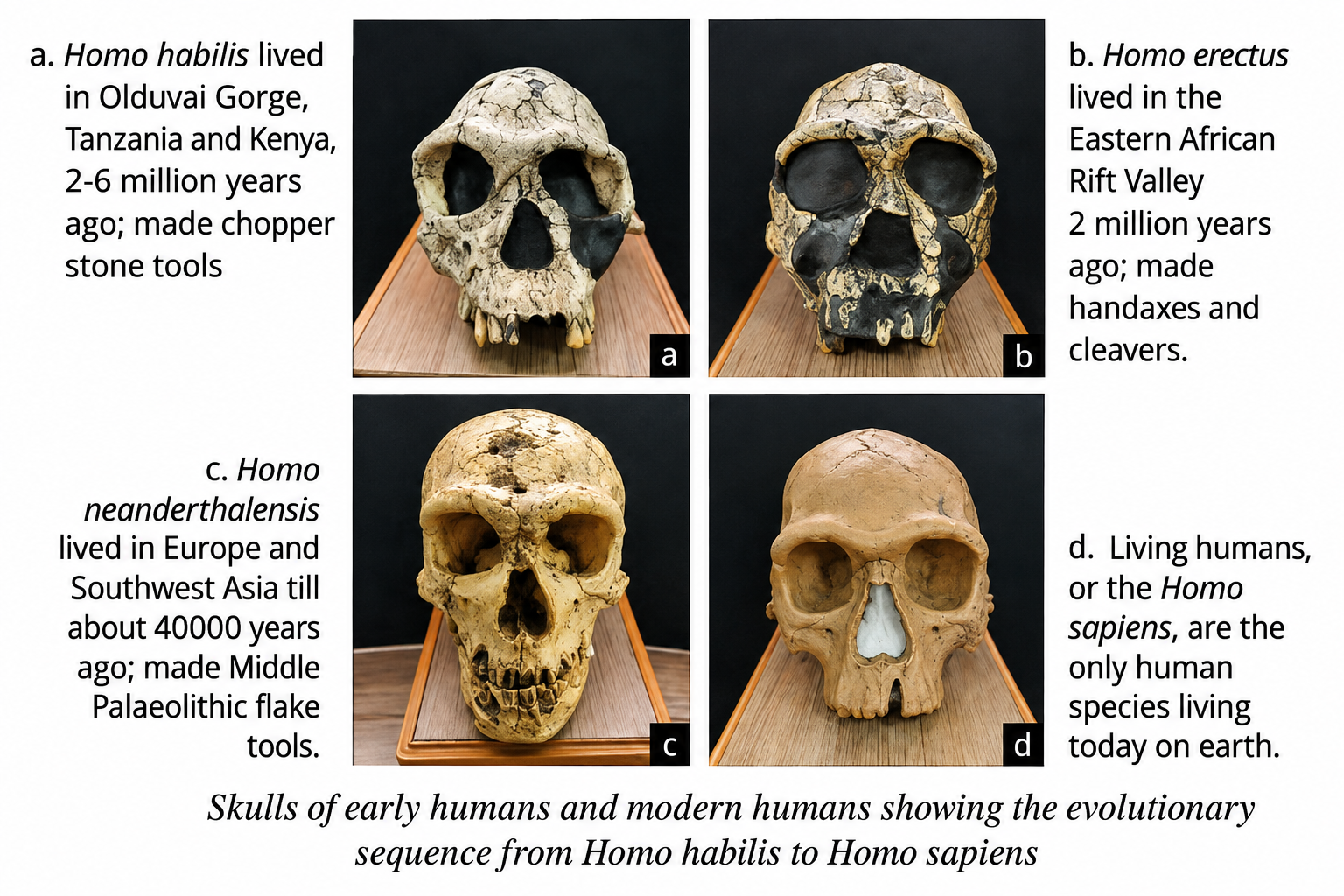
Do you notice any changes in the shape or features of the skulls across different ancestors?
Answer: Yes. The skulls show noticeable changes as human ancestors evolved. The braincase gradually became larger, while the forehead became more prominent. The jaws and teeth became smaller, and the face gradually became less projecting. These physical changes reflect important stages in human evolution.
Can you observe a gradual straightening of the face?
Answer: Yes. The face gradually became straighter and less projecting as human evolution progressed towards Homo sapiens. The jaws and brow ridges became smaller, while the forehead and chin became more developed, giving modern humans their characteristic facial structure.
Question 3. Can you find out which countries constitute West Asia in present times?
Answer: West Asia, often referred to as part of the Middle East, includes countries such as:
Türkiye (Turkey)
Cyprus
Syria
Lebanon
Israel
Palestine
Jordan
Iraq
Iran
Kuwait
Saudi Arabia
Bahrain
Qatar
United Arab Emirates (UAE)
Oman
Yemen
The region is historically significant because some of the earliest urban societies and civilisations, including Mesopotamia, developed here.
Question 4. Do you find any similarities between the temples in India and those of the Sumerian civilisation as centres of socio-cultural and economic activity?
Answer: Yes. Sumerian temples, like many temples in India, served purposes beyond religious worship. They functioned as centres of social, cultural, and economic activity. Temples could be associated with storing goods, organising agricultural resources, conducting ceremonies, supporting education, and managing aspects of community life and trade.
Question 5. The Epic of Gilgamesh, written during the Mesopotamian civilisation, is one of the earliest stories written. Try to find out more such stories and share them in class.
Answer: Some notable early stories and epics include:
Tale of the Shipwrecked Sailor (Ancient Egypt): It describes a sailor who survives a shipwreck and reaches a mysterious island, where he encounters a giant serpent.
Enuma Elish (Ancient Mesopotamia): This creation story describes the rise of the god Marduk and the creation of the world after his victory over Tiamat.
The Epic of Atrahasis (Ancient Mesopotamia): This ancient story includes themes of human creation and a devastating flood from which Atrahasis survives.
The Mahabharata (Ancient India): This major Indian epic describes the conflict between the Pandavas and Kauravas and contains numerous philosophical and moral teachings.
Such stories provide insights into the beliefs, values, traditions, and cultural ideas of ancient societies.
Question 6. Look at the social hierarchy pyramid in the image. What were the social classes of early Egypt? What were the different kinds of occupations? What could have been a typical daily routine of the people from each class?
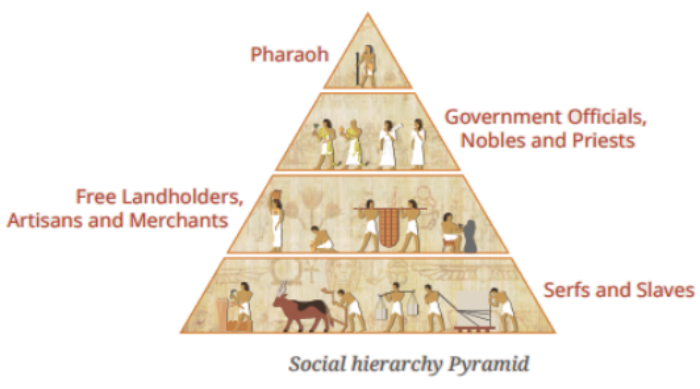
Answer: Ancient Egyptian society had a hierarchical structure. The Pharaoh occupied the highest position, followed by government officials, nobles, and priests. Free landholders, artisans, and merchants formed other important groups, while serfs and slaves occupied the lower levels.
People followed different occupations according to their social position. The Pharaoh governed the kingdom, officials handled administration, and priests performed religious duties. Farmers cultivated land, artisans produced goods, merchants traded, while labourers and slaves performed demanding physical work such as farming and construction.
Question 7. Explore more examples of Chinese characters that resemble the objects or ideas they represent. Note down at least two such characters and explain how their shapes are connected to their meanings.
Answer: Two examples of Chinese characters that have pictorial origins are:
Sun (日): The character has a shape derived from an early representation of the Sun and came to represent the idea of the Sun or day.
Mountain (山): Its three upward projections resemble mountain peaks, making the connection between the symbol and its meaning easy to understand.
These examples show how some early Chinese characters developed from visual representations of objects and ideas.
Think About It
Question 1. Why do you think early humans left Africa to migrate to other regions?
Answer: Early humans may have migrated from Africa for several reasons, including the search for food, water, shelter, favourable climatic conditions, and new resources. Changes in the environment and the availability of resources may also have encouraged groups to move into new regions.
Question 2. Why do you think the shift to farming during the Neolithic period is called a revolution rather than a simple change? Discuss with your classmates.
Answer: The development of farming was called a revolution because it transformed human life in many ways. People gradually moved from a nomadic lifestyle to settled communities, began producing food, domesticated animals, and developed activities such as pottery and weaving. Permanent settlements encouraged population growth, trade, specialised occupations, and more organised societies.
Question 3. Observe the chart (Fig. below) and identify the animals that were domesticated. Also try to identify the types of human habitats and objects that were used. Are any of these still used in present times?
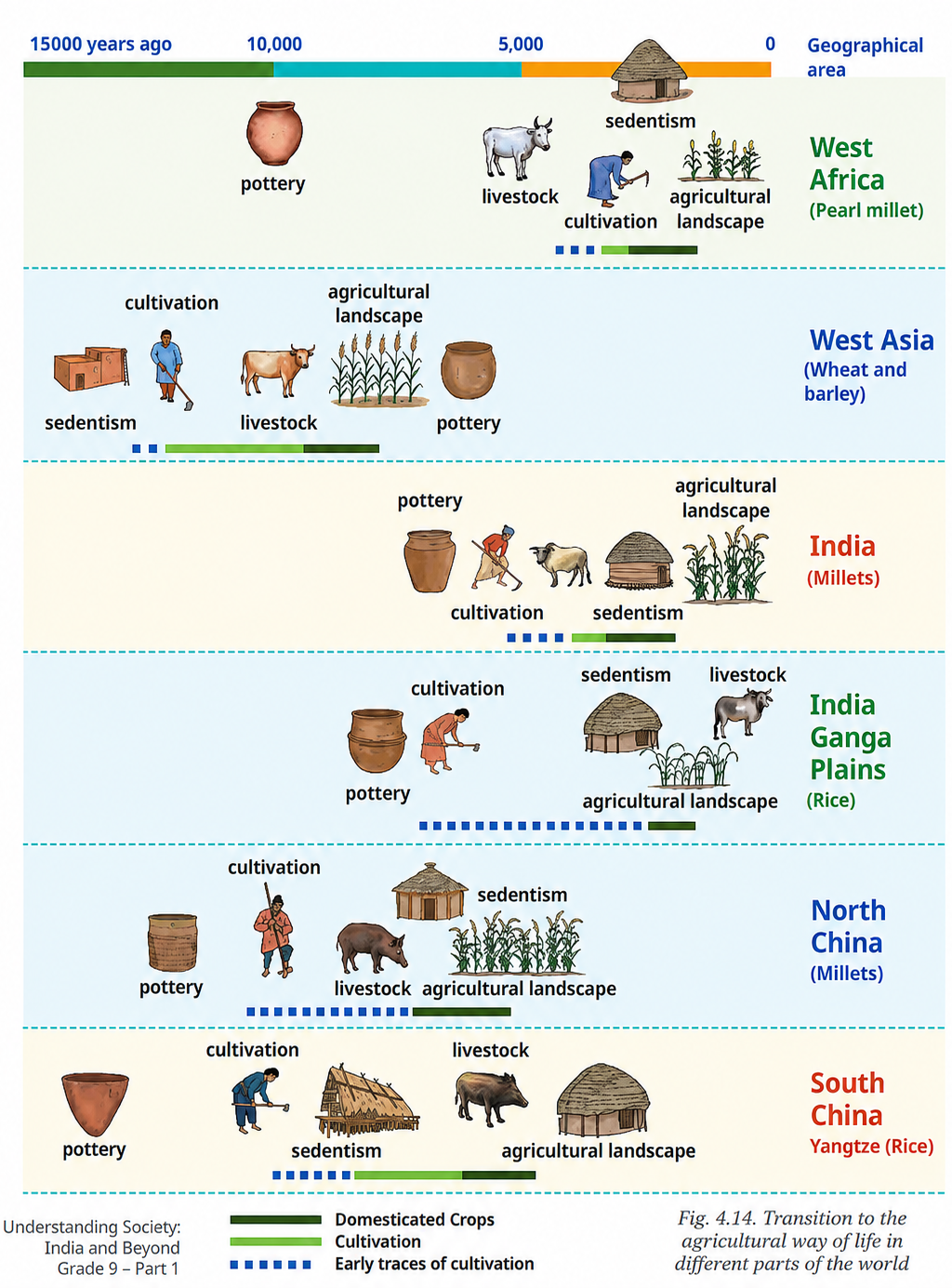
Answer: The chart shows domesticated animals such as cattle, goats, sheep, and pigs. People increasingly lived in permanent settlements with simple houses and huts. They used pottery for storing food and water and practised agriculture.
Many of these practices continue today. People still cultivate crops, rear livestock, live in permanent settlements, and use earthen or ceramic vessels for storing and preparing food.
Question 4. Can you imagine how long-distance trade would have been affected had the Harappans not followed a standard system of weights?
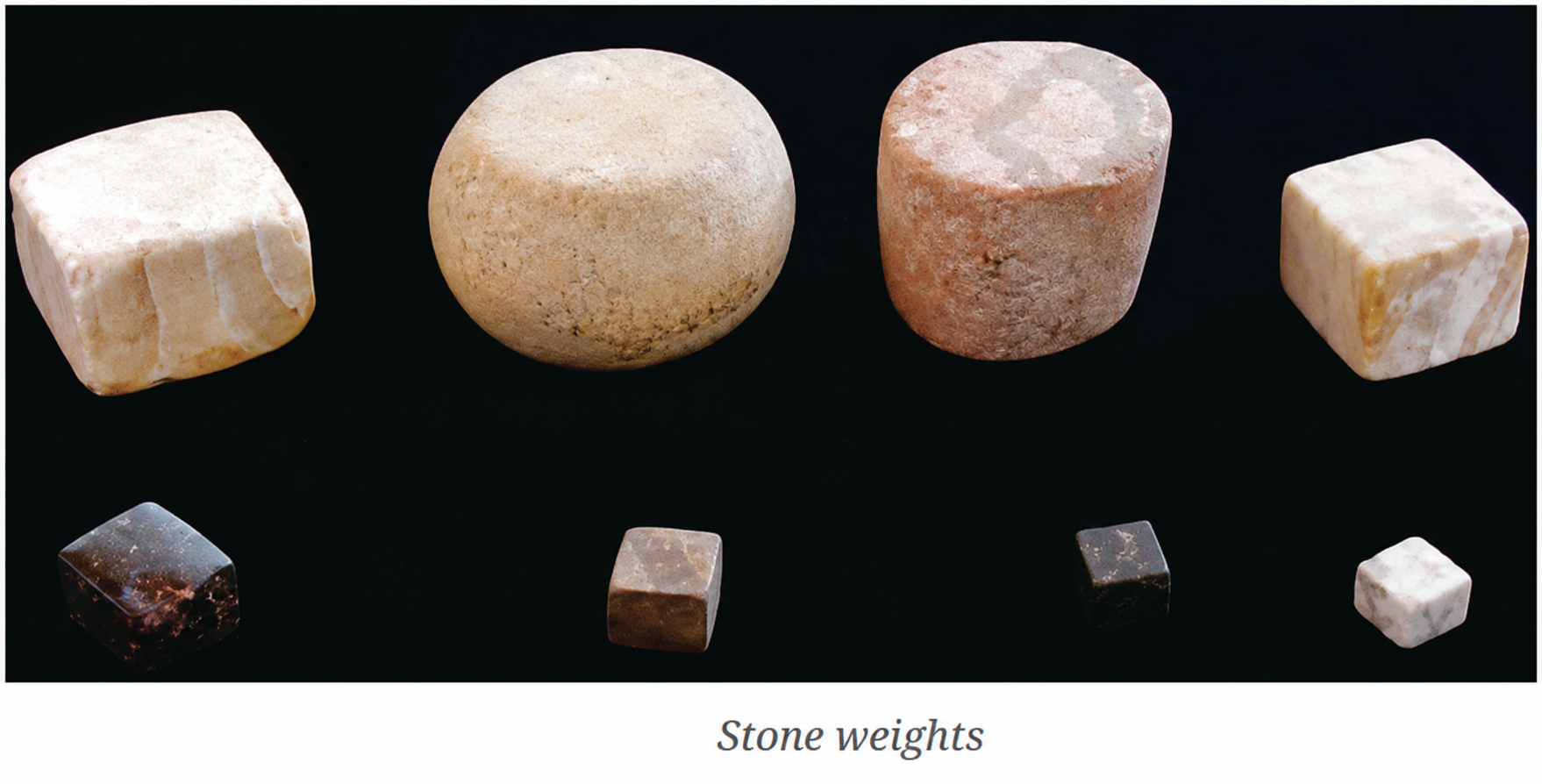
Answer: Long-distance trade would have been much more difficult without standard weights. Different systems of measurement could have caused confusion, disagreements, inaccurate transactions, and unfair practices. Standardised weights made it easier for merchants to measure goods accurately and establish trust during trade.
Question 5. Why were rivers important in the growth of early civilisations?
Answer: Rivers provided early societies with fresh water, fertile soil, food, and opportunities for agriculture. They also served as convenient routes for transportation and trade. These advantages encouraged people to establish permanent settlements near rivers, supporting the growth of towns and civilisations.
Discover More
Question 6. Why do you think there is a scale with a heart on one side and a feather on the other (Fig. below)? What can this papyrus tell us about early Egyptian beliefs?
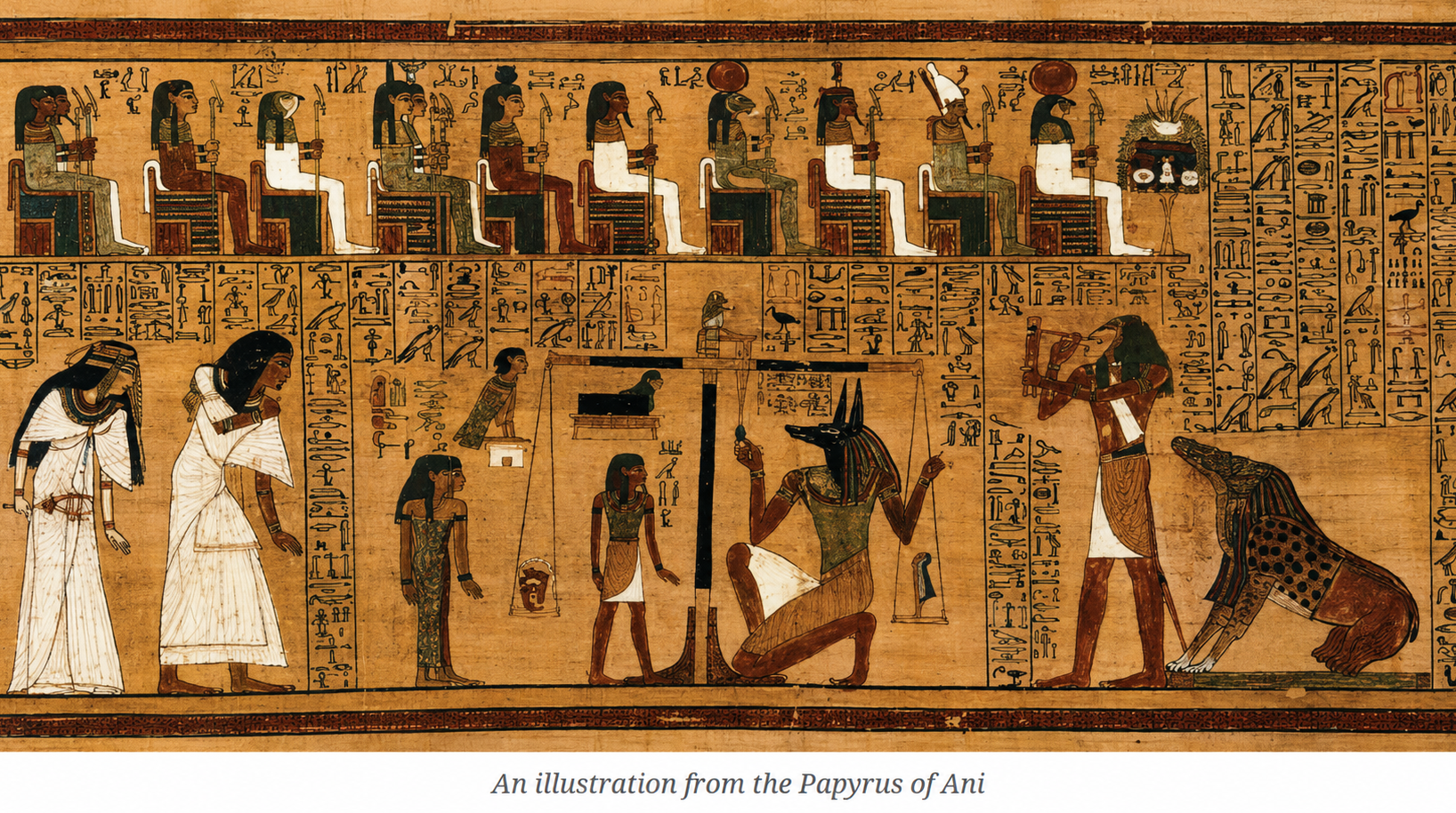
Answer: The scale represents an important ancient Egyptian belief about judgement after death. Egyptians believed that a person's heart was weighed against the feather of Ma'at, which represented truth and justice. A heart considered pure and truthful could allow the person to enter the afterlife, while a heart burdened by wrongdoing faced punishment. The papyrus therefore reflects Egyptian beliefs about death, judgement, morality, and the afterlife.
Question 7. Observe the images given below. What do they tell you about Egyptian fashion?
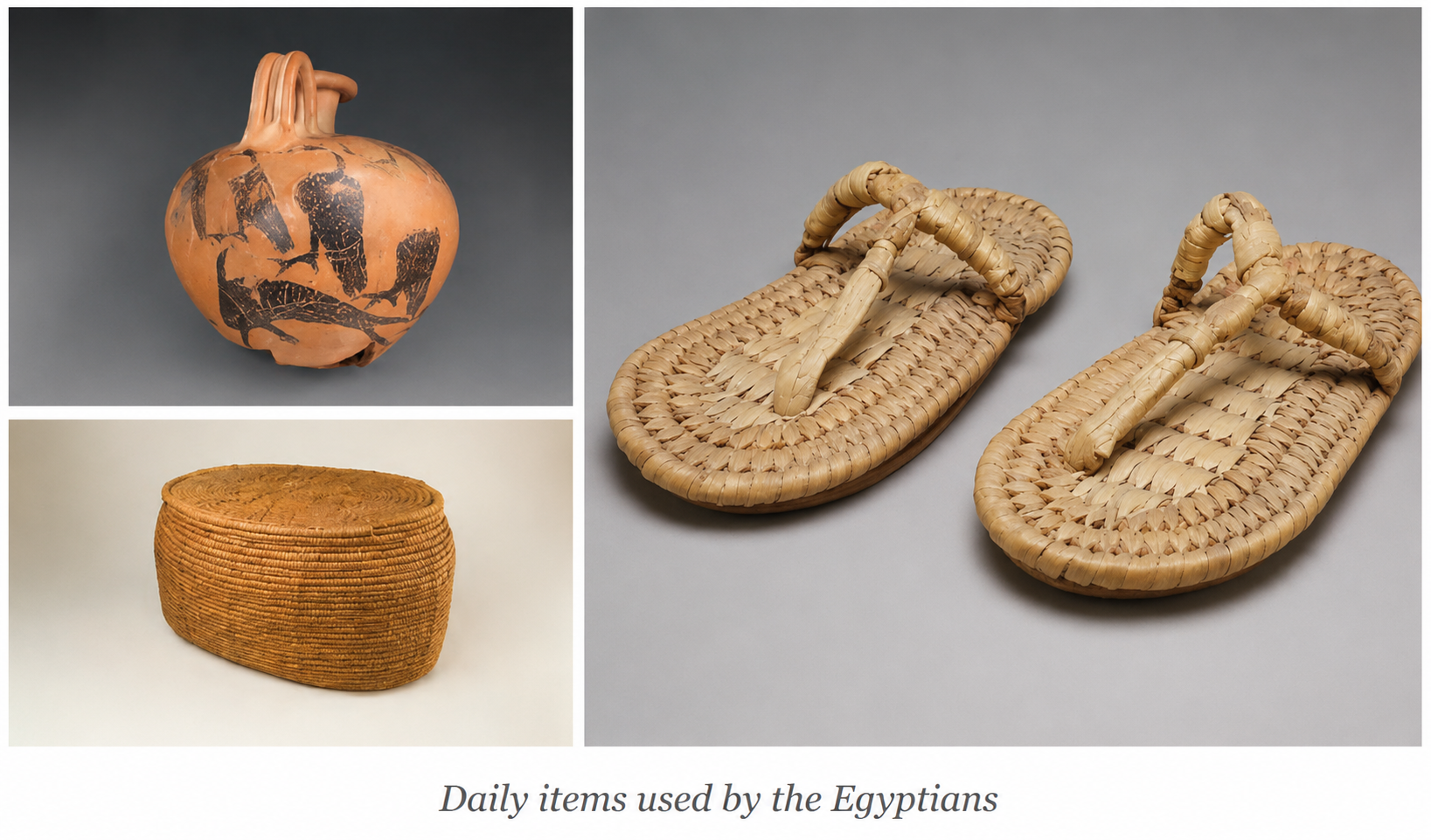
Which social classes do you think used these items?
What clues in the images help you to make this guess?
Try to explain your reasoning based on the materials, designs, or accessories shown in the pictures. (Page No. 88)
Answer: The images suggest that ancient Egyptians used clothing, jewellery, sandals, and other accessories as part of their appearance. Wealthier members of society, including Pharaohs, nobles, priests, officials, and prosperous merchants, could afford more elaborate and finely crafted items. The quality of materials, decorative designs, and jewellery provide clues about the social status of the people who used them.
Question 8. What could have been the other reasons for building the Great Wall of China? Explore and share your findings on the Great Wall through a model or presentation.
Answer: The Great Wall served several purposes in addition to defence. Its important functions included:
Protecting trade routes: It helped secure important routes and control movement along frontier regions.
Controlling movement: Gates and passes allowed authorities to regulate the movement of people and goods.
Collecting taxes: Controlled entry points could be used for regulating trade and collecting duties.
Sending warnings: Watchtowers helped communicate warnings using signals such as smoke and fire.
Strengthening imperial authority: The wall represented the organisational strength and power of the Chinese state.
Let Us Recall
Question 1. Do you think our understanding of a civilisation changes when its script is deciphered compared to when it is not?
Answer: Yes. Deciphering a script can provide much more detailed information about a civilisation. Written records may reveal its language, administration, beliefs, laws, trade, customs, and daily life. When a script remains undeciphered, historians have to depend mainly on archaeological evidence such as buildings, tools, pottery, and other artefacts.
Question 2. Do you remember studying about the Silk Route in Grade 7? How was India connected with it? Can you recollect China’s contact with India with reference to Buddhism that you studied in Grade 7?
Answer:
India’s Connection with the Silk Route
India was connected to the Silk Route through both land and maritime trade networks.
Indian merchants traded products such as spices, cotton textiles, precious stones, ivory, and handicrafts.
The routes also encouraged the movement of ideas, cultural practices, technologies, and religions.
China’s Contact with India through Buddhism
Buddhism travelled from India to China through routes associated with the Silk Route.
Chinese travellers such as Faxian and Xuanzang visited India to learn about Buddhism and collect Buddhist texts.
Their journeys helped strengthen cultural and religious connections between India and China.
Let’s Map
Question 1. Can you locate the River Nile on the given map? Why do you think the northern part is called Lower Egypt and the southern part Upper Egypt?
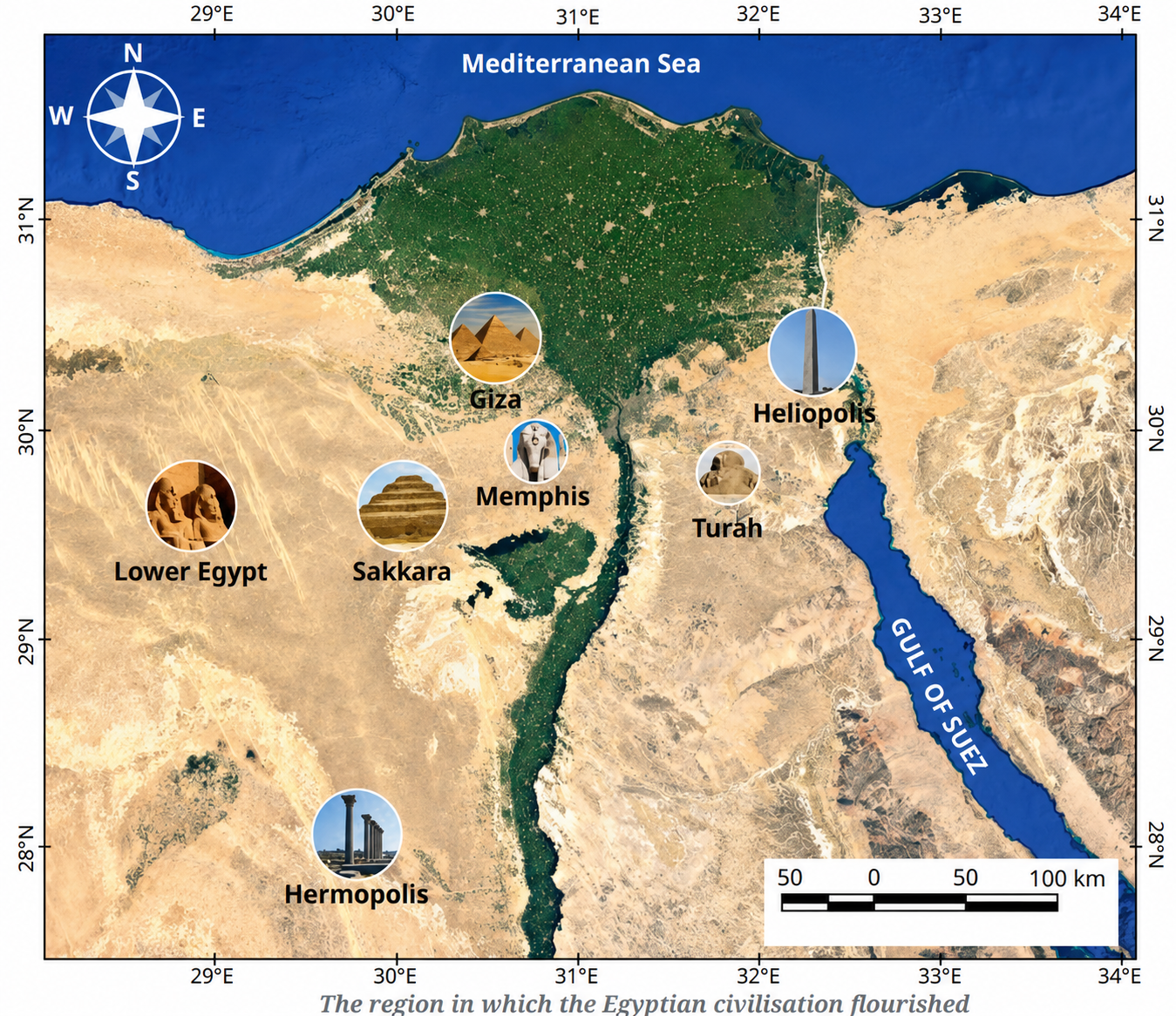
Answer: The River Nile flows from south to north before reaching the Mediterranean Sea. The northern region is called Lower Egypt because it lies closer to the river's mouth and at a lower elevation. The southern region is known as Upper Egypt because it is located upstream, closer to the Nile's source and at a higher elevation.
Questions and Activities
Question 1. Do you think life became easier or more challenging after humans started farming? Give two reasons for your answer.
Answer: In several ways, farming made life more stable because people could produce food and establish permanent settlements. Two important changes were:
People could grow and store their own food, reducing complete dependence on hunting and gathering.
Permanent settlements allowed communities to build houses, develop specialised occupations, and work together.
However, farming also introduced challenges such as crop failure, disease, and the need for continuous labour.
Question 2. The environment offers human societies both opportunities and challenges. Explain with reference to early farming communities and river-valley civilisations.
Answer: The environment provided both advantages and difficulties to early societies.
Opportunities: Fertile soil, accessible water, and favourable conditions supported agriculture, animal domestication, and permanent settlements.
Challenges: Floods, droughts, changing river courses, and other environmental conditions could damage crops and settlements.
Early communities therefore had to adapt to their surroundings and develop ways to manage environmental risks.
Question 3. Why do historians divide early human history into different ages such as the Stone Age, Bronze Age, and Iron Age? What does this classification tell us about human progress?
Answer: Historians use terms such as Stone Age, Bronze Age, and Iron Age to describe major stages based partly on the materials humans commonly used for tools and weapons. This classification helps us trace developments in technology, agriculture, settlements, craftsmanship, and social organisation. It provides a broad framework for understanding how human societies changed over time.
Question 4. Imagine you are a Neolithic farmer. Describe one day of your life. What challenges would you face that a hunter-gatherer would not?
Answer: As a Neolithic farmer, I would begin my day by working in the fields, watering crops, removing weeds, and caring for domesticated animals. I would also repair tools and fences and store harvested grain.
Unlike a hunter-gatherer, I would depend heavily on the success of my crops. Drought, pests, diseases, and crop failure could threaten my food supply. Living permanently in a settlement would also mean greater responsibility for protecting stored food, animals, and property.
Question 5. Imagine that the Harappan script gets deciphered tomorrow. What new types of information do you think historians might learn?
Answer: Deciphering the Harappan script could reveal valuable information about the language, administration, beliefs, trade, customs, and social organisation of the civilisation. Historians might also learn more about its cities, rulers or authorities, economic activities, and possible reasons for changes or decline. Such discoveries could significantly deepen our understanding of Harappan society.
Question 6. Prepare a table with three columns: Palaeolithic, Mesolithic, and Neolithic, and fill in their distinctive features: tools, settlements, art, and subsistence.
Answer:
Question 7. “Bronze Age civilisations developed independently but shared common features.” Examine this statement with reference to the civilisations given in the chapter.
Answer: Bronze Age civilisations such as Mesopotamia, Egypt, the Indus Valley, and China developed in different regions, yet they shared several characteristics. Many grew near rivers, where water and fertile land supported agriculture. They developed organised settlements, trade networks, specialised occupations, metalworking, religious traditions, and systems of governance.
Although these societies developed independently, similar environmental conditions and common human needs contributed to some comparable features.
Question 8. Although rivers provided many benefits, they also created challenges for early societies. Discuss both the advantages and disadvantages of settling near rivers.
Answer: Rivers offered several advantages, including fertile agricultural land, fresh water, fish, transportation routes, and trade opportunities. These benefits encouraged permanent settlement and supported population growth.
At the same time, rivers could be dangerous. Floods could destroy homes and crops, droughts could reduce water availability, and changes in river courses could force communities to adapt or relocate. Thus, river valleys provided opportunities while also requiring careful management of natural risks.
Question 9. With the help of your teacher, find out more about the Code of Hammurabi. Why was it important? Do you think it was fair to all sections of society? Give reasons for your answer.
Answer: The Code of Hammurabi was an important collection of laws from ancient Mesopotamia. It helped establish rules for different aspects of society and specified punishments for various offences. By recording laws, it provided a clearer framework for maintaining order and resolving disputes.
However, the laws did not treat everyone equally. Punishments and legal treatment could vary according to a person's social position and status. Therefore, although the code was significant for organising society, it would not be considered fully equal by modern standards.
Question 10. If you had to choose one major innovation from early civilisations that changed the world permanently, what would it be and why?
Answer: I would choose the invention of writing because it transformed how people preserved and shared information. Writing allowed societies to record laws, trade transactions, religious ideas, historical events, and administrative information. It also enabled the transfer of knowledge from one generation to the next, making it one of the most influential developments in human history.
Question 11. Compare the social hierarchy and daily life of people in the Egyptian civilisation with those in Mesopotamia or China. What similarities and differences do you notice?
Answer:
Similarities:
Egyptian, Mesopotamian, and Chinese societies had hierarchical social structures with rulers and powerful groups at the top.
Priests, officials, nobles, scribes, and other skilled groups played important roles in administration and religious activities.
Farmers and labourers made up a large part of the population and performed much of the agricultural and manual labour.
Differences:
In Egypt, the Pharaoh held an exceptionally powerful religious and political position and was associated with divine authority.
Mesopotamian kings ruled city-states and were closely connected with religious institutions and the gods.
Chinese emperors were associated with the Mandate of Heaven, which provided a basis for their authority.
Religious beliefs and ideas about death and the afterlife also varied among these civilisations, influencing their customs, architecture, and daily life.
Question 12. Activity: Using maps, locate the major rivers and civilisations of Mesopotamia, Egypt, China, and the Sindhu-Sarasvati Valley. Mark the trade links between them.
Answer: For this activity, students should mark the following on a map:
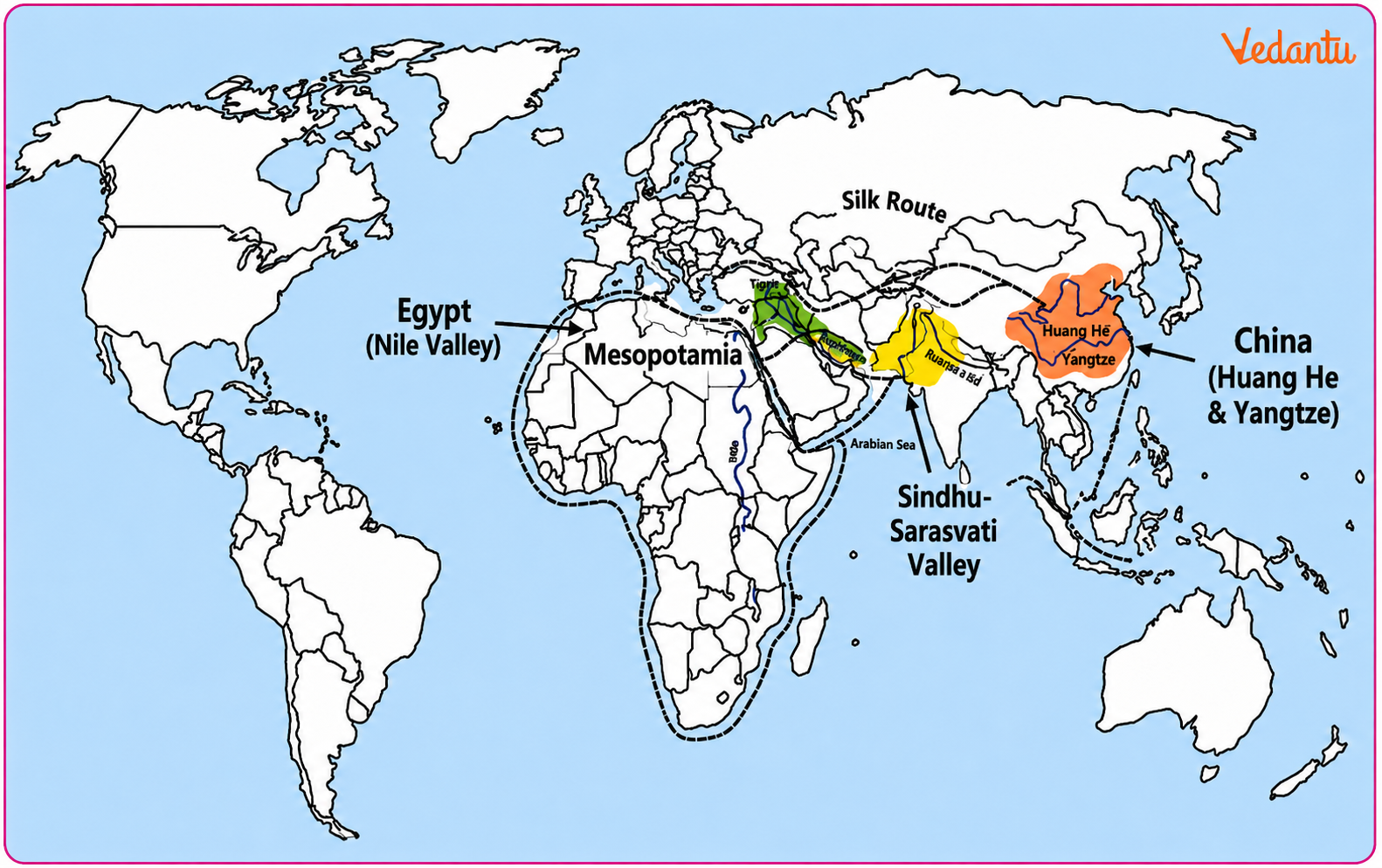
Mesopotamia: Tigris and Euphrates Rivers
Egypt: Nile River
China: Huang He (Yellow River) and other major river systems
Sindhu-Sarasvati Valley: Indus and associated river systems
Students can then use arrows to indicate the major trade routes and connections between these regions. A suitable map legend can be used to distinguish rivers, civilisations, and trade links.
Question 13. Activity: Choose one early civilisation (Mesopotamia, Egypt, or China) and prepare a mini-scrapbook or a presentation showing their innovations in tools, writing, art, and architecture. Include pictures, brief descriptions, and explain their significance.
Answer:
1. Tools
Picture: Bronze tools, sickles, or ploughs
Description: Egyptians used tools made from materials such as stone and bronze for farming, construction, and crafts.
Significance: Improved tools supported agriculture and helped workers carry out large construction and craft activities more efficiently.
2. Writing
Picture: Hieroglyphic inscriptions on papyrus or monuments
Description: Egyptians developed hieroglyphic writing to record religious, administrative, and historical information.
Significance: Writing helped preserve knowledge, beliefs, official records, and important events.
3. Art
Picture: Egyptian wall paintings, statues, or carvings
Description: Egyptian art represented rulers, gods, daily activities, animals, and religious scenes.
Significance: These artworks provide valuable evidence about Egyptian culture, beliefs, occupations, and social life.
4. Architecture
Picture: Great Pyramid of Giza, temples, or the Sphinx
Description: Egyptians constructed large pyramids, temples, tombs, and monuments using carefully planned designs and stonework.
Significance: Their architecture demonstrates their advanced knowledge of construction, organisation, engineering, and religious traditions.
Conclusion:
Ancient Egyptian civilisation made important contributions to writing, tools, art, architecture, agriculture, and administration. Its achievements continue to provide valuable evidence for understanding the development of early civilisations.
Why Study Early Humans and Beginning of Civilisation from Vedantu?
The chapter Early Humans and Beginning of Civilisation explains how humans moved from hunting and gathering to farming, settled life, trade, and organised societies.
These NCERT solutions for Class 9 Social Science Chapter 4 simplify key developments and make revision easier.
Understand the Palaeolithic, Mesolithic, and Neolithic stages.
Learn how farming, rivers, technology, and trade shaped early civilisations.
Revise important concepts through Class 9 Social Science Chapter 4 question-answer solutions.
Use the Early Humans and Beginning of Civilisation PDF for quick and convenient revision.
Related Study Materials for Class 9 Social Science Chapter 4 Early Humans and Beginning of Civilisation
Chapter-Wise NCERT Solutions for Class 9 Social Science (Understanding Society India and Beyond Part 1)
Related Study Material for Class 9 Social Science
FAQs on NCERT Solutions for Class 9 Social Science Chapter 4 Early Humans and Beginning of Civilisation 2026-27
1. Does this page include solutions for the activities in Chapter 4?
Yes. The page covers the textbook's different activity sections, including Let’s Explore, Think About It, Discover More, Let Us Recall, Let’s Map, and Questions and Activities.
2. Can I use these answers while completing my Class 9 Social Science homework?
Yes. Try the questions independently first and then use the solutions to compare your response and identify any points you may have missed.
3. Are the answers arranged according to the order of the NCERT Class 9 Social Science Chapter 4?
Yes. The solutions follow the chapter's sections and questions, making it easier to locate a particular exercise while studying.
4. Does the page cover map-based questions from NCERT Solutions for Class 9 Social Science Chapter 4?
Yes. The Let’s Map section is included, along with guidance for identifying important geographical locations connected with early civilisations.
5. Can these solutions help me check a long answer before submitting my homework?
Yes. You can compare your answer with the solution for important points, logical flow, examples, and overall completeness.
6. Where can I find the Palaeolithic, Mesolithic, and Neolithic comparison?
You can find a clear comparison of the Palaeolithic, Mesolithic, and Neolithic Ages in Vedantu’s Class 9 Social Science Chapter 4 solutions.
The comparison covers their tools, settlements, art, and ways of obtaining food, making it easier to understand the key differences between the three periods.
7. Does this page help with activity-based preparation as well as written questions?
Yes. Along with regular questions, the solutions cover activities involving maps, comparisons, observations, and presentation or scrapbook work.
8. Is the content suitable for students following the 2026-27 Class 9 syllabus?
The page is prepared for Class 9 Social Science 2026-27 and follows the chapter structure presented in the current textbook.
9. Can I access the NCERT Solutions for Class 9 Social Science Chapter 4 when studying from a PDF?
Yes. Students looking for an Early Humans and Beginning of Civilisation PDF can use the available study material for convenient revision and offline reference.
10. How do these solutions support students who struggle with Social Science answers?
The answers break the required information into manageable points and explain historical ideas in straightforward language, making them easier to understand and reproduce.
11. Do I need to write the answers exactly as given here?
No. Understand the explanation and include the important facts in your own words. This helps you develop independent answer-writing skills instead of relying on memorisation.
